

Take a moment to ask yourself two questions:
What are the odds that a random U.S. citizen you meet is a violent criminal and/or a thief?
What are the odds that a random foreign-born person you meet is a violent criminal and/or a thief?
Make a note of your guesstimates and hold that thought for a moment.
My last post addressed the gap between threat perception and reality when it comes to immigration.
Today we’re going to zoom in on a topic involving a yawning chasm between facts and fiction: the relationship between immigration or citizenship status and crime.
I will not elevate the many myths by repeating what you, dear reader, likely have read or heard repeated many times.
Instead, I will share fact-based, myth-busting analysis and sources to which you can turn to verify those facts and explore further. In my next post, I’ll share some insights into why these myths persist and how to change them.
The facts around immigration and crime that contradict claims that I (and no doubt many of you, dear readers) have seen repeated in social and other media.
The research has been very clear for decades: immigrants –whether unauthorized, lawfully present, or naturalized citizens—are less likely to commit violent or property crimes than natural-born U.S. citizens. Not just a little bit less likely: a lot less likely.
Depending on the study you consult, immigrants are one-fourth to one-half as likely as a natural-born citizen to be incarcerated for violent, drug-related. or property crimes.
A 2024 American Immigration Council fact sheet distills 19 peer-reviewed contemporary research reports on immigration and crime. (Full disclosure: I was a fellow at the Council when it was still called the Immigration Policy Center, from 2006-07.) “All came to one of just two conclusions: that the proportion of immigrants in an area appeared to have no effect on either the violent or property crime rate in that area; or that increased shares of immigrants were actually associated with lower violent and property crime rates,” AIC researchers wrote. “In other words, when immigration goes up, crime stays the same or goes down.”
The authors of a recent paper on immigrant incarceration rates from the libertarian Cato Institute, Alex Nowrasteh and Michelangelo Landgrave, similarly consulted multiple studies analyzing correlations between immigration and crime for people between 18 and 54 years old in 2024.
The verdict across legal status: “Immigrants do not increase crime rates in small communities, are less likely to cause crime than their native-born peers, and are less likely to be incarcerated, convicted, and arrested than native-born Americans.”
Overall, US-born citizens were incarcerated at the rate of 1,195 per 100,000, which translates to nearly four times the 303 per 100,000 lawfully present immigrants.
Counting violent and property crimes committed by unauthorized immigrants is more difficult because 1) not all states record immigration status and 2) some official incarceration datasets do not separate violent crimes from immigration violations (most of which are civil, not criminal, offenses).
When immigration related detentions are separated from criminal offenses, the rate for incarcerations for violent, drug, or property crimes typically is still much lower than for natural-born citizens.
In a study funded by the National Institute of Justice published in 2004, the criminologist Michael T. Light found that unauthorized immigrants were arrested at less than half the rate of natural-born U.S. citizens for violent and drug crimes and just a quarter the rate of native-born citizens for property crimes. From 2012 to 2018 in Texas, the arrest rate for violent crimes was 213 per 100,000 US-born citizens and 96.2 per 100,000 unauthorized immigrants. Drug crime arrests were 337.2 per 100,000 US citizens versus 165.2 per 100,000 unauthorized immigrants. And property crimes were 165.2 per 100,000 US-born citizens versus 38.5 per 100,00 undocumented immigrants.
The Cato paper referenced above analyzed immigration data in Texas, Georgia, and Oklahoma, the only states that track arrests and convictions by immigration status. In Texas, unauthorized immigrants had lower criminal conviction and arrest rates compared to the native-born population, including being 26 percent less likely to be convicted of homicide. In Georgia and in Oklahoma, unauthorized were incarcerated at even lower rates than lawfully present immigrants (and, by extension, far lower than natural-born citizens).
“[S]carce law enforcement resources should not be spent on identifying and deporting a subpopulation with such a low crime rate,” the Cato report recommended. “The federal government already has effective programs to identify illegal immigrant criminals who have been arrested, convicted, or incarcerated. The federal government should continue those policies and make the removal of illegal immigrant criminals a priority, but it should not widen its reach to include illegal immigrants who have not committed criminal offenses or have not otherwise put Americans at risk.”
That seems sensible, does it not? Americans are more and more likely to agree.
[Some readers will be unhappy that Cato uses the term “illegal immigrants,” rather than “undocumented” or “unauthorized.” Check back here for my next post for more on the debate over language. I recognize that Cato’s research and position on the subject are worthy and that some readers are more likely to be receptive to their language. I also believe that the term “illegal immigrant” reinforces misconceptions about immigrants and downplays the fact that immigrants, including undocumented and unauthorized people, are less likely than natural-born US citizens to commit crimes.]
The respected Brennan Center for Justice at NYU (with which I partnered on the Citizenship and Security Project post-9/11) in 2024 also debunked myths around immigration and public safety. Authors Brianna Seid, Rosemary Nidiry, and Ram Subramanian cite studies of census data, including one going back all the way to 1870, which confirm that throughout history immigrants are less likely to commit crimes than are natural born citizens. They call rhetoric to the contrary “centuries-old discourse” aimed primarily at boosting a contemporaneous politics of exclusion, not one seriously concerned about the true causes of crime.”
These are just a few of the findings from across the political spectrum that reinforce hundreds and hundreds of studies, carried out over a century and a half, demonstrating clearly that immigrants are less likely to commit crimes than native-born citizens.
Despite clear evidence to the contrary, a 2023 Gallup poll (the most recent I could find on this specific question) found that only 5 percent of Americans believed, correctly, that immigrants reduce crime. Nearly half —47 percent—mistakenly thought that immigrants increased crime.
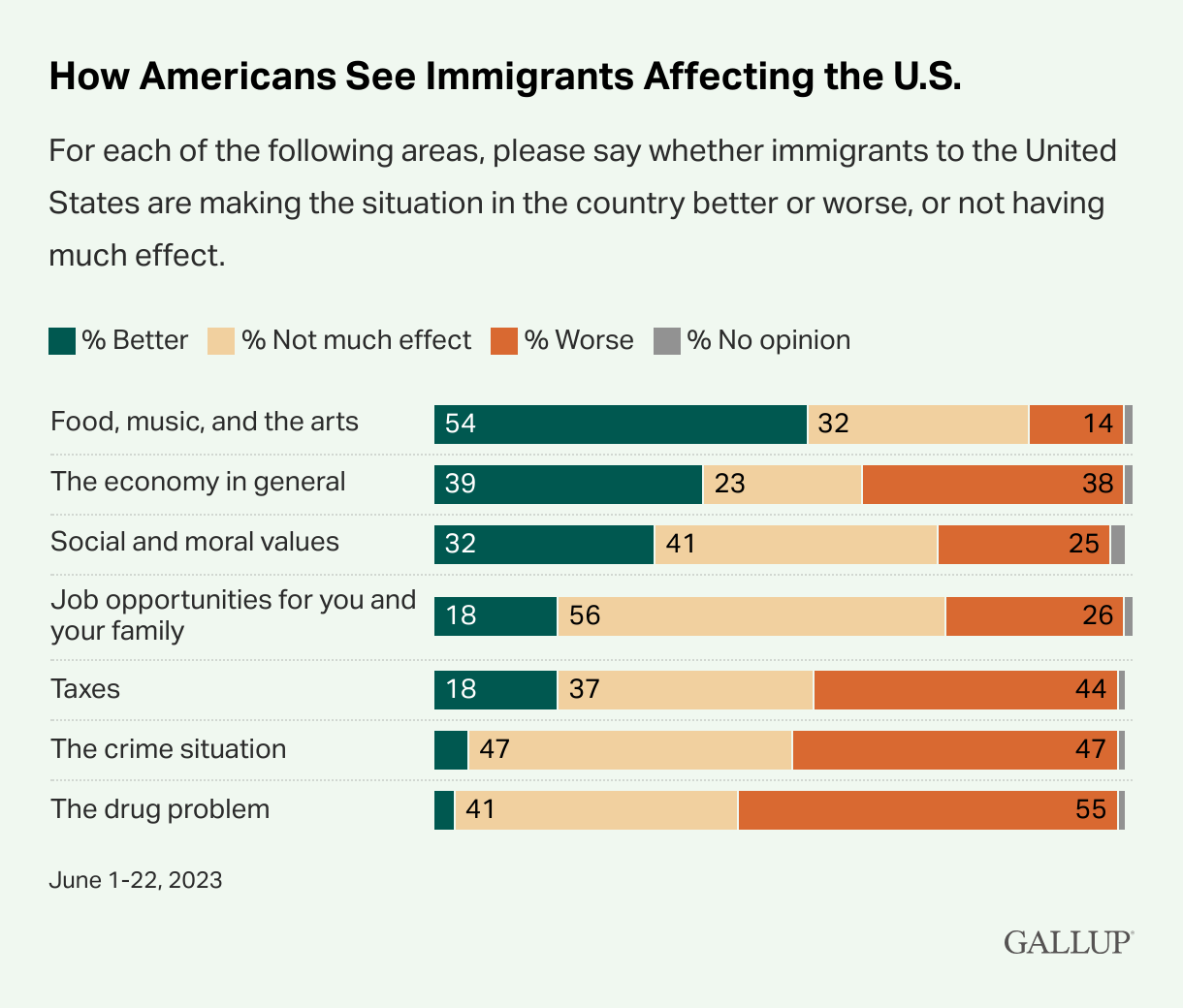
So why do Americans persist in believing the opposite of what the facts show?
Stay tuned for next week’s post, which will help you to understand the disconnect and consider some strategies to counter common misconceptions around immigration and public safety.
Comments
Nothing yet. Say the first thing.
Sign in to join the conversation.