
A mouse runs a maze. It learns nothing it didn’t already know — it has run this maze before, found the reward, returned to its cage. Hours later, asleep, its hippocampus performs a brief electrical event called a sharp-wave ripple, lasting perhaps a tenth of a second. During that ripple, the place cells that fired during the run replay the sequence in compressed form, dozens of times faster than they fired the first time. By morning, the memory is consolidated. The mouse “knows” the maze in a way it didn’t before sleep. I call this “flashing” the hippocampus, like a RAM (memory) card.
This much we have known for a generation. What we did not know, until 2024, was that the brain is making a selection during the day about which experiences to ripple-tag for replay later. Wannan Yang, working in György Buzsáki’s lab at NYU, demonstrated this with optogenetics — artificially boosting ripples around specific waking experiences caused mice to retain memories they would otherwise have forgotten. The brain is not merely storing what happens. It is choosing, at the millisecond level and again at the seconds level and again across the day-night cycle, what becomes part of the animal’s continuing life (Yang et al., 2024, Science).
Hold that fact alongside another, this one about the human cortex. In a 2025 paper in Nature Neuroscience, Samira Epp and colleagues showed that approximately 40% of voxels with significant BOLD signal changes in the default mode network actually showed reversed oxygen metabolism — the imaging signal moved one way while the underlying metabolic activity moved the other (Epp et al., 2025, Nature Neuroscience). The functional MRI literature on which we have built so much of our picture of the brain in the last twenty-five years is, in a substantial fraction of cases, measuring something that is not quite what we thought we were measuring.
The two findings sit at opposite ends of a problem. The first tells us the brain is structured across nested timescales doing work that is functionally consequential for what gets to count as experience. The second tells us our methods for characterizing that work are coarser than we have admitted. Any account of consciousness in the brain has to take seriously both — what we have learned, and what we may have measured wrong.
This essay is about one such account: a working theoretical proposal called Temporally Nested Synergistic Allostasis, or TNSA. The name is technical and the proposal is technical, but the working statement is short. Consciousness arises when a temporally nested, homeostatically grounded system achieves synergistic information integration across scales — and this capacity is developmentally constructed through embodied social interaction. Each of those phrases names a body of empirical evidence. Each also names something the evidence does not yet fully establish. The proposal is offered as a theory in process, not as a settled answer.
My own training is in psychiatry, interventional psychiatry, and psychoanalysis/neuropsychoanalysis, with a long-standing interest in the neuroscience of trauma, attachment, and consciousness, and clinically-applied neuroscience using transcranial magnetic stimulation in long-term psychotherapeutic treatments and in collaboration with other clinicians, and as a primary investigator in TMS research studies. The proposal emerged from an informed and directed multi-stage project I designed, resulting in a synthesis involving multiple large language models reviewing the contemporary literature, the outputs of which I then verified, gap-filled, and consolidated against published work, with notations where ambiguity remains.
Full methodology details are in a footnote at the end. Briefly: TNSA emerged from a multi-stage project involving five independent large language models reviewing contemporary neuroscience and consciousness studies, with their outputs synthesized, verified against published literature, gap-filled, and consolidated. Verification rates of 94.4% (master synthesis), 95.8% (gap-fill update), and 75% on third-pass reference verification (triggering comprehensive correction) give the empirical base its current standing.
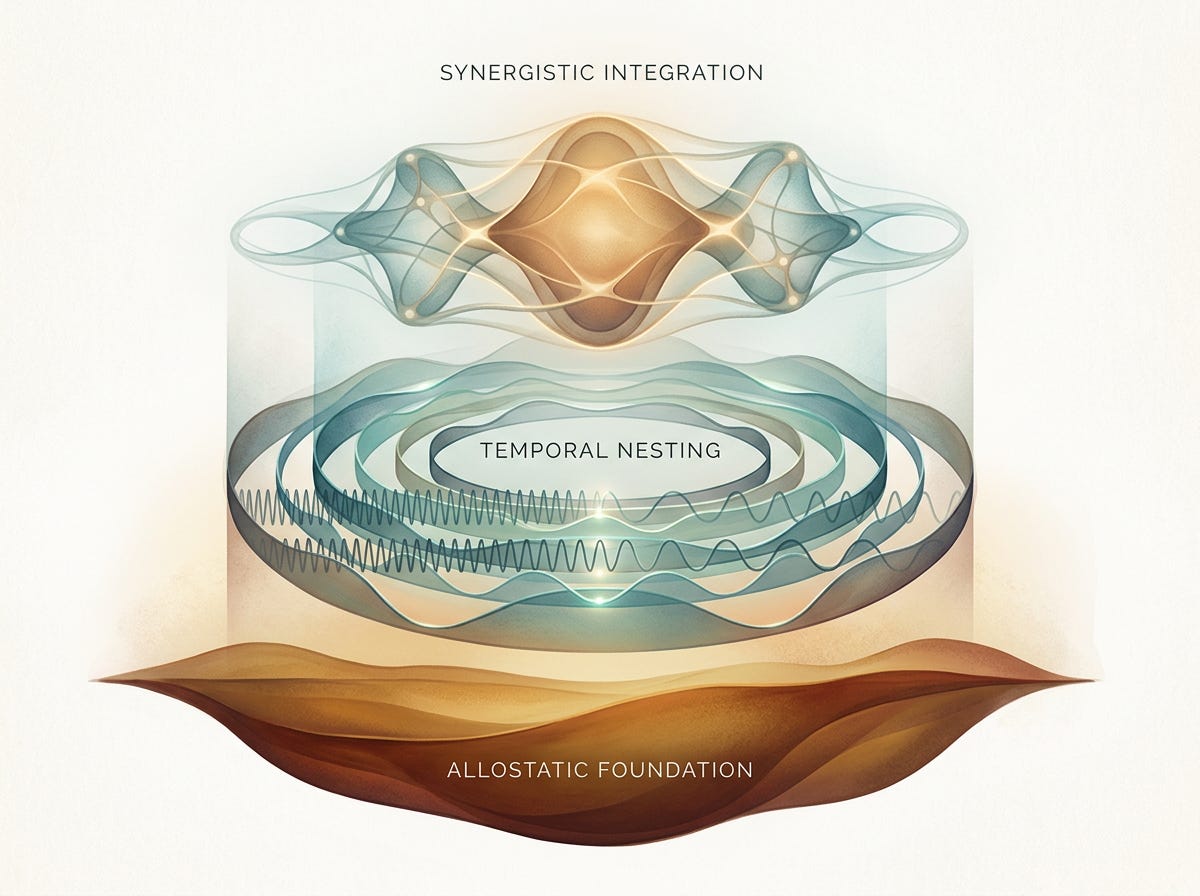
TNSA’s distinctive theoretical move is a conjunction claim. The proposal commits to three components being jointly necessary for content-rich conscious experience. Not three good correlates. Not three convergent features. Three things that, the proposal claims, must all be present for what we call having an experience to occur.
It is the kind of claim expensive to make and useful to test. Expensive because it commits the proposal to falsification: evidence that any one of the three can be fully disrupted while content-rich consciousness persists would challenge it. Useful because it tells you what a counterexample would look like.
The three components are an allostatic foundation, temporal nesting, and synergistic integration.
Body regulation is architecturally central to consciousness, not peripheral. The allostatic foundation component proposes that the felt quality of being alive — the affective ground against which any specific experience appears — is generated by the brain’s continuous predictive regulation of the body. Without that ground, there is information processing. There is no experience.
Start with pain. The “pain matrix” — a set of regions reliably activated during nociceptive processing — was for years treated as the brain’s pain network. A series of studies summarized by Legrain, Iannetti and colleagues (Legrain et al., 2011, Progress in Neurobiology) showed that pain matrix activity can be dissociated from perceived pain intensity, can be evoked by non-painful stimuli, and is heavily influenced by non-nociceptive factors. The matrix is better characterized as a supramodal salience detector than as a pain-specific network. Craig had earlier repositioned pain itself as a homeostatic emotion within interoception — not a sensation telling you something is wrong with the world, but a feeling telling you something is wrong with you (Craig, 2002, Nature Reviews Neuroscience).
Pain is the most phenomenologically vivid form of interoception we have access to. If pain is interoception, then chronic pain becomes a model of interoceptive prediction gone wrong — and this is exactly what the formal Bayesian models propose. Chronic pain, on the predictive-processing account, is a precision pathology: the brain holds abnormally high precision on its predictions of pain, and the predictions become biased toward inferring pain from stimuli that would otherwise be perceived as harmless. The pain becomes “real” not because nociceptive signaling is intact (it sometimes is not) but because the prediction is held with such confidence that contradicting evidence cannot dislodge it.
The placebo data make the same point from the other direction. Botvinik-Nezer and colleagues, with Tor Wager senior, ran a pre-registered placebo study with 392 participants (Botvinik-Nezer et al., 2024, Nature Communications). Placebo treatment reduced fMRI activity in evaluative and affective processing systems — not in nociceptive systems. The placebo did not block pain. It changed what pain meant. Chen et al. (2024, Nature) identified a specific circuit — rostral anterior cingulate cortex projecting to the pontine nucleus — mediating placebo analgesia with causal evidence from pathway-specific manipulation. Pain modulation runs through the evaluation, not through the input.
The brain consumes about 20% of resting metabolic energy for 2% of body mass; during focused cognitive tasks the rate increases by less than 5%, which is to say the brain operates close to its metabolic ceiling at rest. Glucose metabolism is the best single predictor of consciousness level — not the best brain-network predictor, the best predictor full stop. General anesthesia drops whole-brain metabolism by about 55%. NREM sleep drops it by about 23%. Coma drops it by about 60%. The default mode network has the highest rate of aerobic glycolysis of any brain network. The body’s energetic state is the conscious life, in a quite literal way (Chen & Zhang, 2021, Frontiers in Systems Neuroscience; Levy & Calvert, 2021, PNAS).
The gut adds another stream. Vagal afferent fibers carry interoceptive signal from the gastrointestinal tract to brainstem and insular regions; about 80% of vagal fibers run in this afferent direction, body-to-brain. Microbial metabolites — short-chain fatty acids, tryptophan derivatives — cross the blood-brain barrier and modulate microglial activation states. Germ-free mice colonized before weaning develop normal behavior; those colonized after weaning do not. There is a developmental critical period for microbial colonization to do its neurodevelopmental work. The gut-brain axis is not a metaphor (Cryan & Dinan, 2012, Nature Reviews Neuroscience).
Glia add another layer. Astrocyte calcium waves operate on a one-to-two second timescale, three orders of magnitude slower than neuronal action potentials, contributing to interoceptive sensing and circuit modulation. de Ceglia and colleagues (de Ceglia et al., 2023, Nature) identified specialized glutamatergic astrocytes — astrocytes that release glutamate as a neurotransmitter, blurring the strict line between glial modulation and neuronal signaling. The Veiga et al. (2025, Journal of Neurochemistry) review on calcium-dependent astrocyte signaling formalizes a parallel computational layer the synthesis previously assigned exclusively to neurons.
These threads — pain, gut, energy, glia, lateralization of affect regulation in the right hemisphere — converge on the architectural claim that the body’s regulatory state is not an input to consciousness; it is the substrate. Damasio’s tiered self framing — protoself rooted in brainstem homeostatic centers, core self generating moment-to-moment subjectivity, autobiographical self extending the narrative through DMN-mediated self-referential processing (Damasio, 2010) — has worn well.
The component is not without open questions. Whether the lateralization findings — right-hemisphere primacy for embodied affect, left-hemisphere primacy for narrative integration (Schore, 2019) — are best treated as a structural specification of how this principle is implemented or as something more is genuinely open. Whether glia warrant elevation to an independent organizing principle, rather than treatment as extensions of the existing ones, is held open as empirical territory. The core claim — that allostatic regulation is constitutive of conscious experience, not adjunct — has the deepest empirical base of any of TNSA’s components.
Time is not a backdrop against which consciousness happens. Time is something consciousness does — something the brain has to actively construct, across nested scales, in order for there to be a “now” with depth and structure rather than a series of disconnected moments.
Consider the opening anecdote again. The mouse running its maze; sharp-wave ripples a few hours later in sleep selecting which experiences become memory; behavior tomorrow that depends on what was selected. This is one cycle of a temporal architecture running from millisecond spike timing to biographical time. The architecture is real, recordable, manipulable. Buzsáki’s program over four decades has characterized how oscillatory hierarchies (gamma 30–150 Hz, beta, alpha, theta 3–10 Hz, delta, infraslow under 0.1 Hz) carry information at different scales, and how cross-frequency coupling links them. Theta-gamma coupling in hippocampus encodes sequential items within single theta cycles; different place-cell assemblies fire in successive gamma slots within one theta wave (Lisman & Jensen, 2013, Neuron). It is a code. The mouse uses it.
Sharp-wave ripples ride at the top of this hierarchy as a discrete event, a brief burst during quiet wakefulness or non-REM sleep that compresses replay sequences into a tenth of a second. The Yang et al. (2024) work showed that this ripple-tagging is selective and consequential. Experiences not tagged tend to be forgotten. Experiences tagged tend to become part of the animal’s continuing life. The temporal architecture is doing memory work, identity work, life work.
There are time cells: neurons in hippocampus and entorhinal cortex that fire sequentially during temporal gaps, encoding elapsed time. Eichenbaum’s program established this in rodents; Umbach and colleagues (Umbach et al., 2020, PNAS) confirmed it in humans through intracranial recording during episodic memory tasks. Hippocampal activity, more recently, has been shown to align primarily with internally generated action plans rather than with external sensory variables (Zutshi et al., 2025, Nature). The brain is not waiting to be told what time it is. It is telling itself.
Northoff’s temporo-spatial theory of consciousness organizes these findings into four mechanisms — expansion, globalization, alignment, nestedness — connecting intrinsic neural timescales to phenomenal experience (Northoff, Buccellato & Zilio, 2025, Physics of Life Reviews). Transmodal cortical regions show longer intrinsic timescales than unimodal regions. The default mode network has long intrinsic timescales and provides temporal context for self-continuity. Pre-stimulus temporal dynamics predict whether upcoming stimuli will reach conscious perception.
Voss and colleagues applied transcranial alternating current stimulation at 25 Hz and 40 Hz over frontal cortex during REM sleep and induced self-reflective awareness in dreams (Voss et al., 2014, Nature Neuroscience). Frontal gamma stimulation produced the experience of knowing one was dreaming while dreaming. The intervention produced a specific alteration in conscious content, and the alteration tracked the oscillatory frequency manipulated. Frontal gamma is implicated in the reflective component of consciousness.
The architectural claim — temporal nesting is functionally load-bearing for consciousness — is well-supported across species and methods. The specific mechanistic implementation is partially species-specific. In macaque CA1, theta and gamma bands are segregated by behavioral state rather than continuously coupled as they are in rodents — beta2/gamma during visual search, theta during quiescence (Abbaspoor, Hussin & Hoffman, 2023, eLife). In humans, hippocampal theta occurs in brief, intermittent bouts linked to specific cognitive events, unlike rodent theta during locomotion. Goyal and colleagues identified functionally distinct high (~8 Hz) and low (~3 Hz) theta oscillations in human hippocampus with anterior-posterior spatial differentiation absent in rodents (Goyal et al., 2020, Nature Communications).
The architectural principle translates across species. The specific mechanistic implementations — particular cross-frequency coupling parameters, particular oscillatory bands — do not translate at the parameter level. TNSA’s temporal nesting component should be stated at the architectural level; rodent parameters should not be assumed to carry over to humans.
The glial temporal layer adds a tier the older framing missed. Astrocyte calcium waves on the one-to-two second timescale operate between fast neuronal oscillations and slow hemodynamic fluctuations, and modulate the oscillatory architecture rather than being modulated by it (Veiga et al., 2025; bioRxiv 2024 on astrocyte control of UP states and slow-oscillation periodicity). Whether this layer is best understood as a parallel computational substrate or as an extension of the neuronal hierarchy is held open. For the temporal nesting component as currently formulated, it is part of the architecture.
The third component is the most theoretically delicate. It commits TNSA to a specific claim about what consciousness is, in information-theoretic terms — not just where it is generated, not just what conditions are necessary, but what its formal signature is.
The claim is that consciousness corresponds to synergistic information — information existing only in the joint activity of multiple regions, information that cannot be reduced to the contributions of any single region or to redundant information shared between regions. Synergy is an information-theoretic concept with a precise mathematical formulation through Integrated Information Decomposition. Andrea Luppi and colleagues, working with Pedro Mediano and Fernando Rosas, have operationalized this and applied it to brain data.
The 2024 eLife paper by Luppi and colleagues delineates a “synergistic global workspace” — gateway regions in the DMN that gather synergistic information, broadcaster regions in executive control networks that distribute it (Luppi et al., 2024, eLife). Loss of consciousness coincides with synergistic workspace breakdown. Recovery restores it. The framework is interesting because it bridges integrated information theory and global workspace theory — two leading consciousness theories that have traditionally been treated as competitors. They turn out to be measuring different aspects of the same information-theoretic phenomenon.
A 2022 Nature Neuroscience paper from the same research line proposed a “synergistic core” for human cognition: a set of regions disproportionately responsible for the synergistic information that distinguishes human cognition from non-human primate cognition (Luppi et al., 2022, Nature Neuroscience). The cognitive specializations that mark our species map onto regions where the brain combines information in ways that cannot be reduced to redundant copies of the same signal.
The structural anchor is rich-club topology — the finding that about 30% of the connectome forms a densely interconnected hub backbone enabling efficient long-range communication, while modular communities preserve local specialization (van den Heuvel & Sporns, 2011, Journal of Neuroscience). This structure makes synergistic integration possible without requiring all-to-all connectivity. It is what an efficient information-processing system has to look like under the brain’s metabolic constraints.
The master synthesis carried forward a clinical claim that has not held up: depression as characterized by DMN hyperconnectivity. The original support came from Sheline and colleagues (2009, PNAS) and similar early reports. The REST-meta-MDD consortium, with 1,300 patients and 1,128 controls, found the opposite — DMN hypo-connectivity, especially in recurrent major depressive disorder (Yan et al., 2019, PNAS). The original finding appears to be a product of small, heterogeneous samples that did not survive large-sample replication.
This matters for the synergistic integration component because it changes the clinical picture depression presents. Depression is not — on the corrected evidence — over-integrated rumination on the self. It is under-integrated self-experience: a hypermetabolic subgenual cingulate node that fails to integrate effectively with the broader DMN, with the subsystems of the DMN (Andrews-Hanna et al., 2010, Neuron — the Core, Medial Temporal, and Dorsomedial PFC subsystems) failing to coordinate. Repetitive but not integrated — which is consistent with the clinical phenomenology of depression as fragmented self-experience, difficulty maintaining coherent self-narrative, the sense of self as broken or disintegrated. Rumination appears repetitive but is not synergistic. The corrected picture is, if anything, more clinically true to what depression feels like.
Two qualifications go on the synergistic integration component. The first is split-brain. Patients who have undergone callosotomy maintain consciousness despite hemispheric disconnection (de Haan et al., 2020, Neuropsychology Review). On strong integration accounts — both integrated information theory and global workspace — split-brain patients should behave as two conscious agents. They typically do not. Either consciousness operates within hemispheres in ways the synthesis has not specified, or strategic post-operative cross-cueing develops to maintain functional unity, or both. The integrationist claim cannot be that whole-brain connectivity is strictly necessary.
The second is nondual awareness. The Hindu and Buddhist contemplative traditions describe states of awareness in which subjective awareness is present but phenomenal content is absent — pure awareness without an object. Zoran Josipovic’s program at NYU has begun to characterize these states neuroscientifically (Josipovic, 2014, Annals of the New York Academy of Sciences; Josipovic & Miskovic, 2020, Frontiers in Psychology); Tripathi and Bharadwaj (2021, Neuroscience of Consciousness) extend the work into yogic theoretical accounts of consciousness. If consciousness can occur without informational content to integrate, then synergistic content integration cannot be a strictly necessary condition for all consciousness states. TNSA addresses content-rich consciousness specifically; nondual awareness is noted as a scope edge case warranting further empirical and theoretical work. It may also be that the experienced absense of information itself is the information content.
After these qualifications: for content-rich conscious experience — the kind with phenomenal contents that change moment to moment — synergistic integration is the formal signature. The claim is testable. The methods exist. The work is being done.
The three jointly-necessary components rest on seven organizing principles that emerged from the cross-output synthesis as the architectural and dynamical features any adequate theory of brain function and consciousness must accommodate. The first three are most directly load-bearing for TNSA’s components; the remaining four provide architectural and dynamical context.
1. Multi-scale temporal nesting. Neural activity is organized across nested timescales spanning ten orders of magnitude — from millisecond spike timing through oscillatory hierarchies through intrinsic neural timescales to biographical-scale memory, with a glial temporal layer (astrocyte calcium waves, 1–2 second timescale) operating in parallel with the neuronal hierarchy. The principle is strengthened by sleep-consciousness data: NREM connectivity does not merely decrease compared to waking; the majority of connections either reverse direction or increase in magnitude, supporting the characterization of NREM as an altered rather than merely reduced state of consciousness. The Voss et al. (2014) lucid-dreaming TMS experiment provides causal evidence linking specific oscillatory signatures (frontal gamma) to specific consciousness features (reflective awareness during REM).
2. Hierarchical predictive regulation. The brain generates hierarchical predictions about sensory input, motor output, and internal state; mismatches drive learning and model updating. Friston’s free energy principle provides the formal scaffold: organisms minimize variational free energy through perception (updating internal models) and action (changing sensory input to match predictions) (Friston, 2010, Nature Reviews Neuroscience). The Bayesian pain model extends precision-pathology framing to chronic pain. The framework is not without its philosophical critics. The Markov blanket formalism, central to Friston’s account, remains contested — Bruineberg and colleagues (2022, Behavioral and Brain Sciences) drew the now-standard distinction between Pearl blankets (statistical tools) and Friston blankets (ontological boundaries) and argued the latter has not been adequately defended. The free energy principle faces a triviality objection (it applies to any stable system) and a testability challenge (its flexibility can render it post-hoc). The synthesis treats it as a computational-level principle — strong explanatory reach, sparse implementational specification — rather than as a theory of how the brain actually computes.
3. Allostatic-interoceptive grounding. Body regulation is architecturally central, not peripheral. The principle’s empirical defensibility has been substantially extended through pain neuroscience, gut-brain axis findings, neuroenergetics, glioception, and lateralization. This principle now has the deepest empirical base of any of the seven, with causal evidence from multiple domains converging on the architectural claim.
4. Integration-segregation balance. Healthy function requires dynamic balance between network integration (enabling global information sharing) and segregation (enabling specialized local processing). The balance shifts with cognitive demands, consciousness state, development, and psychopathology. The principle is now thermodynamically grounded: communication consumes 35 times more energy than computation in human cortex (Levy & Calvert, 2021, PNAS). The brain cannot sustain all-to-all connectivity. It must balance integration against metabolic cost. This is not a dynamical preference — it is a thermodynamic necessity. The Yeo-17 parcellation (Yeo et al., 2011, Journal of Neurophysiology) reveals additional structure: at finer resolution, the salience network is two functionally distinguishable subnetworks, the DMN fractionates into Core, Medial Temporal, and Dorsomedial PFC subsystems mapping onto Andrews-Hanna’s framework, and frontoparietal control fractionates into Control A/B/C with different relationships to DMN and dorsal attention. Network-level claims are most defensible when they specify which subnetwork is implicated.
5. Precision modulation as gain control. Attention, neuromodulation, and confidence estimation operate through gain adjustment on neural signals. Acetylcholine and dopamine modulate the gain on prediction errors at different cortical levels (Feldman & Friston, 2010, Frontiers in Human Neuroscience). The principle has gained the strongest convergent support in recent years, particularly from pain neuroscience: the Botvinik-Nezer/Wager group’s placebo work demonstrating precision modulation of evaluative circuits (not nociceptive blocking), the rACC-pontine circuit mediating placebo analgesia with causal evidence, the chronic pain Bayesian model of precision pathology. Clinical precision-pathology now extends across depression (sgACC-mediated allostatic rigidity), psychosis (chaotic precision disrupting workspace coherence), chronic pain (excess precision on pain prediction), and OCD (excess precision on error signals). Psychedelics show direct allosteric binding to BDNF receptor TrkB with about 1,000-fold greater affinity than SSRIs (Moliner et al., 2023, Nature Neuroscience), explaining their distinctive plasticity-induction profile. The Carhart-Harris and Friston REBUS model frames psychedelic action as relaxing precision-weighting on overweighted priors, increasing entropy and enabling reconfiguration. The unifying mechanistic vocabulary — gain control on signals weighted by reliability — connects predictive processing, attention, neuromodulation, clinical conditions, and contemplative states.
6. Recurrent cortico-subcortical loops. Cortico-basal ganglia-thalamocortical (CBGTC) architecture provides substrate for action selection, habit formation, cognitive control, and self-state selection. Haber’s spiraling model of striatonigrostriatal pathways — an ascending spiral from ventral (limbic) to dorsolateral (motor) striatum — provides anatomical substrate for motivational influence on motor output. Habit formation involves transfer from dorsomedial to dorsolateral striatum: stereotyped sequences need cortex during learning but after consolidation can run on subcortical circuits alone. The thalamus is increasingly recognized as an active computational hub rather than passive relay, encoding and updating context representations during hierarchical cognitive control. Lateralization adds a hemispheric dimension, with right-hemisphere loops maturing first for affect regulation in early development (Schore, 2019). The species-translation discount applies: rodent prefrontal cortex is entirely agranular, lacking the six-layered isocortical structure characterizing human DLPFC, VLPFC, and frontopolar cortex (Laubach et al., 2018, eNeuro; Preuss & Wise, 2022, Neuropsychopharmacology). Granular prefrontal cortex first evolved in early primates. The pulvinar — critical for visual attention and consciousness in primates — has no clear rodent homologue. CBGTC architecture translates partially across species but with substantial primate-specific specialization.
7. Developmental construction through social interaction. Synergistic information processing, mentalization, emotion regulation, and self-referential processing are developmentally constructed through dyadic co-regulation. This is constitutive, not merely facilitative — the architecture is shaped by relational experience, not just the content. The Tronick still-face paradigm demonstrates rapid infant distress and repair dynamics (Tronick, 1989, American Psychologist). Fonagy’s mentalization research positions reflective function as a transdiagnostic risk factor (Fonagy & Luyten, 2009). Schore’s three-decade program argues attachment circuits self-organize during a critical period of right-brain growth, with the infant’s right orbitofrontal cortex maturing as an attachment control system for implicit affect regulation. The principle now extends to include microbial colonization as a biological precondition with its own developmental critical period — germ-free mice colonized before weaning normalize behavior; those colonized after weaning do not. Inter-brain synchrony work — a meta-analysis of 17 fNIRS hyperscanning studies of close relationships, 1,149 dyads (Zhao et al., 2024, Neuroscience & Biobehavioral Reviews) — shows synchronized prefrontal, temporal, and parietal activity predicting parental sensitivity and child engagement. The most consequential recent finding: Luppi and colleagues’ 2025 Communications Biology paper documented the emergence of a synergistic scaffold in the brains of human infants — the redundancy-to-synergy transition is itself a developmental achievement. Synergistic integration, the information-theoretic signature of consciousness, is not given but achieved through embodied social interaction.
The triple convergence of Principles 1, 3, and 5 — temporally organized, homeostatically grounded, dynamically gain-controlled — does most of the load-bearing work for TNSA’s components and is least dependent on any single framework’s assumptions. Principle 4 (integration-segregation) and Principle 6 (CBGTC loops) provide the architectural and selectional substrate. Principle 7 (developmental construction) explains how the architecture comes to be in any individual. Principle 2 (predictive regulation) provides the unifying computational vocabulary, treated with appropriate epistemic caution about its implementational status.
An information-processing system with allostatic foundation but without temporal nesting may have valence, in some attenuated sense — there is a regulatory state, and it has a felt direction. But there is no temporal depth. There is no “now” with structure. Whether this counts as experience is unclear.
A system with allostatic foundation and temporal nesting but without synergistic integration may have nested temporal structure — a sequence of regulatory states unfolding in time — but the contents of those states do not combine into integrated experience. There is something happening, but there is no unified moment within which the something happens.
A system with temporal nesting and synergistic integration but without allostatic foundation may have integrated information processing across nested timescales — quite a lot, in fact — but no felt quality of being alive grounding the processing. There is computation. There is no experience.
Content-rich conscious experience requires all three. Not as good correlates. Not as overlapping features. As jointly necessary conditions.
This is what makes TNSA falsifiable. A clinical condition, a developmental case, a contemplative state, or — eventually, perhaps — an artificial system that disrupts one component fully while preserving the others and preserves content-rich consciousness would challenge the proposal. It would force decomposition into individually contributory components rather than jointly necessary ones. The empirical work suggested by the proposal is to look for exactly such cases.
From the inside: the allostatic foundation grounds the felt quality of being alive — the affective ground against which any specific experience appears. Temporal nesting gives experience its duration, sequence, and narrative structure — the difference between a moment with depth and an instant without. Synergistic integration gives experience its content — the felt unity of perceiving, thinking, and acting at once, in which the different streams are not running in parallel but combined into a single experience that is more than the sum of its parts.
Five testable predictions distinguish TNSA from competitor accounts. Each varies in empirical accessibility.
The synergistic-information-by-oscillatory-nesting interaction prediction: simultaneous measurement of synergistic information and oscillatory nesting should show consciousness tracks temporally structured synergistic integration, not synergy magnitude alone. Disrupting cross-frequency coupling — through phase-locked TMS, for instance — should reduce synergy more than disrupting amplitude.
The interoceptive-temporal coupling prediction: interoceptive prediction accuracy should predict temporal depth of conscious experience — duration reproduction, temporal integration thresholds, autobiographical memory integration. The allostatic and temporal components should be measurably coupled in the same individuals.
The developmental-synergy-to-adult-phenotype prediction: developmental synergistic scaffold trajectories, measurable in existing longitudinal cohorts, should predict adult individual differences in interoceptive awareness, metacognitive accuracy, and emotional granularity.
The clinical precision-dysfunction prediction: specific psychiatric conditions should map onto specific TNSA disruptions. Depression as collapsed intrinsic neural timescales with sgACC-mediated allostatic rigidity. Psychosis as chaotic precision disrupting workspace coherence. Dissociation as decoupled allostatic-temporal integration. Chronic pain as precision-pathology on pain prediction. The mappings are partly supported; deeper testing is what the synthesis recommends as downstream empirical work.
The psychedelic profile prediction: psychedelics should increase synergistic integration and expand temporal envelope (broader coupling, longer timescales) while relaxing allostatic prediction precision — consistent with REBUS but with specific synergistic-temporal markers that go beyond the existing characterizations.
TNSA is not a solution to the hard problem. It does not explain why the conjunction of these three components produces phenomenal experience. No current theory does. What TNSA offers is a constraint on where phenomenal experience arises — at the conjunction. It narrows the gap. It does not close it.
The eighth-principle question for glia. The synthesis treats glial dynamics as extensions of Principles 1, 3, and 5 — temporal layer, metabolic constraint, interoceptive sensing. This is the conservative position. The empirical question is whether glial dynamics have organizing effects not reducible to neuronal modulation. de Ceglia and colleagues’ specialized glutamatergic astrocytes (de Ceglia et al., 2023, Nature) push toward independent treatment. The Robertson astroglia syncytial theory of consciousness (Robertson, 2025, International Journal of Molecular Sciences) argues directly for it. The 2024 bioRxiv work on astrocyte control of UP states and slow-oscillation periodicity is suggestive but not yet peer-reviewed. The current evidence is not sufficient to establish glial dynamics as constitutive of any function not also explainable through neuronal mechanisms — but glial neuroscience is moving fast, and the picture may change. Causal manipulation of astrocyte calcium signaling in awake behaving animals, measuring effects on consciousness-related dynamics, would resolve this. Until then the principle stands at extension status, but it is held open.
The species-translation question for specific oscillatory mechanisms. The architectural principle of temporal nesting translates across species. The specific cross-frequency coupling parameters do not translate at the parameter level. Theta-gamma in rodents is continuous during locomotion; in macaques it is segregated by behavioral state; in humans it is intermittent and occurs in two frequency bands (~3 Hz and ~8 Hz) not seen in rodents (Abbaspoor et al., 2023, eLife; Goyal et al., 2020, Nature Communications). What translates and what does not is currently a species-by-species empirical question. A more general theoretical framework predicting which features carry across taxa would be valuable. We do not have it yet.
Nondual awareness as a scope question. Whether nondual awareness reflects a baseline operating-system-shell awareness present continuously beneath content-rich consciousness, or a trainable capacity developed through specific contemplative practices, or both, is empirically open. The TNSA position is to address content-rich consciousness specifically and treat nondual states as a noted edge case. But if it turns out that consciousness can occur without phenomenal content — if synergistic content integration is necessary for content but not for awareness as such — then the proposal’s scope is narrower than its formulation suggests. Imaging advanced contemplative practitioners in nondual states with Integrated Information Decomposition analysis — comparing synergistic information content to baseline waking and to states with phenomenal content — would discriminate.
The methodological discount on fMRI-based network claims. Epp et al. (2025, Nature Neuroscience) showed BOLD signal changes can oppose oxygen metabolism across the human cortex, with about 40% of voxels in the DMN showing reversed signals. The Botvinik-Nezer et al. (2020, Nature) study had 70 independent teams analyzing the same fMRI dataset and producing dramatically different results for 5 of 9 hypotheses. Hill et al. (2021, Journal of Neuroscience) showed BOLD-electrophysiology relationship reverses in hippocampus compared to neocortex. These do not invalidate the network findings — convergent evidence from lesion, intracranial recording, and behavioral correlation is too substantial — but they require that network claims resting on fMRI alone be hedged. The synthesis applies a methodological-confidence discount to such claims and weights multimodal and causal-evidence claims more heavily.
The hard problem. TNSA constrains where phenomenal experience arises. It does not explain why the conjunction of allostatic foundation, temporal nesting, and synergistic integration produces experience rather than mere processing. No theory does, including TNSA.
The language we use here matters. We speak of consciousness as if there is a subject — a “user” — and a substrate — the brain — with the user having experiences mediated by the substrate. This is a useful explanatory framing. It is also limiting. Within the framing, the user is the mind and the brain is in the background. Outside the framing, more uncomfortable, the user is the mind, and the brain is interacting with itself as a primitive condition. The duality is heuristic — useful for talking, designing experiments, clinical work — but heuristic, not fundamental. A holistic view in which the brain interacting with itself is the primitive operation, and “the subject” is what that operation feels like from the inside, sits closer to what TNSA’s components imply. The components are not external to the subject. They are constitutive of being one.
This holistic framing is itself a working hypothesis. The relationship between heuristic dualism (subject and substrate) and holistic monism (the operation is the experiencing) is where the philosophical and the empirical meet without yet resolving. TNSA has implications for both, but does not arbitrate between them.
The disembodied AI prediction. TNSA’s allostatic foundation, taken as constitutive rather than merely causal, predicts that disembodied AI systems cannot be conscious — regardless of architectural sophistication. This is a falsifiable theoretical commitment. If future work demonstrates consciousness in systems without bodies, TNSA requires revision. The prediction is held seriously and not retreated from. The prediction does not foreclose useful neuromorphic-inspired engineering — an agent system that implements multi-tier memory, allostatic monitoring, and integrated processing can be functionally effective without being conscious — but engineering applications are outside this paper’s scope. The architectural similarity is one thing. Phenomenal experience, on TNSA’s account, is another. The distinction matters for how we describe what AI systems are doing.
The open questions are not weaknesses dressed up as virtues. They are the work the proposal generates.
TNSA is a working theoretical proposal. It rests on three jointly-necessary components — allostatic foundation, temporal nesting, synergistic integration — supported by seven organizing principles the empirical literature converges on. It is empirically grounded where the evidence is strong, honestly provisional where the evidence is less settled, and falsifiable in ways the predictions section laid out.
A working theory is something different from a finished one. TNSA is offered for testing. It is offered for revision. It is offered as the integration of the empirical evidence as it currently stands, with calibrated confidence about which parts are well-supported and which are open. The verifications and corrections during this synthesis exercise — the Levy & Calvert reattribution from “Yu et al.”; the Himes et al. reattribution from “Mayberg et al.”; the corrected human time cell paper as Umbach 2020 PNAS rather than 2024 Nature; the Tripathi & Bharadwaj 2021 paper replacing a confabulated citation about yogic consciousness — are listed in the references. They matter. They show something real about how empirical claims actually circulate, and how careful work is required to keep the foundation sound.
Consciousness studies has multiple competing theoretical structures. Integrated information theory (Tononi and colleagues) takes integrated information as constitutive of consciousness. Global workspace theory (Dehaene, Baars) takes broadcasting from a workspace as constitutive. Higher-order theories take metacognitive representation of first-order states as constitutive. Each has empirical support. Each has known limits. The COGITATE consortium results — pre-registered head-to-head testing of IIT and GWT predictions across fMRI, MEG, and iEEG, with n=256, on the protocol described by Melloni et al. (2023, PLoS One) — found IIT slightly favored on some predictions but neither theory survived intact.
TNSA does not claim to have superseded these competitors. What it offers is an integration of the empirical evidence — drawing on predictive processing, allostatic regulation, oscillatory neuroscience, network neuroscience, developmental neuroscience, and the synergistic information framework that bridges IIT and GWT — into a single proposal that takes the conjunction of the three components seriously. Whether the conjunction holds across the empirical work it predicts is the question the proposal exists to be tested against.
The proposal will be revised as the empirical work develops. The Luppi group’s continued work on the synergistic workspace, on the developmental scaffolding, on the cross-disorder applications, is one direction the empirical answer will come from. Buzsáki’s program on temporal architecture is another. The COGITATE consortium and related multimodal pre-registered programs are a third. The contemplative-neuroscience work on nondual awareness is a fourth. The clinical-translation work on chronic pain, depression, psychosis, dissociation, and substance-induced state alterations is a fifth. The proposal is positioned to be informed by all of them.
TNSA emerged from a multi-stage synthesis exercise designed to read the contemporary literature and ask what theoretical structure the evidence supports. It is a synthesis, not a single-laboratory program — convergent reading is suggestive but not authoritative; verification against published literature is what gives the conclusions their standing.
Stage 1 — Cross-LLM theoretical synthesis. Five independent large language models — different training lineages and prompt structures — were prompted to review contemporary neuroscience and consciousness studies and propose theoretical structures the empirical evidence supports. The five outputs were extracted and compared. Convergent claims and divergent claims were tagged. Where outputs converged on substantively similar proposals about the architecture of conscious experience, those claims were carried forward as candidates for the synthesis. Where they diverged, the divergences were preserved for further analysis.
Stage 2 — Master Synthesis with verification. The convergent claims were integrated into a unified theoretical framework — the seven organizing principles and the working TNSA proposal. Each substantive empirical claim was spot-checked against published literature. Spot-check verification rate: 94.4%. Corrections identified at this stage included author-attribution errors and journal misassignments. The verified master synthesis was the basis for the working proposal.
Stage 3 — Coverage Gap Update. Thirteen domains the master synthesis had under-covered were systematically researched and integrated: glial contributions, gut-brain axis, sleep architecture, neuroenergetics, lateralization, pain neuroscience, non-Western contemplative traditions, neurovascular coupling confounds, animal model translation limits, temporal resolution trade-offs, causal vs. correlational evidence, replication status, and the Yeo-17 network refinement. Each gap was filled with verified literature. Gap-fill verification rate: 95.8%. The DMN-depression empirical reversal (Yan et al., 2019, PNAS) was identified at this stage and carried forward as a substantive correction to the master synthesis.
Stage 4 — Third-pass consolidation with reference verification. The master synthesis and gap-fill update were consolidated into a unified working document. Comprehensive reference verification was undertaken. Of 65 distinct neuroscience citations checked, 49 (75%) were verified as cited; 14 (22%) required correction for first-author attribution, journal name, or year; 2 (3%) were unfindable as originally cited and replaced with the most plausible verified matches. The 75% verification rate fell below the 85% threshold, triggering escalation to comprehensive verification across all citations bearing on substantive claims.
Stage 5 — Post-publication audit. Following the third-pass consolidation, OpenEvidence performed an independent reference-by-reference audit of this white paper’s citation list. Of 42 distinct references, 38 (90.5%) were verified as cited; 4 (9.5%) were verified with minor metadata notes; 0 were unfindable. All DOIs resolved. The post-correction verification rate (90.5%) is substantially higher than the third-pass pre-correction rate (75%) and reflects the v3 corrections having been applied. The audit also identified a small number of body claims warranting inline citation, addressed in the current revision.
The most consequential corrections: the 35:1 communication-to-computation ratio is Levy & Calvert, 2021, PNAS (not “Yu et al.”); the 172-patient SCC DBS pooled analysis is Himes, Mayberg, Husain et al., 2025, Brain Stimulation (Mayberg senior, not first author); the placebo study with N=392 is Botvinik-Nezer et al., 2024, Nature Communications (Wager senior); the macaque hippocampus theta/gamma uncoupling paper is Abbaspoor, Hussin & Hoffman, 2023, eLife (the previously cited “Tramoni-Negre et al., eLife 2022” did not match any indexed paper); the human time-cell paper is Umbach et al., 2020, PNAS; the AMN reconceptualization is Dosenbach, Raichle & Gordon, 2025, Nature Reviews Neuroscience (Dosenbach first author); the precision functional atlas is Hermosillo et al., 2024, Nature Neuroscience (Gratton senior); the yogic consciousness paper at Neuroscience of Consciousness 2021 is Tripathi & Bharadwaj (a previously cited “Mukundan et al.” did not match).
The synthesis is offered as a working empirical-theoretical position, not a final theoretical statement. Source documents (master synthesis, coverage gap update, consolidated synthesis) are available on request for readers who want to engage with the underlying material directly.
Abbaspoor, S., Hussin, A. T., & Hoffman, K. L. (2023). Theta- and gamma-band oscillatory uncoupling in the macaque hippocampus. eLife, 12, e86548. https://doi.org/10.7554/eLife.86548
Andrews-Hanna, J. R., Reidler, J. S., Sepulcre, J., Poulin, R., & Buckner, R. L. (2010). Functional-anatomic fractionation of the brain’s default network. Neuron, 65(4), 550–562. https://doi.org/10.1016/j.neuron.2010.02.005
Botvinik-Nezer, R., Holzmeister, F., Camerer, C. F., et al. (2020). Variability in the analysis of a single neuroimaging dataset by many teams. Nature, 582(7810), 84–88. https://doi.org/10.1038/s41586-020-2314-9
Botvinik-Nezer, R., Petre, B., Ceko, M., Lindquist, M. A., Friedman, N. P., & Wager, T. D. (2024). Placebo treatment affects brain systems related to affective and cognitive processes, but not nociceptive pain. Nature Communications, 15, 6017. https://doi.org/10.1038/s41467-024-50103-8
Bruineberg, J., Dolega, K., Dewhurst, J., & Baltieri, M. (2022). The Emperor’s New Markov Blankets. Behavioral and Brain Sciences, 45, e183. https://doi.org/10.1017/S0140525X21002351
Chen, C., Niehaus, J. K., Dinc, F., et al. (2024). Neural circuit basis of placebo pain relief. Nature, 632(8027), 1092–1100. https://doi.org/10.1038/s41586-024-07816-z
Chen, Y., & Zhang, J. (2021). How energy supports our brain to yield consciousness: Insights from neuroimaging based on the neuroenergetics hypothesis. Frontiers in Systems Neuroscience, 15, 648860. https://doi.org/10.3389/fnsys.2021.648860
Craig, A. D. (2002). How do you feel? Interoception: The sense of the physiological condition of the body. Nature Reviews Neuroscience, 3(8), 655–666. https://doi.org/10.1038/nrn894
Cryan, J. F., & Dinan, T. G. (2012). Mind-altering microorganisms: The impact of the gut microbiota on brain and behaviour. Nature Reviews Neuroscience, 13(10), 701–712. https://doi.org/10.1038/nrn3346
Damasio, A. (2010). Self comes to mind: Constructing the conscious brain. Pantheon Books.
de Ceglia, R., Ledonne, A., Litvin, D. G., et al. (2023). Specialized astrocytes mediate glutamatergic gliotransmission in the CNS. Nature, 622(7981), 120–129. https://doi.org/10.1038/s41586-023-06502-w
de Haan, E. H. F., Corballis, P. M., Hillyard, S. A., Marzi, C. A., Seth, A., et al. (2020). Split-brain: What we know now and why this is important for understanding consciousness. Neuropsychology Review, 30(2), 224–233. https://doi.org/10.1007/s11065-020-09439-3
Epp, S. M., et al. (2025). BOLD signal changes can oppose oxygen metabolism across the human cortex. Nature Neuroscience. https://doi.org/10.1038/s41593-025-02132-9
Feldman, H., & Friston, K. J. (2010). Attention, uncertainty, and free-energy. Frontiers in Human Neuroscience, 4, 215. https://doi.org/10.3389/fnhum.2010.00215
Fonagy, P., & Luyten, P. (2009). A developmental, mentalization-based approach to the understanding and treatment of borderline personality disorder. Development and Psychopathology, 21(4), 1355–1381. https://doi.org/10.1017/S0954579409990198
Friston, K. (2010). The free-energy principle: A unified brain theory? Nature Reviews Neuroscience, 11(2), 127–138. https://doi.org/10.1038/nrn2787
Goyal, A., Miller, J., Qasim, S. E., et al. (2020). Functionally distinct high and low theta oscillations in the human hippocampus. Nature Communications, 11, 2469. https://doi.org/10.1038/s41467-020-15670-6
Hill, P. F., Seger, S. E., Yoo, H. B., King, D. R., Wang, D. X., Lega, B. C., & Rugg, M. D. (2021). Distinct neurophysiological correlates of the fMRI BOLD signal in the hippocampus and neocortex. Journal of Neuroscience, 41(29), 6343–6352. https://doi.org/10.1523/JNEUROSCI.0278-21.2021
Himes, L. M., Mayberg, H. S., Husain, M. M., et al. (2025). Revisiting subcallosal cingulate deep brain stimulation for depression: Long-term safety and effectiveness outcomes from a pooled analysis of 172 implanted patients. Brain Stimulation, 18(5), 1632–1640. https://doi.org/10.1016/j.brs.2025.08.017
Josipovic, Z. (2014). Neural correlates of nondual awareness in meditation. Annals of the New York Academy of Sciences, 1307(1), 9–18. https://doi.org/10.1111/nyas.12261
Josipovic, Z., & Miskovic, V. (2020). Nondual awareness and minimal phenomenal experience. Frontiers in Psychology, 11, 2087. https://doi.org/10.3389/fpsyg.2020.02087
Laubach, M., Amarante, L. M., Swanson, K., & White, S. R. (2018). What, if anything, is rodent prefrontal cortex? eNeuro, 5(5), ENEURO.0315–18.2018. https://doi.org/10.1523/ENEURO.0315-18.2018
Legrain, V., Iannetti, G. D., Plaghki, L., & Mouraux, A. (2011). The pain matrix reloaded: A salience detection system for the body. Progress in Neurobiology, 93(1), 111–124. https://doi.org/10.1016/j.pneurobio.2010.10.005
Levy, W. B., & Calvert, V. G. (2021). Communication consumes 35 times more energy than computation in the human cortex, but both costs are needed to predict synapse number. Proceedings of the National Academy of Sciences USA, 118(18), e2008173118. https://doi.org/10.1073/pnas.2008173118
Lisman, J. E., & Jensen, O. (2013). The theta-gamma neural code. Neuron, 77(6), 1002–1016. https://doi.org/10.1016/j.neuron.2013.03.007
Luppi, A. I., et al. (2025). Emergence of a synergistic scaffold in the brains of human infants. Communications Biology. https://doi.org/10.1038/s42003-025-08082-z
Luppi, A. I., Mediano, P. A. M., Rosas, F. E., et al. (2022). A synergistic core for human brain evolution and cognition. Nature Neuroscience, 25(6), 771–782. https://doi.org/10.1038/s41593-022-01070-0
Luppi, A. I., Mediano, P. A. M., Rosas, F. E., et al. (2024). A synergistic workspace for human consciousness revealed by Integrated Information Decomposition. eLife, 12, RP88173. https://doi.org/10.7554/eLife.88173
Melloni, L., Mudrik, L., Pitts, M., et al. (2023). An adversarial collaboration protocol for testing contrasting predictions of global neuronal workspace and integrated information theory. PLoS One, 18(2), e0268577. https://doi.org/10.1371/journal.pone.0268577
Moliner, R., Girych, M., Brunello, C. A., et al. (2023). Psychedelics promote plasticity by directly binding to BDNF receptor TrkB. Nature Neuroscience, 26(6), 1032–1041. https://doi.org/10.1038/s41593-023-01316-5
Northoff, G., Buccellato, A., & Zilio, F. (2025). Connecting brain and mind through temporo-spatial dynamics: Towards a theory of common currency. Physics of Life Reviews, 52, 29–43. https://doi.org/10.1016/j.plrev.2024.11.012
Preuss, T. M., & Wise, S. P. (2022). Evolution of prefrontal cortex. Neuropsychopharmacology, 47(1), 3–19. https://doi.org/10.1038/s41386-021-01076-5
Robertson, J. M. (2025). The astroglia syncytial theory of consciousness. International Journal of Molecular Sciences, 26(12), 5785. https://doi.org/10.3390/ijms26125785
Schore, A. N. (2019). Right brain psychotherapy. W. W. Norton & Company.
Sheline, Y. I., Barch, D. M., Price, J. L., Rundle, M. M., Vaishnavi, S. N., Snyder, A. Z., Mintun, M. A., Wang, S., Coalson, R. S., & Raichle, M. E. (2009). The default mode network and self-referential processes in depression. Proceedings of the National Academy of Sciences USA, 106(6), 1942–1947. https://doi.org/10.1073/pnas.0812686106
Tripathi, V., & Bharadwaj, P. (2021). Neuroscience of the yogic theory of consciousness. Neuroscience of Consciousness, 2021(2), niab030. https://doi.org/10.1093/nc/niab030
Tronick, E. Z. (1989). Emotions and emotional communication in infants. American Psychologist, 44(2), 112–119. https://doi.org/10.1037/0003-066X.44.2.112
Umbach, G., Kantak, P., Jacobs, J., et al. (2020). Time cells in the human hippocampus and entorhinal cortex support episodic memory. Proceedings of the National Academy of Sciences USA, 117(45), 28463–28474. https://doi.org/10.1073/pnas.2013250117
van den Heuvel, M. P., & Sporns, O. (2011). Rich-club organization of the human connectome. Journal of Neuroscience, 31(44), 15775–15786. https://doi.org/10.1523/JNEUROSCI.3539-11.2011
Veiga, A., Abreu, D. S., Dias, J. D., Azenha, P., Barsanti, S., & Oliveira, J. F. (2025). Calcium-dependent signaling in astrocytes: Downstream mechanisms and implications for cognition. Journal of Neurochemistry, 169(2), e70019. https://doi.org/10.1111/jnc.70019
Voss, U., Holzmann, R., Hobson, A., Paulus, W., Koppehele-Gossel, J., Klimke, A., & Nitsche, M. A. (2014). Induction of self-awareness in dreams through frontal low current stimulation of gamma activity. Nature Neuroscience, 17(6), 810–812. https://doi.org/10.1038/nn.3719
Yan, C.-G., Chen, X., Li, L., et al. (2019). Reduced default mode network functional connectivity in patients with recurrent major depressive disorder. Proceedings of the National Academy of Sciences USA, 116(18), 9078–9083. https://doi.org/10.1073/pnas.1900390116
Yang, W., Sun, C., Huszár, R., Hainmueller, T., Kiselev, K., & Buzsáki, G. (2024). Selection of experience for memory by hippocampal sharp wave ripples. Science, 383(6690), 1478–1483. https://doi.org/10.1126/science.adk8261
Yeo, B. T. T., Krienen, F. M., Sepulcre, J., et al. (2011). The organization of the human cerebral cortex estimated by intrinsic functional connectivity. Journal of Neurophysiology, 106(3), 1125–1165. https://doi.org/10.1152/jn.00338.2011
Zhao, Q., Zhao, W., Lu, C., et al. (2024). Interpersonal neural synchronization during social interactions in close relationships: A systematic review and meta-analysis of fNIRS hyperscanning studies. Neuroscience & Biobehavioral Reviews, 158, 105565. https://doi.org/10.1016/j.neubiorev.2024.105565
Zutshi, I., Apostolelli, A., Yang, W., et al. (2025). Hippocampal neuronal activity is aligned with action plans. Nature, 639(8053), 153–161. https://doi.org/10.1038/s41586-024-08397-7
ExperiMentations Blog Post (“Our Blog Post”) is not intended to be a substitute for professional advice. We will not be liable for any loss or damage caused by your reliance on information obtained through Our Blog Post. Please seek the advice of professionals, as appropriate, regarding the evaluation of any specific information, opinion, advice, or other content. We are not responsible and will not be held liable for third-party comments on Our Blog Post. Any user comment on Our Blog Post that, in our sole discretion, restricts or inhibits any other user from using or enjoying Our Blog Post is prohibited and may be reported to Sussex Publishers/Psychology Today/Medium/Substack. Grant H. Brenner. All rights reserved.
Comments
Nothing yet. Say the first thing.
Sign in to join the conversation.