
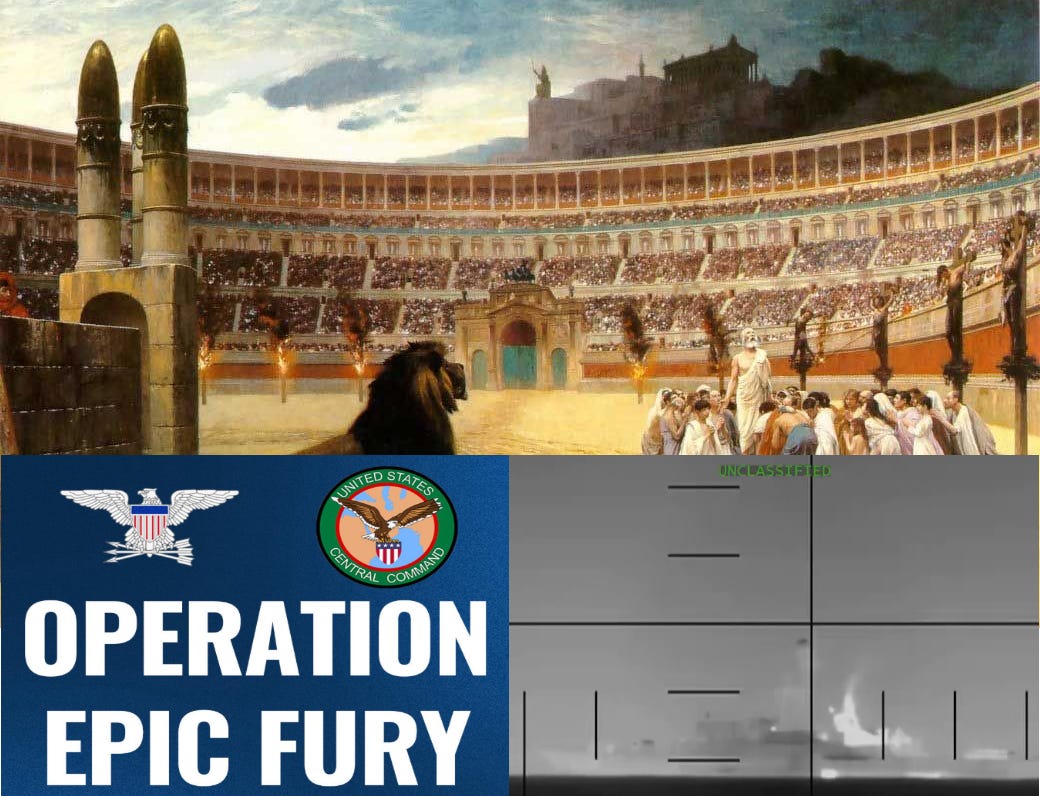
Like most of you, I don’t particularly happen to like the Iranian government.1 I admit that I hope in an abstract sense that this current war Special Military Operation succeeds and that a new (and stable) regime can be quickly found for Iran. I wish they hadn’t started the war in the first place, but now that it’s on and we can’t go back. Even as I think victory may be a lot further off than the president and the military, claiming great success, want to admit, I also have great concerns for what will happen regardless of whether the U.S. succeeds.
Leaving aside all questions about the chances of success, the Israeli/ dispensationalist/ 3rd temple angle to the conflict, the worries many have about how this could escalate into a far larger conflict, either in scale or length, or even the morality of the U.S. engaging in this operation, I worry about what the conflict, and the recent attitude of glorifying violence from the president and many in the U.S. government is doing to us psychologically and spiritually.
Even if U.S. military operations in the abstract against Iran (or, as recently, against Venezuela) are justified, not every particular action is, of course, with Iran apparently near reaching a deal with the U.S. before the U.S. and Israel attacked, a still somewhat unconfirmed report that the U.S. hit a school killing several hundred children on the first day of the new Iran conflict, as well as the U.S. sinking an unarmed Iranian navy cruiser thousands of miles from the conflict. All wars, no matter how well-intentioned or justified, have tragedies, evils, and accidents, of course. I’m not picking on the U.S. military for either of these two actions directly, amidst a flurry of thousands of strikes on the Iranian regime’s military, Revolutionary Guard, militias, and leaders.
My problem, rather, is with the tone of how these events—and the conflict as a whole—are being messaged and received. All wars, of course, are also propaganda wars, depending in part for their outcome and success on the hyperreality of how the war is perceived. Leaders must, practically speaking, put things in the best possible light for their own side. But the triumphalist videos and messaging being put out by the Department of War for this conflict go beyond the “normal” propaganda for war that has in the past merely trumpeted U.S. success and gloried in an end to violence.

Statements like this one below from War Secretary Hegseth are just words, yes, and there’s always bravado in every war, but videos released by the Department of War go quite a long way further in glorifying, promoting, and almost seeking violence for its own sake
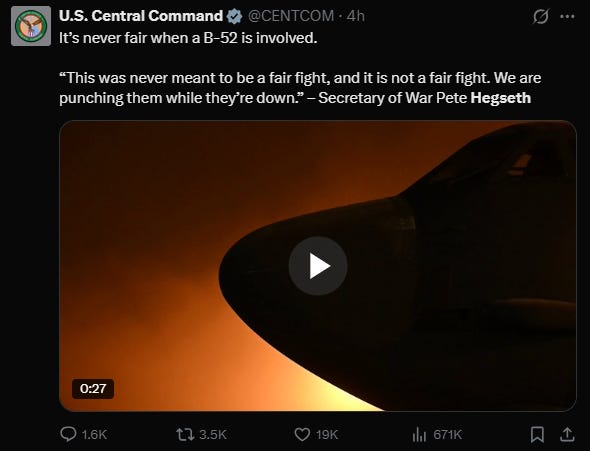
The rap-like soundtrack, the video game-like aesthetic, the people yelling in the background, and the focus on fire, flame, and fury all come together to produce a will-to-power message of dominance and destruction that is exhilarating and seductive. The video draws one in to cheer violence while so normalizing it that many commenting on these videos are reacting as if they’re just cheering on a sports team: little mention made of the suffering on the other side of the explosions.
The ship blown up midway through the video by a U.S. submarine, was completely unarmed and thousands of miles from the conflict zone, attending an international naval event that the U.S. was also to participate in, making the strike, and killing of 80 crew members, as historian Darryl Cooper pointed out several days ago, of little military significance and almost seemingly conducted just to create a propaganda scene for the video. That the primary story was the U.S. had used a torpedo in combat for the first time since World War II, not that the U.S. had eliminated some naval threat, belies the point that the strike, much talked about for the days since, was about creating a video that “looked cool”, and not military necessity.
Didn’t find that aesthetic persuasive to get you to start cheering on death and destruction? Well, here’s another video, posted by the White House this weekend, that features more of a rap aesthetic with different music and a few more scenes of people being killed directly on camera. Language warning (itself part of the problem I have with it):
Didn’t like that one. I understand. How about viewing the conflict completely as a game while epicly combining wholesome Americana with classic rock, football, and yes, a side of death and destruction.
There’s even a baseball version, should you prefer that:
As well as many more besides, such as this one, with too many puzzlingly contradictory movie references to determine exactly what it means, but a general import of “We’re America, we’re in charge, and we can do whatever we want to you.”
Perhaps I’m being too hard on my own country. There are Iranian glorifications of violence galore that are even more glaring than any of these, such as these two videos from last year of an Iranian pop song proclaiming “Boom Boom Tel Aviv” in celebration of Iranian strikes against Israel:
Many other similar videos from Iranian forces throughout the Middle East also proclaim a similar message of glorifying and encouraging retribution, death, and violence:
Regardless of the broader moral questions about the surprise U.S. action, the import of this propaganda, as well as the crass ability of people to bet on the outcome of the war, who will be killed, which countries will be struck, etc., is a turning, in the minds of people on both sides, of war, death, and destruction from an evil into an exciting game.

In part, this turn towards gamification of war and simultaneous glorification of the “game” is just a new strategy for the information war portion of the battlefield, that of the morale of the civilian population. French philosopher Jean Baudrillard’s concept of hyperreality described in his 1991 essay “The Gulf War Did Not Take Place” about the real 1991 Gulf War war being separate from the mediated stage-managed war perceived over the news feeds, is certainly at play here more than ever with these propaganda videos seeking to control the narrative of what this operation in Iran is even all about.2
Americans need a reason to care for the U.S. government to be able to pull this off, and with Iranian propaganda already glorifying violence,3 and since war always has an effect of making mortal enemies more like each other, driving behavior down to the lowest common denominator, some of this is understandable.
But certainly shouldn’t America, in the story it likes to tell about itself, be better than this?
I’d like to think so, but we’ve moved quite a lot in the direction of glorifying war and violence while treating them more and more like an exciting game, what with President Trump’s imperial-sounding rhetoric and military threats towards Greenland, Panama, Canada, Cuba, etc., as well as his approach to certain affairs at home.
Take securing the border, for instance. Obviously, there’s a problem with illegal immigration and violent criminals in particular running around the country that need to be dealt with. Yes, Immigration and Customs Enforcement (I.C.E.) will need to be violent at times to counter violence and create safety, especially with ANTIFA and other leftist groups trying to create havoc.
But is the violence itself to be gloried in, as in this I.C.E. video about deploying to Portland:
From Ben Shapiro's “FAFO” approach to talking about violence against leftists and against civilians living in countries that are America and Israel’s enemies, to those who seemingly oppose him from a more hardcore right-wing disposition like the “Groypers”, to members of the Trump administration and its allies in the middle, violence, the idea that might makes right, or even worse, violence for its own sake, is increasingly on the rise, as evidenced also by the U.S. strikes on drug boats throughout the Carribbean last fall, which also came with their own, violence glorifying videos of the strikes:
Or this video, produced by the White House in collaboration with El Salvador, celebrating how brutal El Salvador’s prisons are. (I’m not denying that their criminals are brutal, or that violence is necessary to maintain order, but the celebration of violence, even if used against violence, is a problem.)
Whatever the particular purpose of these videos from the administration might be, they certainly don’t have a Christian ethos behind them.
The problem, however, goes beyond just some other right-wing group, some particular set of commentators, or some particular politician pushing for violence or pushing to normalize it. The problem is that the attraction is in all with us. Just about all of us, on some level, even if we don’t want to admit it, find these videos, in their portrayal of U.S. national imperial power, tantalizing. We find the idea of U.S. victory intoxicating. Even if our conscience makes us stifle our thoughts of national pride and glory and mourn for innocent victims caught in the middle of violence, we have to admit that these videos, and the disposition behind them, affect us, as I admit that much of this thinking clearly did to me last year, swept up for a time by the idea of national victory, glory, and conquest.
Even as many of the most trumpeting revellers of American power still claim a Christian faith, a pagan moral ethos has most definitely returned to the attitude and mind of many an American. None of us is exempt from this temptation, especially as after decades of modernism, managerialism, and psychological theories that are civilizationally destructive soft-on-crime, soft-on-evil pathologies tempt many of us towards an overcorrection in the other direction, seeking state violence both as a solution to our problems, and, when normalized, as entertainment.
In the city of man, there will always be violence. The enemies of order, in a fallen world, can often only be kept away by violence. But if we accept state violence as it is again being offered today as something glorious, normal, and fun, as it was in the pre-Christian Roman Empire, not only do we deny our common humanity, but we are tempted into worship of the source of violence, the imperial state, as a god, by celebration, as I’ve seen a lot of in the last few days, of the government and military as the righteous judge (or in some quarters, referree) over life and death.
That’s my real problem with this operation. Even if it succeeds without significantly more casualties on either side, it builds upon a trend of normalizing and glorifying actual violence, and will surely, regardless of the outcome, spark more of it from the perfidies and treacheries involved, from the mimetic effect upon people encountering the violence being provoked to imitate it, from hubristic overconfidence that could lead soon to further wars of choice (Israel against Turkey, etc…), and the long run effects of all this upon our hearts.
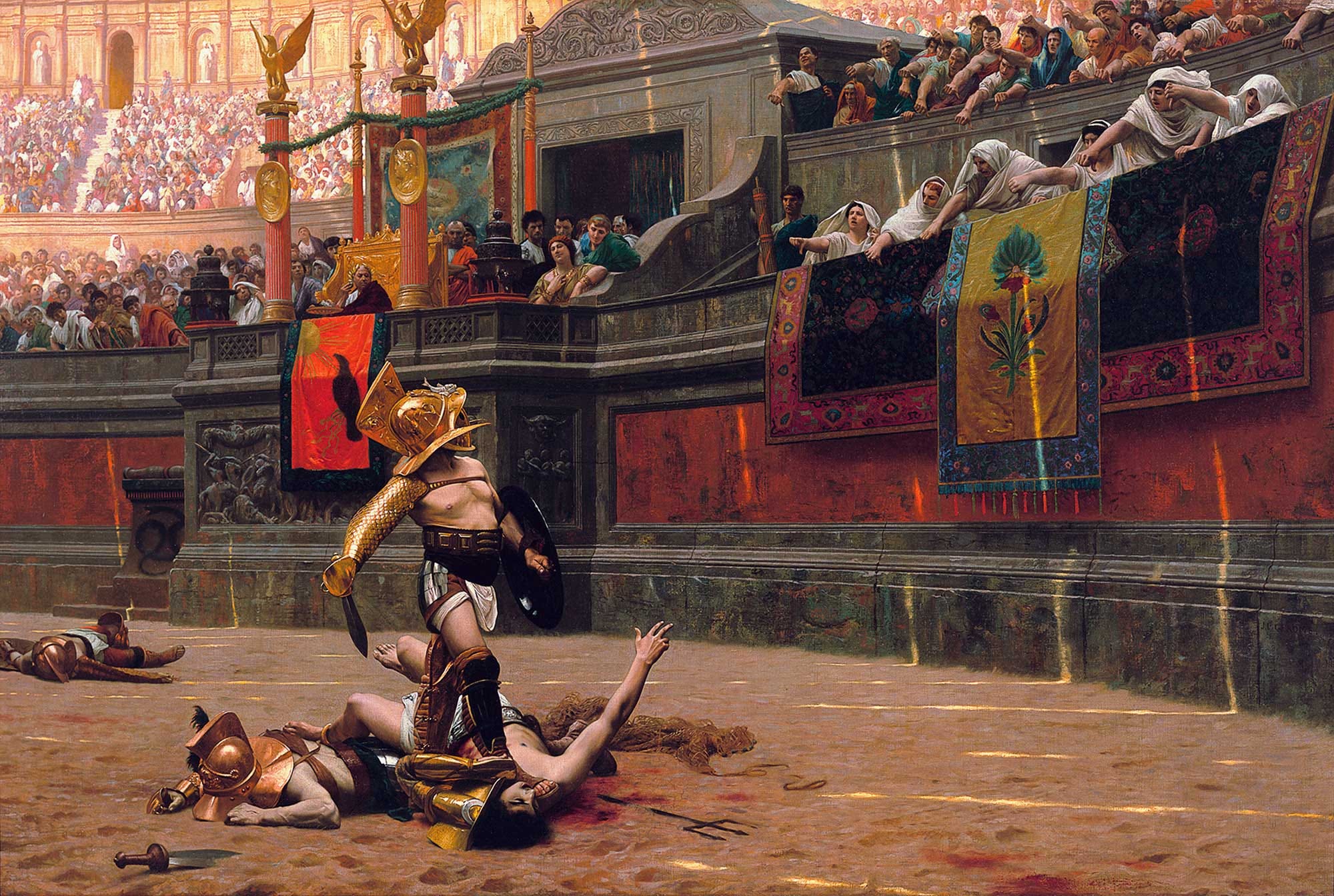
We crow about our moral superiority over the past, wondering how the Romans, for example, could have ever become so depraved as to watch and enjoy gladiators fighting each other to the death, executions in the Colosseum, or all of the other tortures performed by the Roman Empire, especially against Christians.
We defend our “higher morality” by not having in-person executions, having abolished slavery, proclaiming the equality of all before the law under our constitution, etc., and even in our societal-wide fear of death so great that we avoid talking about it as much as possible.
And yet, we worship death, whether in abortion, in IVF, or wherever it occurs around the world. We’ve become Rome without realizing it because screens allow the demons of violence to tempt us in a new way, a sanitized way, a sleeker way, complete with whatever choice of background music, aesthetics, and messaging best suits us.
The American Empire doesn’t entertain its people with death and gore in a physical Colosseum. We have—or are headed for—a digital one instead, our government putting on performative acts of violence, partially for their own ends, but also as an entertainment, distraction, and yes, at least in a way, to encourage the pagan worship of the state and its rulers (or the demons who may be behind some of them) as the ultimate moral authorities, givers of life and givers of death. We may not be cheering on death in a physical crowd in a physical place as did the Romans, yet the violence and death that its demons push on through the mimetic desire of the online mob’s lust for violence is just as seductive and dangerous for all of us.4
As St. Augustine recounts in his Confessions, even those who didn’t want to be drawn in by its violence can, from merely being overwhelmed by it, be turned toward lust for them:
Alypius did not indeed abandon the earthly career of whose prizes his parents had sung to him. He had arrived in Rome before I did to study law. There he had been seized by an incredible obsession for gladiatorial spectacles and to an unbelievable degree. He held such spectacles in aversion and detestation; but some of his friends and fellow-pupils on their way back from a dinner happened to meet him in the street and, despite his energetic refusal and resistance, used friendly violence to take him into the amphitheatre during the days of the cruel and murderous games. He said: ‘If you drag my body to that place and sit me down there, do not imagine you can turn my mind and my eyes to those spectacles. I shall be as one not there, and so I shall overcome both you and the games.’
They heard him, but none the less took him with them, wanting perhaps to discover whether he could actually carry it off. When they arrived and had found seats where they could, the entire place seethed with the most monstrous delight in the cruelty. He kept his eyes shut and forbade his mind to think about such fearful evils. Would that he had blocked his ears as well! A man fell in combat. A great roar from the entire crowd struck him with such vehemence that he was overcome by curiosity. Supposing himself strong enough to despise whatever he saw and to conquer it, he opened his eyes.
He was struck in the soul by a wound graver than the gladiator in his body, whose fall had caused the roar. The shouting entered by his ears and forced open his eyes. Thereby it was the means of wounding and striking to the ground a mind still more bold than strong, and the weaker for the reason that he presumed on himself when he ought to have relied on you.
As soon as he saw the blood, he at once drank in savagery and did not turn away. His eyes were riveted. He imbibed madness. Without any awareness of what was happening to him, he found delight in the murderous contest and was inebriated by bloodthirsty pleasure. He was not now the person who had come in, but just one of the crowd which he had joined, and a true member of the group which had brought him. What should I add? He looked, he yelled, he was on fire, he took the madness home with him so that it urged him to return not only with those by whom he had originally been drawn there, but even more than them, taking others with him. Nevertheless, from this you delivered him by your most strong and merciful hand, and you taught him to put his confidence not in himself but in you (Isa. 57: 13). But that was much later.5
If we don’t step back from the glory of destruction and violence and see it for what it really is, we, if not already like a member of the Roman mob, could all be like Alypius, and fall for love of it against all our better wishes.
And it could, so alluring and enchanting as violence’s hooks, once they are in, are, take a saint, as it did for the Roman one, to end it:
A certain man of the name of Telemachus had embraced the ascetic life. He had set out from the East and for this reason had repaired to Rome. There, when the abominable spectacle was being exhibited, he went himself into the stadium, and, stepping down into the arena, endeavoured to stop the men who were wielding their weapons against one another. The spectators of the slaughter were indignant, and inspired by the mad fury of the demon who delights in those bloody deeds, stoned the peacemaker to death. When the admirable emperor was informed of this he numbered Telemachus in the array of victorious martyrs, and put an end to that impious spectacle6
St. Telemachus, pray for us.
Neither, however, am I particularly fond of most governments.
Of course, the propaganda of all the other groups in the region, from Hamas to Hezbollah, to ISIS, etc. also does much of the same glorification of violence.
St. Augustine. Confessions. Translated by Henry Chadwick. Oxford: Oxford University Press, 1991, pg. 99-100.
Comments
Nothing yet. Say the first thing.
Sign in to join the conversation.