
Why do beige hymns with sketchy theology and liturgical abuse continue under the rule of finance-minded, and therefore attendance-minded, priests and their parish staff, including “Directors of Sacred Music”, even when it’s increasingly clear that the 60-year-long experiment has failed from a statistical perspective at attracting and retaining the faithful? Why are there so few “unicorn Novus Ordo” Masses free from distracting music and liturgical abuses? Why does no one stop “pop liturgy” and “liturgical cringe”?
For some, the problem is that people’s tastes are all different, and music ministers and directors, caught in the middle, and entrusted with power over such things, can’t please all the factions of the liturgy wars and find it easiest to just stick with random (or manufacturer-recommended) selections from what Michael Hitchborn of the Lepanto Institute calls the“Hymnal Industrial Complex” of GIA Publications and OCP Press.
For others, like Thomas Day in Why Catholics Can’t Sing, the problem is cultural; Catholics can’t sing, and music has always been a problem, Novus Ordo Mass or no Novus Ordo Mass, though he admits that the liturgical revolution did create incentives that made music in the liturgy generally more distracting:
I’ve argued variations on some of these themes before, but there’s another option, as the story of an anonymous music director who’s worked at eight Churches in three dioceses, I’ve been in contact with for a while, and received permission to share, reveals.
The reason liturgical cringe continues in most parishes, even when such parishes are losing faithful fast with that strategy, is that anyone with contrary (reverent) views either is forced to violate their conscience and participate or get filtered out of the system, leaving only those left who believe that more innovation, inappropriate music, and irrelevance is the way forward.
As this man, whom I’ll just call Robert, so as not to affect him in his current position for speaking out about the broader situation for Catholic musicians, relates:
It is very close to impossible to work in the Novus Ordo and not be asked to violate your conscience. Just in my time, I’ve been asked to play contemporary styles of music that never would’ve been permitted at any other point in Church history at hundreds of Masses. I’m forbidden at the overwhelming majority of parishes from only playing traditional Catholic music, and if I want to be employed in Church, I must accept modern innovation and play liturgically inappropriate music: it’s either that or be fired. I’ve been told to omit the propers at every single Mass I’ve ever played and replace them with hymns instead.
Imagine doing that with the lectionary. Imagine replacing every single reading at Mass with an “optional substitute.” That’s how I feel when I’m asked to omit the propers at every single Mass I play.
I’ve been told to stop kneeling for Communion at all Masses at a “trad” Novus Ordo. I’ve been told to schedule pop musicians to come and play a sudo concert during Eucharistic Adoration I’ve been told to ignore the Church’s restrictions on superfluous organ playing during Advent and Lent because the Priest feels self conscious about saying Mass with brief periods of silence I could give dozens of other examples, and these aren’t even the worst ones. These are just the ones that can be summarized in brief bullet points. And everyone I’ve spoken to who has a well formed conscience and works in the Novus Ordo says the same thing: You either have to compromise your conscience or find different employment.
The cringe Richard has experienced and been forced to enforce, staggers belief as it tells a tale of micromanagement where engagement, excitement, and novelty are the metrics and silence and tradition are the enemies. Why have Richard and music directors like himself been drafted as the enforcers of novelty?
Though priests definitely pressured him into helping conduct compromising liturgical choices, it’s not just because the priests want it, he concludes, or because the music directors all themselves, in their hearts of hearts, want it, The problem, Robert continues, isn’t that all priests want to play the greatest hits of 70s liturgical cringe, it’s often that they themselves, alongside the music directors, feel powerless to push for anything else:
Robert, at his current job at a mid-sized diocesan parish with an attached school, did actually try to improve and fix things, introducing traditional hymns, chanting the propers, and adding Latin:
It’s insanely frustrating that when I complained about the music at Mass growing up, I was always told “once you become the music director, you can pick whatever music you want.” Even though this was obviously just a rhetorical filler phrase to dismiss my legitimate concerns and get me to shut up, it bothers me much more because now that I am the music director, I’m told that I have to do whatever the congregation wants.
My Priest won’t allow me to fix the music at Sunday Mass overnight or even over the course of a year or two because almost all of his congregants will just go somewhere else to get liturgical pop music. In fact, we had an agreement that at the Thursday 8:00am daily Mass, I could chant a couple of the propers and the only hymns would be traditional hymns. I started to call it “Trad Thursday” in my mind. But before it even got started, a single boomer who heard about it and complained, so the whole thing was cancelled permanently. But they still wanted music at the Thursday 8:00 Mass, so now I have a 6th Mass I have to play every week where I have to compromise with my conscience.
Robert’s best efforts came crashing down because someone complained and because the priest believed that his parish, as with so many that are financially tight, couldn’t afford to take the risk of angering older Catholics attached to the liturgical revolution.
The revolution, however, has been so institutionalized that stagnation and decay (continuing the revolution) are preferred to real change, even though the demographic that loves the revolution isn’t getting any larger and the liturgical cringe devalues the whole idea of the Faith, making it more likely for more to fall away.
Do they actually prefer it? Do most Catholics actually prefer it? Surely there are a few who do find a (shallow) spiritual experience from Marty Haugen’s “All Are Welcome”, but Richard’s experience tells him that, like the Albiene Paradox, most people support liturgical cringe because they think other people want it. Though few actually want it, it becomes the standard because, as in the subjective trap known as the prisoner’s dilemma, the social cost for having a contrary position against the perceived will of the crowd is so great that most people, after a little protest, give in to get along:
People saying you have to have guitar Masses [to attract more Catholics] is the thing that kills me. It’s actually boomers that want it, and they pretend young people want it in order to seem sympathetic and inclusive rather than tyrannical. I’ve been at many Churches where the young congregants beg for a traditional Mass, and they’re always told “It’s too much. It’s not what people are used to.” As if the liturgical revolution that imposed these changes wasn’t the most sudden and autocratic revolution to have ever occurred in the Church.
Though counter-revolution, letting a few things into the liturgy that aren’t Canticles of the Beige is what those who are practicing and deep into the faith want, stagnation (continuing the revolution) is preferable because it’s the path of least resistance and few people of a traditional mindset are willing to hector, heckle, and threaten their priests the way more worldly minded donors may be.
Like a mind virus parasitical within a cult, this mistaken belief among the faithful that “the young” or “the faithful” or, sometimes “everyone who’s with the program” wants liturgical cringe, has hindered Richard’s attempts to add more reverence and less distraction to Adoration, his best attempts constantly getting ruined by people who want to make the experience more fun for the Catholic school children by blasting Christian rock:
You’re never able to be the one person doing the right thing. At the parish I work for I can’t fix the music program for the school because even if I have the best music possible at school Masses and school Adoration when I’m in charge of it, there are plenty of other teachers who will bring a bluetooth speaker and blare Christian rock when they’re in charge of Adoration. I can’t give the school children meat and vegetables while other adults offer them candy. They’ll always prefer the candy if it’s on the table.
In effect, by setting the example for young children that Church means entertainment like music and an atmosphere of liturgical cringe, any attempts to give them deeper sustenance get drowned out with banalities and noise. What do you expect but that they find the whole “Church thing” boring, and like 8 out of 10 people raised Catholic lose their faith in adulthood?1
As Richard continues, the Liturgical Industrial Complex, the system of music and liturgy as it is on the ground, regardless of what it may have been intended to be by Sacrosanctum Concilium (etc.) or the best wishes of bishops or priests in the abstract, eventually either forces people who seriously work in the system to conform to postconciliar novelties or forces them out
As a congregant, I thought my requests for tradition were rejected because we had a set of bad music directors no matter where we moved. Now I realize that it’s because the Novus Ordo simply will not allow tradition.
The Novus Ordo, not as an abstract set of rubrics that exist in the minds of online theologians, but as an observable and tangible system demands you either don’t have a well formed conscience or violate your conscience. If you want to be involved in any significant manner other than receiving the sacraments and immediately driving back home, you have to be compromised. If you do that which Catholics ought to do, and only that which Catholics ought to do, you will be expelled from the system. Acting as Catholics would’ve acted in previous generations is unacceptable to them, and they demand you accept innovation and novelty.
When I say “the Novus Ordo will not allow tradition,” I don’t mean that the rubrics of the Novus Ordo don’t have a traditional option that, in theory, a Priest could exercise. I mean that at 99% of parishes, Priests and liturgists are unable to exercise traditional options due to significant pushback from the congregation, and pressure from Bishops. Sure, there’s a trad Church here and there in the Novus Ordo. But open a phonebook, flip to a random Catholic Church, get a job there as a music director, and will be faced with the same ultimatum that every music director is faced with: Actively participate in liturgically inappropriate actions or be fired. This is the status quo at 99% of NO parishes, so in that sense, the NO, in practice, doesn’t allow tradition
Sure, the rubrics take every sign of reverence and tradition that was once assumed to take place and make them a “valid option among many valid options.” But anyone who maxes out all of the options they’re given towards the traditional side will be expelled from the Novus Ordo. Lastly, just to reiterate my previous question, are we at the point where we can refuse to participate in the Novus Ordo? Because it seems like to say that we cannot refuse is to either say Catholics who work for the Church must compromise their conscience, and Catholics who attend Mass must witness sacrilege barring the two or three truly trad Novus Ordos per state.
The moral crux, one that Richard, still currently employed as a music director, but having found it impossible to make lasting change in, is that you can’t even participate in the system in an institutionalized way without having to make moral compromises so great as to outweigh your positive influence:
I should clarify: When I say “participate in the Novus Ordo,” I don’t mean attending Sunday Mass at a Novus Ordo parish. I mean actively getting involved in keeping the functioning of the Novus Ordo alive. E.g., being employed by them, sending yourself to seminary, etc. If you work a lifelong, full-time career in the Novus Ordo, I guarantee that unless you’re at the tradiest of all Churches, you will be asked to violate your conscience at some point in some manner. You can work a lifelong career as a plumber, electrician, accountant, doctor, or any other number of jobs and never be asked to compromise Catholic Tradition. It’s only in the Novus Ordo that you must participate in denying other Catholics their liturgical, ecclesiastical, and spiritual tradition.
Richard’s experience echoes those recounted in Christendom Quarterly’s recent article “The Parish You Hate, Hates You,” that I’ve also been trying to make about an institutionalized “Diocesan Inc.”, an ideological, managerial-system perpetuated infiltration within parishes and dioceses that pushes corporatist tactics and worldly aims:
The councils, the committees, the little fiefdoms of the men’s and women’s clubs, they exist not to grow, but to act as bulwarks against change. Even if the Pastor wants change, he has to deal with this interconnected web of laypeople who have his bishop’s office on speed dial and know exactly what to say for the pastor to get an unwanted call himself. “Uncharitable. Pushy. Demanding. Rigid.”
Pastors, then, have become powerless middle managers. They own zero assets, are completely and utterly dependent on the whims of diocesan politics to survive and are under the thumb of the loudest complainers in the parish. Those brave pastors who buck this trend are run over. In one of our local parishes, the priest was removed because he did not use the Extraordinary Ministers of Holy Communion sufficiently, and this labeled him as too much of a traditionalist. Bishops would rather close 30% of the parishes in their diocese than take the risks necessary to change. Until this incentive structure changes, dioceses declare bankruptcy, and American Catholics have been fleeced of every dollar that can be taken from them, there is no saving Catholic parishes through the volunteering effort of the laity.2
Richard’s experience is in agreement, but his reflections add a spin that at once makes the situation darker yet also brighter.
Much of the infiltration, as it was with the beginning of the liturgical revolution, is just people doing (and pushing) what they need to do to get along, which often means going along with liturgical cringe and abuse because someone else is pushing for it, and the path of least resistance for many is to continue the tottering liturgical revolutions of the 1970s.
The problem isn’t the pastors who go along with liturgical abuse or that bishops pressure them into doing so out of ideological hubris. It isn’t even the financial incentives that push them that way, or the surviving liturgical revolutionaries, or the misguided who continue to push for it.
Liturgical abuse doesn’t continue because they’re fun, hip, or still exciting. It’s long ago lost the exciting lustre that it briefly held in the 1960s and 70s. The only reason it continues, the real liturgical gatekeepers holding it in place are those who believe that it’s inevitable and, having a defeatist mindset about it, don’t challenge it but follow along, making their belief a self-fulfilling prophecy.
There are conspiracies, business interests, government interests, and anti-Catholic ideological infiltration that have contributed to the situation, yes. But the primary liturgical gatekeepers causing liturgical abuse aren’t secret conspiracies, but rather, like the Abilene Paradox at the beginning of the liturgical reform, everyone going along with the changes because they thought that everyone else wanted them.3 Cringe, and a lot of other present-day crises in the Church stand today primarily because of human mimesis of the crowd, leading to inaction and abdication of responsibility rather than because of positive conspiracy.
The Novus Ordo Mass didn’t institutionalize cringe. It created—and still creates, through what Thomas Day describes as poor incentives in Why Catholics Can’t Sing, a vacuum that cringe was able, in the revolutionary era after the council, to establish a strong foothold in.
Cringe is now today the status quo, the tired baseline, the lowest common denominator that everyone assumes that everyone else wants and feels powerless to rebel against because of institutional inertia, and human nature when working in crowds favors more of the same over innovation and change.
After the mass psychosis that drove us here, we’re now in a place where, even though decline showcases that few want the status quo of liturgical cringe, we continue to get it because crowds and human nature being as they are, no one, as Richard’s experience illustrates, is incentivized to do things any differently.
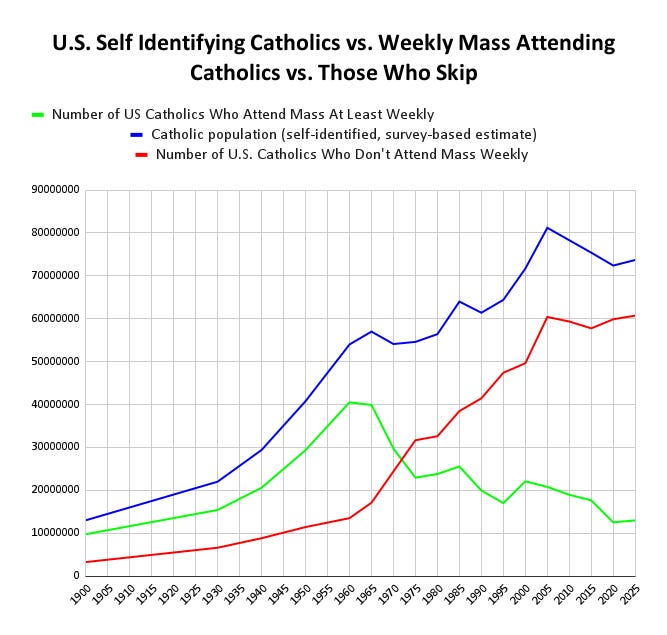
This was the dark part.
The brighter part of the story is the part that at first appears most pessimistic. Since no one is incentivized to fix liturgical cringe and anyone with a positive desire to do so gets filtered out of the system, it won’t, on a broad level, get fixed, and the average parish will muddle through as long as it can on Marty Haugen, David Hass, bubbles, banners, and balloons
This sounds bad, until you realize that the decline in the number of priests is baked so deeply into the system at such parishes that are captured by this mental and institutional inertia that the whole parish model could collapse, firstly from a shortage of priests that temporarily causes a massive wave of parish closures and the average parish to skyrocket in size before future demographic declines in the laity in the further future cause even many of these parishes to struggle.
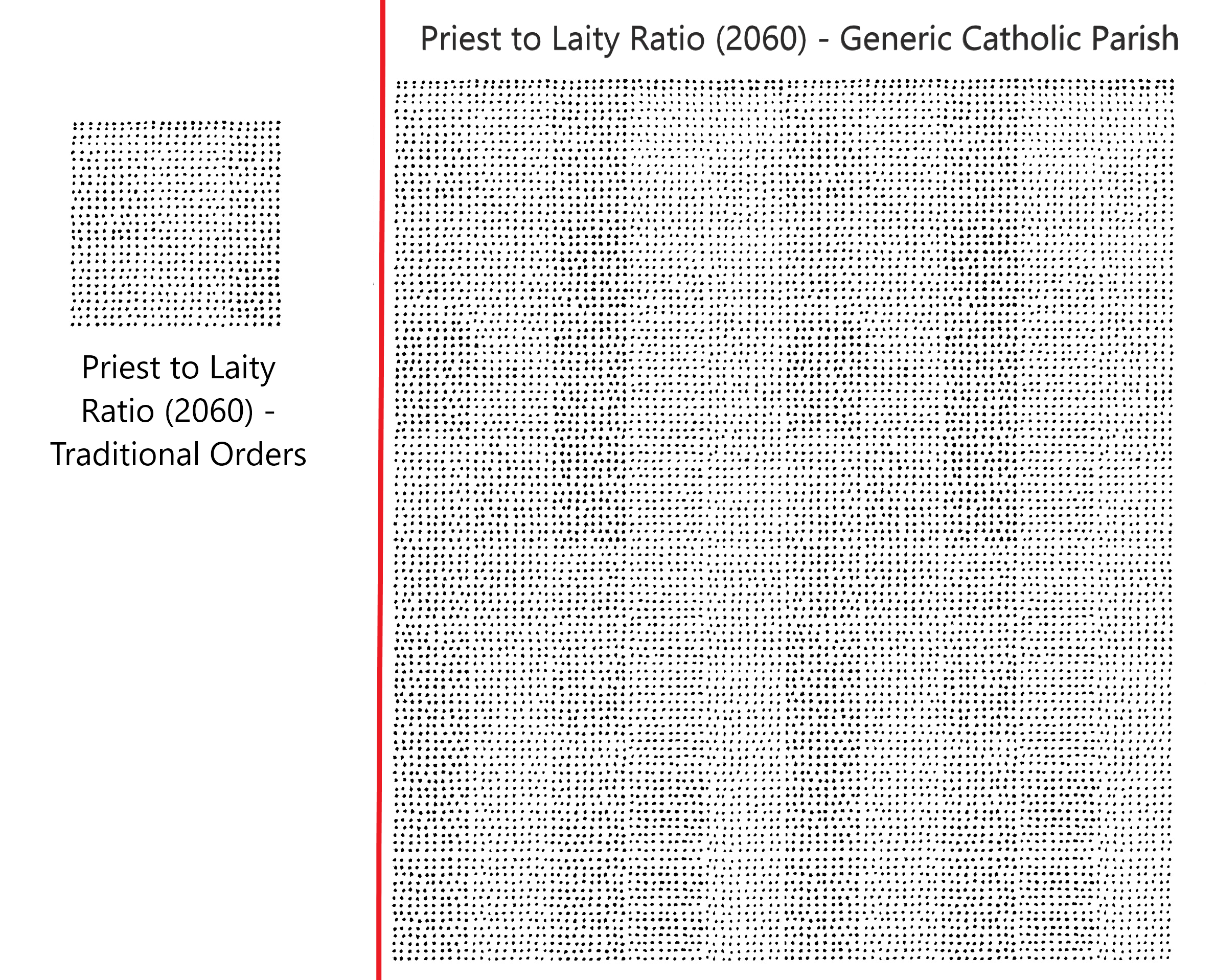
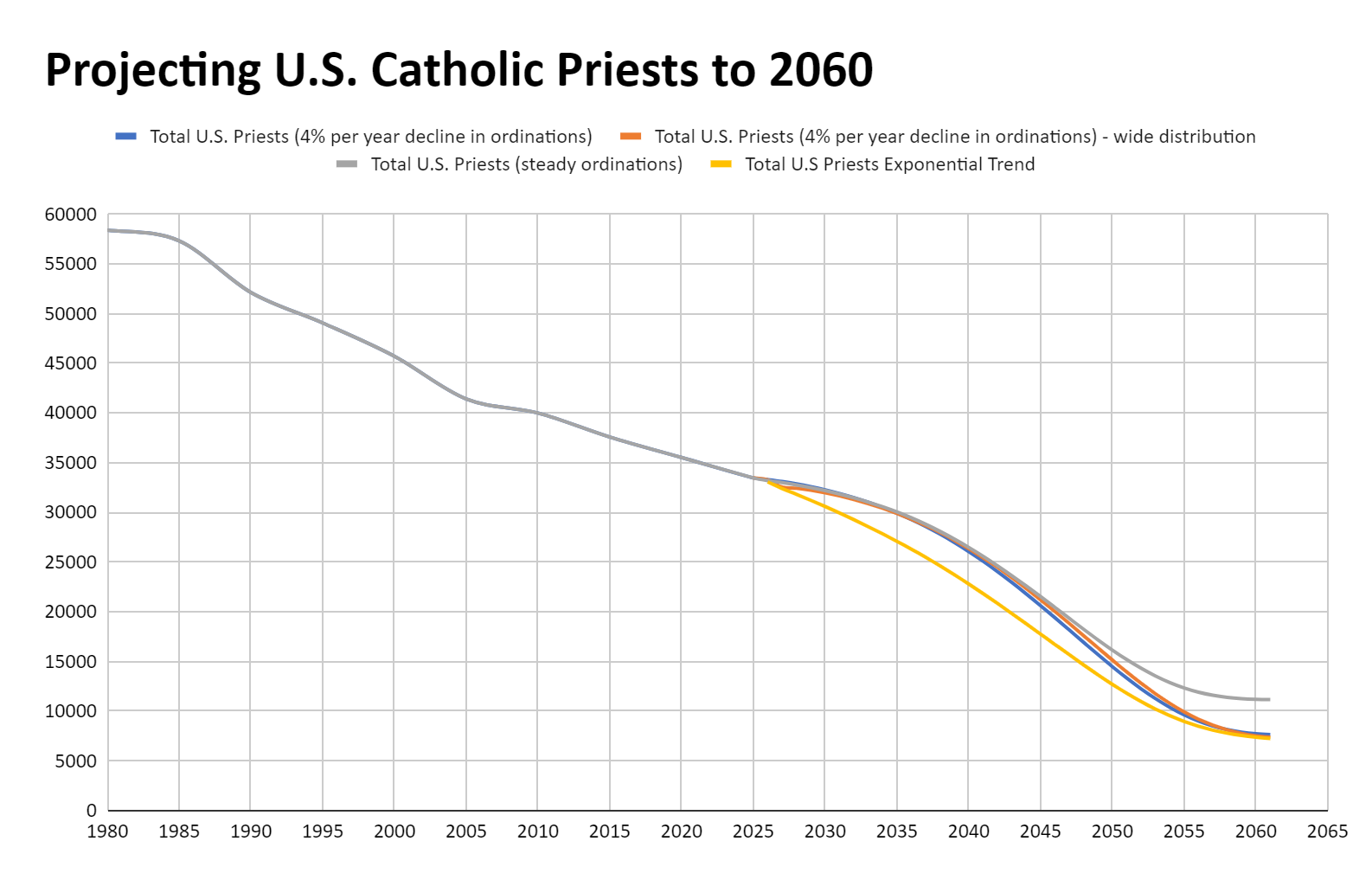
When this happens, the declining model of the average existing legacy parish and the habits of liturgical abuse and cringe that so often come with it, contrasted against the example of the far greater growth (while remaining well supplied with priests) of the traditional orders, will either be forced to die or to adapt.
After the demographic collapse and closure of the old ones, either new greenfield parishes will be formed within dioceses without the habits of liturgical abuse and cringe that have been with us over the last 60 years, or the traditional orders will, as they will within 20 years in France per TLM_Ryan’s projections, overtake them completely, itself also forcing the remaining parishes to adapt.
I don’t know what to tell people like Robert in their situation right now, as they fight against the inertia of cringe in what appears, as has been argued by Christendom Quarterly in their recent article, to be a losing battle. Perhaps the inertia is too strong for any one individual, music director, or even priest or bishop to long resist in many and average parish or diocese.
The war as a whole surely isn’t lost, though, with perhaps the best—and most optimistic—suggestion, being too focus one’s efforts where it does have a chance of bearing fruit, supporting and working, if one is involved in Sacred Music, the liturgies of those traditional orders rather than continuing to try to fix a parish that sees you as the problem.
For now, but only for now, however, the demographic decline in these parishes isn’t great enough for the inertia caused by bad incentives in the Novus Ordo to break by enough people realizing that the path of guitar masses, ad-libbing, and cringe isn’t working.
We should be happy and see as allies those who are already realizing that the novelties held as the default of the last 60 years don’t work well. Even if some of their attempts at renewed reverence are themselves a little cringe, the intention of these “neo-traditionalists” to break out of the mimetic trap of the liturgical defaults is a good thing.4
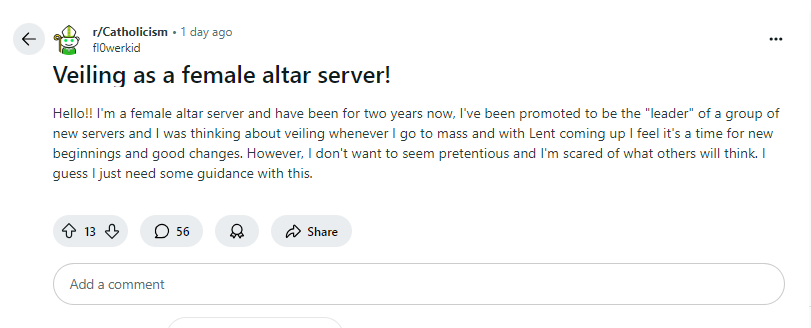
More is needed. The time will, but hasn’t yet come, when the inertia keeping liturgical cringe and abuse in place weakens enough for the spell of the Abilene Paradox to break. Only when this happens, when more are willing to publicly admit that the status quo doesn’t work, would it be the time best placed for success in motivating parishes to recover reverence and the Church’s liturgical heritage through help in Sacred Music and associated ministries, etc. Then, the spell of mimesis broken and all openly looking for alternatives, tradition will appear to them as it does already to those not captured by mental inertia, as something revolutionary (in a positive sense), fresh, deep, and exciting compared to the staid, beige platitudes of the procurators of cringe.
And the best way to achieve that future of saving these parishes and their faithful who are today caught up in liturgical cringe, rather than merely getting stuck in polemics and theories about why it’s happening, as I probably do a little too much of, is to begin with ensuring that our own spiritual life is real, and isn’t itself cringe!
An aside, but a girl that I know well has told a similar story of a religious order she experienced on a discernment visit that takes out guitars during adoration, but only when they have visitors!
Video on the Abilene Paradox:
Comments
Nothing yet. Say the first thing.
Sign in to join the conversation.