
It has been an extraordinary year in America’s political life……whichever political window you might be looking out from. It really did seem prior to that fateful day in November 2024 that the near-future just promised more ‘long-marching’ down Progressive Road. But then Trump2 burst on us. In conventional ‘political’ terms (terms I find myself thinking in less and less) the current Big Question must be whether the Trumpist phenomenon is a real About-Turn or just a temporary Halt in that long march.
I am no futurologist.....I can dimly perceive The Future advancing in a broad wave front.....AI creative destruction; social-mediated epistemological combat; and its ‘populist’ political expression. What I don’t get is a picture of the cultural landscape that might emerge in its wake. My guess though is that America will continue to be dead centre of it.
As far back as this Englishman (and boy) can remember, I always had an inchoate notion of America as epicentre of what we used to call The Free World and thus, in a sense, my own true homeland. The European lip-curling I remember from my youth (‘Americanisms’ and so forth) always struck me as sour grapes. In more recent times, some British conservatives seem to have taken an easy get-out of viewing ‘wokeness’ as another ‘American import’ rather than facing up to their own nation’s delirious embrace of it. Well maybe it was to a degree, but where else than America could there have been so rapid and uncompromising a backlash against it? The “enough already.....let’s give that real estate and tv mogul a go at ridding us of all this p.c. bollocks”
Endorsing Trumpism’s backlash against the Progressive Managerialism that had been running out of control in America (and still is in the rest of the West) is not necessarily to be infatuated with Trump2 in all its aspects - which may well bring us horrors of its own in due course. I love the (probably apocryphal) story of what former Chinese premier Zhou Enlai said when asked for his view on the impact of the French Revolution…… “it is too early to tell” he said.
My youthful fascination with all things US-of-A received a strong fillip in the early 1970s, in the shape of Alistair Cooke’s much admired BBC/Time-Life television series America: a Personal History of the United States. It was broadcast (in both UK and USA) in thirteen episodes from November ’72 to February ’73 and – amongst other plaudits - resulted in Cooke’s invitation to address the joint Houses of Congress. [To Brits like me, Cooke had long been famous for his weekly Letter from America radio show.]
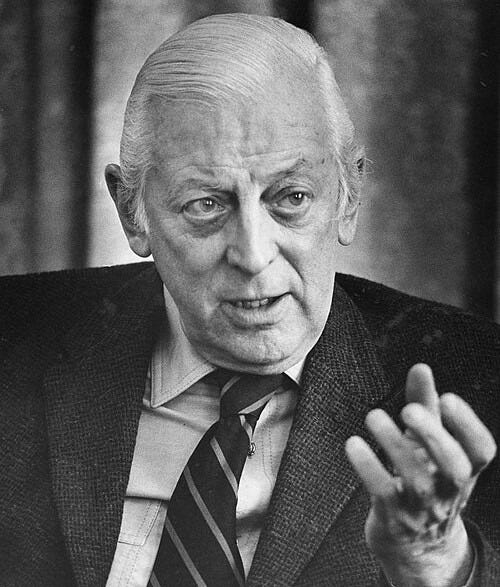
But it was not, in my case, the tv series itself that fired my imagination. When those thirteen episodes were being screened, I would likely have been in my university campus apartment block lounge.......with a blocked sink, a blocked kitchen refuse chute, more unwashed plates and cups than you could shake an unwashed stick at and a low-stakes poker game playing pretty much 24/7. But no television set.
It was ten years later that I came across the book of Cooke’s America in my local library and was immediately captivated. Four times the length of the tv series, it is possibly the only work of non-fiction that I have ever devoured cover-to-cover with no loss of appetite. So in this essay I take a long detour into Cooke’s impressionistic story of America’s past. One that might provide at least some clues to its possible future?
Here he is in the chapter on Inventing a Nation:
The Founding Fathers worried about “democracy” but the American people quickly found politics a delight...
...Jefferson pictured life in America as a long pastoral symphony, a continuing Utopia of chivalrous and learned rulers walking hand in hand with good honest farmers in “perfect harmony”...
....a prospect that ravished Jefferson threw Hamilton into despair. “Democracy” he wrote, two days before he died, “is our real disease”.
The cultural climate in which Cooke was writing his personal history of America will have less resonance for younger generations than for boomers like me. In 1972, we were several years into the post-60s version of ‘Progress’ that continues to this day. Not everyone was on board. Don McLean was singing bye bye to Miss American Pie and to his former self as a lonely teenage bronkin’ buck with a pink carnation and a pick-up truck. To my own lonely teenage self, Progress had largely meant the invention of rock music and miniskirts. 1972 already seemed to me to be prog-rocking and midifying in the wrong direction.
Talking of the 70s counter-culture, Cooke hears echoes of one of the 1770s:
They believed, because they wanted to, in a Brazil where splendid naked women dwelled in perfect amity with men who were seven feet tall and lived to be 140 years old...and to their delight the French explorer Bougainville confirmed the wish with a delirious account of Tahiti. From that moment the idealist trek was on...back to unspoilt nature as the cure for all our woes.
Remind you of anything? (clue: begins with an H) A ‘radical’ counter-culture that left this boy unimpressed. It took another two decades – ‘till the 1990s - for me to sense something genuinely radical coming down the line.
……the biggest historical happening of my lifetime. In the same way that Britain birthed the railway industrial revolution, it was America (nit-picky whataboutery aside) that birthed the internet. It has changed our way of life more profoundly than any political/ideological discourse running in parallel to it. Of course the explosion of that we now call Silicon Valley had its beginnings in the 1970s. It was the creature of a kind of entrepreneurial inventiveness that - whilst not exactly a uniquely American phenomenon – does seem to have always grown remarkably fecund in its cultural soil.
Here’s Cooke on Thomas Edison in the 1870s:....he “could admire the delicate workmanship of a Swiss watch but wonder; How can you make a dollar watch?” One day he left a scrap of paper on the desk of a man names Kruesi....with a note: “make this; Edison”..... “what” asked the puzzled Kruesi “will it do?” “It will talk back” he replied. And it did.
And here he is on Frederick Tudor..... “an inventor with so many mad ideas that a whimsical brother wondered why he didn’t break up the ice on the Boston ponds and ship it to the tropics.....In fifteen years he had his own fleet shipping ice in thousands of tons to the West Indies, Persia, India and Europe. The foreigners were delighted with the product but slightly bemused about what to do with it. Tudor responded by anticipating two centuries of salesmanship and advertising. He realised that the golden rule of merchandising is to create an appetite for something you didn’t even know you wanted.”
With the arguable exception of the Chinese economic phoenix, I think it is fair to say that America still leads the world in its entrepreneurial direction of travel. Absent the young techies of Silicon Valley, it is pretty inconceivable that any other nations would have created the digital age we live in. [My personal appraisal of its societal costs and benefits]
Though the spirit of capitalism was birthed elsewhere, America is surely the place on earth where “the pursuit of happiness” via capitalist enterprise, invention and accumulation of material wealth soared to its apogee. It has not however done that much better than any other part of the planet at the realisation of Benjamin Franklin’s “healthy and wise”. To every upside there is a downside? It seems to me that the downside in this case is a social psychology of what I would call Comfortable Discontent.....or do I mean Comfortably Numb?
Let’s take a walk through the paradoxes and contradictions of American capitalist consumerism’s fizzing evolution...... in these snippets from Cooke’s chapters: Gone West, Domesticating the Wilderness and Money on the Land:
.....Now the crawling companies [of ‘forty-niners’] began to dump stoves, bedsteads, trunks, bellows, dishes, kettles, harness, spades, plows, mirrors, brooms, boiled shirts – anything that added an ounce to the hard limit of 2500 pounds per wagon.....
.......a 100 days after [29 year old Joseph McCoy’s offer], the village of Abilene heard a thunderstorm of hooves coming up from the south. It was the start of the cowboy legend....in the first four years he shipped over two million cattle from his stockyards. He was as they say ‘the real McCoy’.......
....As late as WW2 it was possible to come across.... at hundred mile intervals through Arizona and Nevada: a short row of wooden false fronts – a hardware store, a raddled saloon, the shell of the US post office, the ghost of a newspaper office – a dirt road that led nowhere.......
.......It was some sort of high watermark of Western civilisation when Dodge City Amateur Dramatic Society put on A Midsummer Night’s Dream.......
.......As with many more of the money barons, the coming of arthritis convinced [John D Rockefeller] that he had made all his money for the public good. So with complete sincerity, he disbursed it... he gave $530,000,000 for worldwide medical research.....
......[The Carnegie’s] boy was as lively as a squirrel and he went hopping up the golden ladder rung by rung, from bobbin boy to telegraph messenger, to railroad clerk, to superintendent to director.....[eventually retiring] to a castle in the eastern highland of Scotland and began a career in lavish philanthropy that made his name known around the world.....
....On a historic night the Vanderbilt ballroom glittered with the uniforms of a historic British regiment...and army of actors hired by a devoted wife whose husband had gone quietly mad and believed himself to be the Prince of Wales
America paints a delightful historical tapestry of stories of winning and losing in this carnival of raw capitalist enterprise. In this way it is refreshingly unlike the dominant mythos of recent decades - a dreary narrative that reduces everything to a binary of victims and oppressors. [I have already written at length in this Substack essay collection on the corrosive folly of this mentality. To pick up the theme again here would largely be repeating myself and it has never been my intention to be an accentuate the negative polemicist.]
Revisiting Cooke’s anecdotal tapestry, one word seemed to keep floating into my mind.....the word is struggle. Instinct tells me that The Good Life involves a degree of struggle....one that draws on a will to survive and thrive. And that that is perhaps where our consumerist pursuit of happiness has gone most wrong.
Ads that feature fit-as-a-fiddle-looking folks with all kinds of ‘disability’ aids regularly punctuate the tv stuff I watch these days. The only ‘disability’ on show seems to be their incredibly self-satisfied facial expressions. The advertising pitch is this: ridding you of the need for any kind of struggle, the better to be able to “just enjoy yourself’”. But that’s enough grumpy for now! Here’s Cooke on struggle in his chapters: Gone West and Domesticating the Wilderness:
Russo-German immigrants were told that the hard prairie was bad for wheat but they were stubborn....Twenty years from the time the Roosians arrived, Kansas had become the wheat bowl of America and was to be the granary of the Allied armies in two world wars
......Many otherwise healthy women went mad from the scrimping, the droughts, the burning summers, the polar winters, the loneliness and the ceasless wind – which was both the prairie farmer’s curse and his blessing. The windmill was one of three things which made it possible for a homesteader to make a life. The second was the [John Deere] plow. The third was barbed wire........In the end the West was won with a bleak absence of drama by the homesteader and his woman......it was she who first acquired the symbols of respectability, the dignity of a pony and trap, a frame house and such high-toned city amenities as wallpaper, carpets, pictures on the wall.
.... It took excessive sweat and labour in one century to hew out of the prairie and forest, this comfort and these values, which in the next century the great-grandchildren could afford to despise.
In his Epilogue Cooke anticipates much of what trendy cultural relativism has done to our moral and social norms in the half century since he was writing:
Several of the symptoms that Edward Gibbon....signs of the decline of Rome....an obsession with sex, freakishness in the arts masquerading as originality and enthusiasm pretending to creativeness.....general desire to live off the state.....moral numbness to vulgarity, violence and the assault on the simplest human decencies. And of America’s future: The race is on between its decadence and its vitality
Cooke could not have imagined in 1973, the ocean of internet ‘slop’ that many of his own great grandchildren’s generation are now navigating – and either swimming or drowning in. Maybe struggling for a good life in the twenty-first century will be about finding ways stay sane amid the mind-numbing din of digital age ‘noise’.
Having said that I was amazed to discover recently that EM Forster did manage to conjure a not too dissimilar dystopia as long ago as 1909. This Unherd review of his short story The Machine Stops describes a distant future in which: human beings - isolated, alone, and terrifically self-involved - live in underground cells, where all their needs are met by something called the “Machine”. Contact with others is almost exclusively electronically mediated....surrounded by buttons “to call for food, for music, for clothing” — even for Machine-made literature and poetry.......“The Book” contains “instructions against every possible contingency” — a comprehensive list of buttons to press should one be “hot or cold or dyspeptic or at a loss for a word”. Remind you of anything?
I don’t have much of a clue where AI-enhanced, social-mediated, ‘populism’ might really take us. Nor whether the 21st c. future will be an American or a Chinese one. So......to conclude this essay - I’ll focus my thoughts on what current horrors we might at least dream of escaping. For my money, the most joyous positive outcome would be a course correction away from Liberalism’s 21st c. mutation into anarcho-tyranny.
Few among the voting public fully grasp the concept - which is a real shame because tens of millions of Western citizens are trapped in the reality of it in their everyday lives. I would go so far as to say that it is in fact the dominant political reality in large parts of Western Europe. A crude definition:
anarcho-tyranny is political/judicial culture that places ever greater bureaucratic strictures on ordinary people precisely because their very decency makes them easy meat for compliance with rules and strictures....however inherently absurd they may be. By contrast the state virtually abandons effective policing of lawless rogues because that is too hard for its lazy, blundering, machinery to get to grips with.
This bizarre outcome of hyper-liberalism was presciently foreseen in the 1940s by Samuel Francis who gave the concept its name.
Beyond that one particular hope-and-prayer, I have no crystal ball-gazing to offer. Outside of the realms of science fiction, imagining The Future can be rather abstract and intellectually monochrome. My hope is that my colourful stories from America’s past, courtesy of Alistair Cooke, provide some perspective in terms of seeing what was - and was not - worth having in The American Dream of times past. In doing so though.... Yes I am conscious that it’s no good thinking that the past was in some ways better....even if it was. To adapt LP Hartley’s famous aphorism: the future is a foreign country....they do things differently there.
* * * * * * *
And finally……..
A Message to my readers about this Slouching Towards Bethlehem Substack:
Unlike most, this Substack is neither a newsletter nor a blog. It is in a different, smallish kind of niche.
It is a collection of essays - slowly added to roughly month-by-month. They are not ‘news’-based and so retain the same ‘shelf life’ as when first written.
So..... if you have been moved to subscribe to STB by coming across one of them in particular, please – as time permits – scroll through the archive to see if others sound like they might also interest you.
And a polite request to all readers: if you would like to help grow this Substack, the simplest way to do so is to restack any that appeal to you, irrespective of when they were first published.
Thank you.....and a Happy New Year to you.
Comments
Nothing yet. Say the first thing.
Sign in to join the conversation.