
It has been a while since my last essay. Partly this has just been a case of life getting in the way. But also that this new essay – which follows on from my theme in the last one envisaging an American future – has been particularly long in the gestation. And finally here it is…
[And to make some amends for the dearth of recent offerings I’ll also be cross-posting a cheerier piece, in a day or so. This is one that was guest-posted recently on Jotting in Purple Substack….in which I share some comic songs lyrics from the days of my songwriting youth.]
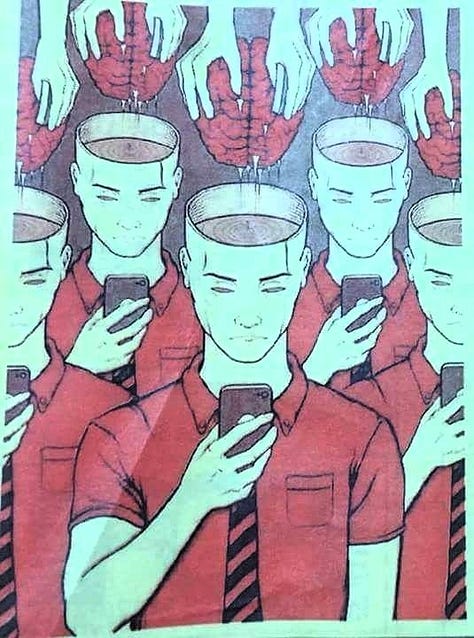
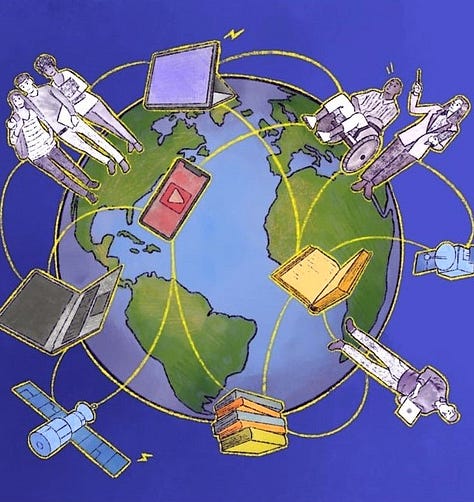
Is the digital revolution – and its LLM offspring - changing the world we inhabit more profoundly than any contemporaneous competing economic or ideological systems? Are we, in other words - both West and East - steadily becoming part of one great global ‘Cyberia’? No this is not me getting all Globalist. The brave new world I am speculating on here. would be a Cyberia With Ethnic Characteristics; not a One Big Global Family.
The default Western view of China, these past 30 years, as The Chinese Industrial Revolution has unfolded on our tvs and smart phones has been to see it as our great looming adversary. But might there actually be less to distinguish a Western vs a Chinese future than might at first seem?
I attempt here a crude audit of the civilisational templates on offer on our 21st century planet. Implicit in it is a question (one that I leave to the reader to answer)......in a history of civilisations conceived of in Darwinian terms, where might one place bets for our 21st century future? America? China? Or Cyberia?
First some basics: Some things are obvious.....Einstein could never have come up with his Theory of Relativity whilst riding on a camel in the Arabian desert. Other things are less obvious. Might his children have had more love and nurture had they been growing up within a tight Arabian kinship network than in the Einstein’s unhappy, tension-riddled and adulterous family life in bourgeois central Europe? This rhetorical question could of course be re-contextualised in myriad times and places down the annals of human history. The dusty Complete Works of Shakespeare on my bookshelf probably has some more universal lines on the subject if only I could thumb my way to the relevant pages.
Since this essay is addressed to a primarily Western readership, it makes sense for it to focus on speculations about the quality of life in China since less of a known quantity than the joys and discontents of life in the 21st c. West (my recurring theme in Slouching Towards Bethlehem).
Some things are obvious.....It seems to me obvious that the China of today will be an outcome of its remarkably rich, five thousand year history as a civilisation. When I recall our default perceptions of the peoples of the Orient that were the norm in my mid 20th c. youth, I can feel a little chastened. To Brits of my generation, for instance, WW2 was a story about us and the Germans, Yanks..... and OK Japs too I suppose. Neither Russia nor China featured in the perceived tragi-heroic drama despite the reality that the sacrifice and death toll in both of those places far exceeded our own.
Other things are not so obvious...at least not to the curious, questioning mind. The default Western image of China is that since it is a one-party dictatorship and so not part of ‘The Free World’ it is thus, axiomatically our adversary. So far, so political-correct-think. But then when I ponder the river of moronic sludge constantly pouring out of my television set – the Orwellian Non-Binary Sibling Who is Entertaining You drama serials and the loathsome ‘consumer’ world conjured up by advertising ‘creatives’ - I wonder “are we in the West really so ‘free’?” We democratic pluralist Westerners consume all this trash in bucket loads.
Don’t get me wrong, I’m not about to launch into the kind of all cultures are equal ‘multicultural’ blah blah that has become so pervasive in Britain that - with consummate irony - it has taken our young Nigerian Conservative Party leader (Kemi Badenoch) to point out to us the once-obvious truth that “not all cultures are equal”.
No; not all cultures are equal....but maybe some are more equal than others. America and China perhaps? From the time Europeans started sailing the globe in search of treasures - and finding it rather easy to colonise the indigenous peoples they came across on those adventures - it came to be seen as axiomatic that we were superior. An informed civilisational hierarchy was always somewhat more nuanced than this but in many ways it was true. Certainly we had become the world’s pre-eminent technologists. And centuries of Christendom did seem, at least arguably, to have become the civilisational template most conducive (in relative terms) to the taming mankind’s uglier impulses.
The recent Chinese economic miracle seems to have falsified the idea of the Western Protestant ethic and its free-market capitalist playing field as the only viable mechanism of wealth-creation. Done this in a way that the Soviet Union never did. And the remarkable wealth transformation of the Orient more generally during the course of my adult life has called into question at least some of that aforementioned cultural conceit, at least in relation to the peoples of South East Asia.
One way of comparing those civilisational templates would be by employing 18th century philosopher Jeremy Bentham’s famous Utilitarian Principle: “the greatest good for the greatest number”. Somehow I am as unenthused by that utilitarian answer as you probably are but it seems fairly predictable that life, for a minority of Chinese will be great, for another minority horrific and for most, somewhere in between. Remind you of anywhere?
What about Quality of Life (that rather nebulous concept) for the great mass of Chinese men and women relative to its equivalent in the West? How are we Westerners to answer a question like that? Buy a book by an ‘expert’? Book yourself on an explorer package holiday to The Orient? Ask your AI assistant?
OK...go on then....... here is Google Gemini on the subject:
“Life in China is a blend of incredible convenience, rapid modernization, rich culture, and intense societal pressures, characterized by a hyper-connected, mobile-first lifestyle, excellent affordable food, and efficient infrastructure, alongside high-stakes education and job competition, and underlying government monitoring, with a focus on community, family, and a pragmatic approach to daily living.”
· Mobile-Centric: Phones handle payments, transport, food delivery, and more; cash is rare.
· Seamless Services: E-bikes, clean subways, drone deliveries, and 24/7 access to goods via delivery lockers are common.
· “15-Minute City” Concept: Essential services (food, hospitals, parks) are often within a short walk in urban areas.
· Intense Education:
· High pressure on students for college entrance exams, with long study hours.
· Pragmatic Relationships:
· Utilitarian approaches to marriage and career, with government jobs highly coveted.
· Community Focus:
· Strong emphasis on family (like the 4-2-1 structure) and local community life.
· Safety:
· Perceived high safety, especially for women in public spaces.
· Affordable & Delicious Food: Street food and local cuisine are cheap, fresh, and varied.
· Varying Living Standards: Wide gap between rich and poor; urban living often in apartments.
· Pollution & Solutions: Air purifiers are necessary; surgical masks aren’t for pollution; VPNs are needed for blocked sites.
· Government Monitoring: Pervasive digital surveillance through mobile apps and systems.
· Information Control: Limited access to Western internet, requiring VPNs.
· Crowds & Manners: Can involve crowded public transport and elevators; differing social norms (e.g., spitting, queuing).
This article by a UK-based writer with strong Chinese connections paints a much more negative picture of life in China post-Covid. But the picture is of a “China in Crisis” arising less from dystopian ideology than from plain, simple political missteps and poor governance. Reading it might make you think: glad I live in the liberal West and not in that crisis-ridden place. Then you read things like this: “rental property listings [in London] uncovered by The Telegraph… carrying phrases such as “open to all genders however no straight males please” and “Terfs, Swerfs, Zionists need not apply” and “Muslim only”
Here - for what they’re worth - are some other takes on life in China.
I think it’s fair to say that I wouldn’t fancy my chances (opinionated, contrarian me) in China. But most people - both West and East – are more go-with-the-flow types than that. Even so, I would guess that not many people who grew up in the West would find it easy to put down permanent roots in Chinese cultural soil. But do we really need to get all adversarial about it? Can’t we be a bit more ideologically fraternal? Recognising that:
· American culture is a breathtaking well-spring of invention and the scaling up of new high tech forms of consumption and entertainment
· But China is the place where industry and infrastructure is built with awesome drive and efficiency
· The Chinese regime seemingly stops you from expressing or consuming political malcontentment....sometimes with brutal repression. But it also discourages you from being a self-absorbed decadent moron and encourages you to pay attention and school and work hard.
Do we really need to get all adversarial towards China? Can’t we be a bit more ideologically fraternal? Might we not be better to get more adversarial towards the kind of people in the West who - whilst being succoured by its hyper- liberalism - are currently doing their very best to trash it?
Might we not be better getting more adversarial towards the kind of people within our own West currently trashing it?
If the world-view of these Westerners was remotely morally and philosophically coherent, then surely protecting their cherished Liberalism from Islam would be their great cause? On account of the chasm between the allotted role of women in Islam and the modern West’s No.1 defining parameter of ‘Progress’. Whereas chattering class opinion chooses instead to make its biggest bogies out of Russia, China and Israel.
The rise of Western civilisation – from its earliest seafaring conquisto-adventuring to its multiple industrial revolutions – was borne on a big beautiful conceit that its rise to global pre-eminence was built on unique foundations. Christianity fused with the Enlightenment, in other words, had brought out the very best in our common human nature. And particularly by comparison to those other seemingly benighted lands that, for a couple of centuries, we had colonised.
This happy moral/philosophical cradle, that we children of ‘The First World’ basked in, was the way of thinking that Boomers like me grew up with. But first slowly and then suddenly, in later decades of the 20th century, it gave way to an intelligentsia-driven, self-flagellation that is our white man’s lot today.
As I have argued in much of my writing, this poisonous mentality has become much, much more widespread thanks to being relentlessly disseminated in our educational institutions all the way from primary school to tertiary. And amongst the millions of ‘metrosexuals’ in metropolitan places like New York, London, San Francisco and Paris - rich metropolises at the apogee of that dynamic Western cultural superiority – this academic priesthood’s proxy-cultural-self-hatred has become the height of fashion. Even to the degree of voting Islamist mayors to at least three of them!
slowly and then suddenly, in later decades of the 20th century, it gave way to an intelligentsia-driven, self-flagellation that is our white man’s lot today.
I have already written enough about the origins of this civilisational self-abuse to not want to endlessly revisit it in detail but - in a nutshell – the great strength of the Christianity+technological wizardry that took hold in the late 18th century also spawned a latent weakness. A strange counterveiling impulse whereby wealth-creating dynamism also afforded the luxury of an intelligentsia indulging in a delicious snobbery.... as in: “we ‘thinkers’ are noble people but we inhabit plebeian lands of greedy commerce and venality”.
One of the most influential of these was the 18th c. French philosopher Jean Jacques Rousseau. He philosophised that the ‘natural’ condition of mankind is to be motivated by The Good and it was civilisation that corrupted this ‘noble savage’. A culture-shaping downstream of this, in modern times, is that recognition of The Bad has been loaded disproportionately onto our elected politicians such that the citizenry can bask in a comforting sense of themselves as blameless....and thus the unfairnesses, cruelties and power games inherent in the human condition can be mentally side stepped.
This Rousseauian version of Liberalism isn’t such a great moral compass when it can generate headlines such as this one: Co-Op Threatens to Sack Staff Who Tackle Shoplifters. Doubtless you could come up with plenty of other equally fist-clenching instances of the anarcho-tyrannous mess that the Rousseauian ‘Progressive’ mentality has got us into.
Nor was it much of a moral compass in the early 70s when, amongst trend-setting intellectuals and middle class college kids who’d never been there, Maoist China suddenly (but briefly) became a utopian paradise where all ‘unfairness’ and ‘inequality’ in the human condition was being ever-so-cleverly eliminated. Recalling this makes me think that there’s at least something to be said for the ‘globalisation’ of perception that the digital revolution enabled. Yes probably most people do still remain as uncurious and suggestible about the nature of the world beyond their particular horizons but - for the naturally curious - knowledge is suddenly at the press of a button not buried in central library shelves. Accessing the world’s fount of knowledge is no longer an officious booking form and a long car or bus ride away!
I’ll round off with the following broad-brush observations on some of “The Permanent Things” (TS Eliot’s resonant phrase) in the human condition that will persist – irrespective of whether America, China or my notional Cyberia holds the keys to the future..
Some observations on those “Permanent Things”
Human beings are fundamentally a mixture of good and bad, kindness and cruelty, honesty and deceit etc. Yes, benign and malign forms of political governance can tilt the ledger towards or away from The Good in terms of collective human flourishing to some extent. History is an encyclopaedia of these tilts. My own parents and grandparents experienced them big-time in the two early 20th century world wars. As did countless millions around the world..... in Asia even more than in Europe.
A hard truth – one that is virtually a taboo in our time - is that few people are ‘independent-minded’ in the way that is paradigmatic to Enlightenment pluralist liberal democracy. They can be independent-minded on matters close to their livelihood, their family & social and their home. But with great political, moral and philosophical abstractions that confront the lives of all of us, the great majority will mentally default to one or other of the dominant narratives swirling around the mass-mediated environment of the time in which they are living.
Could it be (shock horror!) that independent-mindedness may not, in any case, always even the ideal way to be? It is mentally exhausting and it can sap energy from other ways of being. Terms like ‘groupthink’ are fired off in journalism (by people like me) as pejoratives but I sometimes wonder if this is perhaps an essential bonding instinct ……part of the human condition?
So.....optimistic as ever. Enough already!
If you liked this essay please remember to press the ‘Like’ button…and, even better, the Restack button. Thank you.
Comments
Nothing yet. Say the first thing.
Sign in to join the conversation.