
First, the update you’re all pretending you don’t want: I did not cry at the Grand Opening.
Technically.
There was a moment, somewhere between the third hug and the fortieth surprise appearance, when my eyes did something suspicious.
But per last week’s legal disclaimer, that was construction dust.
The Goro record remains intact.
My father would be proud, if pride were an emotion our family acknowledged.
So the store is open. The shelves survived. The marble didn't break, the flowers didn't wilt, and you came. Three rooms full of the smartest, most design-literate people we know, celebrating a dream. I can admit this now: that whole morning I was quietly convinced not a soul would show up.
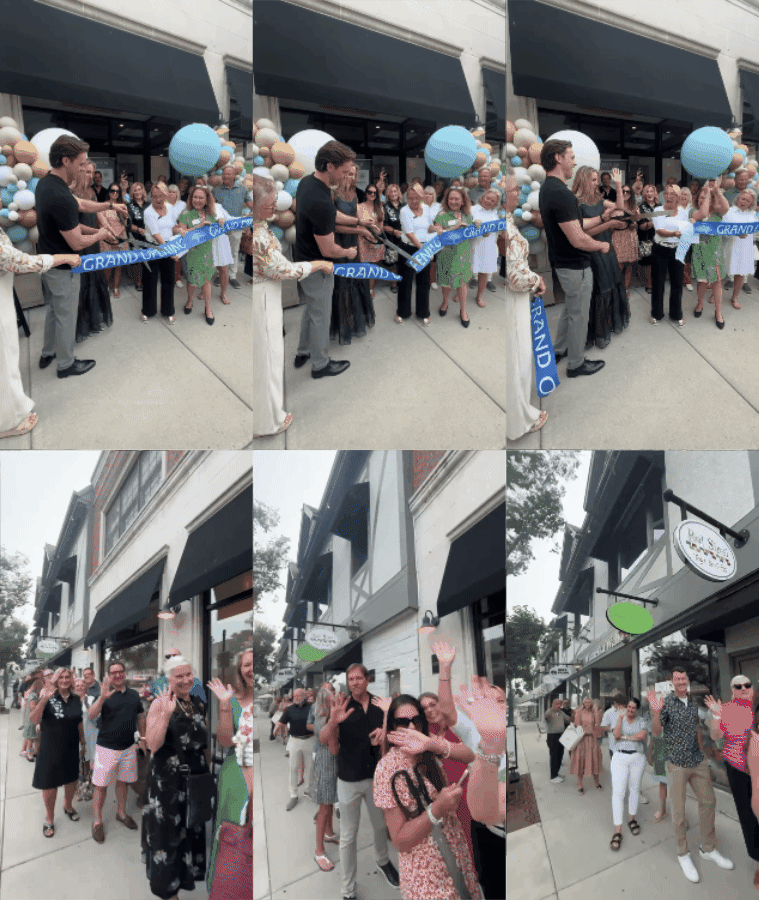
I am enormously grateful.
I am also ready to discuss literally anything else.
Not because of you, you’re lovely, keep asking. It’s me: if I hear myself retell the opening story one more time, I am going to walk into the lake after the golf cart.
Because it’s not about the opening.
I know how that sounds.
A year of permits and pegboard, weekly dispatches from inside our own renovation, actual invitations in actual mailboxes, and now I’m telling you the store was the appetizer.
Stay with me, because this is the most honest thing I’ve written in this newsletter, and that includes the confession email I told you to burn.
Because a store, even ours, even with the pink onyx, was never going to be the whole idea.
You build a place like The Workshoppe when everything you’ve done for over a decade, the firm, the licenses, the five houses, has been converging on one idea… and the idea finally needs a front door.
Now it has one.
Which means the opening wasn’t the finale.
It was us setting the table. The meal is what comes next.
At the party, a woman I’d just met stood in the middle of the shop, looked around, and said:
“This is incredible. I could never do what you do.”
Some version of that sentence has followed me around for years, and every time I hear it I want to grab the person gently by the shoulders and explain that this is not alchemy. It is simply a series of decisions made in the right order, with a useful tax rule standing at the end holding a very large door open.
Here’s our pattern, for the newer readers: KC and I have moved five times in twelve years.
Bought, renovated, lived in, sold. Repeated. Our children believe cardboard boxes are seasonal décor, and as I confessed back in May, the neighbors have started to notice.
From the outside it probably looks like we’re restless.
We are not restless.
We are compounding.
And before you close this email because you have zero interest in moving five times in twelve years: correct. Neither do most people with functioning attachment to their belongings.
We are not the prescription.
We are the proof of concept.
If this works so well that our family keeps doing it over and over, on purpose, with children, think about what it could do for you exactly once.
Most people get a handful of home purchases in a lifetime, and usually one that really matters. This is about making that one count fully.
Which is exactly why today’s post exists.
When I began this newsletter in April, I made myself a promise: stop hoarding what I know, share it regularly, share it honestly.
Since then, you’ve grown from about 30,000 of you to 129,000 and counting.
And as much as I’d love to believe you’re all here for the before and afters, I know better. You’re here for the education and the inside scoop, too.
So consider today me making good on that promise: three generations in real estate, more design-builds than I can count, everything I know (and think about more often than I should), shared here one Sunday at a time.
Including…
Section 121 of the tax code. An unusually helpful bit that has changed my life more than once. Here it is, stripped of the confidence with which it gets explained at cocktail parties:
Own a home and live in it for two of the five years before you sell, and generally a married couple filing jointly can exclude up to $500,000 of the gain from federal tax. Single filers, up to $250,000.
There’s no lifetime limit; you just have to qualify each time, and not more than once every two years.

Your accountant knows it well. I am not an accountant, but I did stay at a Holiday Inn Express last night. (Kidding. Nothing in this email is tax advice. But it does explain why our moving boxes never make it all the way to the attic.)
But here is the part most people miss. The tax code does not create the gain. It lets you keep more of a gain you successfully created.
Section 121 is not the strategy. It is the tailwind.
The actual strategy fits much less comfortably at a cocktail party.
First, you have to buy a house with fixable problems, at a price that leaves room to fix them.
You have to know which improvements the market will reward, and which ones you simply want because you’ve spent too much time looking at unlacquered brass on the internet.
Then you have to solve the house in the right order. And you have to live there, with the dust and the decisions and at least a two-year clock.
And then the market has to agree that your decisions made the house more valuable.
That is the machine.
The tax rule is just standing nearby, being unusually helpful.
One important distinction first: taxable gain and actual profit are cousins, not twins.
For tax purposes, the simplified math starts with the sale price, subtracts selling expenses, and subtracts the home’s adjusted basis. That basis includes what you paid for the house and qualifying capital improvements. It does not include every dollar you spent maintaining, repairing, or decorating it.
Simplified illustration, using opportunities we often see in my area, as an example:
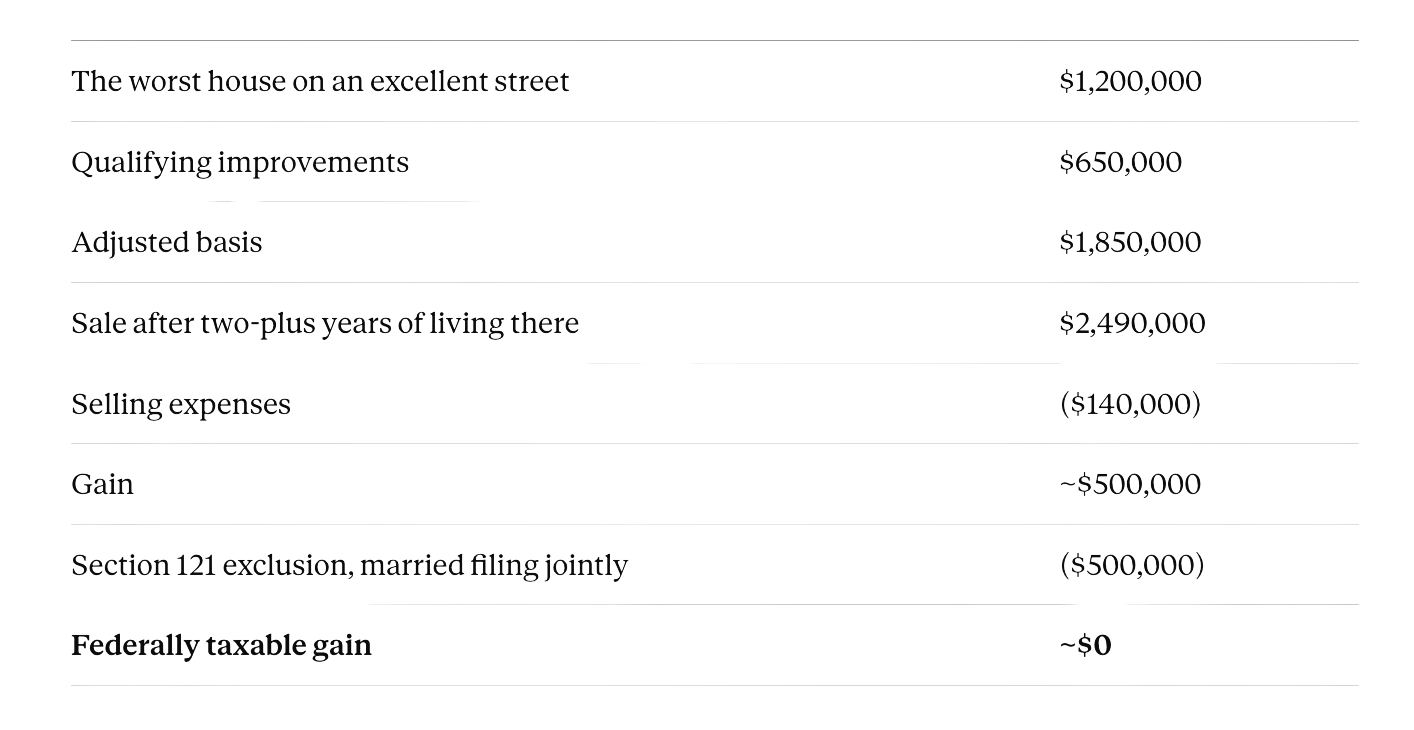
“Federally taxable gain,” in plain English: the portion of your profit the IRS is allowed to tax. On most money you make, that’s all of it. On this house: none of it.
And so we’re clear about what a ~$0 gain actually means: it means the government is not sending you an enormous tax bill on your profits. To illustrate how huge a benefit that is, imagine the $500k came from three different places.
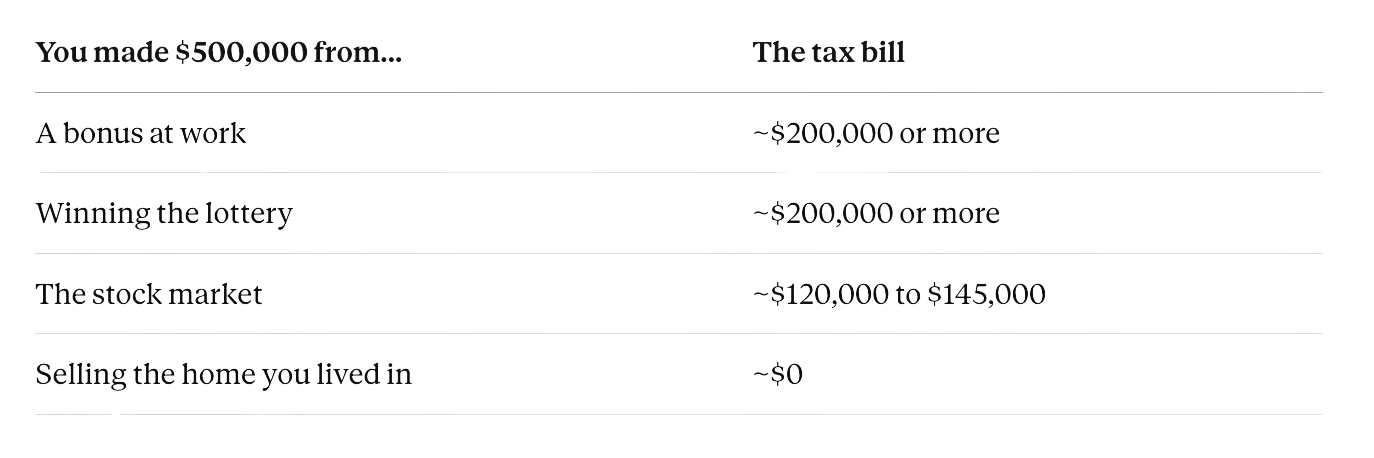
(Rough ranges for a high-earning Illinois couple. Your bracket and your accountant will refine them. Again, not an accountant. Just your real-estate-and-design-obsessed best friend.)
Same half million. The difference between the last row and the rest is a college education.
And yes, even the lottery gets taxed like a paycheck.
Your house is the only jackpot the government lets you keep.
This is the door the tax rule is holding open.
Now, the skeptical footnote, because this table is not a complete investment analysis. Real life also includes mortgage interest, property taxes, insurance, permits, design fees, moving, overruns, and the cost of your dining room operating as a cabinet warehouse for eight months.
Those dollars are real even though they never appear in the gain calculation. A house that appreciated $500,000 has not automatically made its owners $500,000 wealthier.
The spreadsheet must be more skeptical than the Realtor remarks.
Because the rule is easy. The house is hard. Specifically:
Red oak cabinets and 1987 wallpaper scare buyers, and that fear is useful, because both can be changed. A terrible lot or a location the market consistently rejects is a different animal. Wallpaper is removable. A busy street is committed to the relationship.
The best opportunity is not just the ugliest house; it’s the house where the market has priced the problem more harshly than it will cost you to solve it.
That distinction is where experience earns its keep.
Enter, me.
A beautifully renovated house can still be a bad investment.
Every street has a range the market currently understands, and your job is not to spend as much as possible (believe me I’ve seen people with very deep pockets spend their way into very terrible design choices); it’s to know where each dollar works hardest and where spending stops returning the favor.
The market rewards the hierarchy of the house before it rewards the decoration: location, lot, usable square footage, layout, architecture and major systems, and then finishes.
We all enjoy reversing that order, because wallpaper is substantially more fun than drainage.
The house does not care what is fun.
This does not mean beige everything in case someone with no detectable pulse buys it later.
It means making personal decisions inside a house that is fundamentally legible: rooms with clear purposes, circulation that makes sense, storage where humans need storage, major selections that belong to the architecture.
The next buyer should understand why the house works without me standing in the foyer giving a 45-minute presentation.
That’s resale-conscious design. Not generic. Coherent.
And one warning label: the exclusion is not a guarantee. It cannot rescue a bad purchase, force the market to repay an undisciplined renovation, or promise that values rise during your exact two years. It also cannot prevent your child from drawing all over your brand new wallpaper with permanent marker. The tax rule only changes what happens to a gain after you’ve created one.
The skill is creating it.
Two years owned, two years lived in, within the five years before the sale, no more than once every two years.
Rental use, home offices, depreciation, divorce, health, and job moves all change the math, and people who miss the full requirements may qualify for partial exclusions.
Talk to a qualified tax professional about your situation before you buy, not after you sell.
Building the right team early is half the method anyway.
Pick a neighborhood you already understand and pull three recent sales: one house that needed everything, one renovated with restraint and good judgment, and one that spent every available dollar and then located several more. Study the difference.
Then run your own project on paper.
Purchase price, complete renovation scope with a real contingency, selling costs, two years of carrying costs.
Compare against a conservative resale number, not the most exciting comp anyone ever uploaded to the MLS.
Then stress-test it: costs run over, sale comes in light, timeline stretches.
If the project only works when every number behaves perfectly and you set a neighborhood record at the end, it does not succeed. It auditions.
The woman at the opening was right about one thing: the finished result looks impossible when you can’t see the order of operations behind it.
So this is the next chapter, and it’s bigger than a Substack article.
I’m going to show you the whole transformation. How to walk into a dated, unloved house and see the version of it that doesn’t exist yet. Which walls to move and which to forgive. How a kitchen goes from 1987 to the photo people save to their phones.
Where the money hides, how the team gets built, and how a thousand separate decisions become one coherent, beautiful house instead of eating you alive.
The befores and afters you follow us for? We’re opening them up to show you the decisions inside.
It’s what our real estate team does when we walk a property with you. It’s what the design-build firm does every day. It’s why we built the store I am no longer discussing. (At least, not this week.)
And it’s what Sundays here will be, every week, until you stop saying “I could never.”

And for the people who will want the whole method in their hands, I’m building something this fall that can hold it.
That’s all you get for now.
KC says I need to stop announcing things before they’re ready, and as we know he is unfortunately the brakes.
Until next Sunday,
Grace
P.S. The day job continues, gloriously. This week: we’re running out of lots to sell over at The Foresman. Nine (9!) stone slabs are officially on hold across two client projects (the marble equivalent of “going steady”), a contractor coffee at the shop, and a designer consultation booked by a woman named Jill who I already like. If you’re staring at a house and wondering what it could become, a 45-minute designer consultation at The Workshoppe (also available virtually) is the fastest way to borrow our judgment and software. Bring the address and the optimism. We’ll bring the realism.
P.P.S. To the woman from the opening, if you’re reading this: you started something. I hope you’re happy.
Thanks for reading Sunday Strategy(ish) by Grace Kaage! This post is public so feel free to share it.
No posts
Comments
Nothing yet. Say the first thing.
Sign in to join the conversation.