
This week’s guest post is from Beornn McCarthy, a teacher, unionist and writer based in Melbourne, Australia. He writes the Life Against Capital Substack, exploring how ordinary life can become the starting point for socialist politics.
One of the first things English teachers learn is how to help their students climb up ‘the abstraction ladder’. Instead of describing people caring for one another, we ask students to write about compassion. Instead of describing people fighting against authority, we ask people to analyse power. Instead of describing someone being treated unfairly, we ask them to explore justice.
Experienced teachers know that climbing the ladder is only half the journey. The strongest writing – and the strongest thinking – always makes the journey back down. Showing what injustice feels like, and how justice could actually be lived; how compassion is experienced in everyday life, in all its messy contradictions; what power feels like as we suffer under it.
Political narratives should do the same. The left is remarkably good at climbing the ladder. Most leftists can describe ideas like capitalism, socialism, neoliberalism, or intersectionality fluently. The left doesn’t suffer from a shortage of abstraction. It suffers from a shortage of return journeys.
It’s always easier to attack injustice than to describe a just society. It’s easier to argue about socialism than describe what an ordinary day would look like in a socialist society. It’s easier to make statements about freedom than to describe what people can actually do when they become free together.
Recently, I asked people a simple question on social media: What should leftists be fighting for? The answers ranged from ‘sustainability’ to ‘socialism’, ‘healthcare’ to ‘housing’, ‘liberation’ to ‘abolition’. All concepts high up the abstraction ladder.
But as soon as I asked people why we should be fighting for these things, they started to climb back down the ladder. People stopped describing political concepts. They started describing lives. Or, perhaps more accurately, they started describing the rich and fulfilling lives they could build if they worked together.
One commenter began with community. I asked what they meant. Soon, she was describing neighbours, shared gardens, and lives that felt less lonely. Another answered socialism. Asked why, they started describing what it might feel like to live in a society that no longer forced people to work simply to survive. One of the most moving replies came from a homeless man. They began with policies. After a few questions they expressed something simpler: what it would mean to them to have a home.
After these conversations, I realised that people weren’t simply describing better policies or different values. They were describing things they wanted to be able to do together. The capacity to care for one another, to learn, to create, to speak without fear, to organise, to shape our shared conditions together. The ability simply to live a decent life.
I’ve started to think of these as our social powers: our shared capacities to learn, create, care, organise and govern. These capacities never belong to isolated individuals. They only become real when we develop them together through institutions, relationships and shared practices.
Since those discussions, I have started to see examples of the importance of social power everywhere. Teachers in Melbourne, where I live and work, are currently engaged in an industrial dispute. Many rank-and-file members have urged their union, the Australian Education Union, to push harder for concessions from management.
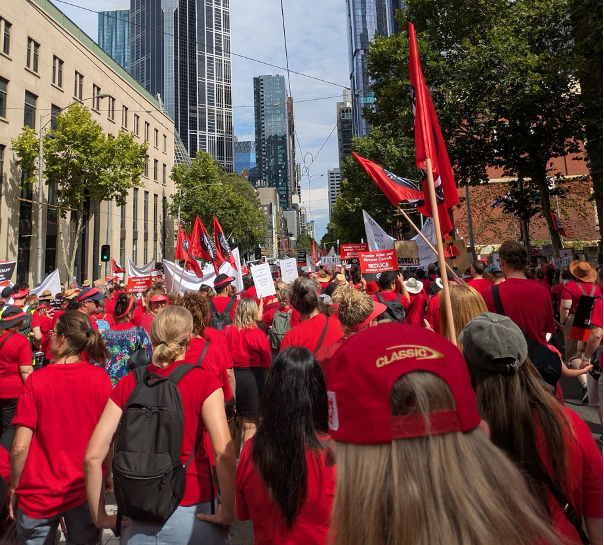
The Victorian Government offered what it described as one of the strongest pay deals in the country. Many teachers rejected it. Not because pay didn’t matter. Because their struggle was never just about pay. It was about the conditions that shape everyday teaching: impossible workloads, chronic understaffing, and the growing sense that teachers are no longer able to do the job they entered the profession to do.
Again and again, when union members have discussed the proposed agreement, I have heard the same question: ‘what will actually change when I walk into work tomorrow?’
That isn’t an abstract question. It’s a question about teachers’ everyday reality, and how they might work together to change it. Will they finally have the time to get to know their students? To plan properly? To teach well? To leave work without carrying it home every night? If they can’t answer ‘yes’ to each of these questions, they will continue their strike.
The point of political thought isn’t to escape life through abstraction. It’s to see the conditions of life with greater clarity.
Politics is lived where people learn, care, create, organise and govern together. It is the space where they begin to imagine a world where the time they spend caring for their relatives isn’t squeezed between two shifts; where they have time to learn new skills because learning belongs to everyone; where work develops our capacities instead of exhausting them.
Whenever I ask people their ‘why’, the conversation comes back down the ladder of abstraction. Teachers, students, union members, and even leftists stop talking about fairness, socialism, capitalism or justice. They stop fighting for political ideas alone and start talking about life: a secure home and community, time with the people they love, freedom from exhaustion, and the chance to learn, create and contribute. Our old political words name these ordinary possibilities. The point is to help people live them.
Socialism is not an ideal to defend. It is a name for struggles over how society’s collective powers are organised, and whether they reproduce class rule or become the basis of transformation. This is what our old abstractions need to become: new social forms, institutions and relationships through which we can work together to build a new way of life.
Beornn McCarthy is a teacher, unionist and writer based in Melbourne, Australia. He writes the Life Against Capital Substack, exploring how ordinary life can become the starting point for socialist politics.
Comments
Nothing yet. Say the first thing.
Sign in to join the conversation.