
I’m making this week’s edition of What I Read this Week – and tomorrow’s podcast – free to read. If you like what you see (and hear), you can subscribe here. If you want to subscribe, but can’t afford it, DM me for a solidarity discount.
Democratic socialists are winning primaries across the US on a platform of opposing imperialism, fighting oligarchy, and helping Americans struggling with the cost-of-living crisis. Professional politicians given millions of dollars by AIPAC and powerful corporate lobbyists are being defeated by ordinary Americans raising funds through small individual donations.
Abdul El-Sayed is the latest socialist to win his primary, in Michigan. Most of the Democratic establishment backed El-Sayed’s opponent, Haley Stevens, and AIPAC-linked Super PAC, the United Democracy Project, spent more than $30 million trying to get her elected. El-Sayed’s victory follows that of Melat Kiros last month in the Colorado primaries, as well as wins for Brad Lander, Claire Valdez, and Darializa Avila Chevalier in New York.
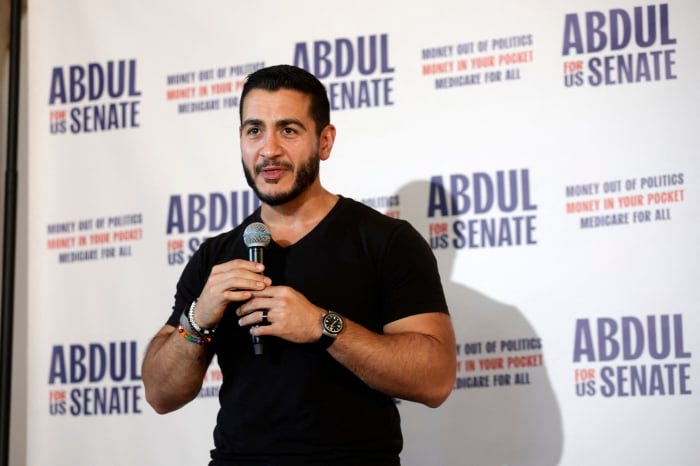
The Guardian claims that top Democrats are “setting aside their qualms” about his platform to support El-Sayed in the hope of beating Trump in the midterms. States like Michigan will be particularly important in achieving this goal. But the Democratic establishment is not being so tolerant towards all DSA-backed candidates. Francesca Hong is being hounded for social media posts in which she stated her support for defunding the police, which she said “upholds white supremacy”.
This is, of course, true – but “defund the police” doesn’t work as a slogan for a populist electoral platform, and Hong has since distanced herself from the comments. While most Black Americans think the police need to be “completely rebuilt” to ensure people are treated fairly, 39% believe spending on local police budgets should remain the same, while 35% say it should increase. This seems to speak to a difference between how people view the police in general, and how they view the day to day policing presence in their local area. Populist candidates need a message that speaks to both.
None of this is to say that Hong doesn’t deserve the left’s support – she absolutely does. But Bernie Sanders seems to disagree. When asked whether he supported Hong, he said he wasn’t endorsing a candidate in the race. This is poor form from Bernie, but I’m not especially interested in making judgements about the values and personalities of individual politicians – I am very interested in what their decisions can tell us about how power works within the Democratic Party and, relatedly, the American state.
The issue for the US left is that, up to now, democratic socialists have been winning as individual democratic socialists, rather than as part of a coherent socialist movement. Building movements is about shifting the balance of power; operating as a politician within the institutions of the capitalist state is about making decisions in the context of a given balance of power. Without a movement to back them, individual politicians end up having to make big compromises on certain issues so they can make progress on their legislative priorities.
This is why the Democratic establishment isn’t too worried about the progressive victories seen in the last few weeks. The election of a few socialists strengthens their appeal to progressives without threatening the balance of power within the party as a whole. The realities of governing will inevitably push progressive politicians towards compromise – as has been the case for Sanders and AOC.
All this would change if the left got its act together and figured out how to work as something approaching a coherent force within electoral politics. That would require the DSA to get its line straight on the role of electoralism in socialist politics, and coordinate with the labour movement, community organisers, and wider social movements to develop a basic set of policy proposals. I’m not especially confident this will happen any time soon – and I imagine the Democratic establishment feels the same.
As I wrote in my piece for Tribune last month, one of the lessons from Corbynism is that you can’t put the cart of electoral politics ahead of the horse of movement building. It’s exciting to see progressives win, but they won’t be able to change much unless we can shift the balance of power in which they’re operating. So be excited, but remember, no one is coming to save us.
In news completely unrelated to the success of insurgent socialist candidates across the US, eight of the biggest oil companies earned more than $90bn in profit in just three months as a result of Trump and Netanyahu’s attacks on Iran – while workers saw petrol and food prices jump sharply, and heatwaves devastated much of the US. According to analysis from The Guardian, this is roughly double what the oil majors made in the same quarter last year, and amounts to about $700,000 worth of profit every minute.
The company that made the most from the crisis was the Saudi state oil company, Aramco, which saw a 34% increase in its profits as its competitors struggled to produce and transport oil thanks to the conflict in Iran. BP saw its profits more than double from the previous quarter; Chevron’s profits were up fivefold on the same period last year; Exxon Mobil made the most profit since Russia invaded Ukraine; and Shell reported its highest quarterly profit ever.
Trump - the fossil fuel industry’s favourite President in decades - went so far as to criticise Chevron and Exxon Mobil for “making too much money”. He claimed they would be forced to return their excess profits to the public – though he’s unlikely to follow through on this promise. This criticism represents an interesting shift in Trump’s position on inflation. Up to now, he’s claimed the affordability crisis is a hoax peddled by the Democrats. But he’s now realising he can’t call “fake news” when people complain about rising bills.
This shift is a big opportunity for progressives to connect imperialism with insecurity and falling living standards at home. It also represents an opportunity to connect these issues to the climate crisis. In the same article, The Guardian points out that wildfires seen across the US and Canada have dramatically increased air pollution and resulted in an estimated 4,000 deaths within just a week. One and a half million people a year have their lives shortened by wildfire smoke. Socialists need to be clear that Americans’ bills are higher, and their lives shorter, thanks to the fossil fuel companies corrupting democracy and profiting from the chaos that results.
The Food and Agriculture Organisation (FAO), a branch of the UN that leads on world hunger, has issued a warning that the world is on the verge of a significant increase in food prices. Climate breakdown is pushing down yields at the same time as the wars in Iran and Ukraine push up the costs of fertilising and transporting crops. The super El Niño setting in this year is only making matters worse.
The Iran war may be “over”, according to Trump, but the effects on food prices will be lasting. Farmers have had to cut back on fertiliser due to the increasing cost of fertilisers produced using natural gas, but this won’t start to affect yields until later this year. The worst effects of the super El Niño have yet to appear, and yields will continue to suffer as it escalates. Other input costs, like diesel to power farm machinery and plastics for packaging, will also feed into higher prices over the coming months.
The FAO’s chief economist pointed out that rising commodity prices take three to six months to affect food prices on the shelves. So consumers won’t feel the full effects of the price shocks from the Iran war until the end of this year. The global South will be the worst hit by the coming food price shock. The FAO warns that tens of millions of people could be pushed into food insecurity – right as aid budgets have been cut and war continues to cause dislocation and starvation everywhere from Gaza, to Sudan, to the DRC.
We know that food price shocks are correlated with political unrest and regime change – the Arab Spring being one of the best examples of this relationship. The effects of this food price shock are likely to be just as significant, especially because the causes aren’t going away any time soon.
I found this piece really interesting, as it highlighted an aspect of the closure of the Strait of Hormuz that I hadn’t considered. Scientists have warned that the ships stuck in the Strait pose an “extreme biodiversity threat” as they could introduce invasive marine species to ports across the world.
There are currently over 1,000 commercial vessels stuck in the Gulf as a result of the closure of the Strait. Their hulls are becoming “encrusted with marine life – from microbes and algae to barnacles and other invertebrates” as they remain stationary in the Gulf. When they finally leave the Gulf, these marine species will travel with them, potentially introducing non-native invasive species into waterways around the world.
The study says that ships only usually remain in harbours for a few days, which means marine life has less of an opportunity to establish itself on their hulls. But some of the ships stuck in the Strait have been there for weeks, even months, and have accumulated entire ecosystems in the process.
The scientists point out that marine life in the Gulf is particularly hardy because of the “extreme heat and salinity” of the water there. These characteristics make the organisms “particularly good invaders”. Ports with similar conditions to the Gulf, like those in India and Singapore, are acutely exposed to these risks.
The ships need to be cleaned carefully before leaving the Gulf, but this is unlikely to happen as global shipping is notorious for a lack of regulation and oversight. Most ships sail under ‘flags of convenience’, tying them to countries with loose climate and labour regulations and low taxes. But if the ships aren’t cleaned, fishing communities across the world – already suffering as a result of overfishing and climate breakdown – will be forced to pay the price.
Comments
Nothing yet. Say the first thing.
Sign in to join the conversation.