
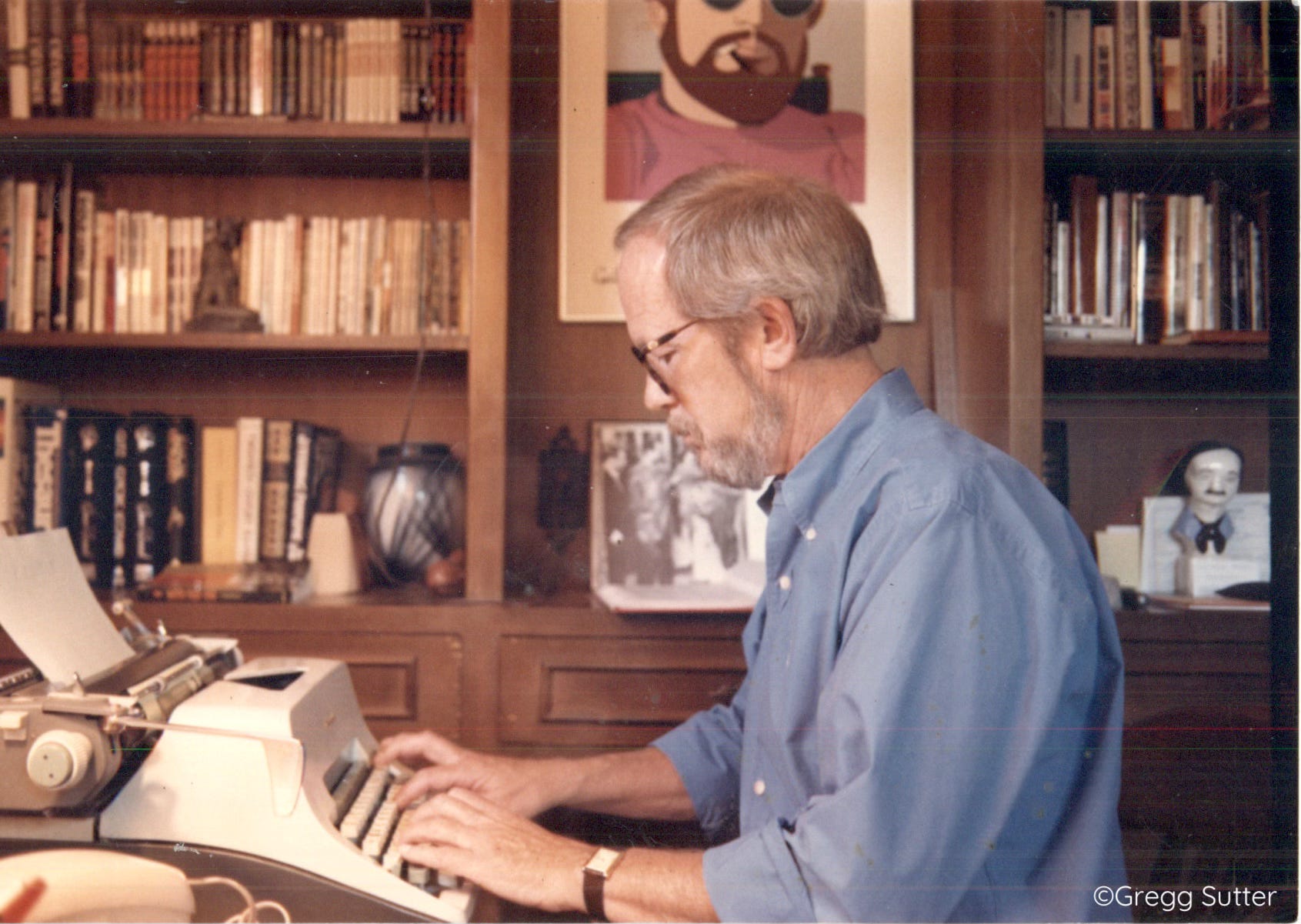
When I met Dutch for the first time, in 1979 at his apartment in Birmingham, the thing I noticed right away was his big manual typewriter. I figured a successful writer like Elmore Leonard would have a sleek IBM Selectric. But not Dutch. He was old school. Later, I learned the typewriter he was using was an Olympia SG-3.
The Olympia SG-3, first introduced in 1963, was a heavy-duty manual typewriter with a large carriage, built for reliability and heavy use. The key action was smooth but had weight — it was the typewriter for people who wrote or typed for a living: reporters, lawyers, secretaries, office clerks, and, of course, a certain novelist who wrote millions of words on one. In the manual typewriter world, the SG-3 was the best money could buy. It was dubbed “the Mercedes of typewriters.” Dutch bought his secondhand in the Sixties.
When I started working for Dutch, the minute his wife Joan would open the side door, I could hear the steady pounding of the SG-3’s keys. Dutch said you could hear it down the block. He loved the clatter of those keys.
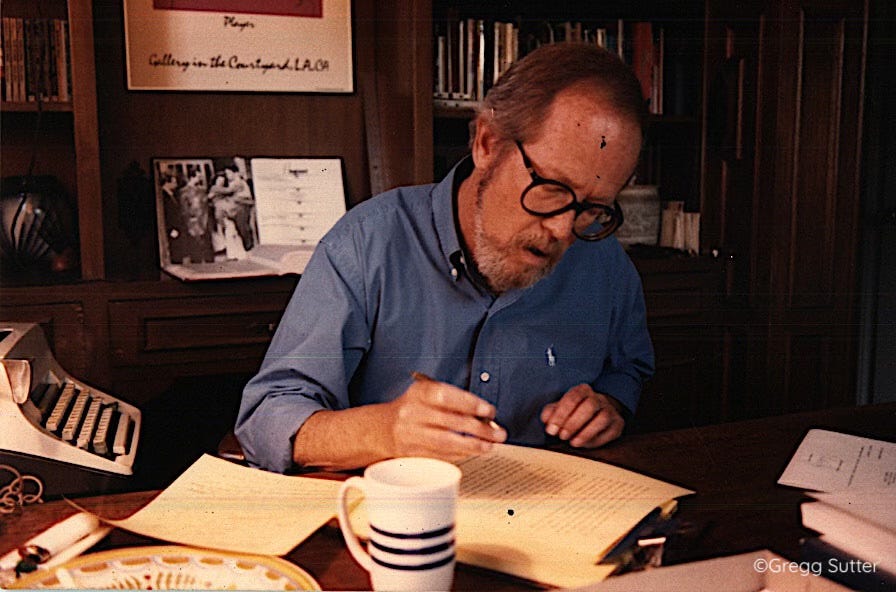
But Dutch didn’t start a writing day on that machine. First, he took pen to paper, specifically unlined yellow paper. It used to piss him off when interviewers wrote that he used lined legal pads. Nothing of the sort. His paper, ordered from a print shop, was very specific: standard letter-sized, 60lb, offset canary yellow — heavy enough to take a pounding from his SG-3. It was uncoated offset stock that produced clean impressions every time. Dutch would buy 50 pads at a time, 60 pages each, for a total of 3,000 pages that would last him a whole year.
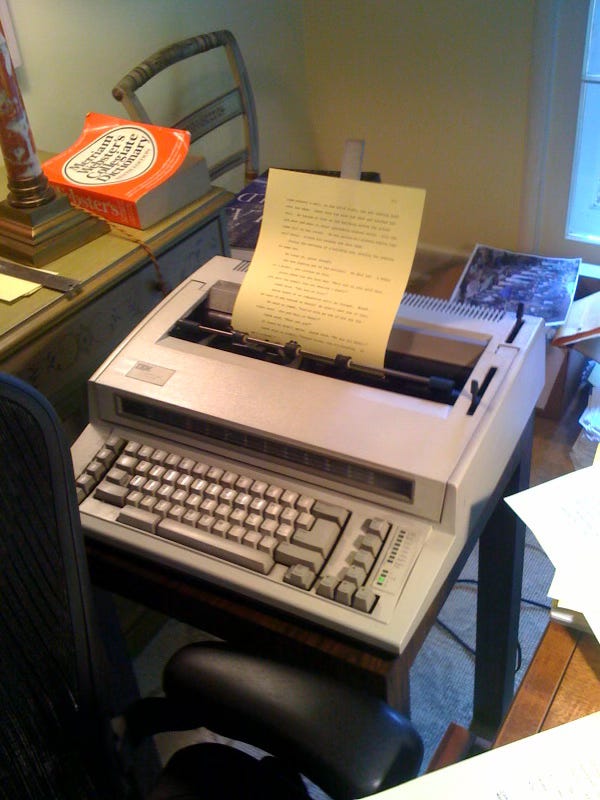
By 1995 it was becoming increasingly hard to find typewriter ribbons for the SG-3 and places to get it serviced. So one day I’m over at his house, and with no warning, in place of the SG-3 sits an IBM Wheelwriter 1000. I couldn’t believe it. Partly because Dutch was a well-known technophobe, and because this wasn’t just an ordinary electric typewriter. The Wheelwriter was a de facto word processor. IBM was trying to slip a computer in on him! But fortunately, it didn’t trigger his phobia. He was blissfully unaware of features like memory that could store lines or paragraphs, spell check that flagged typos on the tiny display, or auto centering, automatic bold, and line justification. He just liked the softer touch of the keys, but there was something cold about the Wheelwriter’s mechanical sound. I think he missed the industrial age thunk of his SG-3.
But even Wheelwriters wear out, and years later, he bought a Lexmark 1000 — the exact same machine. IBM, by now whole hog into computers, had sold their typewriter division to Lexmark.
By then, you might think the next logical step would be a computer. Are you kidding? People (not me, I knew better) would ask him all the time, “Do you use a computer?” or “Why don’t you use a word processor?” Dutch was talking to his friend, the writer Andre Dubus, about this. Andre told him people would say if he had a computer he could write faster. He said, “Why would I want to write faster?” Dutch had a big laugh over that — it sounded so ridiculous.
Comments
Nothing yet. Say the first thing.
Sign in to join the conversation.