
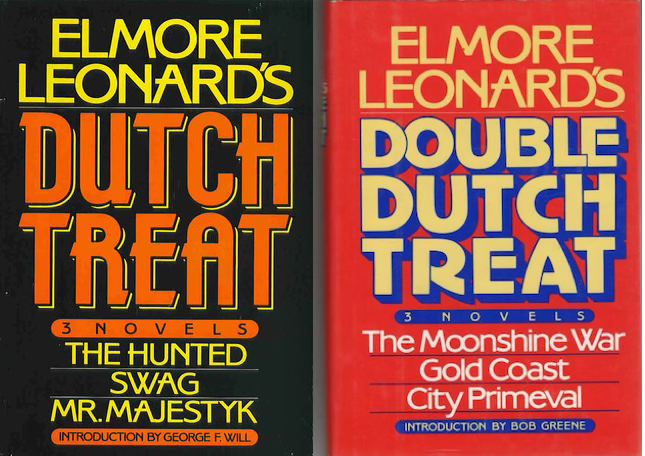
In the mid-1980s, Dutch was, as the New York Times described, “an overnight success after 23 books.” His time had come. Glitz hit the bestseller list, Newsweek put him on the cover, and the mainstream finally caught on to what crime fiction aficionados already knew. Don Fine, Dutch’s longtime champion at Arbor House, had helped set the stage for his breakthrough, but it was Eden Collingworth—Fine’s successor—who seized the moment. She repackaged six earlier novels into two hardback omnibuses: Dutch Treat in 1985, including The Hunted, Swag, and Mr. Majestyk, and Double Dutch Treat in 1986, with The Moonshine War, Gold Coast, and City Primeval. Many of these books had been hard to find for years—some never in hardcover, others long out of print.
For longtime readers, it was a second life for some earlier work they might have missed. For new fans, especially those who only knew Dutch from Glitz or LaBrava, it was exposure to the depth and variety of his work.
To write the introductions, Arbor House tapped George F. Will, the bowtie-wearing conservative columnist, and Bob Greene, the Chicago sports writer with a national following. The result? Both wrote personal conversion stories—arriving at the same conclusion: Reading Elmore Leonard is addictive.
Both had, in a sense, auditioned for the job. Months before the omnibuses appeared, Will and Greene had already gone public with their admiration—writing syndicated columns that ran in dozens of papers across the country. They weren’t just fans—they were evangelists.
Will’s intro to Dutch Treat is an extended metaphor. He compares Dutch’s craft to a knuckleball—deceptive, unpredictable, slow but deadly. “His books are not exactly crime novels,” Will writes. “Although crimes occur and guns go off. But the guns do not go off often enough for the sort of people who cannot be entertained by anything more subtle than a train wreck.”
That’s Will’s backhanded swipe at Hollywood. Will praises Dutch for avoiding “verbal pyrotechnics” and celebrates his ear for street talk. “Leonard’s readers could do something like that with any passage from his novels,” he writes. “He has perfect pitch for the street talk you might hear on some of America’s mean streets.”
Will also calls him “the Dickens of Detroit. Which readers of my Substack will recall, I have a problem with. But to his credit, he pivots quickly, saying Leonard reminds him more of Anthony Trollope—a disciplined, nose-to-the-grindstone craftsman who sat at his desk from 9:30 to 6 every day and treated writing like a job, not magic.
Will respects Dutch’s work ethic. And that’s the throughline of his essay: Leonard’s “sudden” success wasn’t sudden at all.
Greene’s piece for Double Dutch Treat takes a different tone. He started out skeptical—dismissing the big splash around Glitz as hype—but quickly became a true believer. He let the book sit on his table for weeks, annoyed at himself for falling for a publicity blitz. But when he finally read it, he was floored. “Boy, did I read it,” he writes. “And the first thing I did after finishing it was to hurry to the bookstore to purchase other novels by Leonard.”
He discovered Dutch the way many of his fans did: with one book leading to another, and another. Then came the embarrassing realization—he’d been missing out. “I was just learning how good Leonard was,” he confesses. Greene’s intro is less polished than Will’s but more enthusiastic. It’s a fan letter in real time.
Together, Dutch Treat and Double Dutch Treat were published so the wider reading public finally could catch up.
One reviewer summed up the mixed feeling among longtime fans: “It’s bittersweet to see him on bestseller lists. The secret’s out.”
Comments
Nothing yet. Say the first thing.
Sign in to join the conversation.