
My last Substack post promised to profile ‘Déesse des Vallées’. For a long time, I wasn’t entirely sure how to tell the story of these two famous alpine strawberry selections. But to understand the Goddess, we first have to start with the Queen.
‘Reine des Vallées’ (‘Queen of the Valleys’) was selected by alpine strawberry growers in France in the 1940s from a parent plant of ‘Baron Solemacher’ (also known as ‘Baron von Solemacher’). By the mid-1950s, it was widely grown across France, but it wasn’t until the 1960s that it firmly established itself as the premier cultivar for commercial growers throughout Europe.
It exhibited characteristics that made it legendary: it was highly productive, day-neutral, clumping, and the fruit carried an intense, deeply aromatic true wild flavor.
When I started growing alpine strawberries in the late 1980s, importing ‘Reine des Vallées’ into the United States was nothing more than a pipe dream. American seed catalogs only offered varieties like ‘Alexandria’, ‘Mignonette’, ‘Baron Solemacher’, ‘Ruegen’, and ‘Yellow Wonder’. I quickly added all of them to my collection. In 1991, I managed to find ‘Pineapple Crush’ in a mail-order catalog from a nursery in Massachusetts. Little did I know it would take nearly two more decades before I could finally add ‘Reine’ to my collection and sales catalog.
In 2010, I contacted the famous Marionnet Nursery in France, hoping to purchase 20 grams of ‘Reine des Vallées’ seed. Marionnet supplied alpine strawberry seeds to commercial European growers and were the master plant breeders behind the famous hybrid strawberry ‘Mara des Bois’, among others. After some back-and-forth, they agreed to ship the seeds. The total price tag—including shipping and a mandatory phytosanitary certificate—almost broke the bank.
I now know the exact date that historic package arrived because remnants of it were uncovered on May 16th in the freezer of a vintage 1950s refrigerator (a gift from my wife’s aunt—talk about luxurious commercial equipment!). The package was officially received on April 23, 2011.
What makes this discovery so interesting is what managed to survive all these years in that freezer, stuck to the packing tape pictured here:
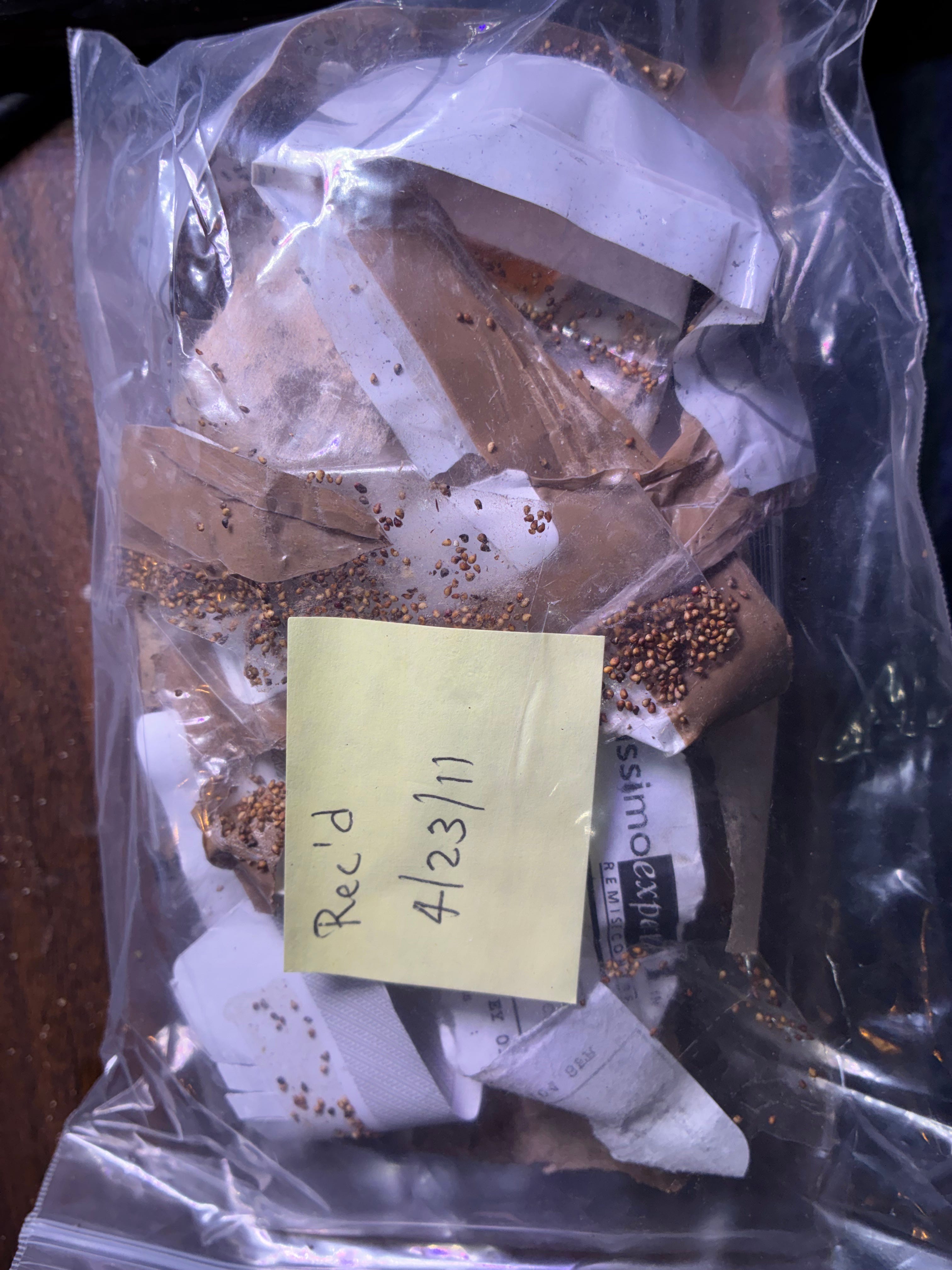
I suspect the tape was removed during a USDA inspection in New York and couldn’t be replaced properly, leaving seeds stuck to the adhesive. When the DHL driver rang my doorbell and I signed for the package, it was immediately obvious that the contents had exploded all over the inside of the box.
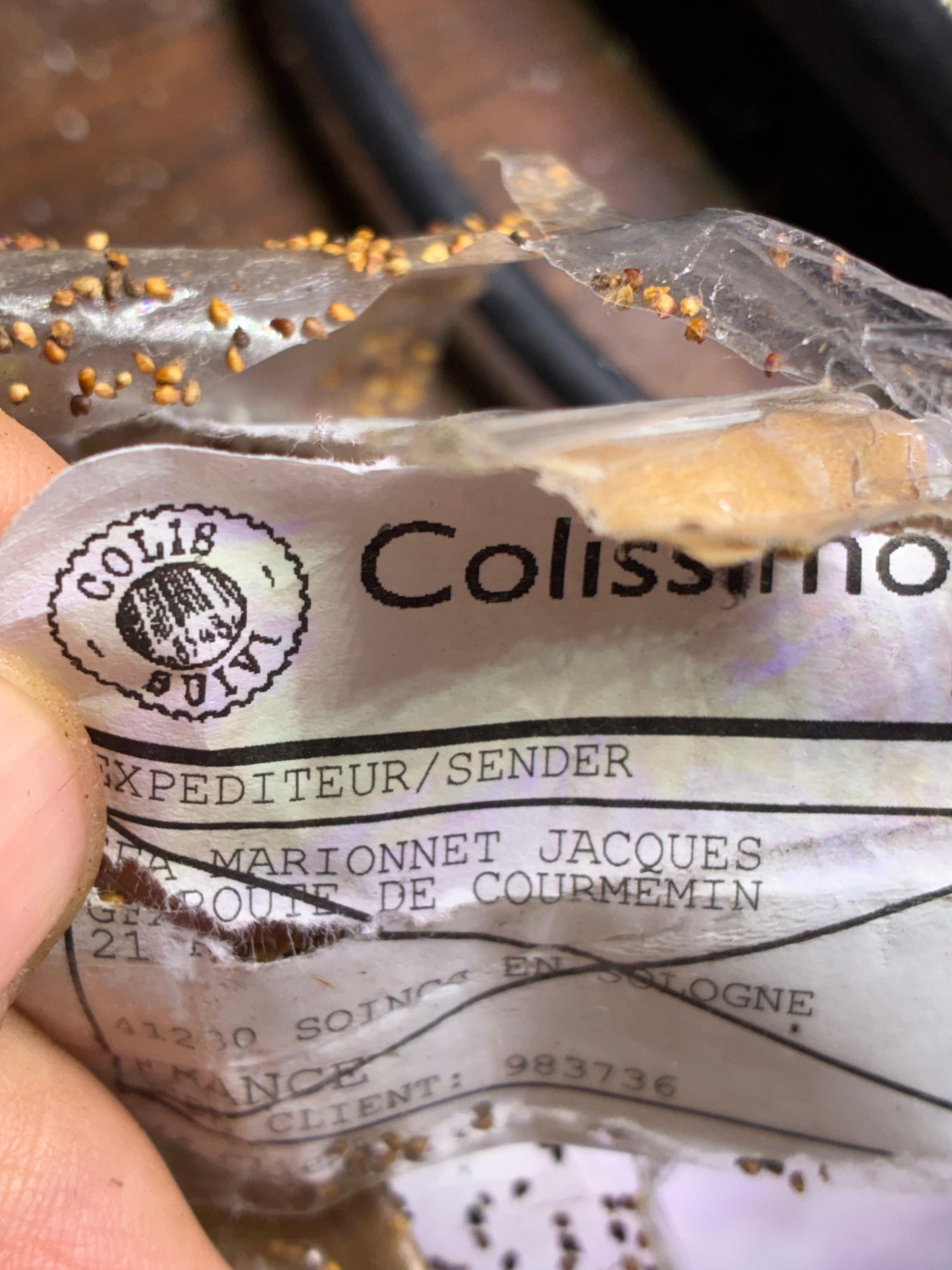
After its chaotic arrival, less than half of my expensive seeds made it into the freezer to await germination tests and retail packaging. But the mission was accomplished: ‘Reine des Vallées’ had finally entered American commerce in 2011 via my business, The Strawberry Store, LLC.
Since then, ‘Reine des Vallées’ seeds have flooded the online market, sold by a myriad of sellers at bargain-basement prices. Their descriptions are largely copied and pasted directly from my old materials—some even use my exact images. Yet, I suspect few of them have ever actually grown the true cultivar.
As for the seeds currently stuck to that vintage packing tape? I’m not entirely sure what to do with them. If any of my readers want to try their hand at germinating them, I am willing to cut a sample of the tape and send it to you for the cost of postage, or include it free with your next order. I’ll be creating a free product listing on my store soon.
Chronologically, I actually received ‘Déesse des Vallées’ before ‘Reine des Vallées’.
In 2009, I was communicating with a now-famous strawberry breeder in The Netherlands. At the time, we were both working with pineberries in different capacities; I had just requested and received rooted runners of three pineberry varieties from the USDA-ARS repository (GRIN) in Corvallis, Oregon, while he was working on breeding a variety he would eventually patent.
He had been collaborating with breeders and growers in Europe (France and Italy) who noticed extraordinarily vigorous seedlings growing in commercial ‘Reine des Vallées’ fields. Over several years of meticulous culling, they eliminated weaker plants until they had a selection that, even as seedlings, were two to three times more vigorous than the parent ‘Reine des Vallées’ plants. They also found that this new selection produced larger fruit with a much darker red hue.
They officially named this selection ‘Déesse des Vallées’—the ‘Goddess of the Valleys.’ Their reasoning was simple: if the Queen of the Valleys was being replaced by a superior selection, it deserved a higher-ranking title.
The Dutch breeder asked if I wanted to add this newly selected alpine cultivar to my collection. I jumped at the chance, fully expecting it to break the bank. I was absolutely floored when he told me he would ship it to me at no cost.
Shown in this picture is what remains of that 16-year-old green pelleted seed, received on February 11, 2010 (and yes, I sowed a few of them the very day after finding them in my freezer!).
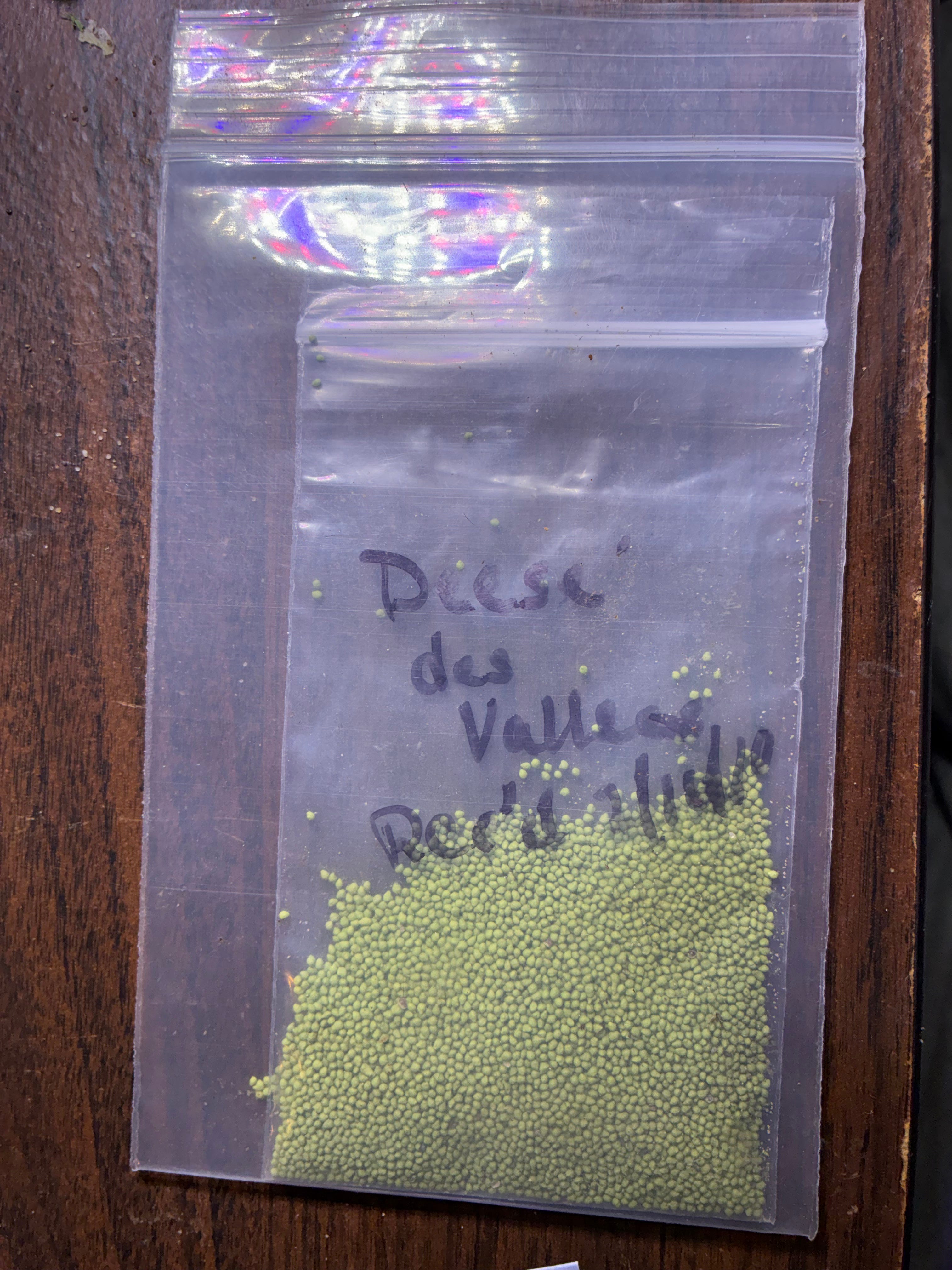
The fact that the seed was pelletized is noteworthy. Pelletized seed allows for precision mechanical seeding, signaling just how high-value this seed was considered in Europe and the immense care taken to protect it.
The Goddess had arrived in America. Over the years, I sowed it regularly to maintain fresh, vigorous seed stock for my store. Surprisingly, it never broke any sales records. A few dedicated collectors praised its flavor and even began saving and selling it themselves, but it remained a hidden gem.
In 2025, I made a massive push to grow and save more ‘Déesse des Vallées’ seed than ever before. I’ll be saving even more this year and next because I will no longer sell ‘Reine des Vallées’ seed once my current inventory is sold out. The superior Goddess is officially pushing aside the Queen, and I hope she takes her rightful place in the American market.
To test the viability of this newly discovered archival seed, I sowed two solo cups the day after finding them. This picture was taken just before the sand was wetted:
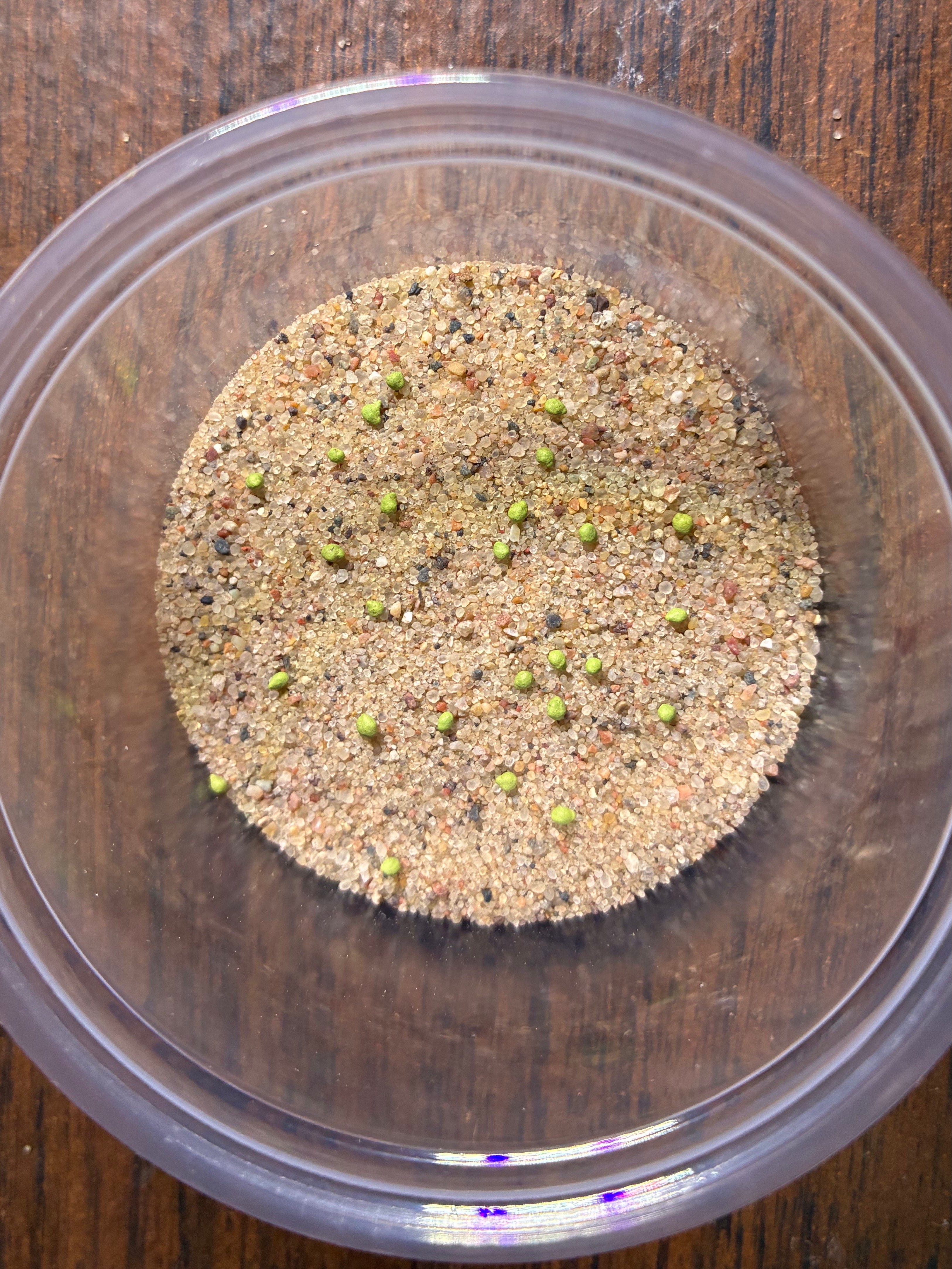
Amazingly, two seeds germinated just five days after sowing. By day nine, 7 out of roughly 25 seeds had sprouted. This picture, taken on June 8, 2026 (22 days post-sowing), shows seeds continuing to emerge. At this point 13 seeds (50%) have germinated. This is definitive proof of the cultivar's legendary seedling vigor!
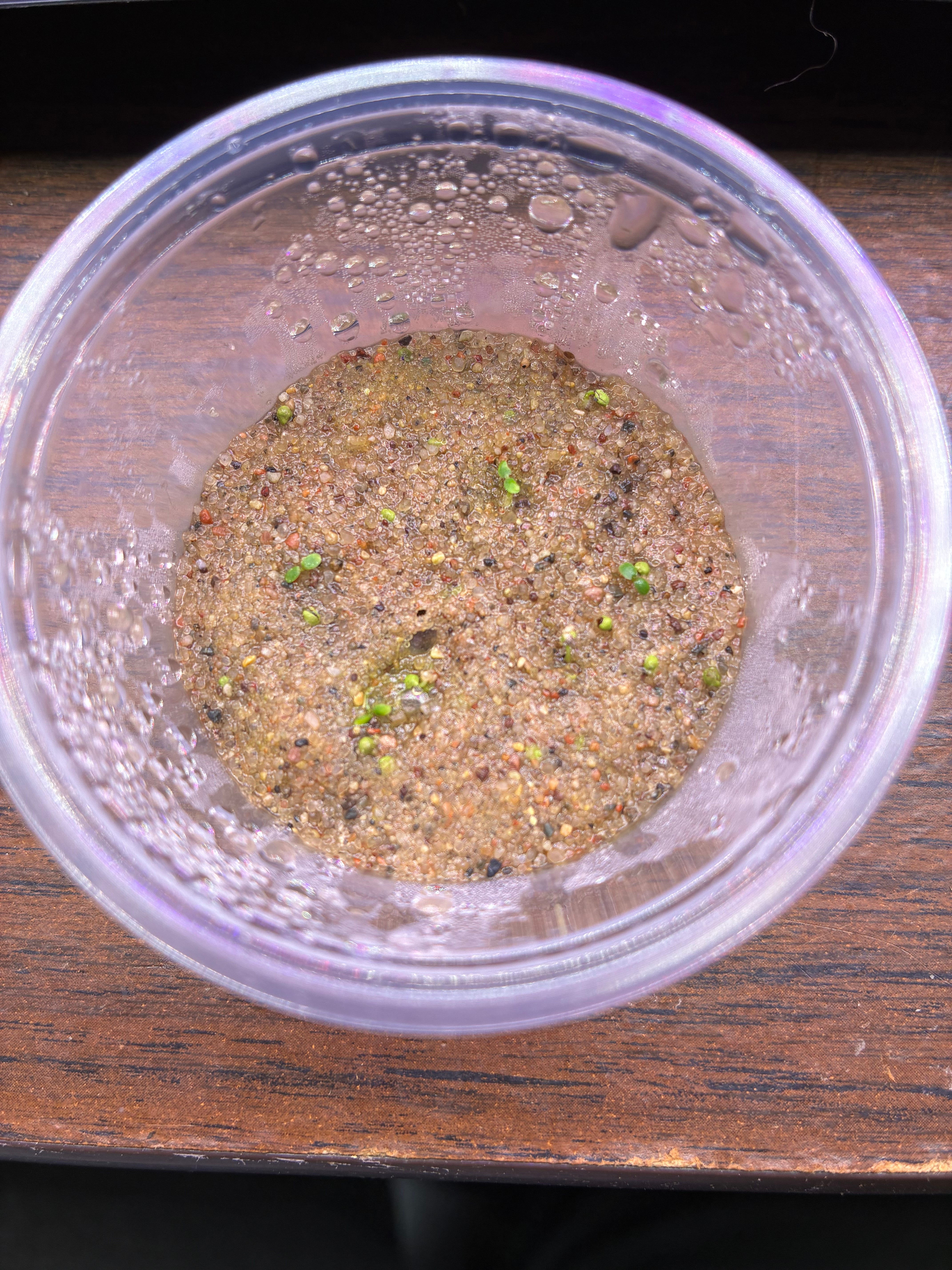
Prior to this experiment, the oldest alpine strawberry seed I had successfully germinated was nine years old. I will continue to update the progress of these 16-year-old seedlings in future Substack notes and posts.
Like the tape-stuck seeds, I will create a free product listing on my store if any readers want to try germinating some of this pelleted seed. Because I doubt it will hit the required standard 60% germination rate for the species, I won’t charge for the seeds themselves, and I will make a special effort to package them carefully so the pellets aren’t crushed by automated postal equipment.
Let's move on to the profile of this exciting cultivar.
Intensely aromatic and perfumed: It delivers the signature wild strawberry (fraise des bois) scent—floral, complex, and highly fragrant with volatile compounds that evoke true woodland berries. This sets it apart from larger cultivated strawberries.
Sweet with depth: High sugar content provides pronounced sweetness, balanced by a subtle wine-like or sophisticated undertone that adds complexity and prevents it from being one-note.
Rich, concentrated wild strawberry taste: Expect an intense, gourmet “strawberry” essence—often described as more flavorful and aromatic than standard varieties, with notes that can include hints of honey or tropical fruit in peak-ripeness alpines generally. It is rated at the top for fruit flavor (10/10 in seed seller ratings, tied with a few other elite alpines).
Texture and appearance notes: Small-to-medium oval berries (larger than many wild types), deep crimson when fully ripe, with a rustic, slightly irregular shape. The flesh is tender and juicy.
Déesse des Vallées’ (‘Goddess of the Valleys’) is a distinct, highly improved cultivar selected directly from ‘Reine des Vallées’. While ‘Reine des des Vallées’ remains the famous European commercial standard, ‘Déesse’ des Vallées’ is its high-performance, more robust improved counterpart.
Growth Habit: Compact, day-neutral, clumping alpine strawberry that fruits continuously from spring until the first hard frost. (Can fruit year-round indoors or in mild climates).
Superior Vigor: Seedlings routinely grow 2–3x faster than traditional alpine cultivars.
“Rustic” Aesthetics: The fruit has a slightly less “smooth” appearance than ‘Reine des Vallées’, giving it a beautifully authentic, wild woodland look. The achenes (seeds) protrude from the fruit which is typical of alpine strawberries. If an image claims to be this cultivar and the achenes are set in pits it is not an image of this cultivar.
High Productivity: Because individual berries tend to be slightly larger, it consistently out-yields ‘Reine des Vallées’ in total harvest weight.
Deep Pigmentation: The fruit matures to a stunning, dark crimson. This intense coloration is even visible in the seeds.
Versatility: Perfect for commercial production, raised beds, traditional garden borders, patio containers, balcony gardens, and indoor countertop hydroponic systems (like AeroGardens).
European Alias: In Italy, you will likely find this exact same cultivar sold under the name ‘Dea delle Valli’.
To buy seeds of this cultivar Click Here.
Frankly, until recently I didn’t know much about the green seeds that were in my freezer all these years. Most of the online information was and is in French. ‘Reine des Vallées’ and its huge reputation completely over shadows many if not most of the red fruiting alpine strawberries. When I grew ‘Déesse des Vallées’ to refresh my supply in 2025 I noticed some things but it didn’t register at the time. This picture has clues that are now obvious. (Sorry, not all plants are picture perfect all the time).
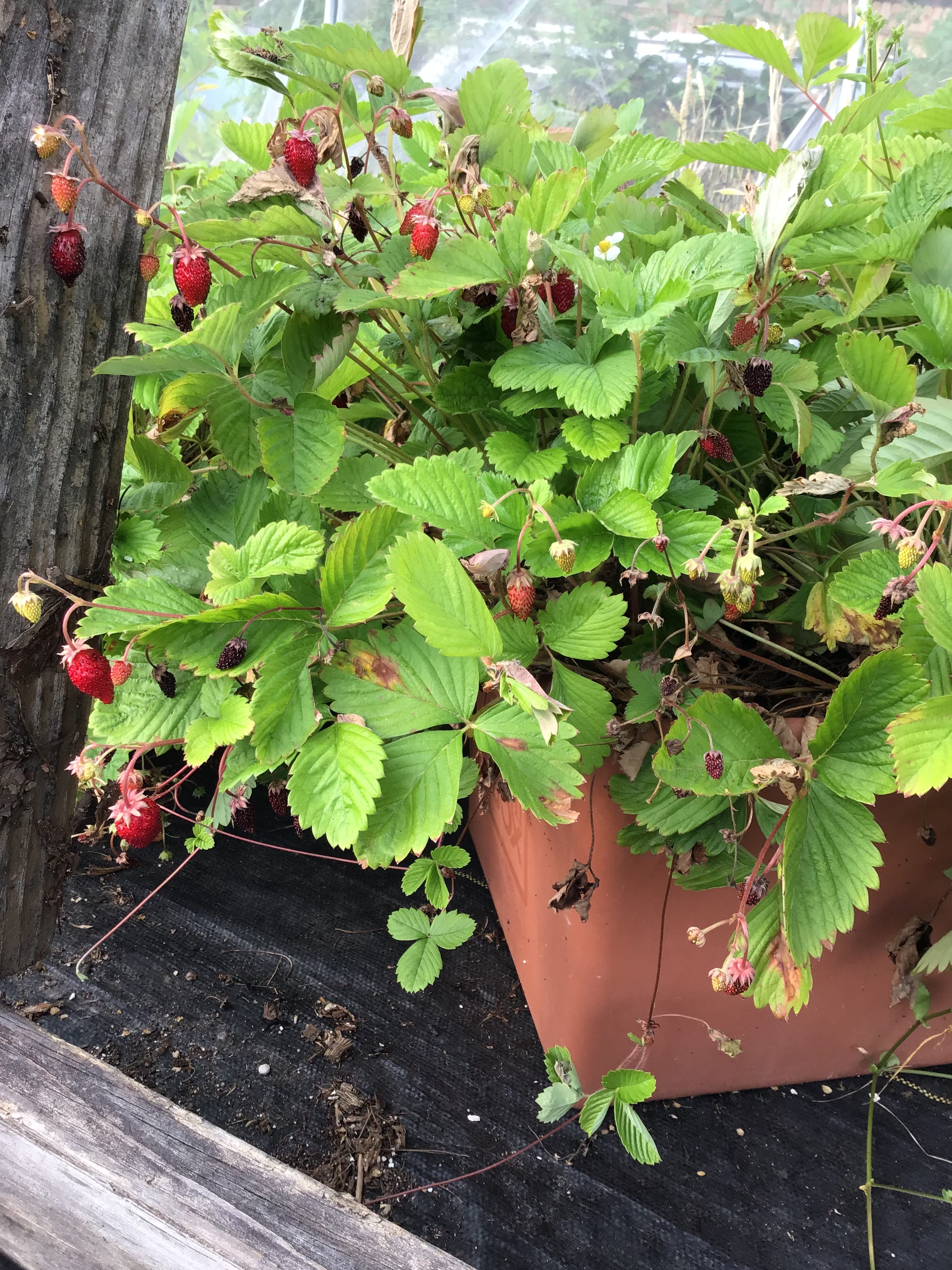
It is a constant blur around here. Maintaining, isolating, and keeping viable stock for nearly 20 distinct alpine and woodland cultivars on just a quarter-acre—while harvesting, processing, cleaning, and packaging every single seed by hand—is an immense challenge. But I have no complaints. I absolutely love what I do. I am still entirely obsessed!
Here’s a picture of fruit on June 5th of ‘Little Red Alpine’ (‘Waldsteinchen’). It was delicious!
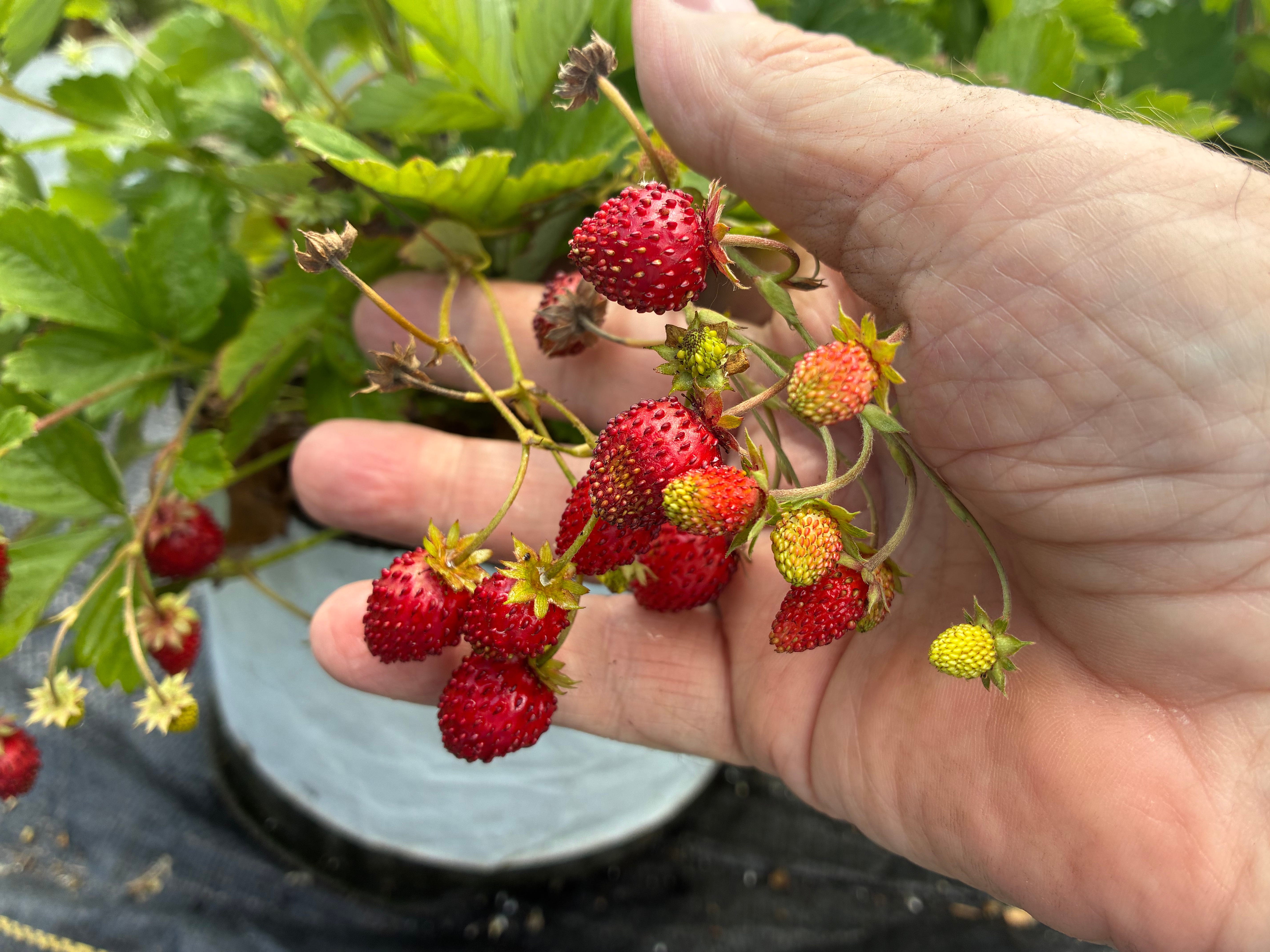
Because ‘Pineapple Crush’ has been popping up so frequently in my recent posts, it is high time we give it a proper spotlight. In next month’s post, I will profile this unique and special cultivar and share some fascinating historical information I uncovered during my research.
I’m becoming increasingly aware that much of the seed sold online under the same name is not genetically identical and in fact might be quite different. We will dive deep into why that happens, and why it is absolutely critical for growers and gardeners to carefully research the source of their alpine and woodland strawberry seeds.
A next to last comment. Someone recently referred to me as an Artisan Plant Breeder. I actually had to look up the formal definition:
An Artisan Plant Breeder is a specialized horticulturist who combines classical genetics with aesthetic artistry to create unique, high-quality, and often rare plant varieties. Unlike large-scale commercial breeders who prioritize mass-market traits like crop yield or shelf-life, artisans focus on bespoke characteristics, visual beauty, and specialized niches.
Reading that, I had a sudden moment of clarity: Yes, that is exactly what I am. I am constantly tinkering, selecting, and striving to preserve and improve my beloved, gourmet strawberry cultivars.
One final comment:
I will make a comment here about freezing strawberry seeds. A seed wholesaler a few years ago told me that freezing strawberry seeds is not permitted. He said that strawberry seed should be stored at room temperature for a year and then discarded. In May of 2026 I did a routine germination test on ‘White Solemacher’ seed from my freezer. This is seed now being sold on my store. It has been frozen since receipt from a European seed wholesaler in 2020. I check germ on all new seed coming in. It was 78% then. Last month this same seed tested 94% germ. Germ improved over time! Don’t believe all you are told without testing!
Happy growing!🍓
No posts
Comments
Nothing yet. Say the first thing.
Sign in to join the conversation.