
These days, it seems like everyone is in therapy. Some enter treatment with specific symptoms and goals in mind, but many others are in “maintenance mode,” using the space as a defined time for reflection and growth and not necessarily working on clinical issues.
While I love the reduced stigma around mental health and will always be a proponent of any sort of personal reflection and growth, I don’t actually support the perpetual therapy model— the idea that people should consistently be in therapy in order to keep growing. Therapists are clinicians, trained to help treat clinical issues and get folks back on the path to living healthy lives. While a therapist can be a great addition to a person’s supports, I’m concerned that many are using therapists the same way they are using AI chatbots: as a safe space that provides consistent validation and support instead of growing and maintaining deep relationships with friends, family, and other community members.
When I start with a new patient, I make it clear to them from our initial phone call that our goal will be to get them out of therapy. While most clients are on board with this plan from the outset, after weeks or months of treatment go by I notice that many patients often become wary of the idea that one day they will be out of therapy and on their own. This hesitation is normal, but I remind patients that clinical support may not always be necessary and that with some hard work and practice they can build out their own natural support networks to help them once their challenges become manageable.
What are natural support networks? Broader than just friends and family, natural supports can be found everywhere in one’s life. From that grocery store clerk you especially like to your great aunt who’s a bit harsh but means well, there are likely many people in your life who are serving important roles; even folks who you may not often think about might be essential pieces of your support circle. Decades of research show that building a strong support circle can make you happier and healthier and is our greatest asset in combatting the “loneliness epidemic.”
You’re probably not surprised to hear that it’s a good idea to have supportive folks around you, but how much time do you actually spend thinking about, building, or supporting your circle? If your answer is “not very much,” you’re not alone— western society has pushed us to live more individualistically and to focus on ourselves and our immediate family members, leading not only to feelings of isolation but to greed and unnecessary competition that have created an insurmountable wealth gap and levels of poverty that no first world country should contain. We can learn a lot by reflecting on the community-oriented practices of indigenous people that supported them to survive and thrive in harmony with the earth far before westerners came to town. Indigenous communities rely on members holding different key roles, such as knowledge keepers, healers, land stewards, etc. and working together in order to maintain balance and support all community members. What key roles can others play in your life? Do you currently have people filling those roles, or do you have some work to do?
When we think about talking to a therapist, many of us often imagine one trusted person who can hold all of our parts, our secrets and dreams, our struggles and hopes. What would it be like to trust other people in your life with some of these parts? Are you already doing this, or would that feel like a huge leap of trust? While it’s important to avoid “trauma dumping” or therapizing those around you, it’s normal and healthy to lean on your natural support network. That doesn’t mean that it’s easy, though!
Helping others build out strong natural support networks (and building out my own!) is something I’m really interested in, so I’m going to be digging into this idea a lot further in the coming months, but for now I’ll leave you with a few high-level tips to get started:
Identify your different layers of support. Some people in your community may be very close to you and privy to your deepest secrets, while others may be a bit more distant and more appropriate for a casual chat. Take a moment to identify which people in your life serve which roles (we’ll do more work on this in the future too!). Don’t underestimate how much joy and connection you can get from your more distant buddies! While a deep chat may sometimes be what you need, a quick stop at a favorite store to chat up the sales rep may do the trick to boost your mood if you’re feeling lonely.
Always check in before you start sharing or venting. Just because the timing seems right for you to connect with someone doesn’t mean the other person is in a good headspace to receive. Try saying something like “hey can I talk to you about something a little heavy?” or “is it ok if I vent about something?” to get consent before you get into it. Not only will this give the other person a chance to push pause if they don’t have the bandwith for a heavy convo, but it will help prepare them for what you’re about to start sharing.
Know when it’s time to get some deeper support. It can be hard to know when challenges are getting so heavy that you need a clinician to step in, and it’s always better to get support before things get worse. The general rule of thumb is that when your symptoms (feelings such as anxiety, depression, overwhelm, etc) start to interfere with your daily activities to the point where you’re having difficulty functioning (difficulty getting out of bed, going to work/school, taking care of yourself or others), it may be time to reach out for extra support. If you’re ever feeling unsafe, like you may harm yourself or someone else, that’s also definitely a time to reach out for urgent support (call or text 988 — they really are always there!).
In a world where therapy language and self-diagnosing have become mainstream, it seems like many folks have lost sight of the value that the people around them can bring when it comes to mental health. While I’m not advocating for your neighbor to replace your therapist, I do think that by bolstering and nurturing the circle of supportive people we have around us we can become happier, healthier, and more resilient to the challenges that life is going to continue to throw our way. Human support circles are going to become even more important as people turn more and more to AI bots for support— while AI may be able to provide concrete answers and boundless validation, it will never be able to replicate the magic feeling of being seen and heard by someone in your community.
✨ this information is for educational purposes only and is not a substitution for therapy. ✨
↓
↓
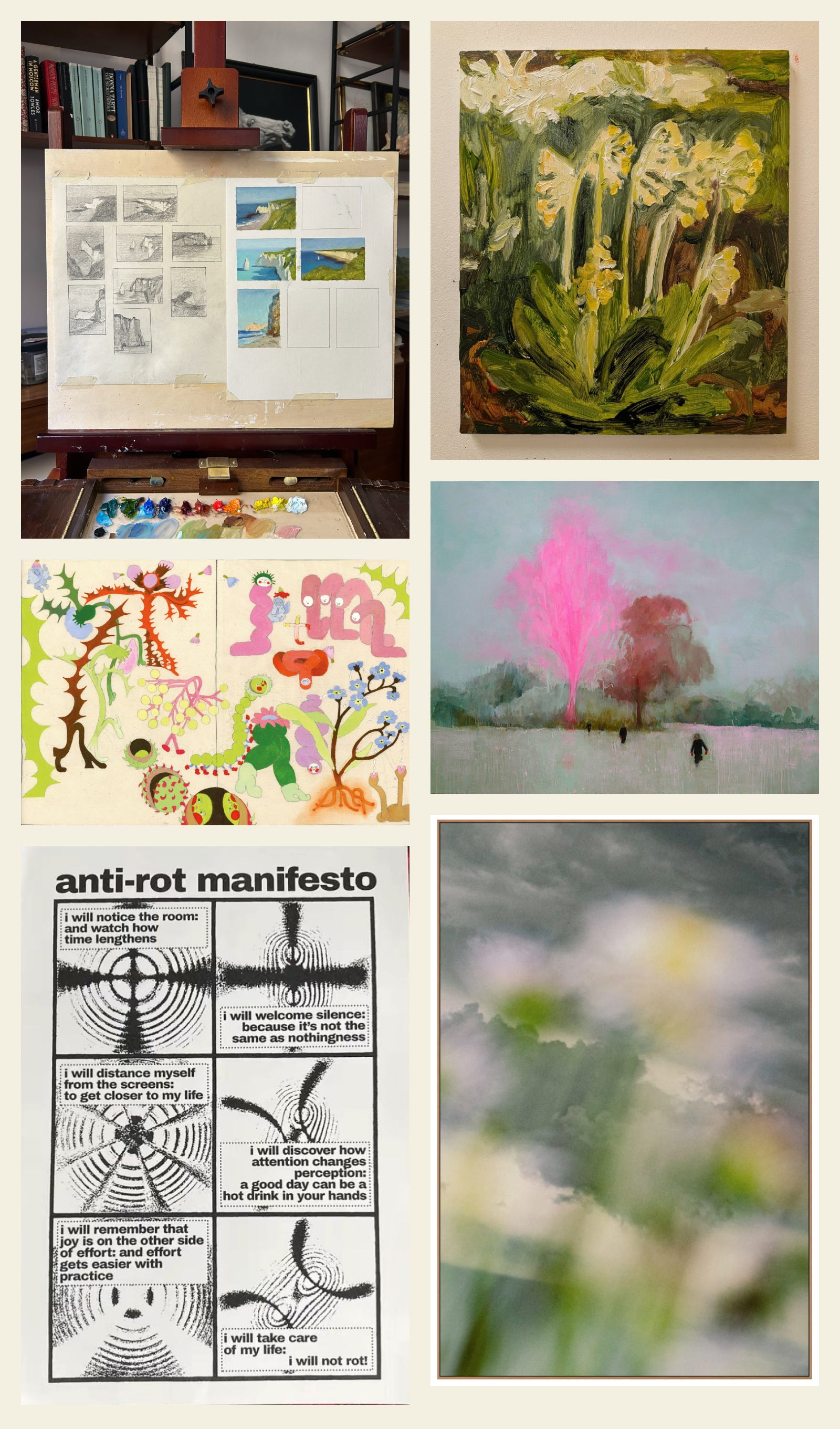
(from top left to bottom right)
↓
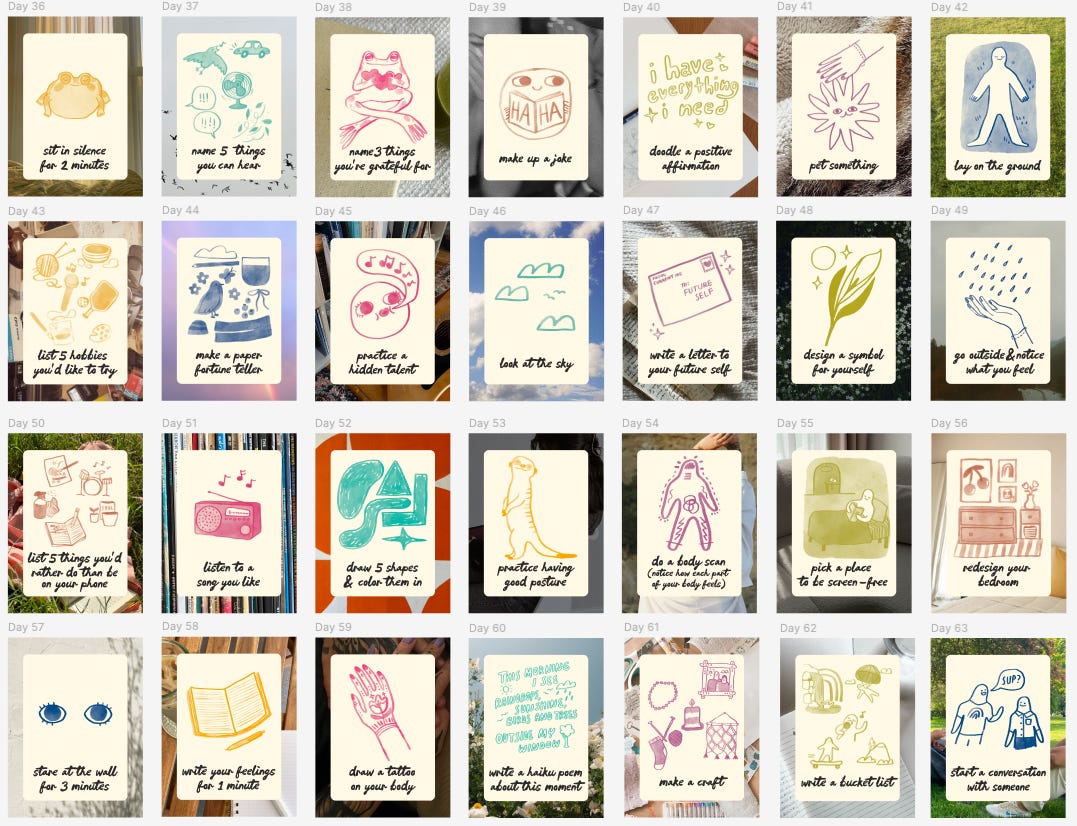
Oh my gosh it is day 68 over here and I’m still going! It is both harder and not as hard as I thought it would be. One thing that has been challenging about this project is that it has actually caused me to spend MORE time on screens rather than less— kind of the opposite of what the whole project is about. For a while I was spiraling pretty hard about this— should I keep doing the project if it’s not actually getting me off of my screen?? I finally came to terms with this upfront screen heavy cost though because I know the end result will be worth it and, I hope, will lead to much less screen time for myself and others. Only time will tell! For now, enjoy this SCREENshot of my big figma spreadsheet of cards. Only 33 days to go!
Once the project is done, I plan on releasing a physical card deck of all 100 offline inspo cards as well as a digital version that you can set as your phone lock screen. I’d love to know if you’re interested in a deck— let me know here!
↓
New email section alert! Each month I’ll answer a real life mental health question or offer a practical mental health tip that you can use to add a little more WeLlNeSs to your everyday life.
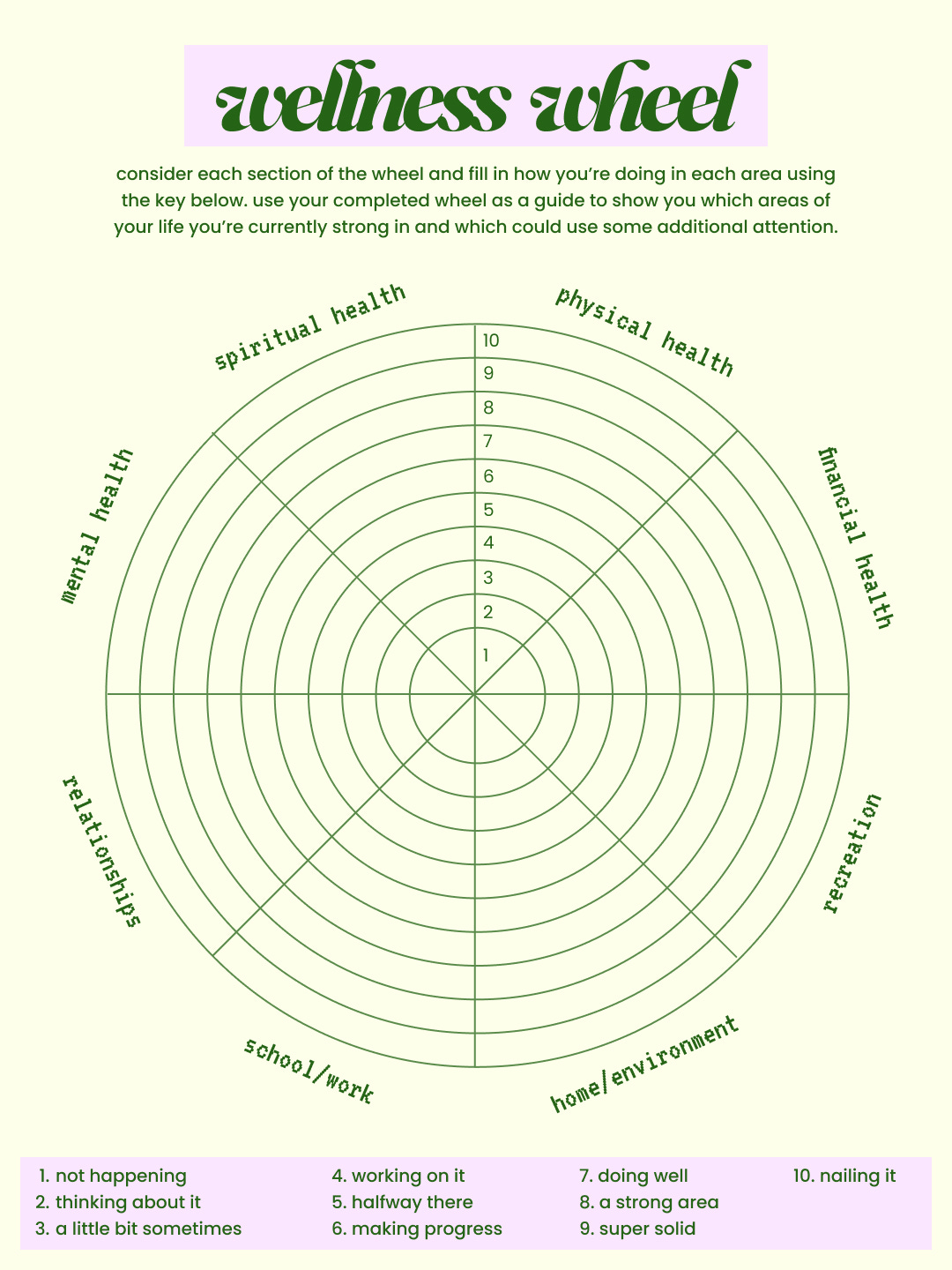
Without further ado, here is this month’s lil’ tip: assess your current situation with a wellness wheel. Have you ever heard of these before? A wellness wheel is a little tool you can use to get a better picture of where you’re at, what areas you’re already devoting lots of time and energy to, and which could use a little extra focus.
There are many different wellness wheels out there— I created one for you to try above, but I also really like this one that includes lots of reflection questions and is geared towards teens but works for adults too. You can also just draw a circle on a piece of paper— doesn’t have to be fancy!
Take a look at each category on the wheel and mark how strong you currently feel in that area, with 1 being not so strong at all to 10 being super strong. Then take a look at what your wheel looks like. Is it super lopsided or pretty even? Were you expecting what you’re seeing or are there any surprises? It can be helpful to write a little bit to reflect on what you’re seeing.
After you complete your wellness wheel, some questions you might ask yourself are:
Which areas am I currently doing well in and which could use some more attention?
What actions can I take this week to give the areas that need more energy a boost?
What would my life look like if I were to improve the areas that are currently lacking?
How can I improve the areas that need a boost while still maintaining the areas in which I am currently strong? What will need to shift?
I hope this helps you assess your sitch and helps clarify how you’d like to spend your time moving forward. Let me know if you have any interesting revelations in the comments!
↓
Really loving the Baum Kitchen (a great stationary store in LA) email newsletter— sign up if you love notebooks and/or analogue living
Last month my Planta app told me that I had to re-pot all of my plants. This month I finally actually completed this task and OMG— here to tell you that yes, you should definitely re-pot your plants! My plants have never been so perky and happy! turns out soil is important, ya’ll.
Peanut butter, banana, granola and honey wrapped up in a flour tortilla. I’ve been watching my friend do this and every time I see it I’m like man I need to do that. This month I finally did it and it did not disappoint at all! I used to have a version of this every day from the dining hall in college but I don’t think the nostalgia is the only thing that made this delicious.
This essay from a nutritionist that I’m still unpacking and will be for a while! So many gems in here. Always trying to figure out my hormones and this piece got me much closer than I’ve ever been!
Here to officially recommend gel nail polish strips, specifically the Hay Hae strips. SO much easier than painting your nails and they last so long— currently wrapping up week 2 and going strong! They say you can cure them in the sun but I used their LED lamp and it took 45 seconds. The technology I’ve been waiting for! I did this baby blue color and am currently wearing matcha green— love them both!


I thought it could be nice to start ending each week’s email with a little reflection question— maybe something that I’ve been thinking about lately or something that feels like it would be nice to linger on for a minute after staring at your screen reading this email. If you made it this far, you deserve a break! So here’s this month’s question:
How have you been showing up for your friends this month, and how would you like that to change next month?
🌸 Read past issues of Good Things here
🌞 Shop fun mental health & art items here
👯♀️ Follow me on the internet here
🎳 Peep my pins here
↓
Thanks for reading – see you next month!
No posts
Comments
Nothing yet. Say the first thing.
Sign in to join the conversation.