
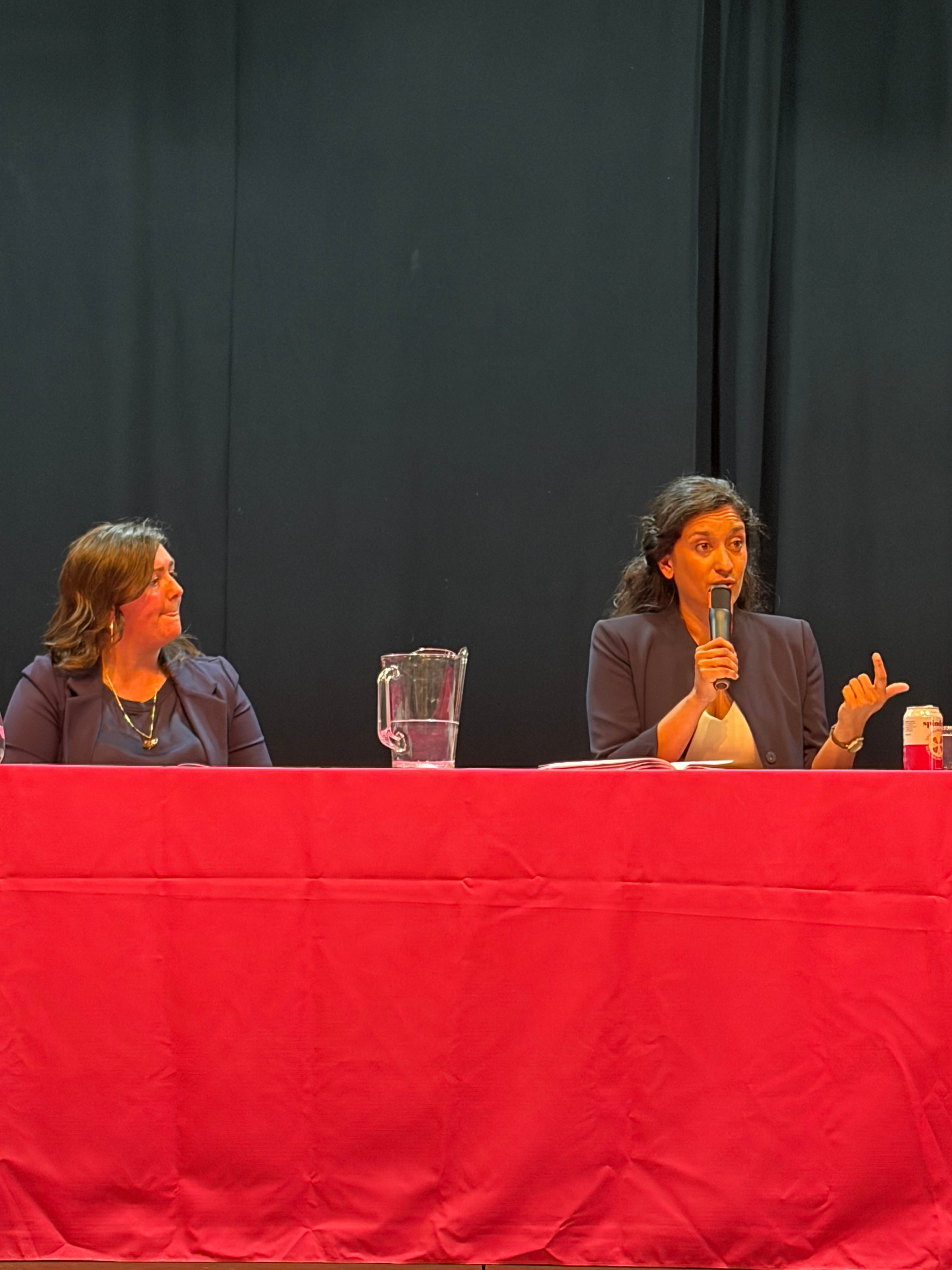
Good Govermont sat down with the two candidates in the Democratic primary to be Vermont’s next governor, to discuss their ideas in the areas of energy and land-use policy. This week, we are publishing a series of questions and answers with Amanda Janoo, of Burlington. Next week, we will be publishing our conversation with Aly Richards of Montpelier. The conversation with Janoo took place on June 25; a federal housing bill she refers to has since become law.
This Q&A has been edited for length and clarity. The candidate’s responses have not been fact-checked and Good Govermont makes no warranties concerning their accuracy.
I don’t think this is controversial, but feel free to disagree: For more people to be able to afford a home, we need to build more housing. For us to have more affordable energy that doesn’t fry the planet, we need to build a lot more generation and transmission lines. How do you envision those sorts of things getting built in Vermont? How does that differ, if at all, from the way they’re built today? And how would you, as governor, help make that happen?
I would say with housing: Yes, we need more housing, but I actually think that just building more housing is not going to solve our housing crisis. The actual root of our housing crisis is the financialization of housing: we treat houses as investments and not homes. And so in Vermont, I think it’s an issue of what is the form of ownership and what is the distribution of housing.
What is the data that supports the idea that this is primarily an issue of private equity buying up the housing stock?
Nationally, at least, I think it was something like a third of all new housing was being bought by or funded by private equity.
And this is part of the larger issue where we’ve seen a huge amount of senior living facilities being bought by private equity in Vermont. And because we have such a concentration of wealth by a different number of corporations, and then they’re all owned by three major private equity funds, even globally, most of the investments have been going into things like healthcare and housing that are viewed as safe investments. And when you have more and more of that being owned by private, speculative investors, that’s gonna invariably drive up housing costs. It’s interesting right now because nationally, the housing policy that Trump last minute is deciding maybe not [to support], is also looking at private equity and large corporate ownership and putting some limits on how much, how many units these kind of entities could own.
But if I take a step back again to the point around the root being the financialization of housing: I lived in Vienna for a couple years, and it’s always cited as the capital city with the most affordable housing, because the majority of the housing stock is publicly or cooperatively owned. And so—just building more houses, supporting large contractors to build houses that are going to be sold back to us at market rate, and then the state just subsidizing part of that through taxpayer money, doesn’t feel like it’s the most efficient way to deal with this.
We should be supporting more housing trusts and co-ops and public housing and things that are going to ensure permanent affordability. Or, we have first-time home-buyers’ incentives. We should have first-time home builders’ incentives. Like, people who want to live in those houses as their own houses, not as investments that they’re going to be selling after the fact. So I think that’s just some of the shift in logic when we look at how to ensure permanent affordability in the housing sector, as well as, ideally, reducing the amount of our housing stock that is being used up by Airbnb’s and second homes.
So that’s housing. How about energy?
Yeah. I mean I do think that we really urgently need more public investment to transition to more renewable energy for a variety of reasons: economic, environmental, and political. I am worried about the cost for people of heating their houses this winter. I think it’s going to be brutal. I’m also worried about the geopolitical relationships that we are in right now and our level of energy-import dependence. And clearly, oil and gas is destroying our planet. So we need to reduce our reliance on fossil fuels.
I was just learning actually from someone, apparently when Douglas was in office, we had an opportunity to buy all of the hydro dams on the Connecticut River that would have powered like a third of our state, and we didn’t see the point in that, or felt like we maybe didn’t have the capacity, or I don’t know, what. So then the Canadians ended up buying it and selling it for five times as much or something like this, and all that power goes now down to Rhode Island and Connecticut.
But I think it does need to be a mix of energy sources. I’m trying to explore more renewable community microgrids, more community solar, because I know right now, because of the net metering policies and things like this, it’s really constrained the capacity for communities to develop more decentralized renewable energy systems that people can feed into and make money off of. And so, I’m trying to just get a better sense of how much investment that would take. What’s the timeline? What are the mechanisms?
So you mentioned microgrids and community-owned projects. This does get to one of the key current issues [in renewable energy], which is that the types of projects that are the least controversial—solar going on rooftops or over parking lots—or the types of projects that have this added co-benefit of some level of community ownership, tend to be more expensive to build [per megawatt]. And so the energy from them is more expensive, compared to a utility-scale solar farm or wind turbines. So, how do you balance those goals of affordability for everyone with building out to make this energy transition in the ways you envision?
There are a lot of these types of trade-offs that we’re gonna face. I mean this is one of those rare areas where renewable energy is now cheaper than oil and gas. And if we were a producer of oil, that would be a different thing, but we’re not. I mean, one of the things that I worry about a little bit too is, the minerals and inputs that actually go into solar, right, and batteries and stuff like this, we don’t produce ourselves. So there’s also that side of it too—really, just thinking about also the longer-term sustainability of those systems as our basis. And also, what’s the lifespan, and the sort of skills that are necessary for maintenance and construction? I’d like to look into that a bit more.
Would you say that currently, residents who live near a proposed development in Vermont have too much power or ability to block the proposed development, not enough ability or power to do that, or just the right amount?
What type of development?
Let’s start with the two we’ve been discussing, housing and energy.
Yeah, I don’t know. This is again where, I really believe in the importance of participatory process and of more community decision making and control. To the extent to which we’re seeing the dangers of too much concentration of power by the state or by large corporations, and so to the extent to which you can, decentralize some of that—Of course, there are examples like in Greensboro, right? Where they wanted to build affordable housing, and they’re like, “oh, poo-poo, no, we don’t want those people who would live in apartments, to live here,” right? There’s a lot of classist sorts of undertones to that. But then there’s also examples like in the Upper Valley, where I grew up. Remember New Vista? Where it was that Mormon billionaire who was buying up all of the land around South Royalton, Sharon, Stratford, etc., because that’s where Joseph Smith was born, and was planning to build this whole eco-housing apocalypse sort of shelter for the Mormons, and was planning to transplant 40,000 people into that area, and he was succeeding in terms of buying up all of that land and a scrappy group of community activists were just like, “over my dead body.” And it was such a David versus Goliath thing, and they succeeded in blocking it against all odds. And so it’s really, sometimes, in the eye of the beholder in these ways.
I see the role of the state as being really important as an underwriter to protect and ensure everybody’s basic rights and needs. But then, what is important is to actually decentralize and redistribute a lot more resources and power and decision-making back to the community, to deliver on those things and have more self-determination and the types of innovations that they want to advance. Because, even though we say we have a lot of local control through some types of processes, we’re still a Dillon’s Rule state. There are a lot of contradictions within our own state around what we allow towns to have say over and what we don’t. In Burlington, for example, they were trying to advance rent-stabilization policy forever, and the legislature just refused to take it off the wall for consideration.
So, fair to say, you envision a transformation of the economy—I watched a different interview with you, where you said that transforming the global economy is your life’s goal.
Laughs. Yeah.
How feasible is that in a small state, that is part of a larger federal system, where the rules govern and help create one type of economic activity?
I would say our size is actually a benefit in this regard. In working with a lot of different countries, or communities, it’s easier actually to achieve transformation in smaller communities, and especially because of the level of social trust and engagement we have, and the values that underpin a lot of Vermont, that center in really loving our community and our natural environment, being handy, the Vermont value of self-sufficiency. And I want to advance that. So all of the pieces are already here, and we’re already doing it. It’s just the reality of—the right has historically been really good at using crises to achieve really big, systemic, policy transformations. In this moment where we are in crisis—but we are headed for something much worse, too—that is an opportunity for us to really get back to questions like, “What do we value? How do we want to be providing for one another?”
At the Vergennes debate, you proposed the idea of, essentially, getting off of federal funding. The last year that I could find data for was 2023, when funds from the federal government were 36% of overall state spending, and that doesn’t even include local [town] budgets. And it’s higher in things like natural resources, transportation, all of our climate-friendly subsidies. So what are the steps you propose to replace that level of funding?
This starts with healthcare. So I’ve been part of the Fund Vermont’s Future coalition, and Public Assets [Institute] has been so incredible around providing a lot of information, looking at the state budget, the different revenue streams, expenditures, etc. And yeah, my understanding is that about 30% currently of our of our budget comes from the federal government, and a big chunk of that is from [sic] healthcare. So this is why healthcare is a critical starting point, a day one thing: One, because we already passed a universal health care policy, and it’s just an issue of an implementation. So, as governor, you don’t actually need to wait for the legislature, if this is just something we are actually legally obliged to be providing anyways, and we haven’t been. And at first I got really into the weeds, where it’s like, “oh, the UVM Medical Center” and “oh, the ACA waivers,” and then I was like, “let’s take a step back and just think about, ‘how do we ensure that everybody has access to good, free healthcare?’”
Our healthcare system is collapsing, and again, crises are opportunities. Some towns have been starting to hire their own town nurses, like Tunbridge and Strafford and some others. That’s a really good model, where what we can do as the state is just pay primary care providers a good annual salary, bring back small-town doctors, nurses, mental health providers to our communities and embed them within them, so that they can provide good free primary care.
And so based that off of the proposed fair share proposal and the estimates that were created by Public Assets as part of Fund Vermont’s Future, to just see what we would be able to cover, not just in terms of the salaries for [Primary Care Providers], nurses, admin, etc., but also relocation incentives or student loan forgiveness or basic pharmaceuticals, equipment, that kind of thing.
So this question is more about politics than policy. It sounds like you are still in touch with a lot of people in the places you grew up, like Strafford. That part of the state shifted rightward in the last election, and I’m curious what you’re hearing from the people you grew up with about how they see politics, and how they see your politics.
Oh yeah. I think we’re all sick of politics. I mean, going around the state, everybody hates the Dems. Even the Dems hate the Dems. You know what I mean? I think people are sick of party politics. And I get it. I think one of the biggest barriers we face right now is that the property tax burden for people has been massive, 40% I think, on average, increase over the last five years. And so, when Phil Scott makes the case that affordability means tax cuts, that is real for people. And I think that they believe that’s the only thing that the government can make more affordable, because every time we add new taxes, it adds a bit more complexity, but it isn’t clearly illustrated that it has an immediate sort of material impact.
Vermont’s interesting in that way, where, the area, the town I grew up in is half back-to-the-land hippies, half old-school redneck Vermonters. And they’re very different politically, but they shared that appreciation for nature, self-sufficiency, and weed, pretty much; that was the common denominator. But I think, as a result of that, I have my own kind of interesting, libertarian-socialist philosophy. Which is: I think everybody’s basic needs should be ensured, but I don’t think actually that it’s good for the government--It’s always so funny to me because again I lived internationally; we call ourselves the land of the free, but you get arrested for everything in this country. It’s crazy.
We have so many laws and restrictions and regulations and all of this stuff, and I get why it’s frustrating for people, and also because our state government has been hollowed out over the last decade, and so when people are trying to get a hold of somebody who needs to come to their farm to check on whatever, before they’re allowed to build something, it takes six months. And then they’re frustrated, and they’re like, “Ah, the government sucks.” And that’s been so much of the purpose, I would say, of a lot of the Republican agenda is just like, hollow out the government so that people see the government as inept. It’s the same in the UK with the NHS, right? Like, “let’s just defund it so that people then view a public healthcare system as ineffective, so that we can ultimately just privatize it.”
So, your ideas for [economic] transformation—even if part of it involves returning power to local self-government, a lot of it will have to come down from the state, won’t it?
Obviously, I’m running for governor because I believe in the positive capacity of the state and of policy to be able to help a population. And, I think that the current structure that is very top down, very much, “let’s tell the people what they have to do all of the time,” is a big part of the reason we’ve ended up here in the first place. Because our communities are the ones who are bearing the brunt of these crises and trying to respond to them. They don’t have the resources or even decision-making power or capacity to do so. And so, how can the state government—or actually, the administration, because we’re the largest employer in the state, we have a huge amount of incredible skills, passion, capacity—really reorient towards, “what is it that our communities are needing and asking for?” In Barre, they still haven’t been able to recover from the floods that they’ve had. They’ve asked twice for support, for funding, and been denied by the state for it. And it’s just: “what are we doing?”
—
Vermont’s primary elections will take place on August 11. You can request your absentee ballot if you will be away.
No posts
Comments
Nothing yet. Say the first thing.
Sign in to join the conversation.