
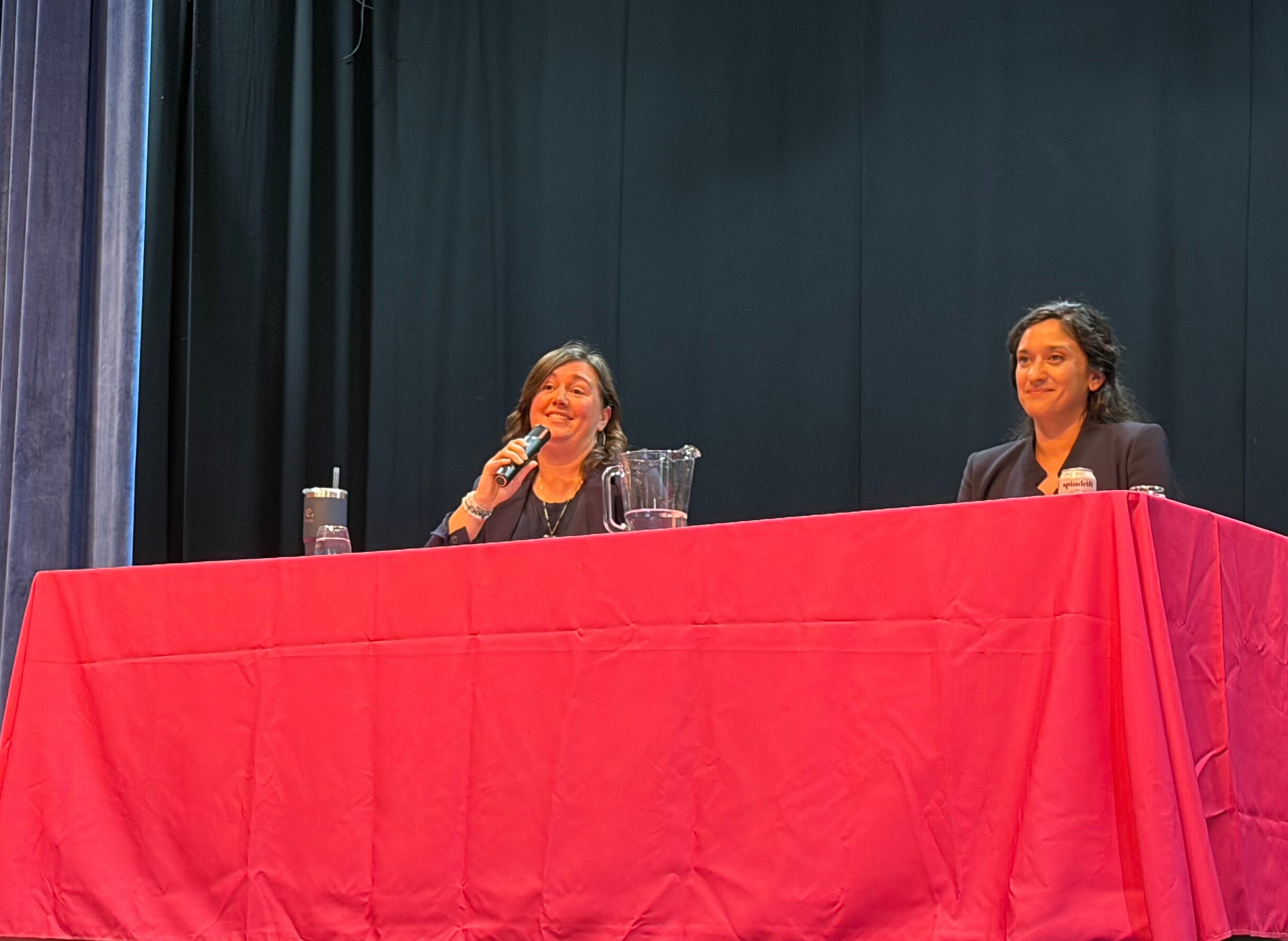
Good Govermont sat down with the two candidates in the Democratic primary to be Vermont’s next governor to talk about their ideas in the areas of energy and land-use policy, after hearing them speak at a debate in Vergennes. This week, we are publishing a series of questions and answers with Aly Richards, of Montpelier. Last week, we published a Q&A with Amanda Janoo. The conversation with Richards took place on July 14.
This Q&A has been edited for length and clarity. The candidates’ responses have not been fact-checked and Good Govermont makes no warranties concerning their accuracy.
Let’s start here: You’ve called for Vermont to become energy independent. What does that mean?
The most vulnerable Vermonters I’m seeing are the ones who are stuck at the pump and are stuck at home because they cannot afford their oil bills, they cannot afford their gas. We have to be able to use this moment as an authorizing environment to go big in this arena. So that means a bunch of things to me. First, it means investing in renewable energy like we used to. We used to be the tip of the spear for the country on investing in renewables, and we just have let that stagnate—Everything from not having a partner in the governor’s office and the Public Utilities Commission, [to] all our changes on net metering…we’ve sort of just changed our entire incentive structure and stagnated the solar industry.
We used to be understanding that the only way you’re going to afford electricity is to have our own renewables, especially I would say, heavy on solar and continue [sic] to understand the technological advances in wind, especially offshore wind, and how we can tie into that…We have a moment now that it is an imperative for our affordability crisis to have Vermonters, working class families, be able to afford the heat pump, the solar panel, the EV. And when we do, they’re going to be able to afford to live in Vermont, and it’s going to move us towards energy independence, and it’s great for the environment.
“It is an imperative for our affordability crisis to have Vermonters, working class families, be able to afford the heat pump, the solar panel, the EV.”
…The last thing I’d say is, “What can little fierce Vermont do, as far as mitigating climate change?” Like it is great that we all compost. We should all compost, but what are we really going to do to make sure that we are truthfully shining a light on climate change as the existential crisis that it is, and mitigating it? And things like, investing in batteries and grid technology and being an incubator for how this all ties together. And making sure that Beta technologies is wildly successful if they’re going to truly revolutionize green air travel.
I’ve got a couple follow up questions there. When you talk about building more energy in-state, a major hurdle that many projects have to leap over is local opposition that can develop. I’m curious, in this moment, do you think that abutting landowners, private citizens, or local town governments have too much ability to influence or even block proposed energy projects, too little ability, or just the right amount?
You just got to the crux of everything in Vermont with that question. To me, it is a relationship. It is a partnership because, on one hand, towns understand their needs the most in some ways. On the other hand, when one person can stop a housing development or an energy project, we are starting to have a problem.
We also don’t have an economic action plan for the state. We don’t have a vision for the state of where we’re going. When you don’t have a north star, I think it’s hard to put your thing aside and you know see how we’re moving forward together. This is sort of a higher level point, okay? But you know, in other words, I see a lot of fear-based decision making in Vermont in communities and at the state because things are so bad that we’re going in our corners with our stuff, and we aren’t willing to come out and put it on the table, because we don’t know if where we’re going is going to be better. And I really think that’s a role of the governor and the government to say, “we’re going to help.”
And again, looking at how this worked in childcare… It was not an easy conversation, but the thing was, people were brought together around the collective goal. So in this case, we could say, the collective goal is: Vermont have our own energy here, we have enough energy to power ourselves, so we are not at the whim of the president’s next war. So we are ready for this scary future we’re entering together, and you’re not going to be driven out of your home because you can’t pay your oil bill anymore. If you paint this picture, you tie it together, I think that really limits some of this opposition that we’re seeing when you really get down to that granular level and explain it.
The Department of Public Service, through its advocacy before the PUC and also through its rulemaking, has a huge impact on how much renewable energy get built in the state and where. And it’s arguably more under the control of the governor than the pretty independent PUC. Have you paid much attention to the Department under Governor Scott? And can you point to any things that you would have it do differently?
I’ll point to one thing. I haven’t heard many proactive ideas from this administration….One is five school districts unvetted, you know, not done in partnership with anybody, just dropped on the table… And the other one I can point to is, you know, Kerrick Johnson coming to the legislature saying, “Here’s an idea. Let’s put a data center and a nuke back at Vermont Yankee.” That’s crazy to me, and it’s really unsettling for that community. …
First of all, the data center, come on. [They] suck up our water, skyrocket our energy. This is back to our first conversation, of “what can Vermont do?” Someone said, “Well, you’re going to have to put those data centers somewhere.” The governor said he vetoed [the Vermont Sustainable Data Centers] bill—[which] wasn’t even to say no to data centers; it was just to give communities a say of where they go and how they interact with the grid, right? So it’s not radical at all. It’s literally how we do business in Vermont—and the reason was because it sends the message, “Vermont is not open for business.” Are you kidding me? The only thing that sends that message in this context is a governor of Vermont saying those words out loud, because a data center doesn’t provide any permanent jobs. So this is one of these wild things where that department put this idea out, [and] the governor vetoed this bill, and this is where Vermont can shine a light. If we say “no,” or if we put restrictions on this totally unbridled new industry, then maybe it gets other people starting to stop and think: “Wait a minute, where are the regulations? Why are we allowing this to go unbridled without thinking about the trade-offs? We need some regulation on this industry now.” That’s where we can put a stick in the spokes and get people’s attention here on something pretty huge and existential for our world.
I want to ask about that because this is a really interesting debate I’ve heard: On the one hand, that makes sense, the idea of Vermont being an incubator for policy ideas, especially when it comes to clean energy and energy affordability and independence. I think the point that Governor Scott has made is that it can be costly to be the guinea pig, and “what are what are the potential unexamined costs of being the first to pass new policies?” Do you have any thoughts on that?
I do. I think it’s a balance. You have to be incredibly thoughtful, and it worked when we legislated same-sex marriage. It worked when we went first on childcare because… some of these things are not experiments. They are well studied return on investments, and we just have not had the political courage to make the change. I think that everything is its own thing, which is why you have to build trust about judgment and track record, so that you let your leaders go on these things.
… And I love looking at what other states have done and adopting it immediately if they’ve worked out the kinks for us, and we can just take it and accelerate it because they’ve done that hard work. I am all about that. In fact, a lot of my thinking on universal access to primary care comes from hard work that Massachusetts has done for many years, and they’ve worked out a lot of the pitfalls on our behalf.
“Not one place so far has proven they have figured out nuclear energy in a way that is actually not being subsidized by the state, and that they have figured out what to do with the 400-plus years of toxic waste that we don’t know what to do with.”
… I wanted to just say about the nuke, though. This is another thing, right? That they said data centers and nukes in the same breath, and that’s like, “well, because [nukes] have gotten cleaner and cheaper.” I’m sorry, prove it. Not one place so far has proven they have figured out nuclear energy in a way that is actually not being subsidized by the state, and that they have figured out what to do with the 400-plus years of toxic waste that we don’t know what to do with.
Your housing platform talks about making it easier and faster to build the homes Vermonters need, alongside a discussion of investments [in housing]. Drilling down specifically on regulatory reform, which is obviously something Governor Scott talks a lot about: Where do you see agreement with him? Is there remaining regulatory reform that’s warranted that could help make it easier to build housing?
I do agree with the governor on the need to build more housing. My two pillars that start the economic action plan are housing and healthcare because I believe those are the root causes and it’s all connected: We have more humans here, our taxes will come down; it’ll support us investing in things like renewables. What I mostly agree with the governor on actually is getting clarity on the tools we already have, especially coming from state government. And I guess that’s where I find it kind of ironic he tried to do this executive order to limit the buffer zones for wetlands, but also to use the maps that already exist. That second thing is what I agree the most with, but it ties into a much broader point. I actually have been studying this for some time and I have identified this deep need for state government to be going together, rowing together under the same vision, where the governor says to all the commissioners and secretaries, “our goal is to build more housing. We have to do it in a way that balances our environment and resiliency. So go forth and get to a yes.”
And here’s a specific example. You know the wetlands folks, right? You have the goal to build and not to ruin our wetlands. Fantastic. So, can you prioritize having our wetlands mapped in a way that is permittable, is actionable, instead of it’s some big picture high level guidance? [Right now] It’s totally opaque as a developer. You have no idea. You use them as a guide, but you can’t do your permits based on them. So basically, you start down into a minefield, not knowing for maybe six months if you’re going to hit a mine. That lack of transparency and opaqueness doesn’t serve our environment or our development, and that’s where I feel like it’s—we don’t have to pit these things against each other, if we actually have a customer service-oriented state government. Everything from the wetlands office up to our agency of education; everything under the same goal.
I will say, the one thing I’ve heard from wetlands ecologists on this is that yes, the maps can improve, but also, wetlands are not static. They move and they appear in new places, and, they say, that was always the reason why things had to be ground-truthed to know whether a wetlands permit would be required for a particular project.
Fair. But you, you know, there’s always a balance, and that’s the thing for me…
Then it becomes, “can you promise a process where you have an answer within a month, not six months and then a change and then another change?” It’s that rug getting pulled out from you multiple times in a process is the thing I hear most from all kinds of developers, nonprofit and for profit, that is actually really problematic.
You called the state gas tax regressive at the Vergennes debate and also noted that it’s no longer bringing in enough revenue to fund all of our necessary road and bridge work. What is your plan to fully fund transportation? Would you increase the gas tax? Would you replace it with something else?
I think what I called regressive specifically was not paving roads and bridges. I cannot tell you on the trail how many Vermonters have told me they have had to spend thousands of dollars repairing their axles, a tire, etc. because the roads are not functioning. So there is a cost to everything, and we just have to be smart about where we invest. What not to do is what this governor has done, when his own Republican Party chairs of the transportation committees in the House and Senate have begged him practically to take his head out of the sand and understand the world has changed around us, and the revenues are withering that used to stand this up. And instead of dealing with it, he’s literally just paving 50 miles of road instead of 250 miles, which is how much we need to stay on track. … So now we’re in a terrible deficit and disadvantage of deferred maintenance thanks to this governor. And we all know what deferred maintenance feels like in our own lives, in our own cars…
For me, the approach is: first get every federal dollar that we are owed. We are leaving millions of dollars on the table from highway dollars, from transportation dollars, because we’re not finding the match. You can’t tell me we are spending our $9 billion state budget in the state of Vermont so efficiently that we cannot find the match to then draw down all this other money and help us with our roads and basic infrastructure.
“I don’t have all the answers for you right this second. What I do is bring a coalition of people together who understand it the most.”
Number two, we’ve got to look at our new landscape. Are people driving EVs? Great. We don’t want to discourage that, but the truth is, if we’re going to have a stable, sustainable funding mechanism, that’s going to have to be part of the discussion. And that’s where I started with this: I don’t have all the answers for you right this second. What I do is bring a coalition of people together who understand it the most. We look at the facts at hand and we see what makes the most sense for transferring our revenue streams based on the reality that we now live in.
You grew up in a more rural part of the state. You’ve called for a cabinet-level Office of Rural Prosperity. It seems safe to deduce from this that you think ordinary representative politics haven’t been enough to secure the best possible outcomes for rural Vermonters. And I’m curious what your explanation is for why that might be so.
Correct. I don’t think we are energetically in discussion with people on the ground in the state of Vermont in any dimension: on education, on energy, on rural economic development. Act 181 is the perfect example. We passed a bill that has very worthy goals: develop more and protect our landscape. And we didn’t do it in partnership with folks on the ground in the development of the details of the law. And the governor vetoed that bill and basically washed his hands of it. “Well, I vetoed that, so I’m out.” But it got overridden and it became the law. So then his team is implementing it and the implementation is a master class on how not to implement something: Get a couple people in a room with a closed door and not be in communication with folks who understand what’s going on.
“We have seen one of the greatest loss [sic] of trust in our public officials and state government that we’ve seen in a long time, and it’s hard to get that trust back. And we need it to do the hard things.”
I go back to this group I call the Working Lands Vermonters, a bunch of people who saw the writing on the wall and tried to ring the alarm bell, saying, “We actually agree with what you’re trying to do, but it’s gonna backfire for these 15 reasons. if we got in there early and started finding the compromise and actually having the law dictate what you want it to do on the ground in a real way, we could avoid this.” And honestly, no one took heed, from the legislature all the way to the Administration. And we have seen one of the greatest loss [sic] of trust in our public officials and state government that we’ve seen in a long time, and it’s hard to get that trust back. And we need it to do the hard things ahead of us on housing, on renewables, on healthcare. We are going to need to be doing this together, and we have hard choices ahead so that Vermont can turn into this growth mindset and go back into thriving.
No posts
Comments
Nothing yet. Say the first thing.
Sign in to join the conversation.