
I want to tell you two things.
One is idealistic. The other is a spreadsheet. They’re connected.
The idealistic thing: human ingenuity is unstoppable. When people genuinely want to build something that matters — when the desire is real, not performative — obstacles don’t stop them. They dissolve. Sometimes slowly, sometimes all at once, but they dissolve. The chip industry was supposed to be the one barrier that couldn’t be crossed. Silicon fabrication. Rare earth materials. Geopolitics. Billions in capital requirements. This was the moat nobody could swim.
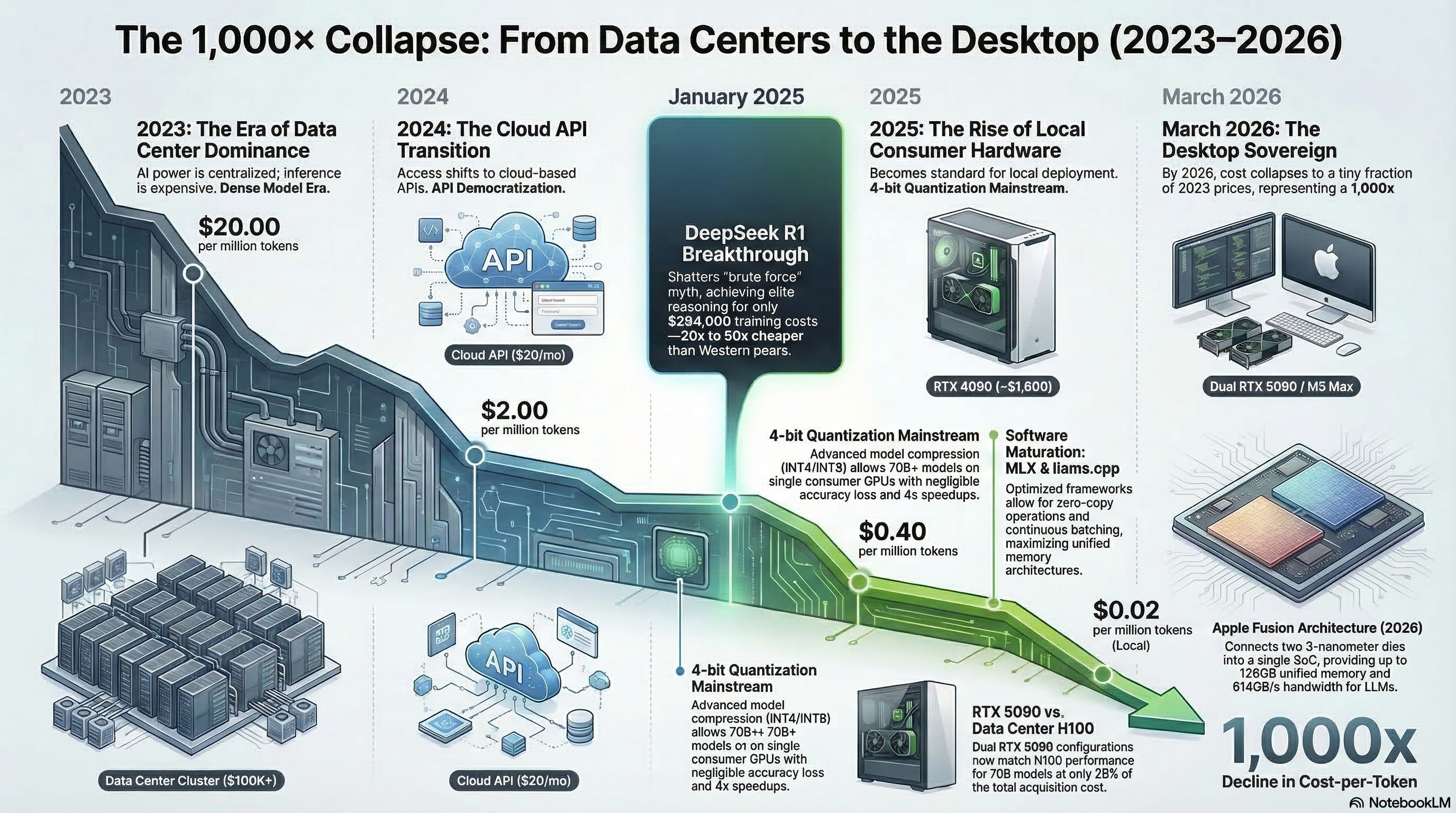
The spreadsheet: the cost of running a GPT-4-class AI model has fallen 1,000× in three years. From $20 per million tokens to $0.40. A $2,000 consumer graphics card now outperforms a $15,000 data center card from 2023. A laptop with 128GB of unified memory runs models that required a server rack two years ago. And a burned-out Austrian founder shipped a weekend project that became one of the fastest-growing open-source projects in history — 247,000 GitHub stars in four months — proving that AI doesn’t require a hundred billion dollars. It requires persistence.
The gates they said would never open? They’re open.
Last week we talked about the $602 billion bet — the chasm between what the AI industry spends and what it earns. This week, let’s look at what’s happening on the other side of that chasm: the hardware that’s making AI accessible to anyone willing to build.
The 1,000× collapse. In early 2023, running GPT-4-equivalent inference cost roughly $20 per million tokens through the API. Today, open-weight models running on consumer hardware bring that cost below $0.02 per million tokens — your electricity bill, essentially. That’s not a typo. That’s three orders of magnitude in 36 months.
Here’s what’s driving it:
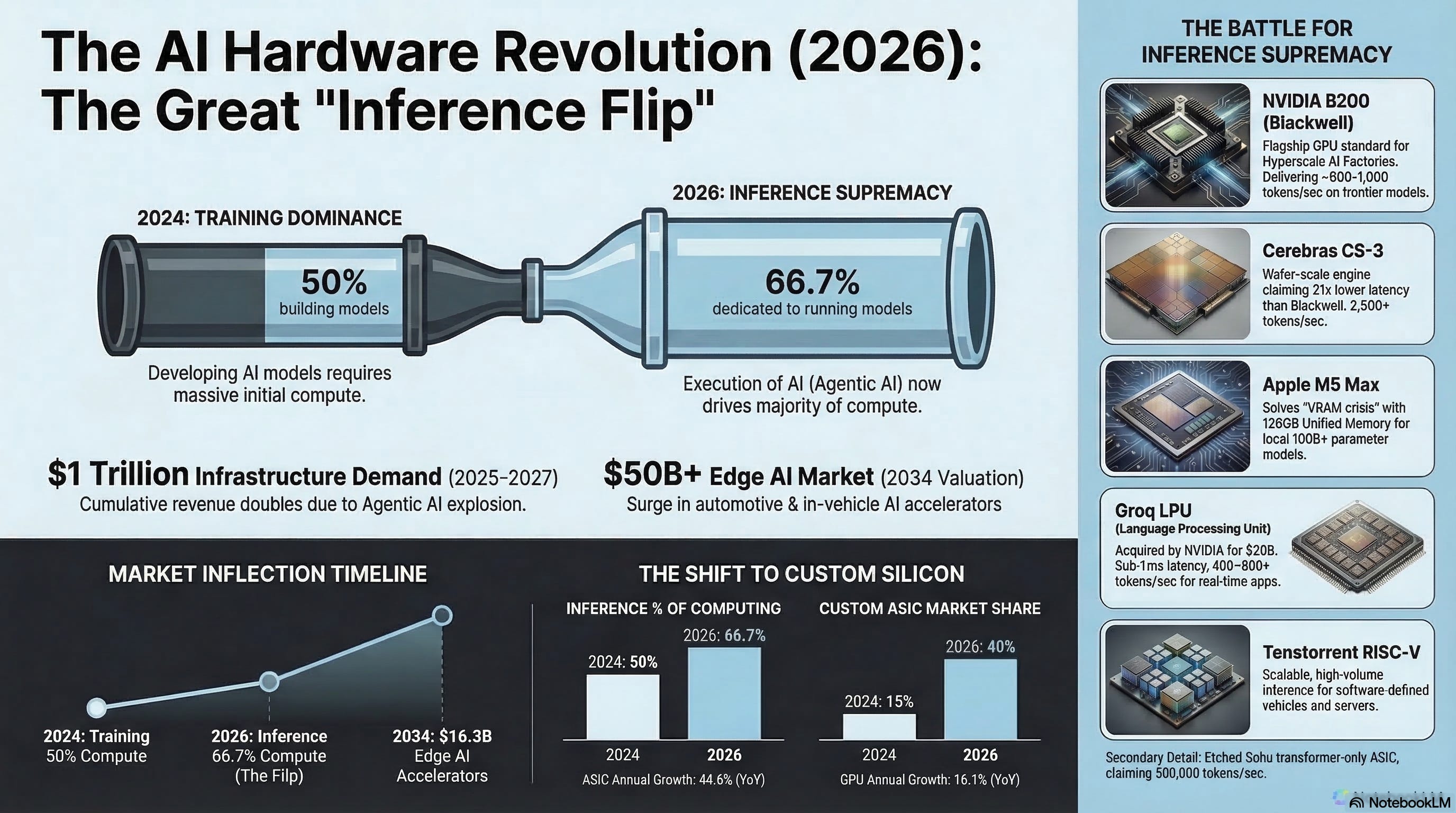
Purpose-built silicon is fracturing NVIDIA’s monopoly. NVIDIA still controls 80–90% of the AI accelerator market, and their data center revenue hit $193.5 billion in fiscal 2026. But their most revealing move wasn’t a product launch — it was paying $20 billion on Christmas Eve 2025 to acquire Groq, an inference-focused chip startup. When a monopolist pays 3× the last valuation to absorb a competitor, it reveals where the real threat lives.
The threats are real and multiplying:
Cerebras Systems builds wafer-scale chips — a single processor spanning an entire silicon wafer with 4 trillion transistors and 900,000 AI cores. Not a cluster of chips. One chip. The size of a dinner plate. They’ve shipped to the Department of Energy, Mayo Clinic, and Argonne National Lab. In January 2026, they signed a $10 billion deal with OpenAI for the largest high-speed inference deployment ever built. By February, they’d raised at a $23 billion valuation — nearly 3× the $8.1 billion from six months prior. Their IPO is targeting Q2 2026. Oracle named them alongside NVIDIA and AMD on its most recent earnings call.
Tenstorrent, led by legendary chip architect Jim Keller — the man who designed Apple’s A4 chip, AMD’s Zen architecture, and Tesla’s self-driving chip — is running the opposite playbook: open everything. Their $1,399 Blackhole developer cards ship with a fully open-source software stack built on RISC-V, the open instruction set architecture. On March 11, they announced the TT-QuietBox 2: a $9,999 liquid-cooled desktop workstation running Llama 3.1 70B at 476 tokens per second. Entirely on-device. No cloud. No subscription. No one watching.
“Whatever NVIDIA does, we’ll do the opposite,” Keller has said. His belief: RISC-V will take over all data centers within a decade. Nations — Japan, Morocco, Cyprus — are already adopting Tenstorrent’s technology for sovereign compute, building AI infrastructure that doesn’t depend on any single American company’s licensing terms.
Apple’s M5 Max, which shipped March 11, delivers 128GB of unified memory at 614 GB/s bandwidth. That’s enough to run 200-billion-parameter models on a laptop you carry in a backpack. The new Fusion Architecture bonds two 3nm dies into a single chip, with neural accelerators in every GPU core delivering 4× the AI compute of the M4 generation.
And then there’s Etched — the cautionary tale. $625 million raised at a ~$5 billion valuation. Claims that one Sohu server replaces 160 H100 GPUs. But as of March 2026: no confirmed shipped products. No independent benchmarks. A Manifold prediction market on whether the chip would ship within a year resolved “No.” Every number comes from the company itself. This matters because in the hardware world, the distance between a press release and a shipped product can be infinite.
This is where the spreadsheet gets personal.
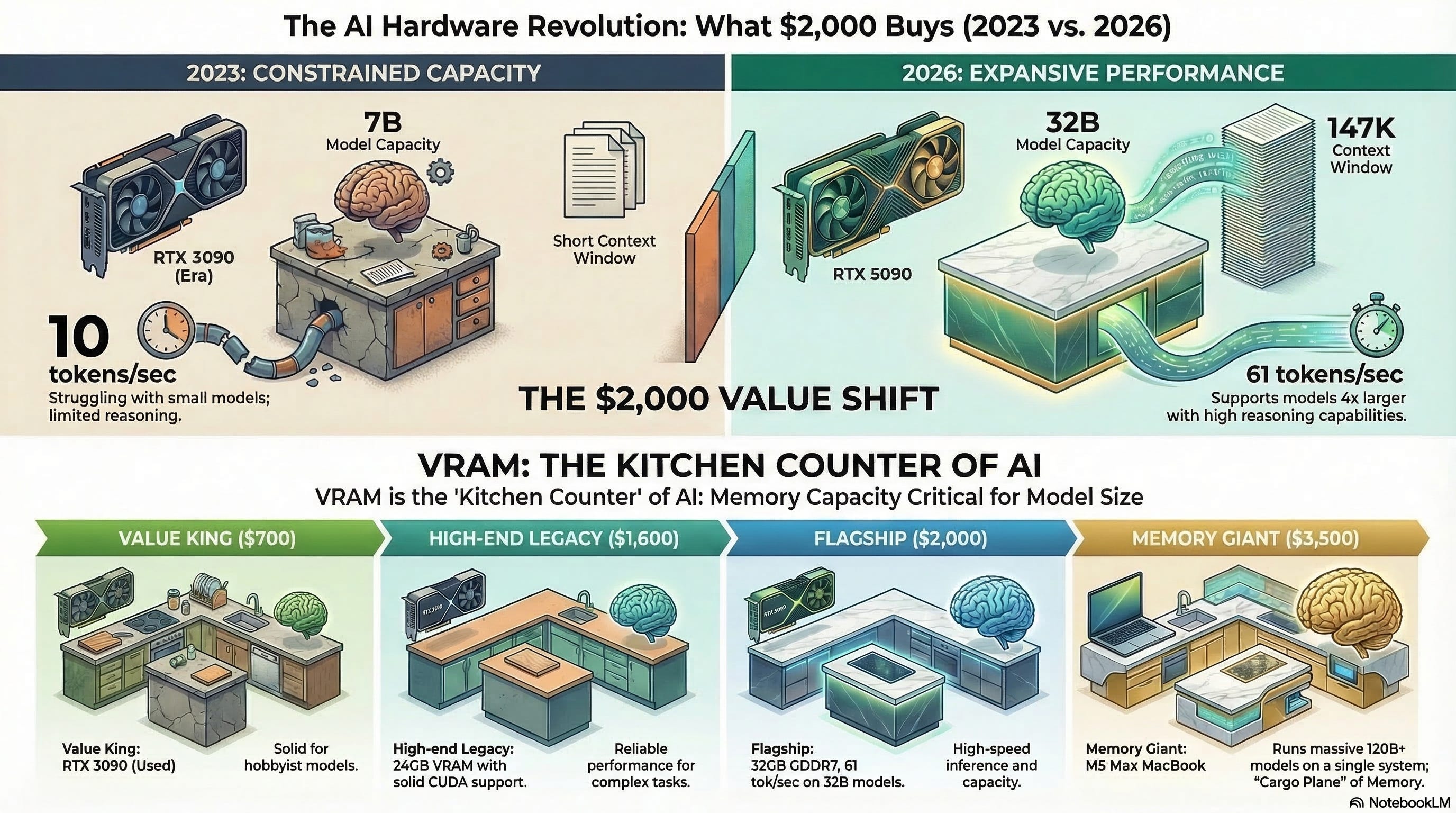
An NVIDIA RTX 5090 — a $2,000 consumer card you can buy at a store — runs a 7-billion-parameter coding model at 5,841 tokens per second. It handles 32-billion-parameter models at 61 tokens per second. It fits a 30-billion-parameter mixture-of-experts model entirely in its 32GB of memory with 147,000 tokens of context.
An RTX 4090, now available for around $1,600, delivers 128 tokens per second on Llama 3 8B. Even an RTX 3090, findable for $700–$900 used, provides 24GB of VRAM and runs 70-billion-parameter models quantized to 4-bit.
Can you run GPT-4-class models locally? Yes. Open-weight models have closed the gap to a 1.7 percentage point difference from closed models on standard benchmarks. DeepSeek V3.2, released under an MIT license, matches GPT-5 at a fraction of the cost. A 4-bit quantized 70B model needs roughly 35GB of memory — achievable on an M5 Max or a pair of RTX 3090s.
The software side has matured to match: llama.cpp runs models on everything from Raspberry Pis to multi-GPU rigs. MLX leverages M5 neural accelerators for a 4× speedup. Ollama has become the “Docker for LLMs” — one command pulls and runs any of 200+ models with automatic hardware detection.
Three years ago, this capability required a $15,000 server in a data center with a monthly cloud bill. Today, it requires a trip to the electronics store and an afternoon.
Peter Steinberger didn’t plan any of this.
After 13 years growing PSPDFKit — a bootstrapped PDF toolkit that reached nearly a billion users and powered apps at Dropbox, IBM, and inside Lufthansa cockpits — he sold the business, stepped down as CEO in April 2024, and stopped coding entirely for a year. Burned out. No challenges. No spark.
The spark came back in late 2025. He built a simple AI agent — something that lives on your machine, talks to you through WhatsApp or Telegram, and can actually do things: manage files, browse the web, execute code, automate workflows. Privacy-first. Model-agnostic. Runs on any hardware, locally or with cloud models. He called it “Clawdbot,” a playful nod to Anthropic’s Claude, and released it open-source. A weekend project.
In late January 2026, two million visitors hit the project in a single week.
GitHub stars rocketed past 100,000. Steinberger was averaging 6,600 commits per month, running four to ten AI agents simultaneously, building most of the codebase by talking to AI rather than typing code. One person, working from Austria, building something that scaled beyond anything he imagined.
Then the obstacles hit. Anthropic sent a trademark complaint — the name was too close to “Claude.” Crypto scammers hijacked copycat websites. He was close to deleting the entire project. His infrastructure costs were bleeding $10,000–$20,000 a month.
And here’s where the human spirit of innovation shows what it does with obstacles: three days later, after what he described as a coordinated, secretive rebranding effort, he renamed the project OpenClaw — spending $10,000 on a Twitter business account just to secure the handle. He routed all sponsorship money to dependencies rather than himself.
By March 2026, OpenClaw had 247,000 GitHub stars, 47,700 forks, and over 1,200 contributors. A separate platform called MoltBook — a social network exclusively for AI agents — reached 2.8 million registered agents. The ecosystem exploded: 5,400+ community-built skills. Integrations with 20+ messaging platforms. A grassroots robotics community connecting OpenClaw to Unitree humanoids, robotic arms, drones, and even $1.50 microcontrollers in China.
The acquisition offers came from everywhere. OpenAI. Meta. Anthropic. A personal call from Satya Nadella at Microsoft.
On February 14, Steinberger joined OpenAI. Sam Altman confirmed: “He is a genius with a lot of amazing ideas about the future of very smart agents.” But this was a talent hire, not a corporate acquisition. OpenClaw itself transitioned to an independent open-source foundation, with OpenAI as a sponsor. The software remains free. On March 10, Meta separately acquired MoltBook, bringing its founders into Meta’s Superintelligence Labs.
The most telling signal came from China, where a cottage industry of OpenClaw installers emerged overnight — charging $15–$100 per setup. One programmer quit his job and hired over 100 employees to handle 7,000+ installation orders. Tencent launched a full suite of AI products built on OpenClaw compatible with WeChat.
From a burned-out founder’s weekend project to a global phenomenon in four months. No institutional backing. No venture funding for the project itself. Just persistence, open-source conviction, and the momentum that builds when you’re genuinely trying to contribute something useful to the world.
Here’s what the convergence of purpose-built silicon, collapsing costs, and the OpenClaw story tells you if you’re building right now:
The hardware barrier is gone. What remains is the motivation barrier.
You don’t need hundreds of billions. You don’t need a data center. You don’t need NVIDIA’s permission. You need a clear idea of what you’d keep building even if the rewards were delayed — what problem you’d solve even if nobody was watching. Because the obstacles will still come. Steinberger nearly deleted his project three times. The crypto scammers, the trademark complaints, the $20,000/month infrastructure costs — none of that was in the plan.
What carried him through was something no GPU can provide: genuine desire to build something useful, and the human awareness to know when to push forward and when to pivot. AI can be 5,841 tokens per second on an RTX 5090. But it can’t tell you what to build. That’s your intuition. Your gut. The part of you that no model can replicate.
One way to think about AI is as an extension of your mind — not a replacement for it. A way to catalyze and nurture the gifts and talents you already have. Steinberger didn’t become a different person when he started building with AI. He became a more amplified version of the person he already was — a meticulous builder who cares deeply about craft and independence.
The practical takeaway for builders:
For a few thousand dollars, you can run frontier-class AI entirely on your own hardware. No API costs. No rate limits. No one reading your prompts. That changes the economics of building with AI from “recurring subscription that scales with usage” to “one-time investment that compounds forever.”
A solo developer in India documented using an RTX 3060 with Ollama for local development — $540–$720 for the GPU, then near-zero marginal cost. A Munich law firm moved contract analysis to Llama 3 70B in 4-bit quantization inside a VPN, eliminating NDA risks and saving €600 per month. One developer repurposed six old cryptocurrency mining GPUs — totaling 96GB of VRAM — to run 70-billion-parameter models locally.
In Africa, the Africa Compute Foundation in Nairobi provides GPU access at up to 40% cheaper than global hyperscalers, expanding across 20+ countries. Lelapa AI in South Africa is training multilingual models across five African languages. Nigeria’s N-ATLAS became the country’s first multilingual AI model.
These aren’t Silicon Valley stories. That’s the point.
Other people are doing exceptional work on these themes. Your time is well spent with any of these:
Peter Steinberger wrote “OpenClaw, OpenAI and the future” — a first-person account of building the most viral open-source AI project of the year, the emotional lows of nearly quitting, and why he chose OpenAI over Meta. Raw, honest, and exactly the kind of builder story that doesn’t get told enough.
Sally Ward-Foxton at EE Times has done the best long-form interview with Jim Keller on RISC-V, open source, and the future of AI hardware. Keller’s conviction that open hardware beats proprietary hardware in the long run mirrors the open-source AI thesis — and his track record (Apple A4, AMD Zen, Tesla FSD chip) means he’s earned the right to make that bet.
MIT Technology Review published “Hustlers are cashing in on China’s OpenClaw AI craze” — a fascinating look at how a Western open-source project spawned an entire economy of installers, customizers, and derivative businesses in China within weeks. The grassroots adoption patterns here are a preview of how AI tools will spread globally.
An arXiv research paper on “Democratizing AI Development: Local LLM Deployment for India’s Developer Ecosystem” documents real benchmarks of running open-weight models on affordable consumer hardware in Indian conditions — including multilingual performance data across Hindi, Tamil, and other languages. If you’re building for or from the Global South, this is essential reading.
Three issues ago, we talked about the distance between an idea and its impact. Two issues ago, we showed you the hidden tax in every AI conversation. Last week, we laid out the $602 billion bet and asked who pays when the subsidy era ends.
This week, the answer is clearer than it’s ever been: you don’t have to wait for them to figure it out.
The hardware revolution isn’t coming. It’s here. Purpose-built chips are shipping. Open-source stacks are production-ready. A weekend project from a solo founder reached 247,000 stars because it solved a real problem with genuine conviction. The resistance between “I have an idea” and “this idea is running on my hardware” has dissolved to almost nothing.
The barriers that remain — the obstacles that feel immovable — they’re not what they appear. They’re temporary. Every great shift in technology has had its moment where the gatekeepers seemed permanent and the doubters seemed wise.
Next week: The gatekeepers who became believers. From JP Morgan to the SEC — when Bitcoin converted the naysayers into adopters, it revealed something fundamental about the human spirit of innovation. What today’s obstacles can learn from that story.
Keep building. Meet your obstacles. They dissolve.
Where the world is opening up — and where it’s closing.
— Praveer, founder of kontinuity.space and dtoxify.life
No posts
Comments
Nothing yet. Say the first thing.
Sign in to join the conversation.