
I want to tell you two things. One is idealistic. The other is a spreadsheet. They’re connected.
The idealistic thing: every obstacle you’re facing right now — the cost, the gatekeepers, the skepticism, the people telling you it won’t work — will one day look like a mirage. Not because you ignored the obstacles. Because you built through them.
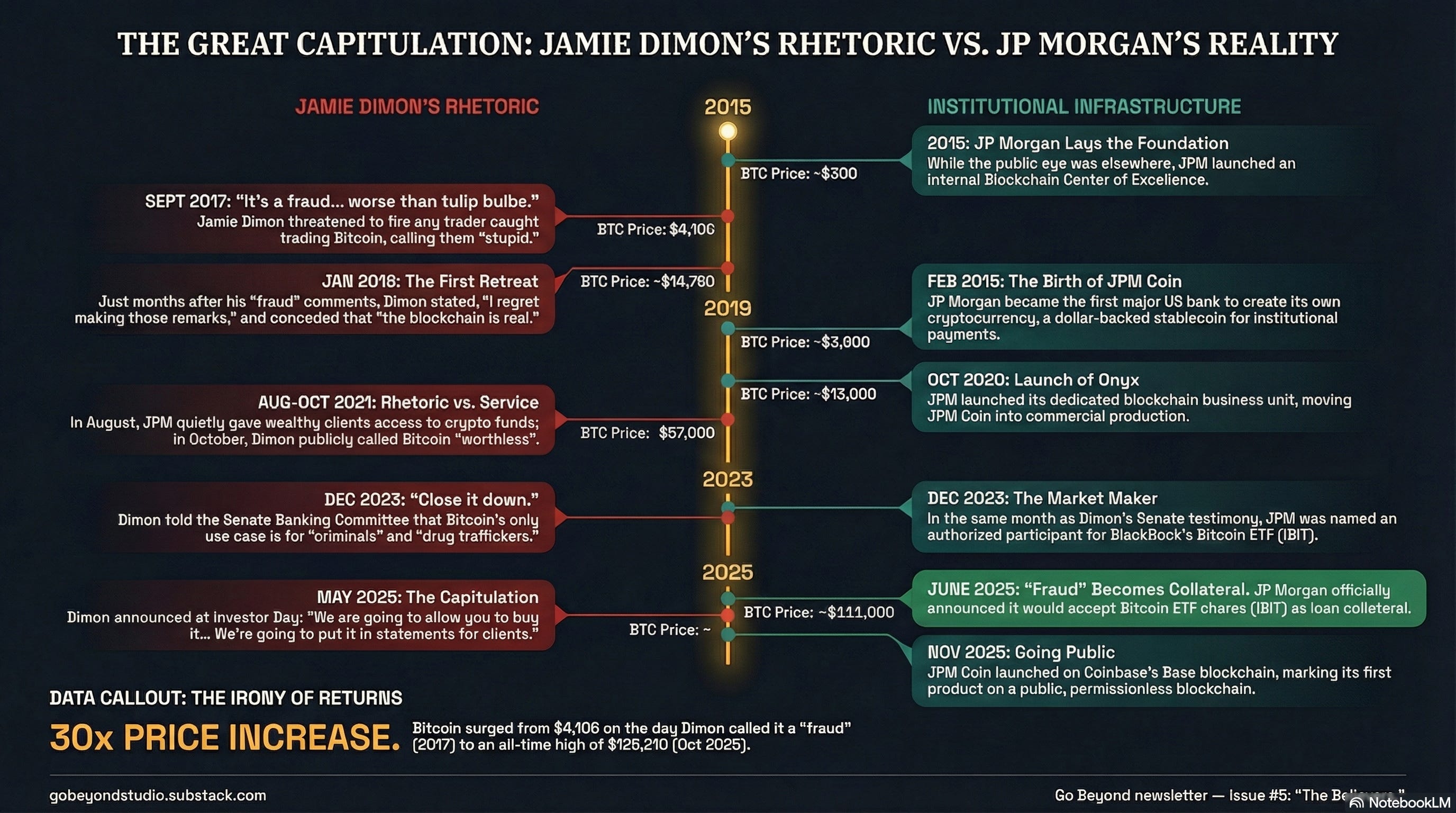
The spreadsheet thing: On September 12, 2017, Jamie Dimon — the CEO of JP Morgan, the most powerful banker on Earth — called Bitcoin “a fraud.” He said it was “worse than tulip bulbs.” He said he’d fire any trader who touched it “in a second.”
Bitcoin’s price that day: $4,106.
Eight years, a dozen denials, and one capitulation later — in May 2025 — Dimon told JP Morgan’s Investor Day: “We are going to allow you to buy it.” Bitcoin: $111,000. By June, JP Morgan was accepting Bitcoin ETF shares as loan collateral. The fraud had become balance-sheet-grade collateral at his own bank.
Here’s the part that matters for builders: JP Morgan was building the entire time Dimon was denying. A Blockchain Center of Excellence in 2015. Their own cryptocurrency, JPM Coin, in 2019. A full blockchain business unit by 2020. An authorized participant role in BlackRock’s Bitcoin ETF by late 2023.
The CEO said fraud. The institution said infrastructure.
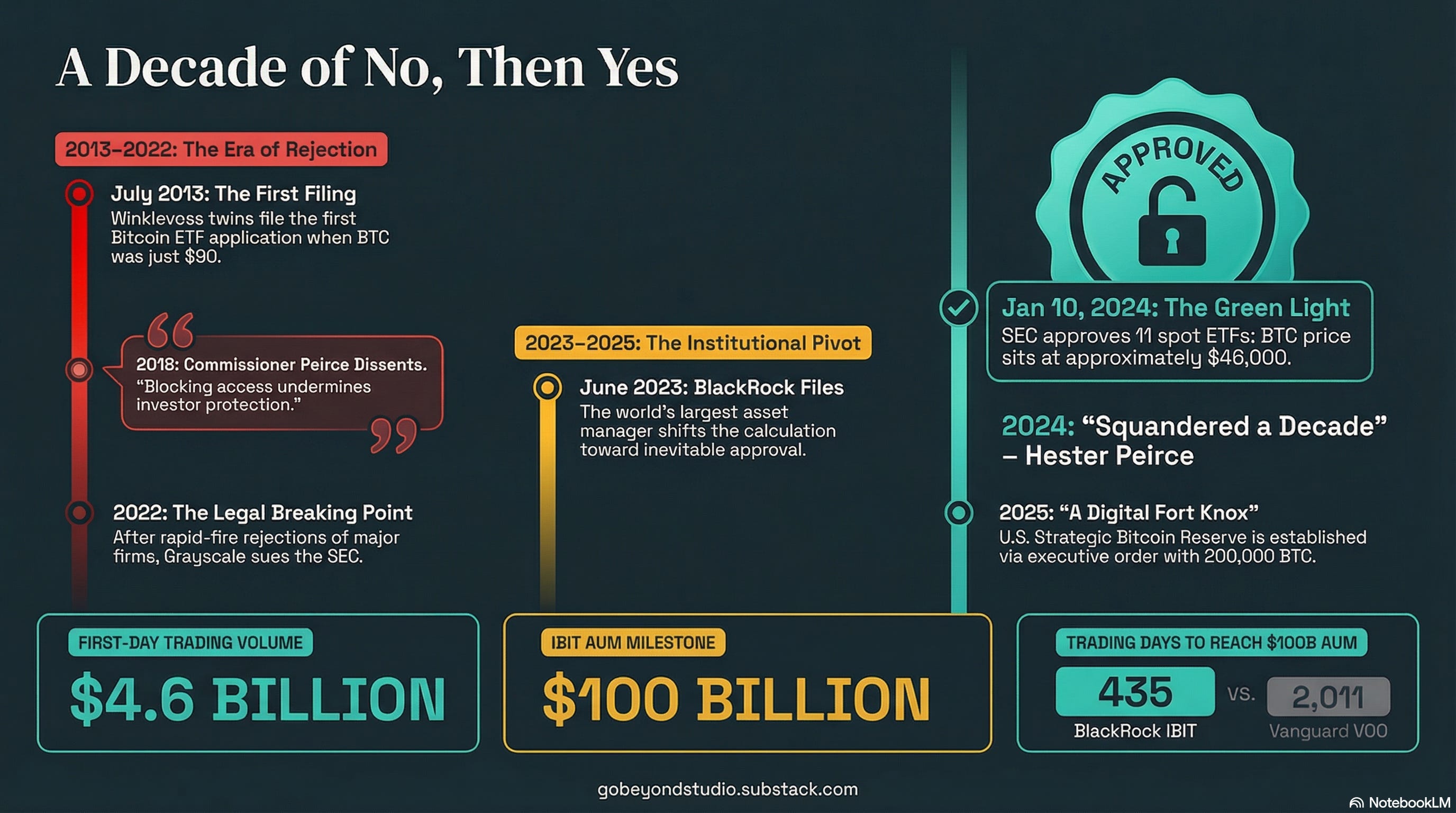
The SEC’s arc is even longer. From the Winklevoss twins filing the first-ever spot Bitcoin ETF application in July 2013 — when Bitcoin was $90 — through a decade of rejections, to the 3-2 approval vote on January 10, 2024, that opened the floodgates. BlackRock’s IBIT became the fastest ETF in history to reach $100 billion in assets under management. First-day trading volume alone: $4.6 billion. By March 2025, Trump signed an executive order creating a U.S. Strategic Bitcoin Reserve — a “digital Fort Knox” seeded with 200,000 BTC from federal forfeitures.
From an asset regulators wouldn’t touch to a strategic national reserve in twelve years.
The believers always outlast the naysayers. But the naysayers don’t disappear — they reposition. That’s the pattern.
The spreadsheet tells you about institutions converting. It doesn’t tell you about the people who never needed converting — the ones who were building the whole time. Not for the price chart. Because the technology solved a problem no one else was solving.
Kgothatso Ngako grew up in Mamelodi township near Pretoria, South Africa. He worked as a developer at AWS. Then in May 2022 — with Bitcoin crashing toward $15,700 — he launched Machankura.
Over 600 million people in sub-Saharan Africa have no internet access. They have basic feature phones — physical buttons, tiny screen, no apps. But they can make USSD calls, the same protocol behind mobile money systems like M-Pesa.
Machankura is a Bitcoin Lightning wallet that works on those phones. No internet. No smartphone. No app store. Dial a number, navigate a menu, send or receive Bitcoin.
He launched it into the worst bear market in crypto history. Self-funded. While the headlines screamed “crypto is dead,” Machankura grew tenfold — from a few hundred users to nearly 3,000 across eight African countries during the crash. By March 2026, it connects to over 39,000 phones.
He wasn’t waiting for Dimon to change his mind. He was building for people who don’t have a JP Morgan account to begin with.
Janet Maingi and Erik Hersman founded Gridless Compute in early 2022. Their premise: across rural Africa, small renewable energy sites generate more power than local communities can use. That surplus is wasted. What if you mined Bitcoin with it — and used the revenue to make the energy infrastructure financially viable?
They raised $2 million during the depths of the bear market. Then built six mining sites across Kenya, Malawi, and Zambia — every one powered entirely by renewables. Geothermal near a volcano in Kenya. Hydroelectric in Malawi. Solar in Zambia.
The result: their operations have helped electrify 1,200 houses in Zambia, 1,800 in Malawi, and 5,000 in Kenya — plus health centres, a tea factory, cold storage for farmers, and battery charging stations.
Bitcoin mining — the thing critics called an environmental catastrophe — is literally turning on the lights in rural African communities. That’s the gap between headline and reality.
Bernard Parah is a 30-year-old from Jos, Nigeria. In 2016, the Central Bank of Nigeria restricted naira cards from international transactions. Parah was studying abroad and couldn’t access his own money. Bitcoin was the only thing that worked.
He built Bitnob — a Bitcoin-native financial services app using Lightning Network for cross-border payments. When Nigeria’s Central Bank banned banks from serving crypto customers in 2021, he kept building. When crypto winter hit, he kept building.
He integrated with Strike to launch instant dollar-to-naira transfers — using Bitcoin as invisible infrastructure. The users don’t need to know or care about Bitcoin. Their money arrives in seconds instead of days, at a fraction of the traditional cost.
Nigeria — where 36% of the population is unbanked — received $92.1 billion in cryptocurrency value between June 2024 and 2025. The gatekeepers tried to shut it down. The builders found another way.
The thread connecting Ngako, Maingi, and Parah: none of them built for the price chart. None waited for permission. Each one solved a problem — financial access, energy infrastructure, capital controls — that institutions weren’t solving. The share of crypto developers from non-Western countries grew from 18% in 2018 to 36% in 2023. That’s not a trend. That’s a transfer of agency. And it happened during a crash. It always does.
The obstacles facing AI builders in 2026 mirror early Bitcoin opposition almost point for point. The “it’s a bubble” narrative — Ray Dalio compared AI to the dot-com boom. Energy consumption criticism — AI data centres now consume roughly 415 terawatt-hours per year, double Bitcoin’s usage. Regulatory uncertainty — the EU AI Act requires full compliance by August 2026. And the institutional skepticism — the 10:1 spending-to-revenue gap we covered in Issue #3 hasn’t closed.
These are real concerns. The idealist with a spreadsheet doesn’t ignore the spreadsheet.
But the pattern. Every gatekeeper who resisted Bitcoin — Dimon, the SEC, national governments — eventually converted. Not because they changed their values. Because the value became undeniable. Many former Bitcoin miners are already pivoting to AI data centres, repurposing the exact same infrastructure. The convergence is physical — the power stations that mine Bitcoin during the day are training AI models at night.
If you’re building an AI product today and facing cost barriers, regulatory uncertainty, or people telling you the whole thing is a house of cards — you are standing exactly where Kgothatso Ngako stood in May 2022, launching a Bitcoin wallet for feature phones into a 75% crash.
The obstacles feel permanent. They’re not. They’re just loud.
One week ago — March 18, 2026 — Apple quietly blocked updates for popular vibe-coding apps, including Replit and Vibecode, from the App Store.
“Vibe coding” — a term coined by AI researcher Andrej Karpathy in early 2025 — means building software through natural language prompts rather than writing code. A teenager with a phone can describe an app in words and have it running in minutes. It’s one of the most powerful democratisation moments in computing history.
Apple isn’t blocking apps built with AI tools. It’s blocking apps that provide vibe-coding capabilities — apps that let users generate and deploy new apps inside them. Apple’s argument is security: these become unreviewed distribution platforms.
But the context demolishes the argument. In February 2026 — six weeks before blocking Replit — Apple released Xcode 26.3 with native AI coding integration from Anthropic and OpenAI. Apple’s own VP: “Agentic coding supercharges productivity and creativity.”
So Apple simultaneously promotes AI coding through its own tool, blocks third-party vibe-coding apps, and partners with the very AI companies powering those tools. The message: vibe-code all you want, as long as you do it Apple’s way and pay Apple’s 15-30% commission.
We’ve seen this movie before. Apple blocked third-party apps entirely in 2007 — then launched the App Store a year later. Removed all Bitcoin wallets in 2014 — reversed within months. Killed PWA support in the EU in 2024 — reversed after 500+ complaints and a €500 million fine.
Resistance. Backlash. Reversal. Every time.
In Issue #4, we saw hardware barriers dissolving — a $2,000 GPU outperforming a $15,000 data centre card. Now the software distribution barrier is the one being tested. When JP Morgan adopts Bitcoin, it’s not the same revolution the cypherpunks envisioned. When Apple eventually embraces vibe-coded apps, it’ll be on Apple’s terms. The gate opens, but the gatekeeper still collects the toll.
That’s the closing. The obstacles dissolve — but the new landscape isn’t the one the builders imagined.
Alessandro Ottaviani — “Bitcoin 2024-2026: The Triennium of Institutional Adoption” (Atlas21). The definitive account of the institutional capitulation arc, from the $15,500 low to strategic reserves. Read it here: https://atlas21.com/bitcoin-2024-2026-the-triennium-of-institutional-adoption/
Jared Busby — “Build in a Bear Market” (Crypto Confidence on Substack). “The tourists leave and the builders stay. Bull markets do not create innovation. They reveal it. Winter is when the work gets done.” Read it here:
Mervyn Chua — “AI Bubble: Parallels Between the Rise of Crypto and AI.” “AI is real. The bubble is too. One doesn’t cancel out the other.” Read it here: https://mervynchua.com/ai-bubble-parallels-between-the-rise-of-crypto-and-ai/
MindStudio — “Apple vs Vibe Coding: Why Apple Is Blocking Replit and Vibe Code from the App Store.” The most thorough analytical explainer — fair-handed, distinguishes security concerns from revenue protection. Read it here: https://www.mindstudio.ai/blog/apple-blocking-vibe-coding-apps-explained
Kgothatso Ngako didn’t wait for feature phone users to get smartphones. He built for the phones they had. Janet Maingi didn’t wait for Bitcoin mining to become respectable. She used it to turn on lights. Bernard Parah didn’t wait for the Central Bank to change its mind. He built around the restriction.
Not a single one of them needed Jamie Dimon’s permission. The SEC’s approval. Apple’s App Store.
Every obstacle you see now will be looked back on as a mirage. Not because the obstacles weren’t real. They were. But because the human spirit of innovation — the refusal to stop building — converts naysayers into adopters every single time.
The pattern has a 100% success rate.
Keep building. Keep meeting your obstacles. They dissolve.
Next week: the company that opened computing and closed it again. Apple turns 50 — and it’s outsourcing its brain to Google.
— Praveer, founder of kontinuity.space and dtoxify.life
No posts
Comments
Nothing yet. Say the first thing.
Sign in to join the conversation.