
Hello and welcome to the Go Addressable Certification Program – a course designed to deepen your knowledge about Addressable Advertising, provide best practices for targetable and effective advertising in an age of fragmentation, and offer you certifiable expertise from a range of the best minds in TV advertising.
The course is hosted by media expert Evan Shapiro, noted media writer and analyst. This video is our first lesson in the Certification course – an introduction to the topic from Shapiro and featuring his special guest, Matt Van Houten, SVP of Product and Partnerships at DIRECTV Advertising, as well as a past Chair of the Go Addressable trade organization.
Below, you will find an outline of important terms and concepts from the lesson, as well as downloadable images of the charts and infographics included in this class.
In this same Substack, you will find Class #2, focusing on Identity. After going through these first two classes, you’ll be offered a Quiz, where you can test your retention of these lessons and receive an Addressable Advertising Certification Badge that you can display on LinkedIn.
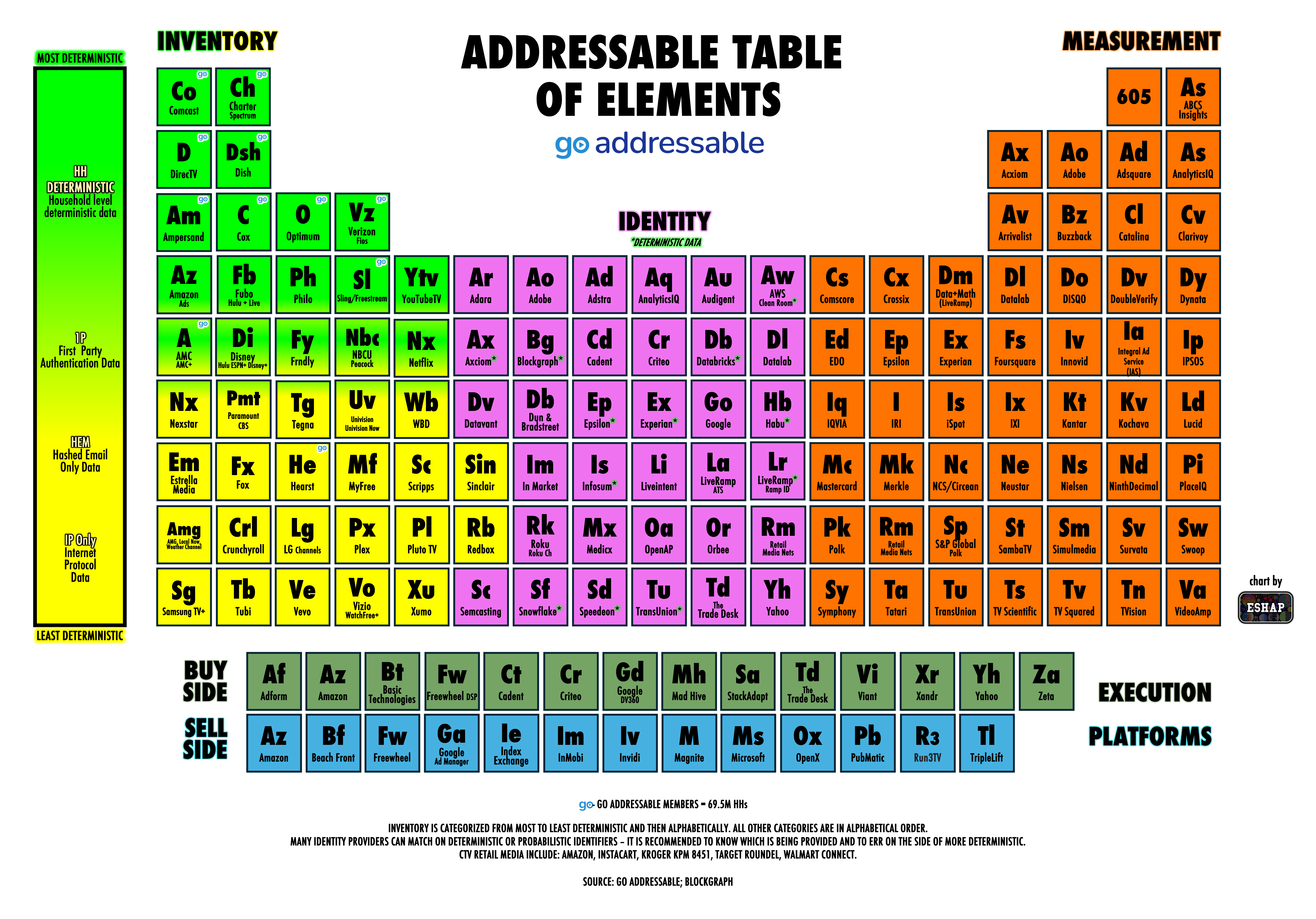
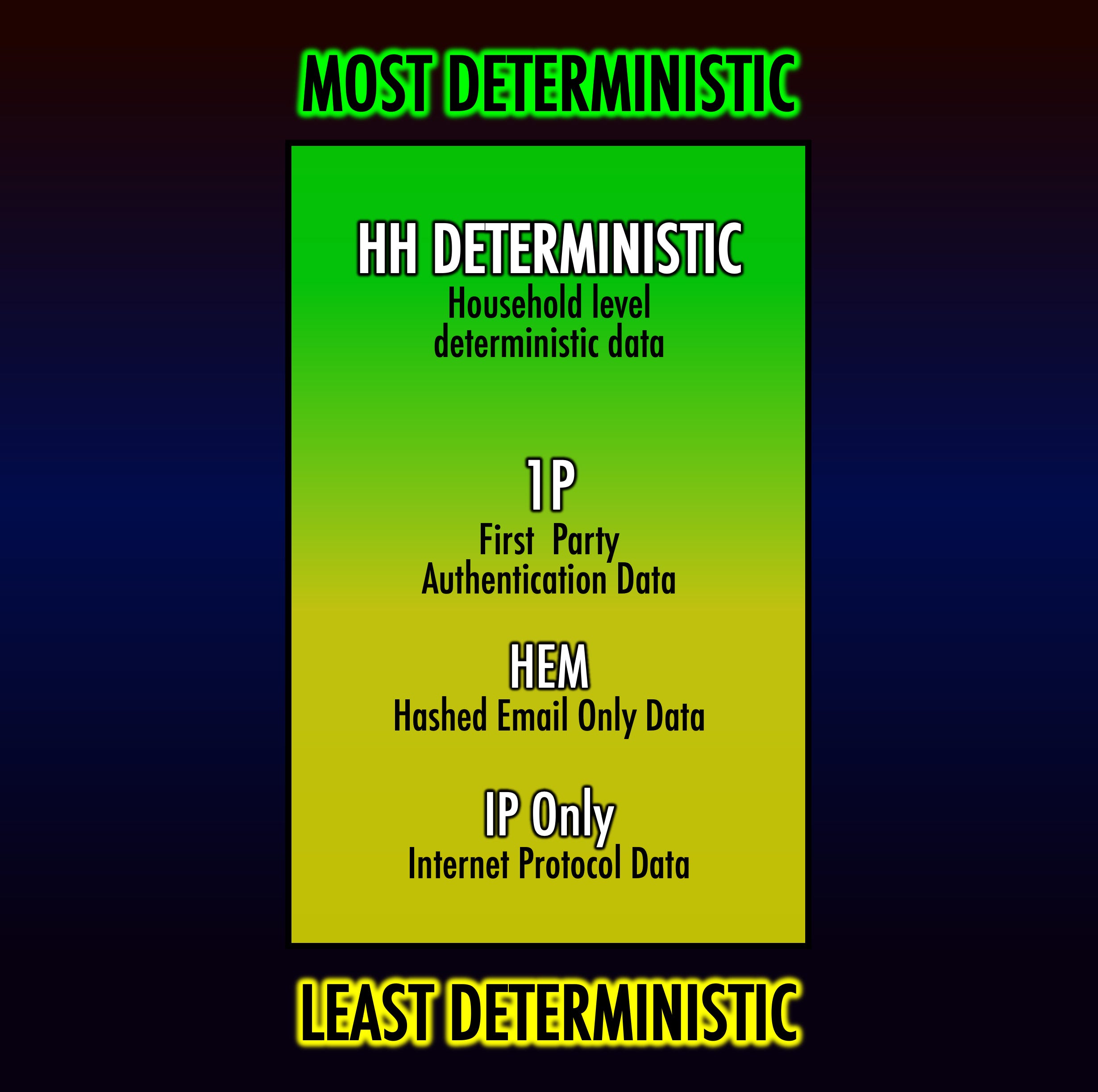
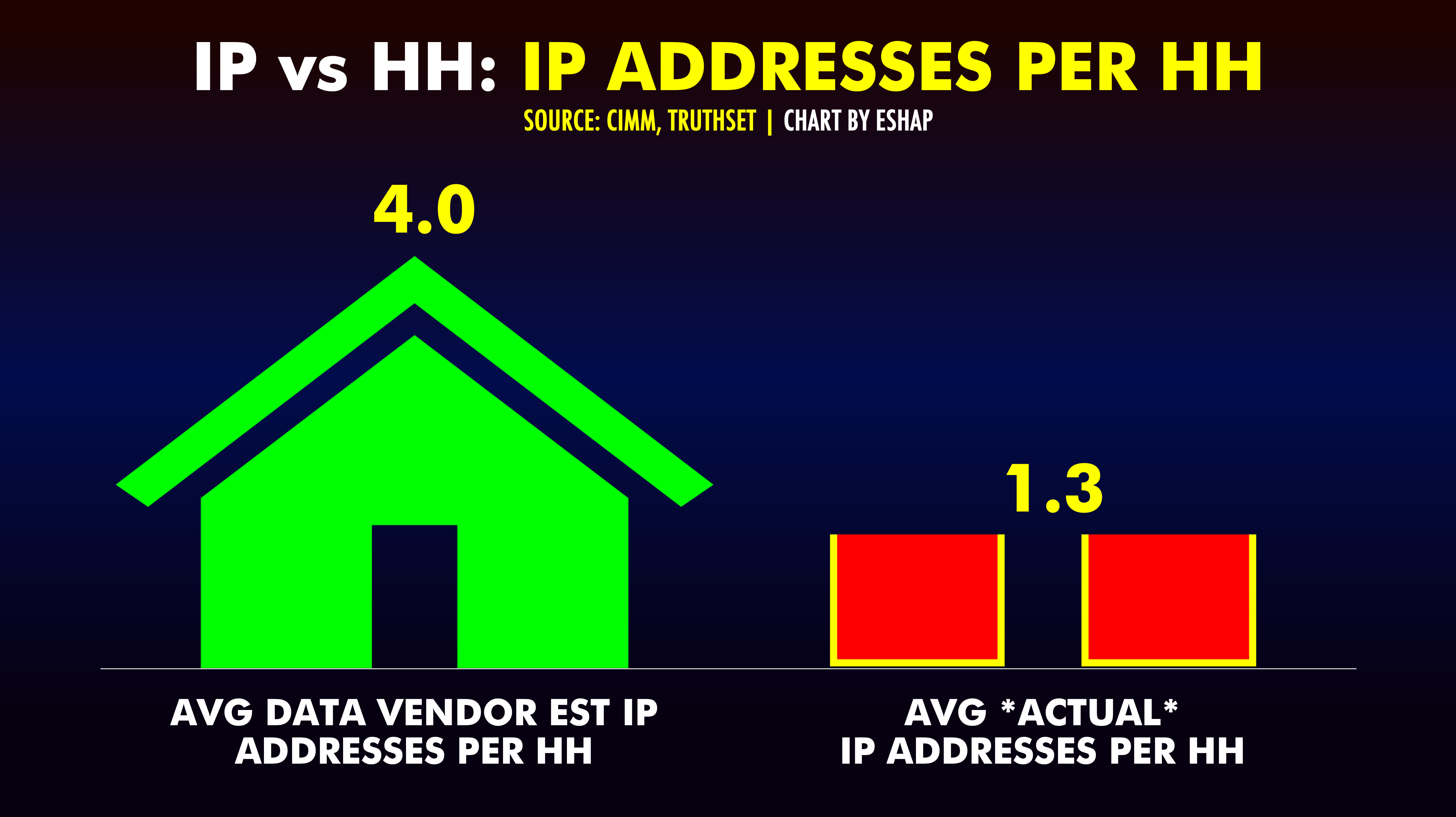
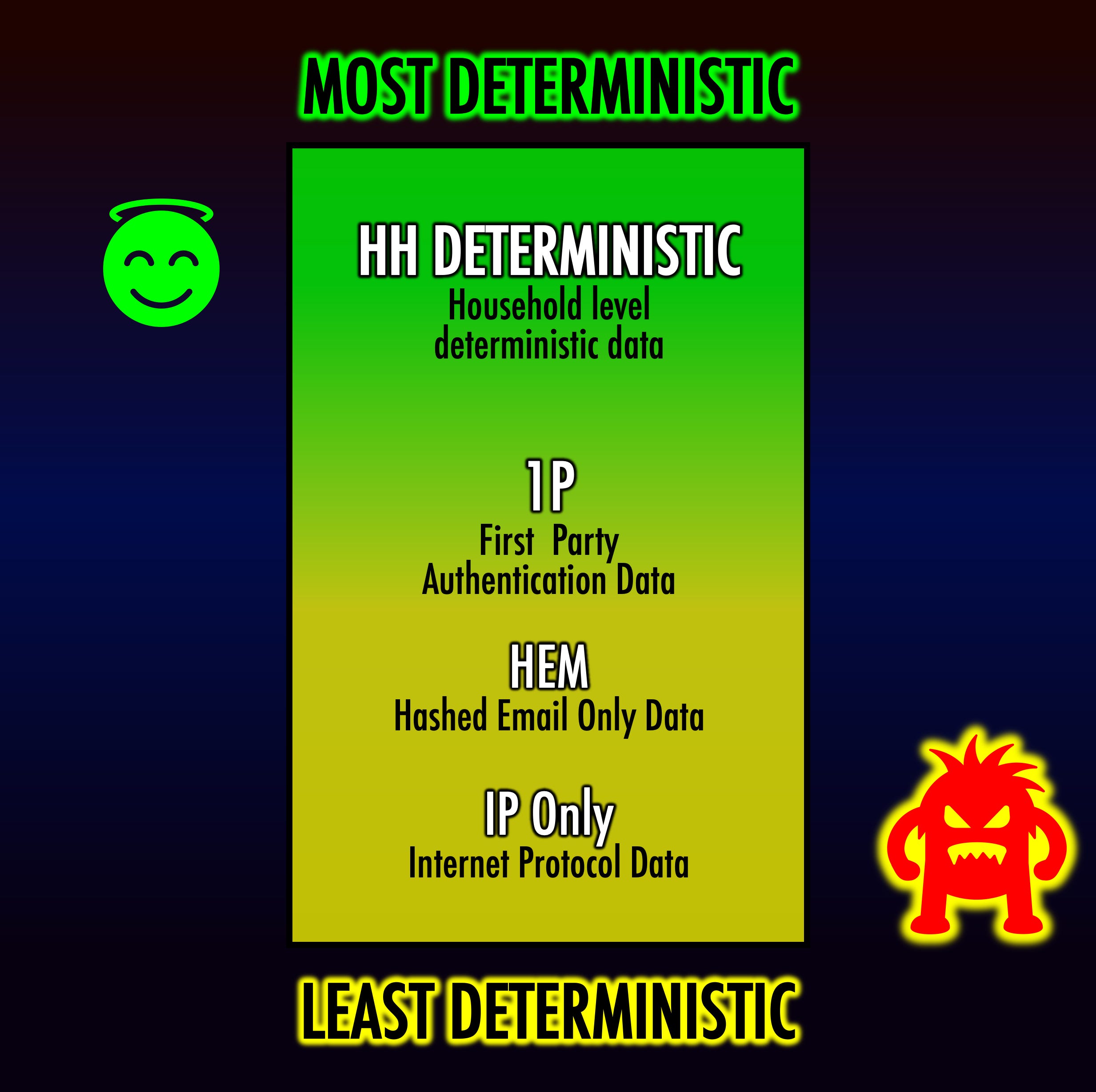
Least Deterministic/Least Accurate: IP protocol or IP addresses. Although many people think IP addresses are accurate, they are increasingly inaccurate, largely because the law now requires providers to cycle through IP addresses to maintain privacy. Other factors include multi-unit dwellings like apartment buildings, and the natural rollover of phones and modems. Consequently, there are far more IP addresses for sale than there are actual humans using them.
Next Level Probabilistic: Hashed email addresses. Although many think of hashed or regular emails as reliable first-party data, users can often have multiple email addresses, including those invented just to sign up free for something then never used again, or old emails from previous jobs or older services like AOL. This means there are many bad/defunct email addresses in the world. However, there is no standard quality measurement for data pools that vendors offer to customers.
Lowest Level Deterministic: First-party data (1P), typically email addresses, log-in information from users, shopper loyalty data, or purchasing histroies. However, without a unifying identity tying them together, this data cannot always be connected to actual consumers. Once again, a lack of industry-wide, uniform data quality standards means there are large caches of 1P data that lack demonstrable accuracy.
True Deterministic Data: Specific identifier such as postal addresses, properly anonymized, yet tied to phone numbers, billing information, along with emails tied to the data above. These are connected through a direct billing relationship that Pay TV providers have. This data can be pooled with a brand’s 1P data to build a targetable audience of most-likely buyers and which can be used to track the true performance of a campaign on the back end of an advertising campaign.
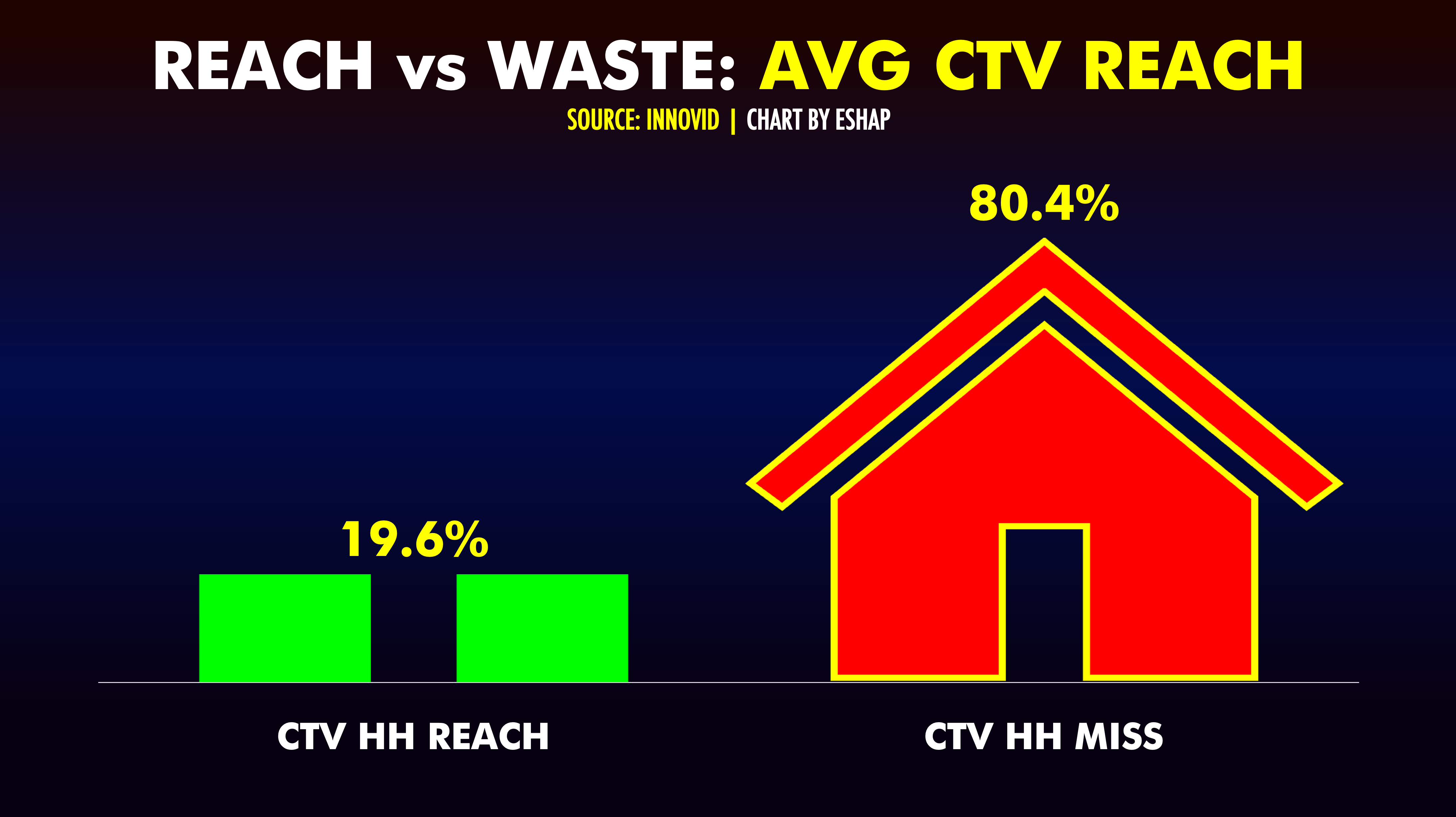
As Matt Van Houten says in the class, 85% of impressions are delivered to just 30% of the intended audience. This means the heaviest TV viewers may see an ad many times, while lighter TV viewers likely never see it. Addressable technology helps redistribute impressions toward lighter TV viewers by “capping” impressions against heavy TV viewers and redistributing the campaign weight where it can extend reach to targeted potential consumers.
Identifying the audience with a high degree of confidence and delivering the ads on the front end
Accurate post-campaign performance metrics on the back end for analysis and measurement against the brand’s Key Performance Indicators (KPIs)
Reach frequency management to ensure optimal exposure across heavy and light TV viewers
Access to premium, brand safe and fraud free inventory
Brand health studies
Website visitation data (typically using mobile opt-in)
Location visitation (aka “foot traffic analytics”)
Sales lift (using sales data and campaign exposure data)
Achieve cost-effective media investment with strategic focus on relevant audiences
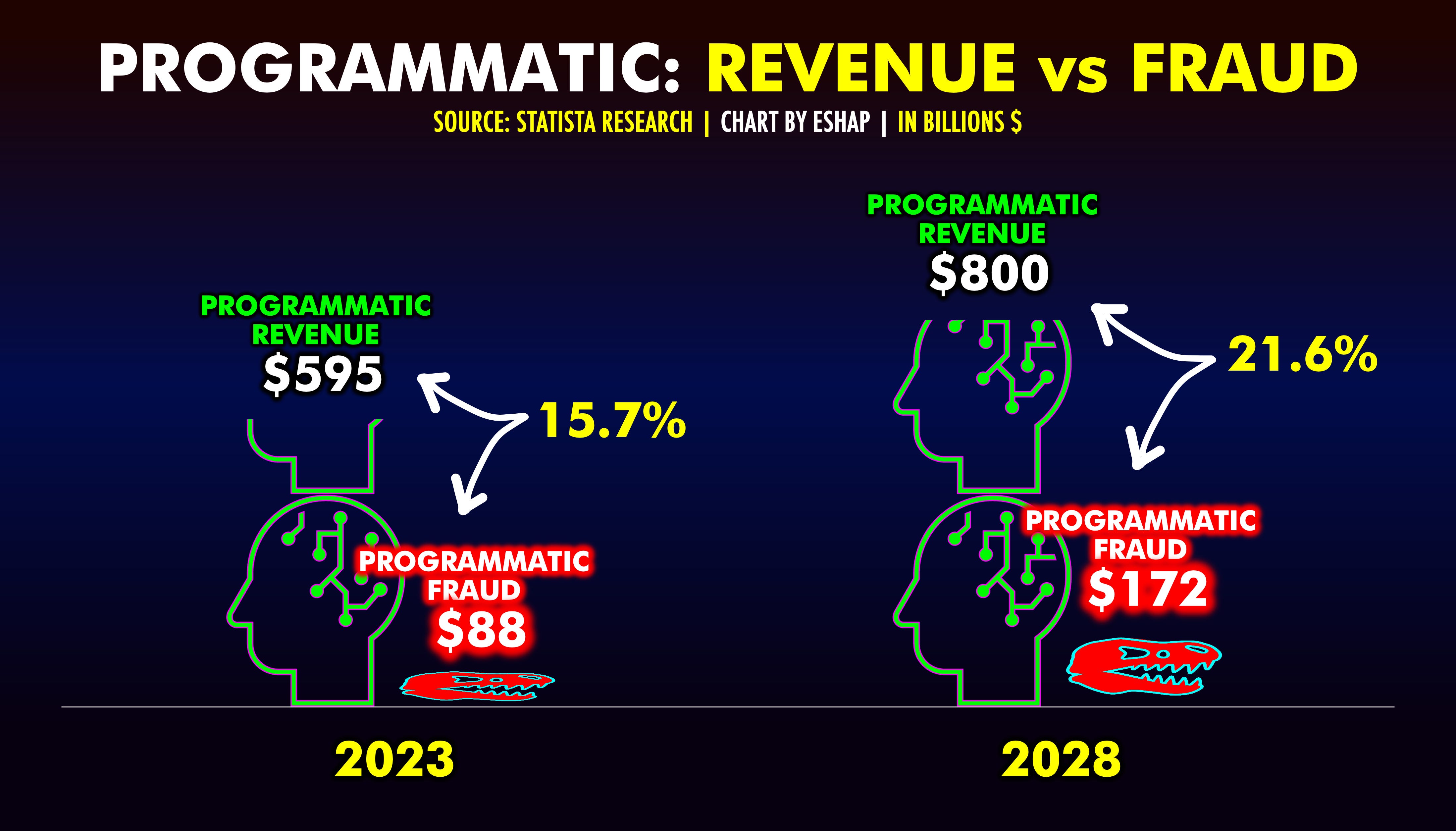
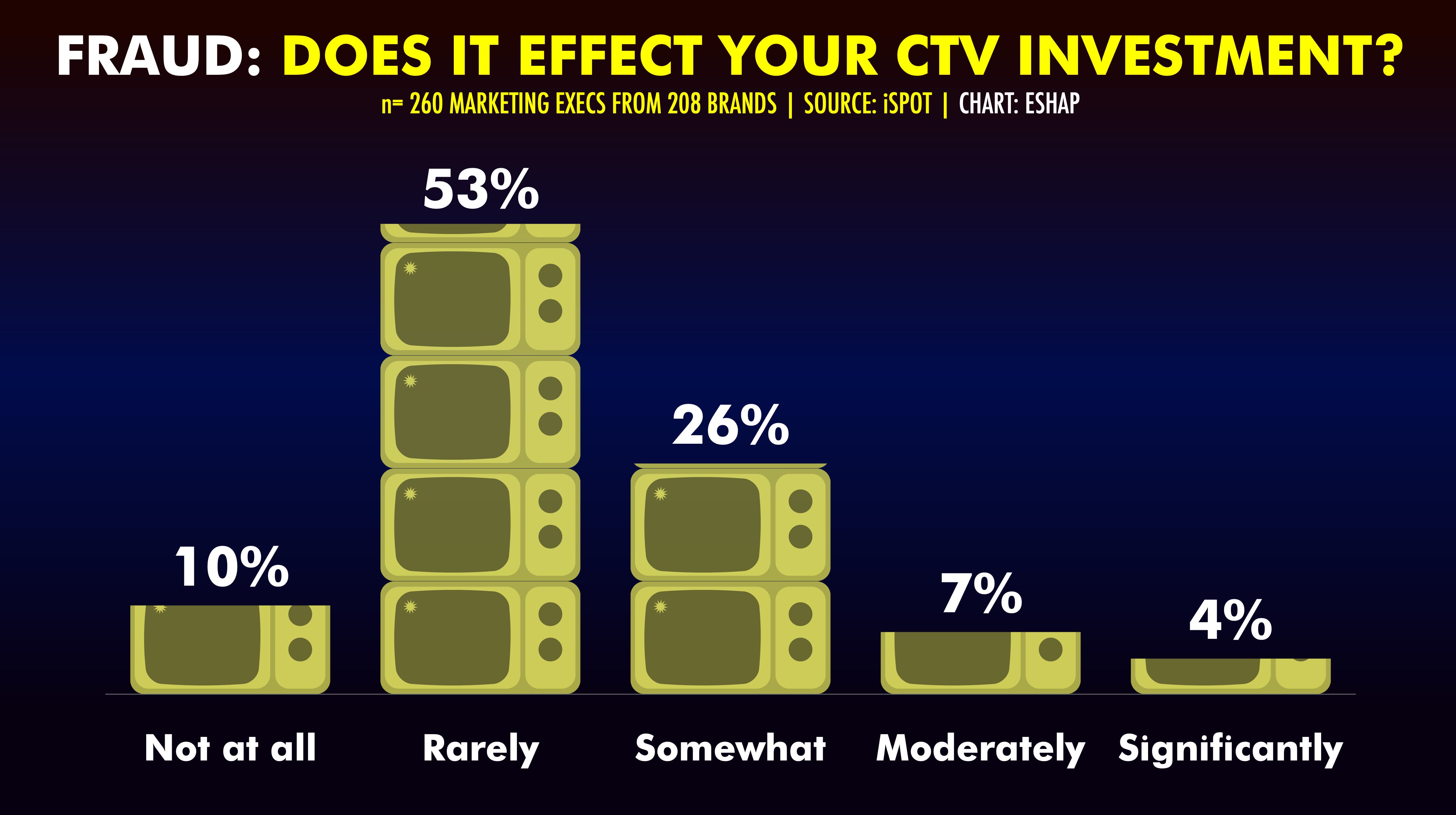
Brands/agencies win because their message can be managed for quality of frequency, and they can eliminate waste in their media buys.
Inventory owners/publishers/MVPDs win because they can better manage their ad inventory to provide access to the most premium quality inventory.
Viewers and consumers win because they see more relevant ads and not the same repetitive ads, over and over.
Addressable TV Advertising: A data-driven method to deliver relevant ads to specific individuals or households using deterministic identifiers.
ROAS: Return on Ad Spend, which proves a campaign’s effectiveness. Also often referred to as ROMI (aka Return on Marketing Investment).
First-Party Data (1P): Data collected and owned by an individual or company, which is data garnered within the “walls” of a brand, company, or agency.
Third-Party Data (3P): Data that is typically licensed through a third party or vendor.
Second-Party Data (2P): A mix of first and third-party data, supplementing owned data with other data pools to create a new “audience.” This most often seen in the audience segment curation space.
Deterministic Data: Information about consumers, that is provably accurate, because it is supplied directly by the consumer themselves (e.g., name, postal address), validated and then properly and legally anonymized.
Probabilistic Data: Information which infers consumer characteristics or behaviors, instead of relying on exact personally identifiable or household level information (e.g., IP address, device type, or zip code). This data is often modeled.
Target Reach: The projected size of an audience for an ad campaign. This is a subset of the entire TV viewing population and represents the “actionable segment.” Determining the pool of consumers “in target” is a first step in generating a precise audience target, followed by campaign activation, optimization, and post-campaign analysis.
Ad Frequency: How often an ad is seen by the target audience.
Conversion: The result of the desired business outcome of the advertiser. Conversion is determined by the advertisers – it can be a download of an app, an in-store purchase, the provision of an email address, even the complete view of an ad.
CPM (Cost Per Mille): The cost per thousand people reached for advertising campaigns. This has been the primary transaction metric for TV and digital campaigns for decades.
eCPM (Effective CPM): The effective Cost Per Mille. Addressable campaigns are sometimes viewed as expensive, but the targeting nature of addressable ads eliminates wasted impressions from irrelevant viewers, which results in a lower effective CPM. The eCPM is the cost per thousand audience impressions against the actual intended targeted consumers, as opposed to reach against more generic metrics such as reach against a demographic or the entire viewing audience of a scheduled linear tv buy.
The more time, effort, and (yes) money you invest in building a targeted audience of most-likely consumers, using reliable, deterministic data, the more accurate your ad campaign will be, and the more measurable the outcomes (conversion) will be after the fact.
If you employ an Addressable-First strategy for building your campaign, you can hyper-focus on the most-likely buyers, then expand your reach with less deterministic data, while using the deterministic targeted audience profiles to minimize waste, cap frequency, and measure outcomes.
Consumers are more likely to respond well to advertising that is relevant to them. This is less doable with purely probabilistic data and far more achievable with the deterministic data that Addressable Advertising Technology offers.
Thank you for taking the time to “attend” this first class in the Go Addressable Certification Program.
At this link you’ll find Class #2. At the end of that class, you will find a link to a Addressable Certification Quiz, where you can test your retention of the information in both classes. After you take the second class and quiz, you can receive an Addressable Certification Badge to share your expertise with your community!
Also, please feel free to leave your thoughts on this class in the comments. We would love to hear what you think!
Cheers!
TEAM GO ADDRESSABLE
Comments
Nothing yet. Say the first thing.
Sign in to join the conversation.