
Welcome back to the Go Addressable Certification program. For this class, Evan Shapiro is joined by guest lecturer Mike Treon, Head of CTV and Video Strategy at PMG. This session explores the strategic shift from traditional persona-based planning to data-driven addressable execution, bridging the gap between theoretical identity and practical agency application.
FOR THE PREVIOUS MODULE CLICK HERE.
After you consume this content, look for the Master Course: Class #1 Quiz at the bottom of the page to test your retention and work toward your Go Addressable Master Certification.
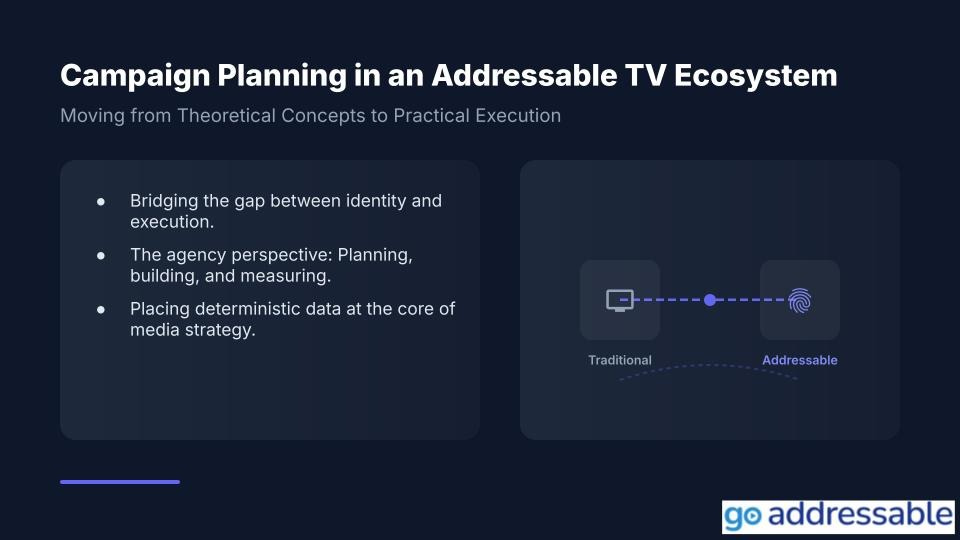
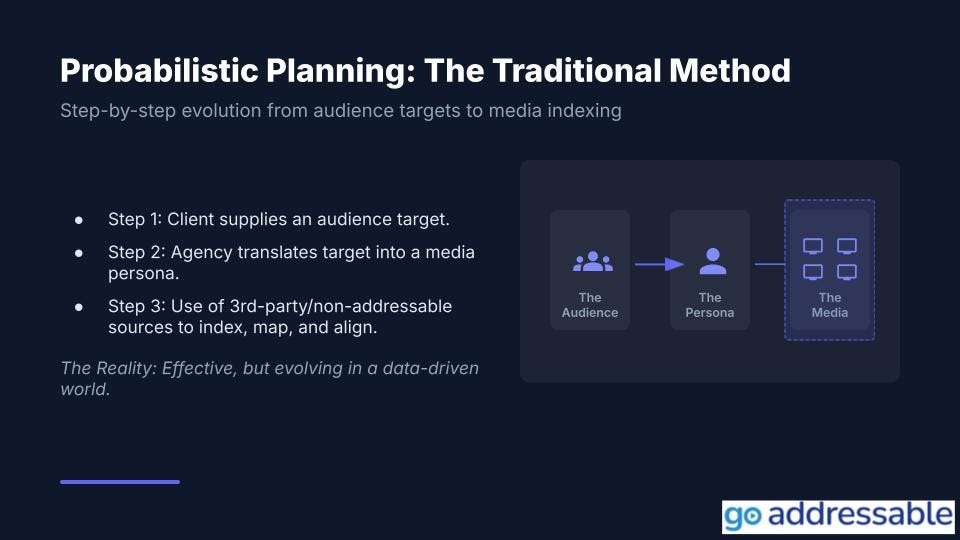
Historically, media planning followed a step-by-step evolution from broad audience targets to media indexing:
Step 1: The client supplies a broad audience target or persona.
Step 2: The agency translates that target into a media persona, often an idealized version of a customer (e.g., “Athletic women, 25-54, in specific DMAs”).
Step 3: Planners use survey data (Nielsen, MRI, Experian) and non-addressable sources to “infer” where these people might be.
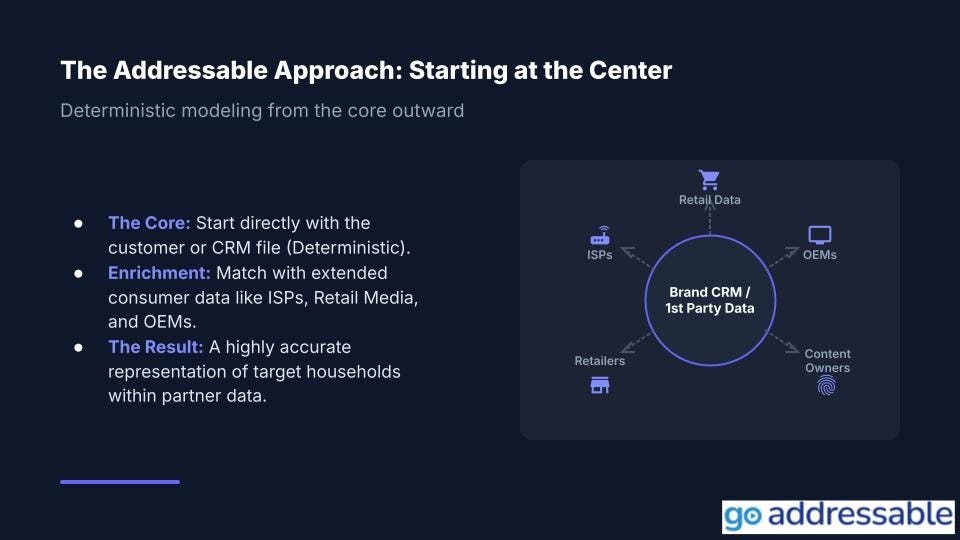
Addressable planning flips the model, placing deterministic data at the core of the strategy:
The Core: Start directly with the brand’s own first-party deterministic data (emails, addresses, phone numbers) from a CRM file.
Enrichment: This core is matched with extended consumer data from TV Providers, ISPs, Retail Media, and OEMs (like Samsung, Vizio, or Roku) to find exactly where those consumers spend time.
The Result: A highly accurate representation of target households within partner data ecosystems, allowing media to align with actual consumer digital lives.
Mike Treon structures the addressable workflow into three distinct buckets: Plan, Build, and Measure.
PLANNING: Using Business Development Index (BDI) and Consumer Development Index (CDI) to understand where business opportunity exists within various targets and geographies. .
BUILDING: Creating “seed audiences” from high-quality first-party deterministic data to ensure high fidelity for future modeling.
MEASURING: Analyzing the “media exhaust”—the real-time data and exposures coming back from a campaign—to tie TV delivery back to outcomes and optimize on the fly.
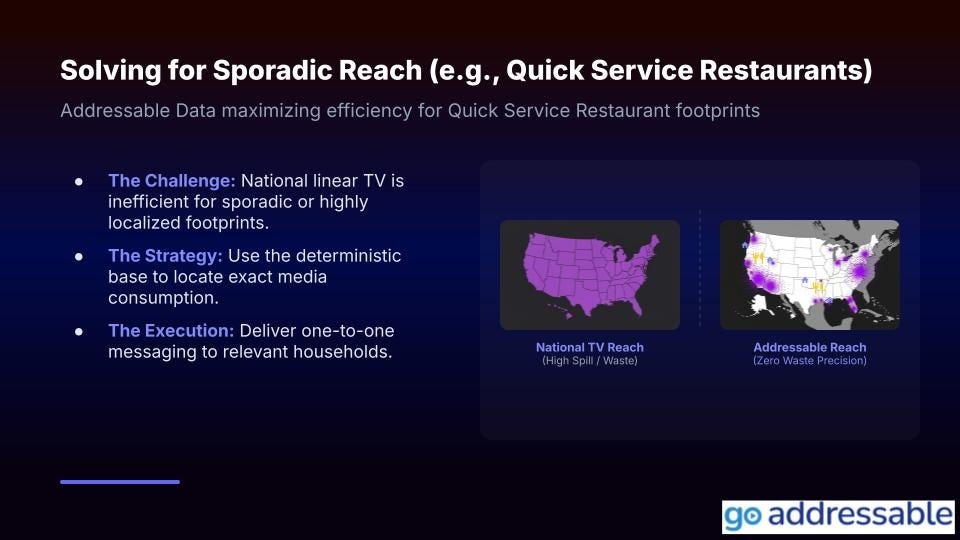
Even for national brands, the most effective TV dollars are often shifted into CTV and Addressable Linear because business happens locally.
The Precision Advantage: If 85% of a brand’s business comes from within 5 to 10 miles of a store (common for Quick Service Restaurants), addressable technology allows you to focus reach specifically in those zones.
Zero Waste: While national broadcast is good for broad reach and “impact” (like live sports), addressable delivery eliminates “spill” by messaging only relevant households near physical business locations.
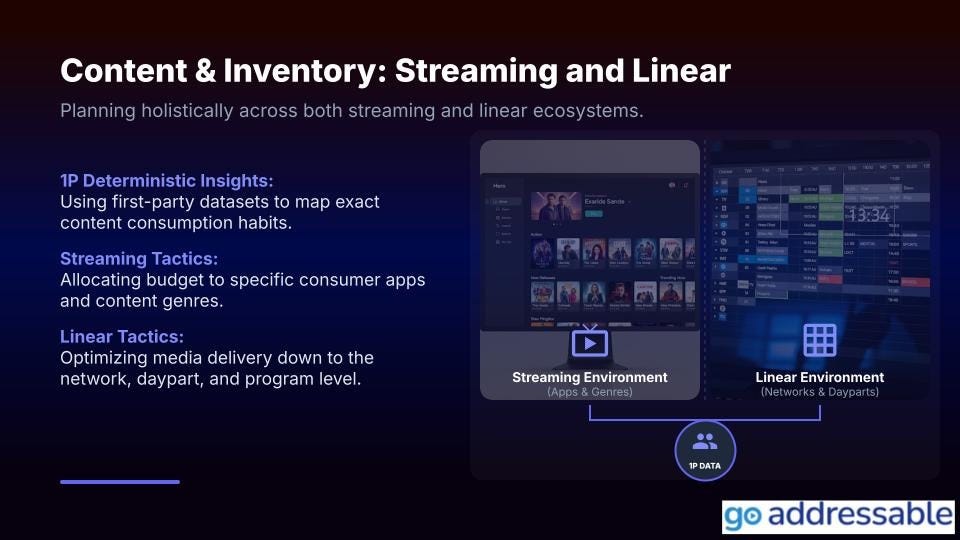
Planning must be holistic across both environments:
Streaming Tactics: Using first-party deterministic insights to allocate budget to specific consumer apps and content genres where your customers spend time disproportionately.
Linear Tactics: Optimizing media delivery down to the network, daypart, and program level, often through frameworks like OpenAP.
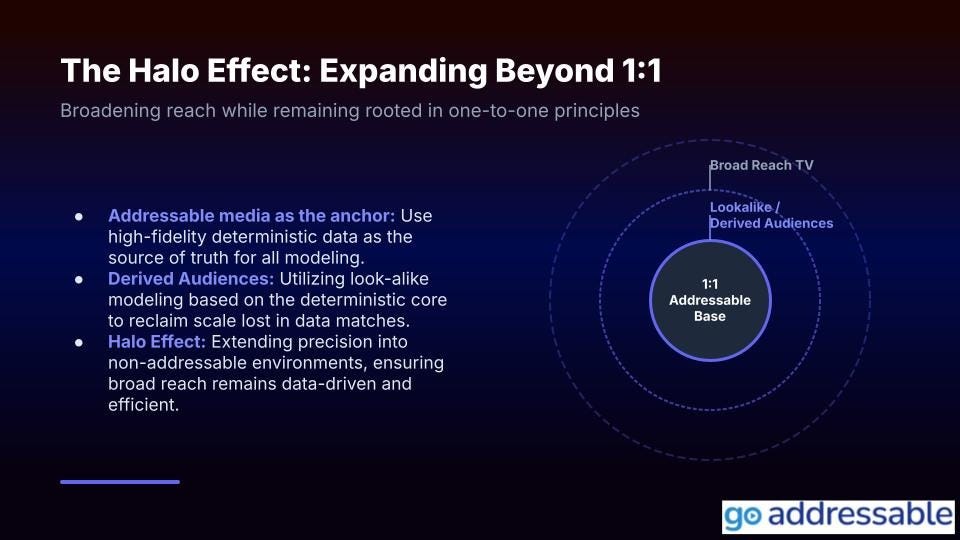
First-party data serves as the anchor for reclaiming scale beyond a 1:1 match:
The Trade-off: Planners must choose between Quality (highest fidelity to actual customers) and Scale (widest reach).
Derived Audiences: Agencies use lookalike or algorithmic modeling based on the deterministic core to reach “Halo” audiences in non-addressable environments without diluting performance.
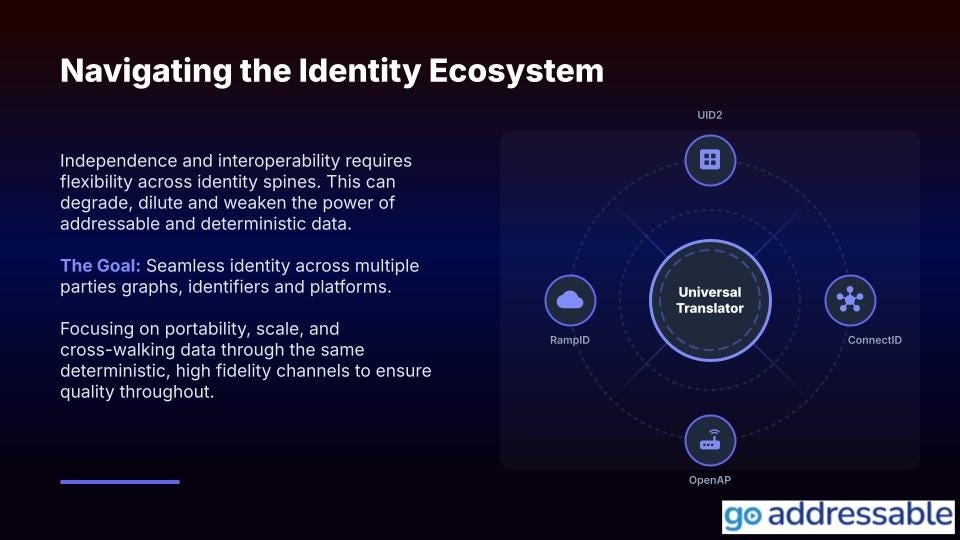
Independence requires flexibility across different identity spines.
The Goal: Achieving seamless identity across multiple graphs, identifiers, and platforms without weakening data power.
Cross-Walking: Ensuring quality by porting data through deterministic, high-fidelity channels like MVPDs, vMVPDs, OpenAP, UID2, RampID, and ConnectID.
Addressable buying creates a continuous learning flywheel: Audience IN, Exposures OUT.
Media Exhaust: Campaign exposures generate earned insights that tell you who converted, where, and when.
Real-time Optimization: Addressability allows for instant “suppression.” If a customer has already filed their taxes (as with Treon’s client TurboTax), the agency can remove that household from the buy immediately to stop wasting spend.
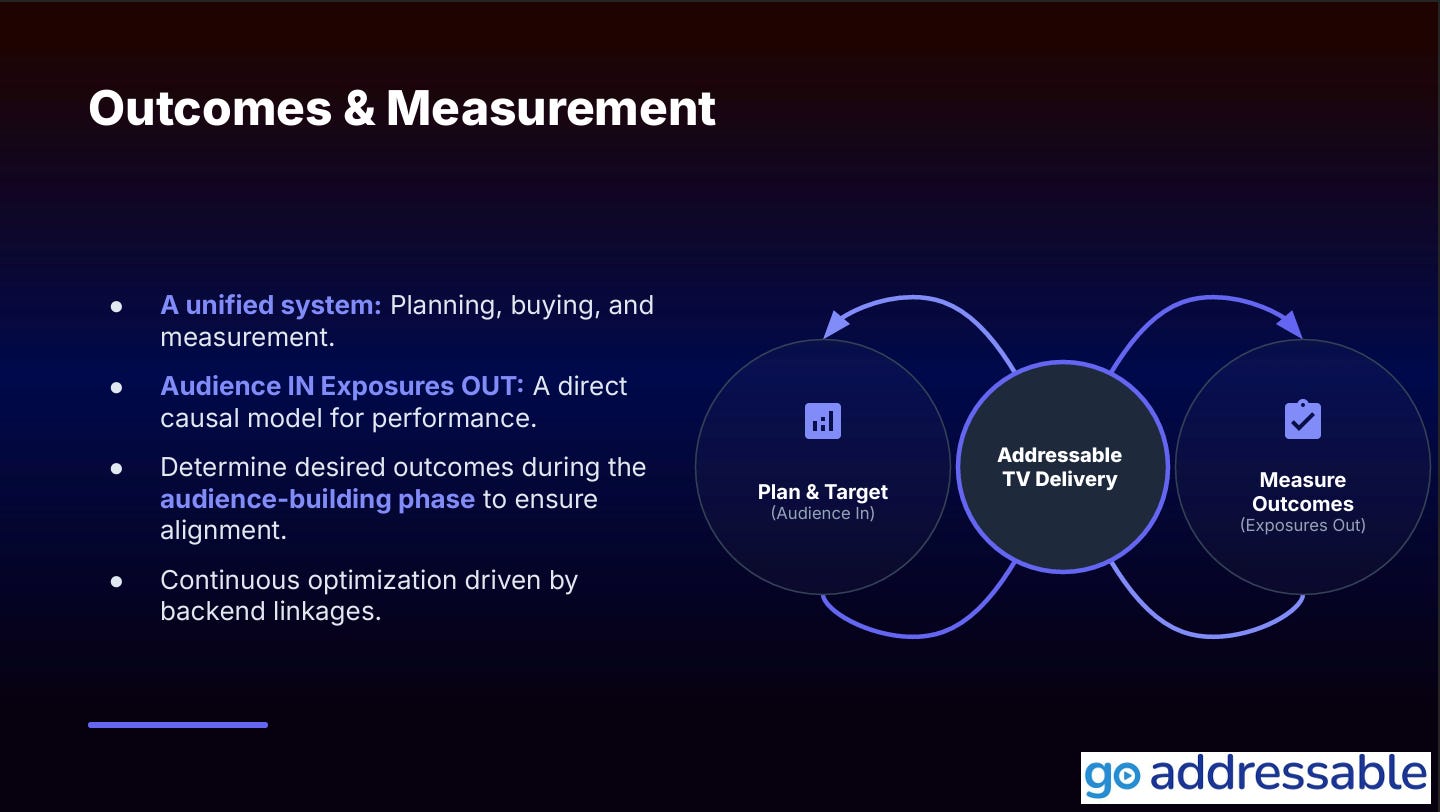
Addressability turns media buying into a continuous cycle of learning and near real-time correction.
Leveraging deterministic data allows for hyper-local effectiveness on a national scale.
Test your knowledge with the Quiz below.

Subscribe to be alerted when further classes are published!
Cheers!
TEAM GO ADDRESSABLE
No posts
Comments
Nothing yet. Say the first thing.
Sign in to join the conversation.