
I’m pleased to announce that the CyteType pre-print is out on bioArXiv!
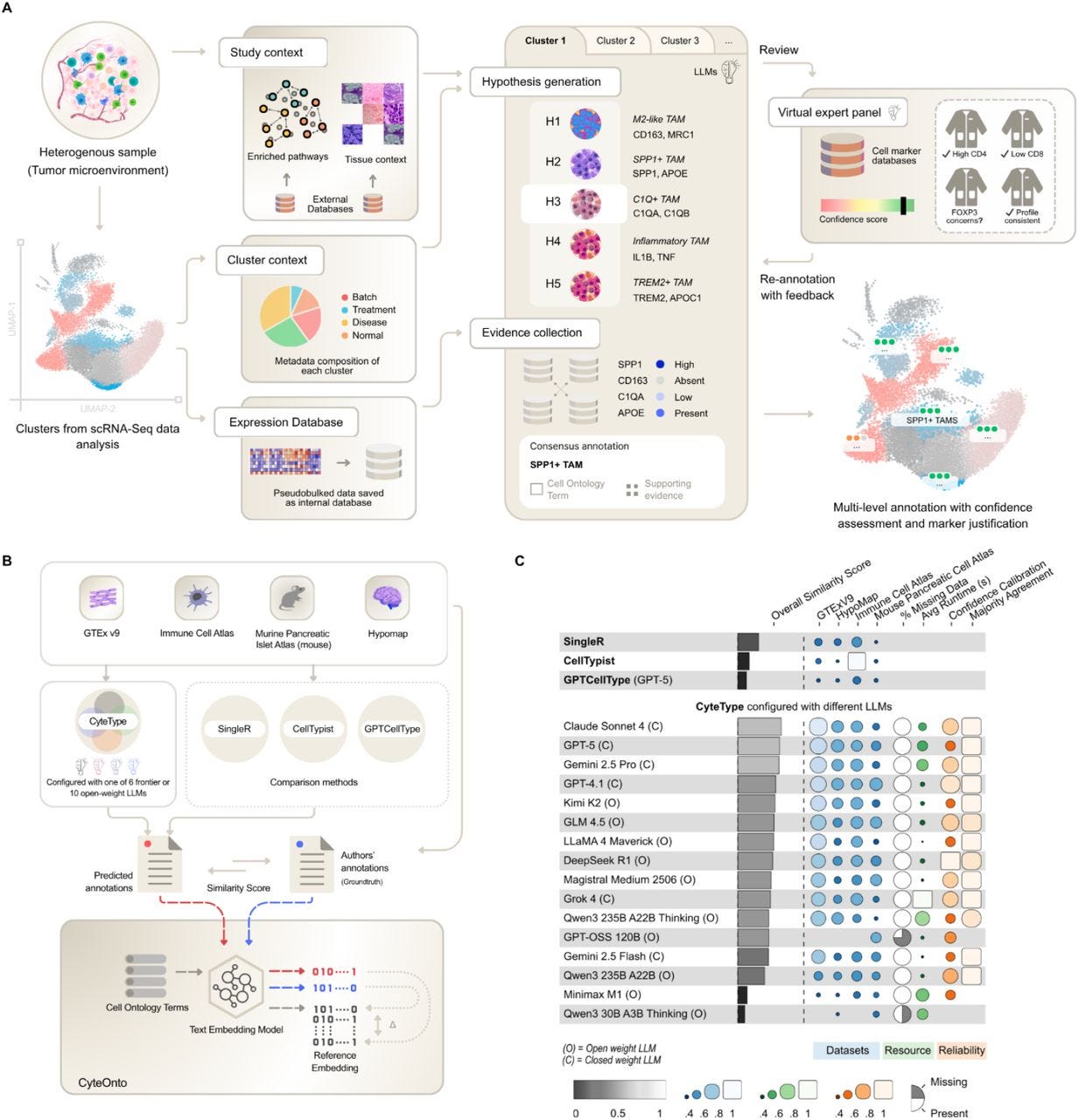
CyteType is an agentic framework for annotation of cell types in single-cell data. It addresses one of the biggest challenges in the analysis of single-cell data - identifying which cell is which, and assigning a name to each cell in the experiment. I reviewed an earlier version this summer, but now the full preprint is out.
One nice thing about CyteType is completely free to use - no API keys to configure, no custom software to install, apart from the python package itself. Just uv pip install cytetype and run the tool. The package will send a query to Nygen’s servers, in an anonymous way and containing only the minimal information required, and send you back the results. No costs to pay.
The paper also includes a hidden gem: CyteOnto, a tool to compute similarity between two Ontology terms, using an agentic framework as well. In short, CyteOnto asks a LLM to provide an extended description of a cell type (or a gene ontology term); then it uses the embeddings to compute similarity. I believe it is a big step-up from GO2vec and similar systems.
Let’s get into the details!
One of the first steps in the analysis of a single-cell dataset is the annotation of cells into known cell types. We want to know, based on gene expression, how to call each of the cells we sequenced. Which cells are T-cells or B-cells, where are the hepatocytes, and so on.
In the early years of single-cell, cell annotation was a manual and time-consuming process. It was based on a manual evaluation of each cluster, in which scientists plotted known gene markers for specific cell types, and tried to make educated guesses about which cell was which.
As the field evolved, more advanced methods for cell annotation emerged. Some methods were based on curated lists of marker genes, like CellAssign, scSorter, SingleR. Others were based on regression models, like CellTypist and scMatch. Other methods involved merging the dataset with a reference, and computing the distance based on k-nearest neighbours or other metrics, like Azimuth or CellMapper. There are so many methods out there, and newest are being published as we speak.
CyteType handles cell annotation in a completely different manner, because it is an agentic system.
In short, five LLMs take the role of experts, each with a different specialization.
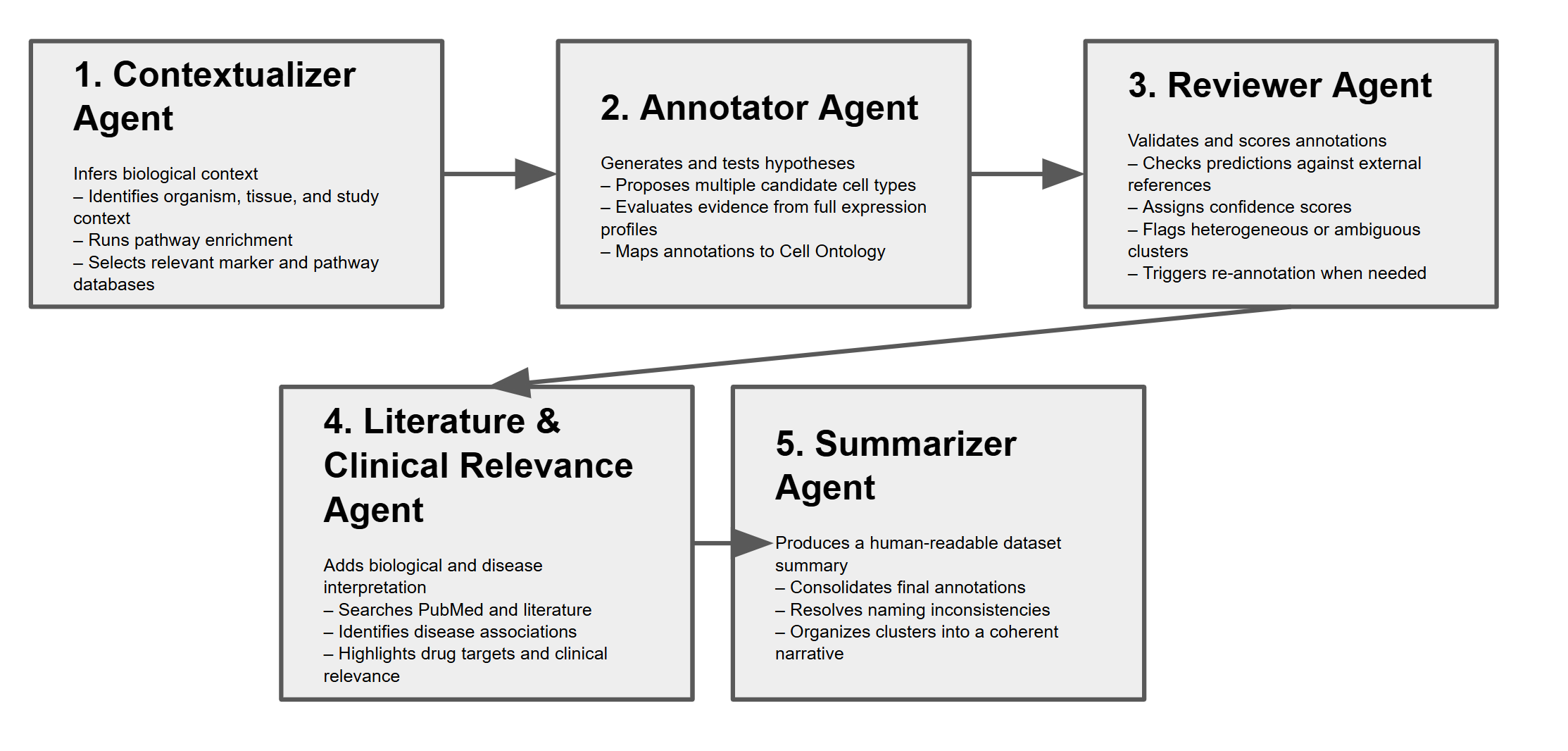
The first expert is the Contextualizer Expert. It infers organism, tissue, and broad biological setting, and also performs a pathway enrichment to identify cluster-specific content. It uses GTEx data, EnrichR, and other pathway databases.
Then, the Annotator Agent generates and tests multiple hypotheses for each cluster. It tests the hypotheses, and tries to reduce ambiguities and hallucinations. It also maps cell terms to CellOntology.
The third agent is the Reviewer, who judges the previous annotations, and flags those that seem ambiguous. It can trigger reannotation, if evidences look weak.
The fourth agent is the Literature and Clinical Relevance Agent, who searches PubMed for supporting literature, and adds biological interpretation to the data.
Finally, the Summarizer Agent cleans up the data and produces a human readable summary of all annotations.
So, these five agents together do the work that most bioinformaticians would do manually, at scale.
CyteType has been developed by Nygen Analytics, a company leader in the single-cell field, whose main product is a powerful and easy-to-use interface for the analysis of single-cell data.
After posting my review on this blog this summer, the authors reached out, and they asked me to help with the benchmarking and evaluation. Thanks Parashar! :-)
(as a disclaimer - I am not being paid or anything to write this post).
As mentioned above, running CyteType is very easy, and it does not cost anything.
It takes a lot of confidence and engineering skills from Nygen’s part to offer this, but they have optimized the costs in a way to make it feasible. There is a rate limit of 3 reports per day, for now.
Running CyteType takes just a few lines of code. There is a Google/Colab notebook, linked in the github page, that walks through an example.
The main steps are initializing the annotator by using the CyteType() function; and triggering the annotation, using annotator.run().
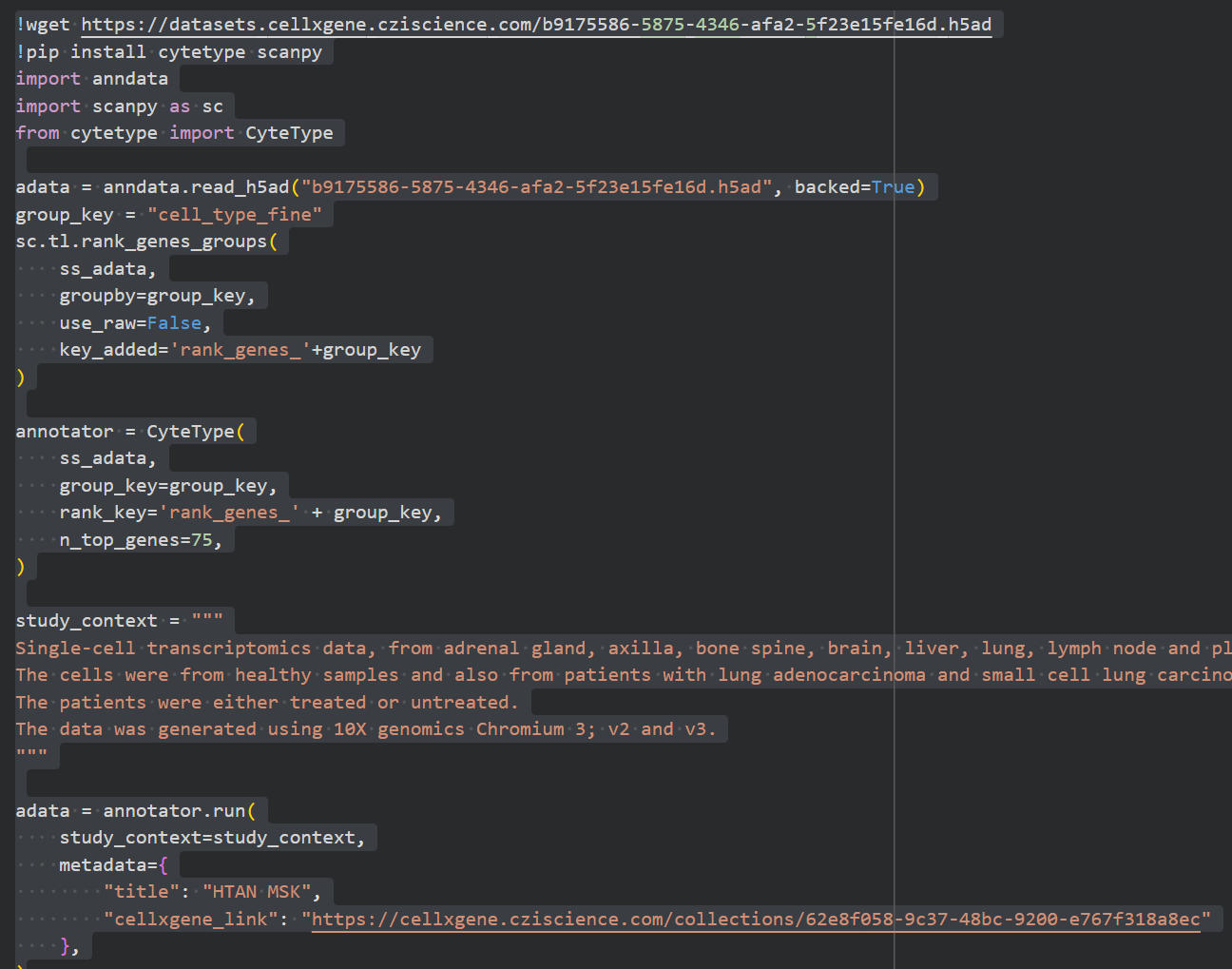
That’s really it. Running the annotator triggers an API call, initiating the annotation process.
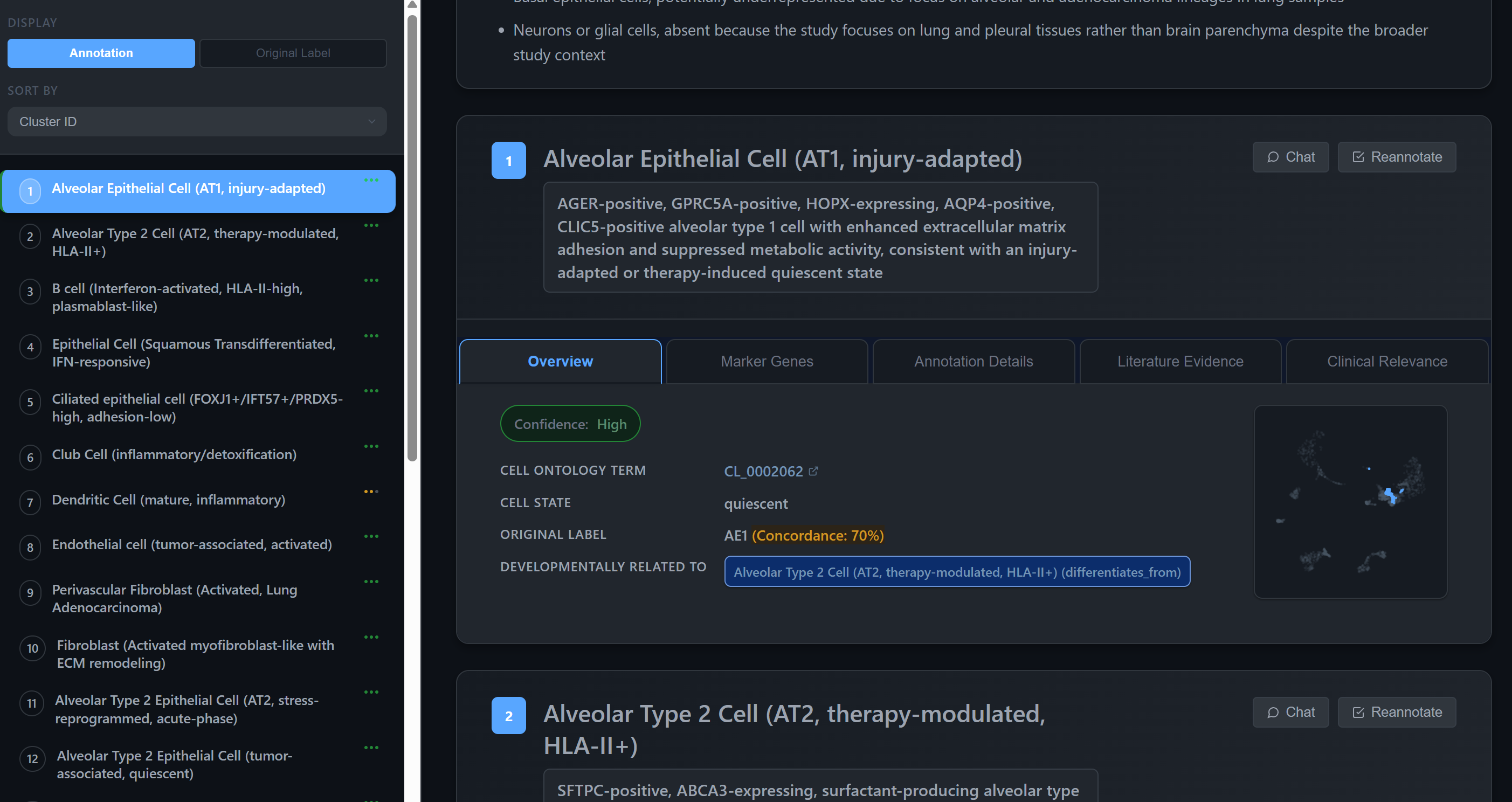
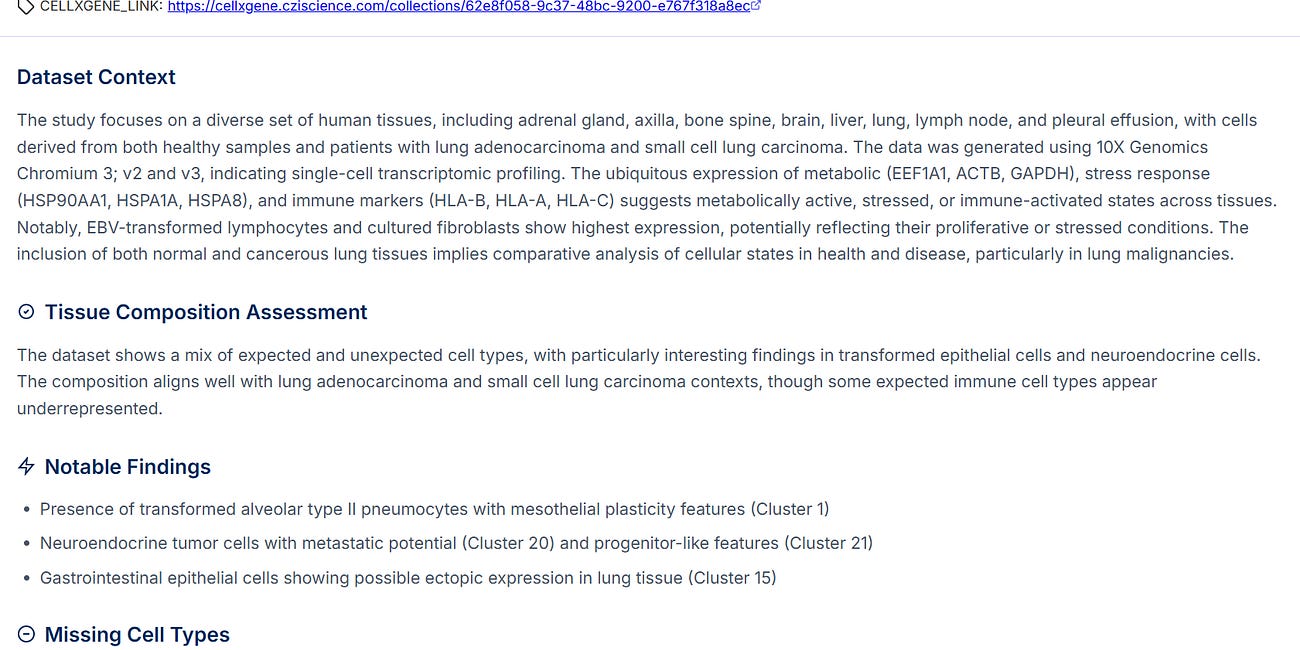
Here is an example on Report generated by CyteType:
An important question, when developing CyteType, was “does it work better than existing systems”?
So, a lot of effort has been put into evaluating the performances and comparing it with other tools.
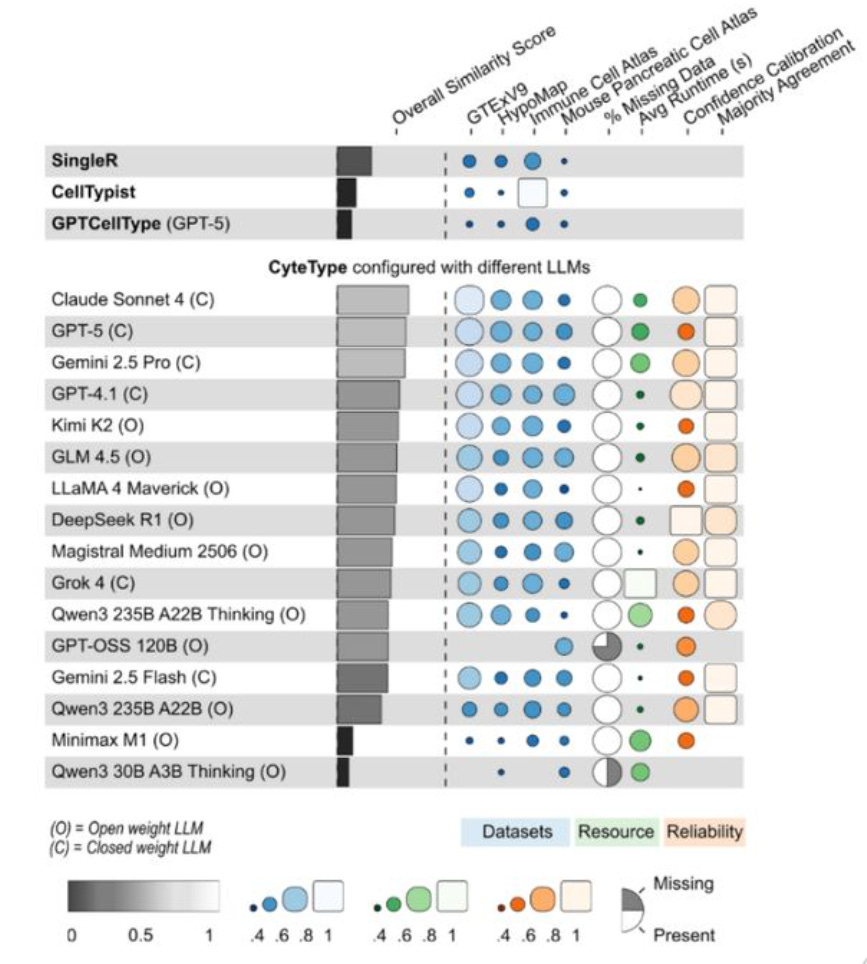
Overall, CyteType is pretty solid, and it performs better than other tools.
The main issue with traditional tools for cell annotation is identifying the right reference. For example, if we are working with immune cells, we can use a model based on the Immune Cell Atlas, and this will likely lead to excellent annotations.
However, in some cases, it is difficult to find the best reference for a dataset. For example, GTEx contains data from multiple tissue; so, a single reference is not enough. We need to manually try different references, and choose the right one.
CyteType is clever enough to figure this out by itself. The Contextualizer Agent will choose the most appropriate reference, based on the data. This makes annotation much simpler, and increases confidence in the predictions.
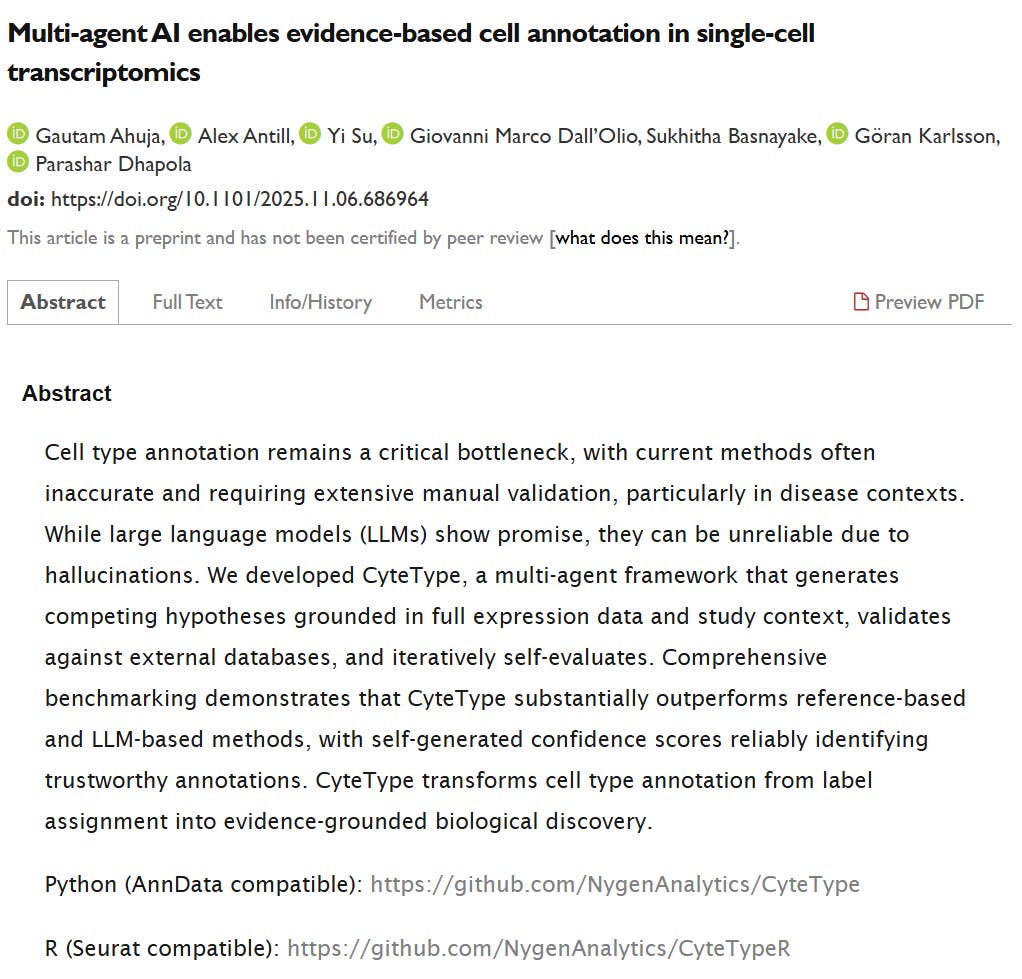
The paper is on bioArXiv now. Hopefully, it will be published in a peer-reviewed journal soon:
Nygen is preparing several events to help users get started with CyteType.
For example, this seminar will happen in two weeks from now, and the attendance is free:
I’m going to prepare another article on CyteOnto, which is a novel approach to the problem of computing similarity between Ontology terms. Stay tuned!
Genomics and Genetics
CyteType: an agentic system to annotate cell types in single-cell data
·
July 8, 2025
Cell type annotation is one of the most important steps in single-cell RNASeq analysis. Yet, it is also one of the most delicate and time consuming. By examining gene expression profiles, marker signatures, and relevant literature, researchers assign each cell to a defined identity. This process used to be mostly manual in the early days of single-cell,…

Comments
Nothing yet. Say the first thing.
Sign in to join the conversation.