
We’ve passed the midway point of the epic and the year, but as the opening of Book 7 reminds us, “half yet remains unsung” (7.21). Here in the seventh book we get an account of the seven days of the creation of the universe as the conversation between Adam and Raphael continues to unfold…
For anyone looking to break this book into four roughly equal sections without breaking off in the middle of a sentence, you can use the following pacing:
Week 1: lines 1-173
Week 2: lines 174-328
Week 3: lines 329-484
Week 4: lines 485-640
At just 640 lines, this is the shortest book in the epic. In fact, in the first edition of Paradise Lost published in 1667, there were only 10 books rather than 12, and Book 7 contained all of our current Book 7 as well as our current Book 8. It wasn’t until 1674 that a version was published in which Milton had split those 10 books into 12, and added a handful of lines, creating the version that we read now. For an inside look at what a first edition of Paradise Lost looked like you can check out my video showing a 1667 edition here, or my article talking about print history and materiality here!
I’m certainly grateful that Milton made the choice to change the division of the epic into 12 books. Not only does it makes this year-long reading project so very convenient, but it also means that we get a nice short book to read now during the peak of summer!
We open Book 7 with another invocation, this time to the muse Urania. Milton calls upon her aid to narrate the remaining half of the epic, which he hopes will “fit audience find, though few” (7.31).
The beginning of this book returns us to Eden, where Adam is curious to hear more from his angelic guest: he is “yet sinless, but with desire to know” (7.60), and specifically desire to know how his world was first created. Raphael agrees to share this information, though again references how challenging it is to make divine works legible to a human audience. He also issues a warning that as with appetite for food, appetite for knowledge must be temperate, as an excess “soon turns wisdom to folly, as nourishment to wind” (7.129-30). This is…well, not exactly a fart joke, but definitely a fart analogy: wisdom is to food as folly is to farts.
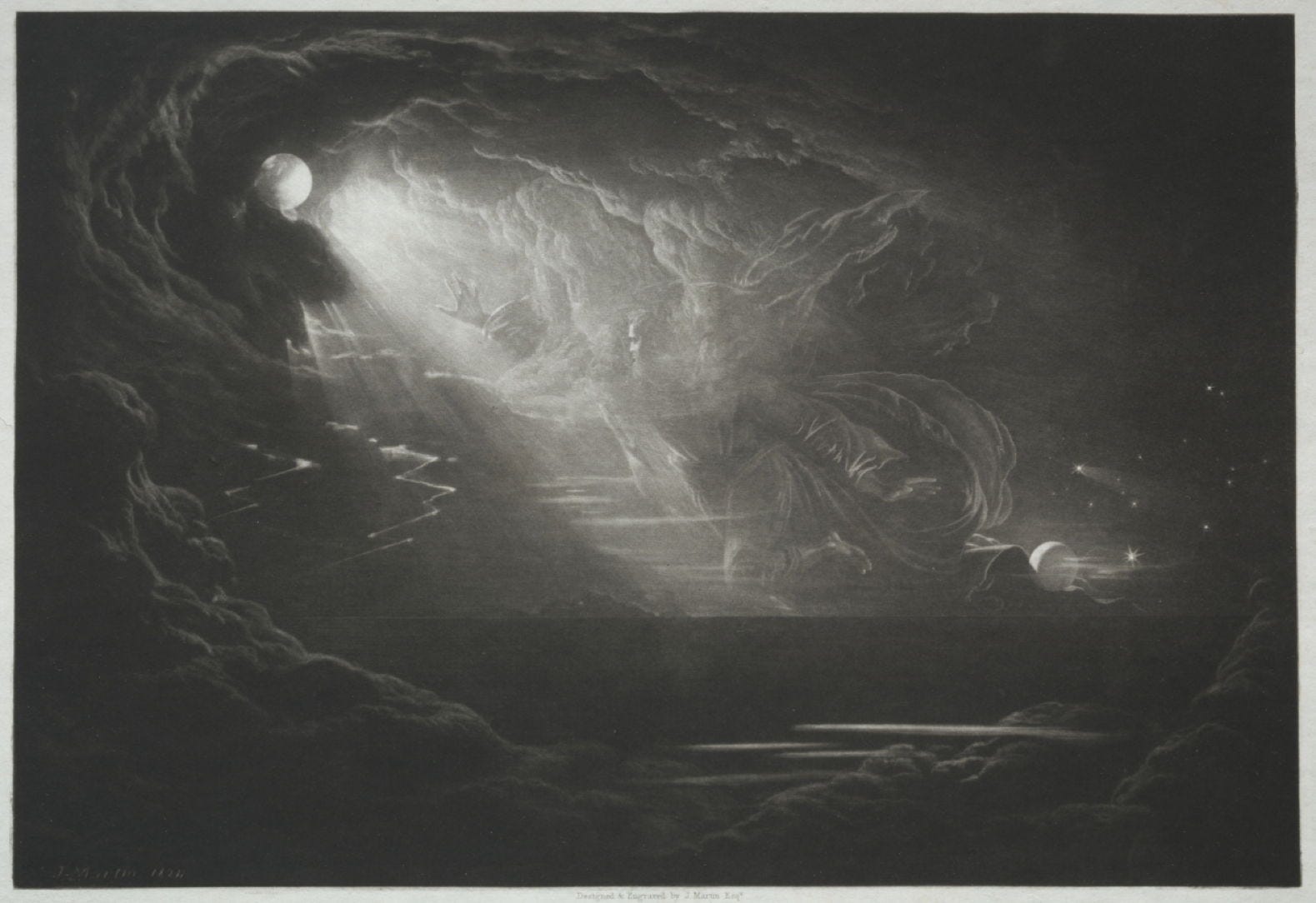
Raphael picks his story back up in the immediate aftermath of Lucifer’s fall (this is the second of only three times in the epic that Satan is given his heavenly name). God speaks to the Son, saying that he will repair the loss of the rebellious angels by creating a new race of men, who will live on Earth. As soon as God has finished spoken, his word begins to go into effect and creation begins. Raphael explains that the creation is immediate, but to translate it into human understanding, can be thought of as taking place over six days. The angels who remain in heaven sing a chorus of triumphant hallelujahs, and open the gates of Heaven to watch the creation taking place.
The description of the creation of the world begins at line 216. Not God, but the Son, creates Earth out of Chaos, using a golden compass to set the bounds of the universe. Then “God” gives the command “Let there be light” (7.243).1
God separates the light from the dark, creates land to separate the water, shapes the mountains and rivers, and creates plants and rains. On the fourth day, he creates the stars, the sun, and moon. On the fifth, he populates the sea and sky with animals, and on the sixth creates beasts of the land, numerous but as yet unnamed. Starting at line 505, God begins to create his “master work,” a creature who stands upright and has the “sanctity of reason” that will enable him to rule over all other creatures. God and the Son create Adam in their image out of the dust of the ground, and breathes a soul into him. Raphael recounts how God brought Adam into Eden and issued his one limitation:
All sorts are here that all th’Earth yields,
Variety without end; but of the tree
Which tasted works knowledge of good and evil,
Thou may’st not; in the day thou eat’st, thou die’st;
Death is the penalty imposed, beware,
And govern well thy appetite, lest sin
Surprise thee, and her black attendant Death.
(7.541-47)
On the seventh day, God retires to Heaven to the sound of jubilation, which Raphael acknowledges that Adam must remember. Raphael recounts some details of the celebrations in Heaven, and closes the book by inviting Adam to ask more questions if he still seeks to know more.
I referenced the invocation of a muse as a convention of the genre of epic poetry back in my introduction to Book 1, and in my deep dive article in March I spent some time discussing Milton’s invocation to “Holy Light” at the beginning of Book 3. Now, in Book 7, we get our third (and penultimate) invocation. This time, the muse has a name: Urania. So let’s take a moment to look back over the three invocations we’ve seen so far, and consider why Milton chose to invoke Urania specifically here.
In the Book 1 invocation, after proclaiming the intended scope of his story, Milton writes:
Sing Heav’nly Muse, that on the secret top
Of Oreb, or of Sinai, didst inspire
That shepherd, who first taught the chosen seed,
In the beginning how the Heav’ns and Earth
Rose out of Chaos…
…instruct me, for thou know’st; thou from the first
Wast present, and with mighty wings outspread
Dove-like satst brooding on the vast abyss
And mad’st it pregnant…
(1.6-22)
It’s interesting to look back on this invocation now, as we are reading the book that contains the description of how the Earth rose out of Chaos. I’ll talk more later this month about this passage in relation to the language of creation and birth being used, but for now what I want to flag is that the “Heav’nly Muse” being invoked is specified not only to have been present since the creation of the world, but responsible for that creation. The poetic muse he is calling on isn’t a classical Greek figure, as one might expect in an epic; he’s calling on the Holy Spirit for aid.
Our next invocation comes in the very first lines of Book 3:
Hail holy Light, offspring of Heav’n’s first-born,
Or of th’Eternal Coeternal beam
May I express thee unblam’d? Since God is light,
And never but in unapproached lgith
Dwelt from eternity, dwelt then in thee,
Bright effluence of bright essence increate.
(3.1-6)
In his lecture on “The Blind Prophet,” John Rogers asserts that these lines are among the most difficult lines of poetry ever written, in part because of how challenging it is to unravel exactly what figure, what muse, Milton is invoking here. Milton is calling on light itself, which he names the “first-born” of Heaven, a reference to the “let there be light” moment we see narrated in Book 7. But he then takes a half-step back, and suggests that maybe Light isn’t the offspring of the eternal, but instead is co-eternal, as old and as enduring as God. Is it God himself who Milton is calling upon for aid? Or a power equal to God in age and power? Whatever power or figure Milton is calling on, we’re seeing here, as in Book 1, that Milton is invoking extremely lofty, and explicitly Biblical, sources for aid and inspiration in his poetry.
So it’s interesting that in Book 7, he does name a classical muse:
Descend from Heav’n Urania, by that name
If rightly thou at call’d, whose voice divine
Following, above th’Olympian hill I soar,
Above the flight of Pegasean wing.
The meaning, not the name I call…
(7.1-5)
Urania is one of the nine classical muses, and is specifically identified as the muse of astronomy / astrology. This would be an appropriate choice of muse, since in the creation story of Book 7 we are getting a lot of cosmic imagery. It could seem a little incongruous for Milton to go from invoking the Holy Spirit and the ambiguous figure of holy Light to now naming a poetic muse, but in line 5 we get clarification: “the meaning, not the name I call.” Milton is using the name “Urania” not to call upon the muse herself, but to call upon the idea of astrology, of the Heavens.
I’m spending this time here looking at these three invocations for a couple reasons. One is simply that, the further we get into the epic, the more time we can spend looking back at the whole. We’re going through the text one book at a time, yes, but that doesn’t mean we need to look at each book in isolation. We can instead be considering how the wider story is taking shape, and how threads laid in earlier books are reemerging as we draw closer to the climactic moment of original sin. And another reason I’m raising this as a point of interest is that the Book 7 invocation in particular reminds us of part of the intentionality of the epic. Milton is demonstrating his determination to create a Christian epic, illustrated through how he is taking the classical muse Urania and separating her from the classical context, instead connecting “Urania” to his Heavenly Muse and Holy Light of Books 1 and 3. And, as the invocation continues, Milton roots his epic and his need for inspiration in his current moment:
More safe I sing with mortal voice, unchang’d
To hoarse or mute, thou fall’n on evil days,
On evil days though fall’n, and evil tongues…
Still govern thou my song,
Urania, and fit audience find, though few.
(7.24-31)
These “evil days,” we can infer, are the years Milton has spent in the aftermath of the English Civil Wars and the collapse of the non-monarchical government that he so dearly hoped would continue. He calls on Urania for continued aid through these hard times, and hopes that she will direct him to an appropriate audience, however small that audience might be.
Are we a “fit audience” to Milton’s epic? We can’t know whether he would consider us to be so, but I’d like to think that the stars have aligned and that Urania has brought all 11,000 of us to this epic because we are!
As I referenced earlier, this is the first of five Fridays in the month of July. Rather than fill the month with additional articles as I have in the past, I’m going to embrace the extra-slow pace of reading a short book during a long month, and give myself a light writing month! The articles for the months will be sent out on the following dates:
Friday, July 24: Creation and Birth in Paradise Lost
Friday, July 31: Book 7 Reading Notes
In the meantime, I hope everyone stays hydrated and finds ways to enjoy the summer safely in these heatwaves!
Below, you can find a few questions that you could choose to keep in mind and reflect on during the month of reading ahead:
What do you make of the specification that Adam’s curiosity is, at this point, “sinless?” Without having yet read the narration of the fall, what do you think would constitute “sinful” curiosity in this story?
What catches your attention about the creation narrative within this book?
Looking back on the first half of the epic, what themes, passages, points of interests, etc., seem most interesting or significant to you so far?
The titles of “God” and “the Son” are being used somewhat interchangeably through the creation narrative of Book 7, a choice that is ripe for analysis if anyone is interested in parsing Milton’s theology!
No posts
Comments
Nothing yet. Say the first thing.
Sign in to join the conversation.