
By Su Qingyi and Jiang Yang
On June 19, a two-day European Council summit concluded in Brussels, Belgium. European Council President António Costa stated afterward that the bloc must tackle “unsustainable global economic imbalances” and work toward “economic relations based on rules and reciprocity.” While the official communiqué did not name any specific country, many foreign media outlets reported that the core of the summit dinner’s two-hour strategic discussion was China, with debate focused on how the EU should respond and whether it should further expand its toolbox of trade policy instruments targeting Beijing.

Just weeks earlier, on May 29, ahead of a European Commission meeting, France, Italy, Spain, the Netherlands, and Lithuania jointly submitted a strongly worded policy paper. The document called for more aggressive trade defense measures against so‑called “unfair trade practices,” including fast‑tracking tariff hikes, raising thresholds for anti‑circumvention investigations, and establishing a “resilience tool” to limit dependence on specific supply sources. French President Emmanuel Macron additionally proposed creating a “European Section 301” mechanism modeled on the United States, which would allow the EU to directly impose tariffs on countries engaging in “unreasonable, unjust, or discriminatory practices.” On June 3, all 27 EU member states then voted to impose additional countervailing duties of up to 35.3 percent on Chinese electric vehicles, with plans already taking shape to extend such measures to multiple sectors.
The EU’s attempt to frame a trade war with China under the banner of “overcapacity” raises several fundamental questions. Is the logic behind this trade offensive sound? If a trade war does break out, what kinds of economic costs will Europe itself bear? And what would be a more appropriate way for the EU to manage its economic and trade relationship with China?
The EU’s case for escalating trade confrontation with China rests on three core propositions.
First, at the level of observable facts, EU officials claim that China’s export volume is excessively large and that this “overcapacity” shows up as a growing trade deficit for Europe. Second, at the causal level, they attribute China’s export surge not to market dynamics, but to supposed “distortions” such as government subsidies and industrial policies. Third, at the impact level, they argue that the export of China’s “surplus capacity” damages European industry, destroys jobs, and drives the relocation of industrial supply chains.
Taken together, these propositions appear to form a coherent causal narrative that links phenomena, causes, and consequences. In reality, however, the argument suffers from multiple factual misreadings and structural flaws.
1) The myth of Chinese “overcapacity”
The allegation of Chinese “overcapacity” relies almost entirely on a single metric: the EU’s overall merchandise trade deficit with China. According to data from the European Commission’s Directorate‑General for Trade, in 2025 the EU exported goods worth 199.5 billion euros to China, while imports from China reached 559.5 billion euros, producing a goods trade deficit of 359.9 billion euros—a 2.7 percent increase compared with the previous year. EU officials frequently cite this figure as key evidence of a looming “China Shock 2.0.”
Yet the size of a merchandise trade deficit by itself does not justify trade protectionism. The basic logic of international trade is grounded in comparative advantage. Countries participate in global production based on their factor endowments and industrial structures, allowing resources to flow into their most efficient uses and raising aggregate output. Differences between export and import volumes simply reflect this pattern of optimized resource allocation rather than providing proof of “unfair” behavior.
In manufacturing, China has built a complete industrial chain, large‑scale production capacity, and steadily improving technological capabilities. The EU, by contrast, retains comparative advantages in sectors such as high‑end services, precision machinery, and creative design. The divergence in their trade structure therefore reflects differing industrial profiles, not structural unfairness. In 2025, manufactured goods accounted for 97.3 percent of the EU’s imports from China, with machinery and vehicles comprising 54.4 percent, other manufactured products 33 percent, and chemicals 9.8 percent. Manufactured goods also made up 86.2 percent of the EU’s exports to China. This pattern shows that EU–China trade is dominated by industrial manufactures and features significant intra‑industry trade in machinery and vehicles, underscoring deep supply‑chain integration.
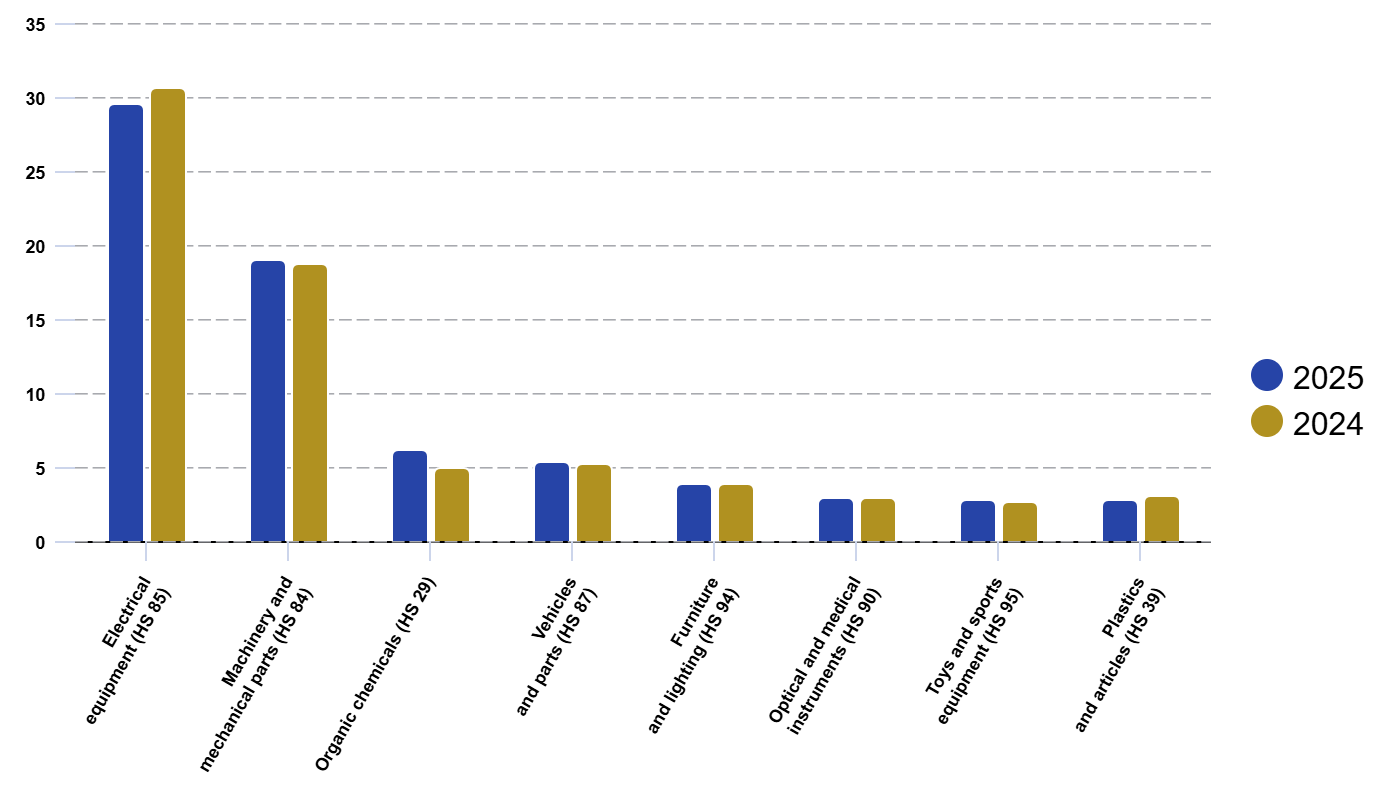
Focusing only on the merchandise deficit also hides important structural realities. At the member‑state level, China actually runs persistent trade deficits with countries such as Germany, Finland, and Ireland. Reducing a complex and heterogeneous web of bilateral trade relations to a simplistic “China versus EU” binary erases these differences in member‑state positions and interests. At the same time, the EU’s narrative largely omits services trade. In 2025, the EU enjoyed a 21.3 billion euro surplus in services trade with China, making China its fourth‑largest services trade partner after the United States, the United Kingdom, and Switzerland. Once you incorporate services trade into a broader macroeconomic assessment, the overall degree of EU–China trade imbalance looks much smaller than the headline goods deficit suggests.
2) Is Chinese export growth really driven by “policy distortions”?
For years, the EU has attributed the rise of Chinese exports to Europe to government subsidies and allegedly distortive industrial policies, an argument that features prominently in its anti‑subsidy investigation into Chinese electric vehicles. Yet China’s sustained and expanding export volume ultimately reflects the interaction of several forces, in which both cyclical and structural factors play critical roles.
One crucial factor is the development of endogenous competitive advantages within Chinese industry. After decades of industrialization, China has built a comprehensive manufacturing ecosystem that runs from raw materials all the way to finished products. The completeness of this industrial chain creates economies of scale and strong synergies, enabling Chinese firms to develop competitive strengths in cost control, delivery speed, and quality consistency that are difficult for others to replicate.
Chinese firms have also increased their investment in research and development year after year. By 2025, China’s R&D intensity—R&D expenditure as a share of GDP—had risen to 2.8 percent, surpassing the average level of OECD economies for the first time. In the 2024 fiscal year, 525 Chinese firms appeared in the list of the world’s top 2,000 corporate R&D spenders, placing China second globally in terms of the number of firms on the list. In the EV sector specifically, Chinese companies have accumulated significant technical expertise in power batteries, electric drive systems, and vehicle integration. Leading firms such as CATL and BYD rank at the forefront of the global market in both battery energy density and cost control and have achieved self‑reliance in several key components.
China’s huge domestic market provides fertile ground for rapid technology iteration. Diverse application scenarios allow new technologies to be tested and refined quickly, accelerating progress along the learning curve. In this environment, government support for the EV sector has shifted toward more market‑oriented tools, such as building charging infrastructure and offering R&D tax incentives, rather than relying on blunt production subsidies.

A second factor is the “backfire effect” of EU restrictions on Chinese direct investment. Standard trade and investment theory holds that when a host country blocks foreign investment, firms that might otherwise produce locally instead serve that market via exports. When a country allows foreign capital in, firms can use greenfield investment or cross‑border mergers and acquisitions to build local production and distribution networks, replacing cross‑border exports with local supply. Chinese firms could have used direct investment in Europe to build factories, create local jobs, and facilitate technology spillovers while avoiding tariffs and the costs and risks of long‑distance shipping.
Since 2019, however, under the banner of “de‑risking,” the EU has systematically tightened restrictions on Chinese investment. The EU Foreign Direct Investment Screening Regulation, together with a patchwork of national‑level review mechanisms, has raised approval thresholds, lengthened review cycles, and increased political interference. As a result, Chinese direct investment flows into the EU have declined sharply. Total FDI dropped to 10.1 billion euros in 2023 and fell to just 1.1 billion euros in the third quarter of 2025, the lowest level in eight quarters. During the same period, EU demand for Chinese imports surged. Imports from China rose to 559 billion dollars in 2021 and increased further to 658.6 billion dollars in 2022, a year‑on‑year rise of 17.8 percent. The EU’s trade deficit with China climbed from 221.2 billion dollars in 2019 to 418.8 billion dollars in 2022, far exceeding its 2010 level of 225.3 billion dollars and remaining elevated.
By tightening the investment channel, the EU effectively pushed Chinese firms back toward exports as their main way to serve the European market. That shift appears as an expanding export volume and a widening bilateral trade imbalance. At the same time, efforts to shorten and “onshore” European supply chains have not restored local production capacity fast enough, leaving domestic supply gaps that are still being filled by imports from China.
A third factor is Europe’s failure to use the opportunities created by the U.S.–China trade war. When the United States launched its tariff offensive against China in 2018—imposing steep duties on Chinese goods and initiating a wave of trade investigations—it disrupted the global distribution of trade flows. A substantial volume of Chinese exports that would have gone to the U.S. had to seek alternative markets. Between 2018 and 2024, the share of China’s exports destined for the United States fell from 19.3 percent to 14.7 percent, dropping China to third place among America’s trading partners. China’s export share to Europe, however, remained roughly steady at around 16 percent, showing no evidence of large‑scale diversion driven specifically by U.S. tariffs.
Europe could have taken advantage of the drop in Chinese imports from the U.S. to expand its own exports to China and narrow its trade deficit, but it did not. The share of EU exports going to China peaked at 11.0 percent in 2019 and then declined for six consecutive years, falling to 7.4 percent in 2025. In value terms, EU exports to China slipped from 260.7 billion dollars in 2021 to 220.2 billion dollars in 2025. Europe thus missed a major opportunity to expand its sales into the Chinese market and offset its merchandise deficit.
3) Is European industry really facing a “China Shock 2.0”?
The claim that rising Chinese exports are delivering a “shock” to Europe’s economy rests on a highly selective reading of the data. This narrative not only draws a simplistic line from trade expansion to job losses, but also largely ignores the benefits that Chinese exports deliver to European consumers and downstream industries.
On the employment side, declines in industrial jobs must be understood in a broader macroeconomic context. As the Draghi Report emphasized, the EU is grappling with an “existential challenge” rooted in domestic structural weaknesses: fragmented markets within the single market, underinvestment in innovation, and structurally high energy costs, compounded by rising geopolitical risks. The Ukraine crisis triggered a surge in energy prices, while Europe’s lagging digital transformation and rigid labor markets have further squeezed its manufacturing base.
Protectionist tariffs also tend to backfire in an interconnected global economy. In theory, higher tariffs can reduce imports via substitution, boost domestic output, and create jobs. In practice, when tariffs target intermediate goods, they raise input costs for domestic producers, narrow profit margins, and weaken international competitiveness. Under such pressure, firms often cut labor costs instead of expanding hiring. Tariffs also invite retaliation from trading partners, squeezing external demand for domestic exports and dealing a second blow to manufacturing employment. Attributing job losses primarily to import competition therefore diverts attention from Europe’s own structural problems and distorts the way industrial reallocation works under globalization.
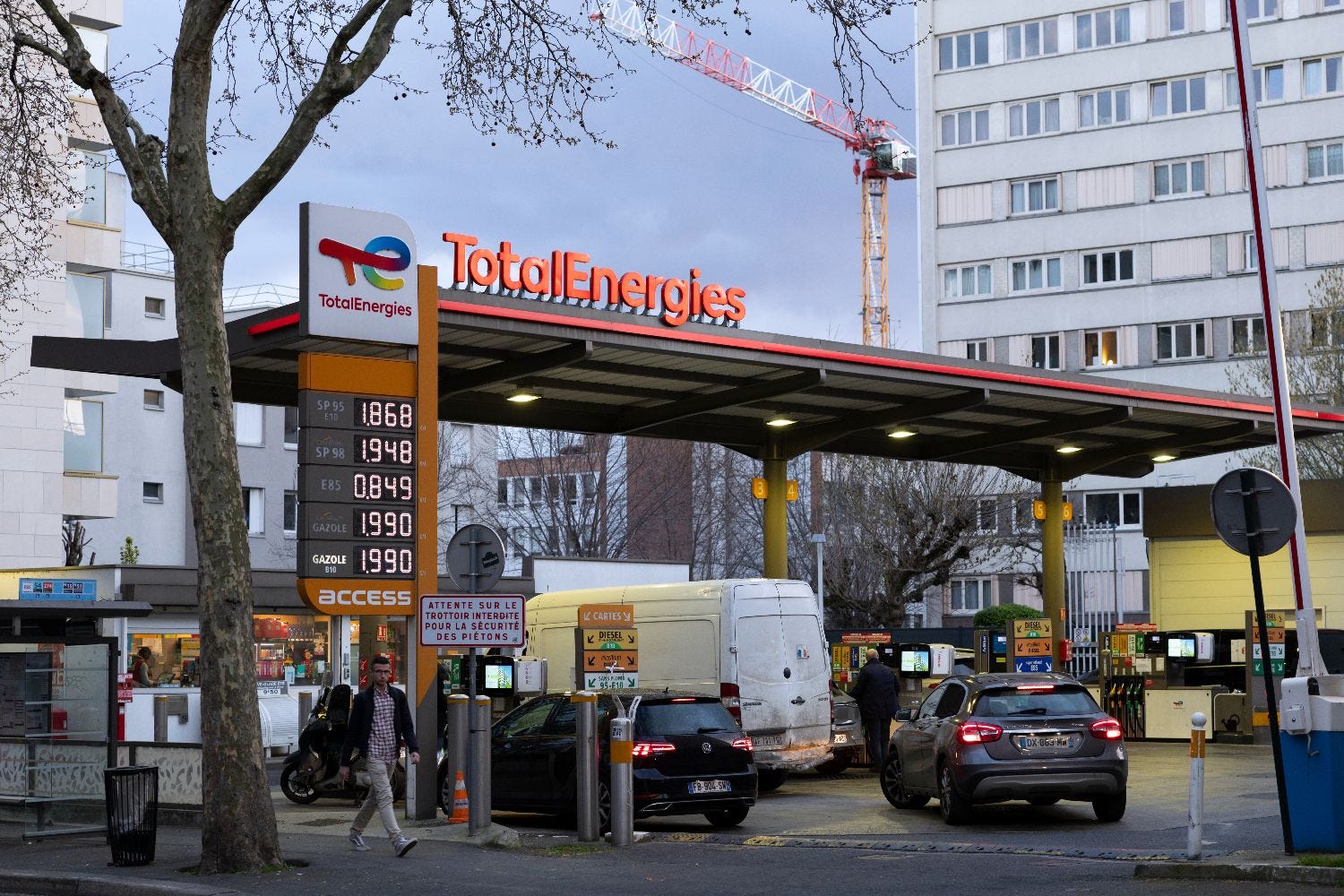
On the consumer and price side, Chinese exports have a clear effect on European price levels that policymakers often understate. Existing research shows that in 2023 alone, the influx of low‑priced Chinese goods reduced Eurozone headline inflation by around 0.4 percentage points through two channels: the competition effect on existing varieties and the variety effect from new products. The European Central Bank has similarly estimated that if U.S.–China trade tensions push more Chinese exports toward the Eurozone, the resulting increase in supply would lower Eurozone import prices by 1.6 percent in 2026. That decline in import prices would gradually pass through to consumers, reducing non‑energy industrial goods inflation by 0.5 percentage points and the overall consumer price index by about 0.15 percentage points. These disinflationary effects, which support price stability and household purchasing power, are real economic benefits that European debates often overlook.
If the EU were to launch a trade war against China, Beijing would almost certainly respond with countermeasures to protect its interests. Such escalation would further undermine Europe’s already fragile industrial competitiveness, disrupt the supply chains on which its green transition and digital transformation rely, and ultimately trap the EU in a spiral of shrinking exports, rising costs, and declining welfare. In this scenario, Europe would likely bear heavier economic losses than China.
Macroeconomic simulations by the Structural Trade Analysis System at the Chinese Academy of Social Sciences model a range of scenarios in which the EU raises tariffs on Chinese goods and China responds with proportional retaliatory measures. Under all scenarios, both sides suffer welfare losses, but the damage is consistently greater for Europe. If tariffs extend to all goods and increase in steps from 10 percent to 30 percent, the adverse impact on the EU grows non‑linearly and becomes clearly asymmetric.
When tariffs reach 30 percent, the model suggests that the EU’s GDP would fall by 0.294 percent, a deeper contraction than in China, which indicates that each additional tariff increase imposes a higher marginal cost on Europe. At every tariff level, the aggregate price index for EU member states rises—from 0.124 percent under a 10 percent tariff to 0.225 percent under a 30 percent tariff—showing that most tariff costs pass through to consumers via higher import prices. China’s overall price index, by contrast, remains negative across these scenarios, which points to greater resilience and flexibility in its export structure. While the EU might see a technical improvement in its terms of trade, it would pay for this by reducing its trade volume. In effect, Europe would be sacrificing market scale in exchange for a minor shift in relative prices and would end up with a net loss in real welfare.
The automotive sector highlights how severe this asymmetry could be at the industry level. In scenarios where both sides impose automotive tariffs of 30, 35, and 40 percent, the EU’s overall merchandise export growth rate falls by 0.759, 0.933, and 1.054 percentage points, respectively. These drops are roughly 1.8 to 1.9 times larger than the corresponding declines in China’s export growth rate, which exposes the structural vulnerability of Europe’s export‑oriented manufacturing. As one of the world’s core suppliers of high‑end vehicles, Europe’s auto industry depends heavily on the Chinese market. When tariffs restrict access to that market, the elasticity of foreign demand magnifies the hit to European producers. China would experience a sharper decline in import growth, which mainly affects domestic consumer surplus and input costs. For Europe, however, the export shock directly threatens manufacturing jobs, disrupts upstream and downstream segments of the industrial chain, and erodes the foundation of its trade surplus. As a result, the welfare losses at the sector level would be even more severe than headline macroeconomic figures suggest.
Taken together, both the macro‑level impact of across‑the‑board tariffs and the sector‑specific shock to the automotive industry show that a bilateral tariff war would harm the EU more than China. On the growth side, punitive tariffs would dampen external demand for exports and push up import costs, further weakening Europe’s already sluggish recovery. On the inflation side, rising import prices would pass down the supply chain and raise living costs for European households. Faced with weaker growth and stronger inflation, the European Central Bank would encounter a sharp policy dilemma between supporting activity and keeping prices under control. Under these dual pressures, Europe’s output and welfare losses would likely be larger and more persistent than the trade contraction shock facing China.
The EU’s current predicament does not fundamentally arise from allegedly “unfair” shocks delivered by external competitors. It stems instead from a deeper strategic misalignment within Europe. In an era of intensifying global industrial competition and heightened geopolitical risk, Europe still tends to act as though it were a traditional great power at the center of the system, without fully acknowledging the relative decline in its political and economic weight. This reluctance to adjust its self‑perception has hindered effective responses to internal structural crises and increased Europe’s strategic passivity—not only in its relationship with China, but also in its dealings with Russia and the United States.
To regain economic autonomy and industrial resilience, Europe needs to shift from scapegoating to structural reform and from defensive unilateralism to pragmatic cooperation.
First, enhancing its own industrial competitiveness must become Europe’s top priority. As the Draghi Report argues, Europe’s primary problem is a domestic crisis of competitiveness rather than external pressure. On the cost side, the EU has long suffered from high labor and energy costs that erode manufacturing margins and deter new investment. The structural surge in energy prices following the Ukraine crisis has amplified these weaknesses. On the innovation side, the EU lags behind both the United States and China in R&D spending in critical fields such as digitalization, artificial intelligence, and clean technologies. Market fragmentation within the EU prevents firms from realizing economies of scale and quickly turning innovation into market leadership. Addressing these bottlenecks requires deeper market integration, streamlined regulations, lower transaction costs, energy system reform, and more flexible labor markets—not new tariff barriers.
Second, Europe should pursue pragmatic economic dialogue and broader cooperation with China. At the institutional level, China and the EU already maintain a multi‑layered framework of high‑level economic dialogues and technology cooperation platforms. Policymakers on both sides should use these channels more fully to conduct technical, reciprocal consultations on capacity, subsidies, and market access, and should rely on rules‑based mechanisms rather than political signaling alone to manage disputes and build trust. With regard to investment, Europe needs a more mature and balanced view of Chinese FDI. The current mix of rhetorical openness and practical restriction—welcoming Chinese capital for green transition and infrastructure projects on paper while erecting new barriers under “de‑risking” tools such as the Net‑Zero Industry Act—undermines policy credibility and deprives Europe of much‑needed investment and technological partnerships. On the practical side, China and the EU could jointly design investment frameworks that speak directly to Europe’s concerns over innovation gaps and supply‑chain resilience, including joint ventures and technology‑sharing arrangements in batteries, renewable energy, and electric vehicles.
Third, Europe should recommit to the multilateral trading system and avoid setting precedents that may boomerang back on its own interests. For years, the EU has portrayed itself as a central pillar of multilateralism. Its increasing reliance on anti‑subsidy investigations, carbon border adjustment mechanisms, and unilateral trade restrictions risks eroding the WTO‑centered global trading order that Europe itself helped construct. This inward turn conflicts with the EU’s stated international commitments and injects new instability into global markets. Over time, such measures will not only expose European exports and foreign investment inflows to greater uncertainty, but also increase the vulnerability of its own supply chains.
Only by choosing rules over power politics, institutional openness over investment blockades, and multilateral cooperation over unilateral confrontation can Europe preserve its distinct role in the global economy while maintaining a workable balance between economic security and trade‑driven prosperity.
Reference:
1. https://www.euractiv.com/news/france-and-allies-call-for-eu-trade-defence-tool-to-fend-off-china/
2. Di Sano, M, G Pongetti, T Schuler and S G Toh (2023): “Spillovers to the euro area from recent negative inflation in China”, ECB Economic Bulletin, issue 7, November
3.https://www.ecb.europa.eu/press/blog/date/2025/html/ecb.blog20250730~833a22650e.en.html
About the Authors:
· Su Qingyi: Director and Senior Research Fellow, International Trade Research Department, Institute of World Economics and Politics, Chinese Academy of Social Sciences (CASS).
· Jiang Yang: Graduate Student, School of Global and Regional Studies, University of Chinese Academy of Social Sciences (UCASS).
No posts
Comments
Nothing yet. Say the first thing.
Sign in to join the conversation.