
By Liu Heng
Foreign Affairs recently published an essay by Shoumitro Chatterjee and Arvind Subramanian arguing that China has “pulled up the ladder” behind it. Their claim, put plainly, is that China rose through export-led industrialization and now occupies so much of the lower end of manufacturing that poorer countries can no longer use the same path. From that premise comes a policy recommendation: pressure China to vacate more of that space so late-developing economies can move in. This argument depends on a story about history as much as on a story about trade. It assumes that the world economy once offered a broadly open and reasonably fair route to industrialization, that the West facilitated, and from which China now departs. Without that assumption the argument immediately crumbles. The real issue is not whether China has betrayed a generous developmental order. The issue that matters is who built that order, which countries were permitted to rise within it, which countries were confined to subordinate roles, and whose interests the system was designed to serve.
In light of those questions, our essay makes three claims. First, the postwar development order never functioned as an open ladder available to all. It operated as a hierarchy created by Western powers, and access to industrial upgrading was extended selectively, usually where geopolitical advantage was needed. Second, many countries in Africa and Latin America were not blocked from industrialization by China’s later success. They were constrained much earlier by debt regimes, structural adjustment, restricted policy space, and a global division of labor that kept them in commodity and low-value positions. Third, Chinese engagement in the Global South has produced contradictions, but it cannot be understood through the crude formula that China simply steals opportunity from the poor. In all cases, Chinese capital has built infrastructure, manufacturing capacity, and local linkages that Western engagement either neglected or actively discouraged.
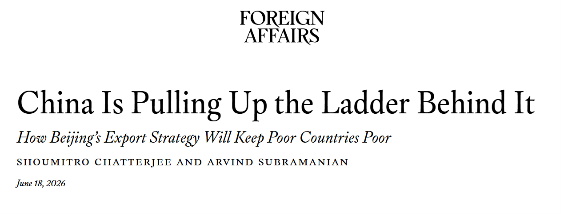
A methodological point belongs up front, because the original argument leans heavily on trade-in-value-added estimates. Those measures can be useful, but only if they are applied consistently. If one follows value-added through the chain, the obvious question is not just how much low-skill export value China retains. The deeper question is who captures design rents, technology rents, branding power, logistics margins, financing, and downstream control. Western lead firms still dominate those segments across much of the global economy. A framework that highlights China’s share of assembly or lower-end export value while passing lightly over Western control of the most profitable functions produces a distorted picture from the beginning. The distortion grows sharper once one remembers that these datasets lag real shifts on the ground. Supply chains have already been moving. Yet a moving target is being used to support a fixed moral claim.
The postwar order did not offer all developing countries a common route upward. What it did do was organize economic advancement through layers of power. The United States built a regional and global system in which selected East Asian economies could industrialize, but they did so inside a structure whose strategic direction, financial leverage, technological ownership, and consumer-market power remained concentrated in the advanced capitalist core. That distinction matters because factories could relocate, assembly could move, yet the activities that generated the highest returns remained elsewhere. Patents, finance, software, standards, high-end components, global branding, and final market access stayed concentrated in the United States, Western Europe, and, in some sectors, Japan. The World Bank’s own study of the East Asian Miracle recognized that foreign investors retained control over proprietary technologies and shaped the terms under which recipient economies could gain access to them. Even where production shifted geographically, command over the chain did not shift in the same way. This selective industrialization was not politically innocent. The countries most clearly allowed to rise under the U.S.-led order were not chosen by accident. Japan, South Korea, Taiwan, Hong Kong, and Singapore occupied frontline positions in the Cold War. Their economic success strengthened a strategic bloc in which they were developed as industrial allies inside a global security architecture. Even China’s later integration into the world economy followed political reasoning. Washington did not facilitate China’s entry into the global trading system out of abstract generosity. Many Western policymakers believed integration would transform China from within, soften its political system, and eventually fold it securely into a U.S.-centered order. That judgment now appears, in retrospect, to have been naive, but the strategic calculus behind it was never benign.

From this perspective, Asia’s contrast with Africa and Latin America is striking. Those regions were rarely treated as sites for parallel industrial ascent. Much more often, they were drawn into a center-periphery structure where their role was to export minerals, agricultural commodities, and lower-value goods while importing technology, capital goods, and high-value manufactured products. Coffee, copper, cobalt, soy, oil, iron ore, lithium, and even quinoa could travel outward from the periphery, but pricing power, processing depth, branding, finance, and technological command sat in the West. An iPhone assembled in China still delivered its richest margins to firms controlling design, software, intellectual property, and global distribution. A Bolivian or African commodity producer could increase output without gaining equivalent leverage over the terms of trade. That is how the hierarchy was designed to work. Value created at the bottom moves upward even when production spreads outward. Once we name this structure clearly, a question should intuitively follow. Were countries outside the favoured East Asian tier given similar room to build the institutions, industrial capacity, and policy autonomy necessary for independent upgrading? In Africa and much of Latin America, they were not.
To understand the current debate about China, one has to start earlier than China’s manufacturing rise. Why did so many African economies not industrialize under Western tutelage if the system was as open and facilitative as some now imply? Why did Latin America’s industrialization repeatedly stall, reverse, or get trapped short of transformation? The answer lies not in a sudden shortage of effort, but in the international conditions under which those regions were forced to operate.
From the 1980s onward, structural adjustment programs attached to IMF and World Bank lending sharply narrowed the policy space available to indebted states across Africa and Latin America. Governments facing crisis had to cut spending, remove trade barriers, privatize state firms, liberalize capital accounts, reduce industrial subsidies, and dismantle state-directed credit systems. These measures were not negotiated from a position of equality. They were imposed in moments of financial distress, when debtor states had little leverage and acute financing needs. What made this especially destructive was the historical double standard beneath it. Every successful industrializer had used some combination of tariffs, public banking, industrial subsidies, capital management, or state guidance. Britain had done so in earlier forms. The United States had done so. Germany, Japan, South Korea, and Taiwan had all relied on statist policy tools. Yet once many African and Latin American countries needed similar instruments, the Western-controlled international financial system recast those tools as illegitimate distortions of “proper” economics.
The damage was not abstract. Fiscal contraction weakened education and health systems. Public investment stalled. Infrastructure deteriorated or failed to expand at the pace industrialization required. Domestic firms lost protection before they gained competitiveness. Long-term financing dried up. All of these combined with forced capital account liberalization exposed fragile economies to sudden reversals that disrupted industrial planning and amplified vulnerability. This history matters because it identifies the real source of vulnerability in many poorer economies. A country with unstable electricity, thin credit markets, poor transport links, weak technical training, and limited state capacity will struggle against any efficient external competitor, Chinese or otherwise. When that country then loses firms or jobs under import pressure, the surface effect is visible but the underlying cause gets misread or misdirected. China did not create those structural weaknesses. It entered a field already shaped by decades of constrained development. By no means should China be held responsible for the structural deficits borne of Western exploitation decades earlier.
That does not mean Chinese imports have had no effects. In labor-intensive sectors in South Africa and elsewhere, Chinese import penetration has certainly reduced manufacturing output and employment. Firm-level research across sub-Saharan Africa also shows that exposure to Chinese imports can undermine growth where domestic producers are fragile. Those findings are real and they should be taken seriously. Still, the jump from “Chinese competition can hurt vulnerable firms” to “China has closed the path of development for poorer countries” remains analytically weak. It assumes a fixed world in which one country’s manufacturing gain must necessarily erase another’s possibility. That is simply a much stronger claim than the evidence supports. Part of the problem lies in the category itself. “Low-skill manufacturing” sounds simple, but the underlying production chains are not simple at all. What appears labor-intensive at the final assembly stage often depends on upstream segments that require machinery, reliable energy, industrial chemicals, logistics systems, standardized inputs, technical management, and quality control. Those functions do not disappear just because commentators label the final product low-skill. When China remains dominant in upstream segments, that does not automatically mean it has robbed poorer countries of their natural industrial role. In almost all cases, Chinese intermediate goods, global logistics networks, and industrial inputs are what allow factories elsewhere to operate in the first place. That is why domestic absorptive capacity matters so much. Research on African firms repeatedly shows that infrastructure quality, managerial capacity, institutional effectiveness, and human capital shape whether competition becomes destructive or developmental. Stronger firms can use cheaper imported inputs to raise productivity. Weaker ones collapse under the same pressure. Economically speaking, the right conclusion is not that Chinese competition is harmless, nor that it mechanically blocks late industrialization. The right conclusion is that competition lands on unequal ground. Where the underlying industrial base has been weakened by earlier international constraints, Chinese imports expose that weakness.
Another problem in the “pulled up the ladder” thesis lies in its treatment of manufacturing space as if it were closed and static. It is neither. Supply chains have been reorganizing in response to tariffs, geopolitical risk, labor costs, and strategic diversification. China’s direct share of U.S. imports has fallen markedly from earlier highs. Vietnam, Mexico, and other developing economies, in response, have captured part of that reallocation, demonstrating that the global manufacturing space has remained responsive to dynamic macro trends.
Bangladesh and Vietnam illustrate the point from different angles. Bangladesh has retained a major place in global garments while China remained dominant in manufacturing more broadly. Meanwhile, Vietnam has expanded electronics exports dramatically without waiting for China to withdraw from the field. These cases do not prove that the path is easy or universally available, but they do show that Chinese strength does not by itself seal off the route.
Where countries fail to capture shifting production, the explanation usually lies in domestic and structural constraints that the “China blocked us” story flattens into a single cause. Nigeria’s industrial weakness has been shaped heavily by infrastructure failure, especially in electricity. Zambia’s manufacturing diversification has stalled amid debt distress and regulatory instability, constraints that long predate any meaningful competition from Chinese imports. Beyond such country-specific cases sits a broader structural change: automation has reduced the labor absorption capacity of manufacturing across the world. Many developing economies now face premature deindustrialization, peaking earlier and at lower income levels than earlier industrializers did. That would remain true even in a world where China were less competitive.
The Foreign Affairs “China floods markets and crowds out industry” narrative also obscures something more concrete. Chinese firms and financiers have built a great deal across the Global South. They have financed ports, roads, railways, energy projects, industrial parks, logistics corridors, and manufacturing sites-exactly the things the Global South were denied by years of Western structural intervention. In many countries, Chinese investment has created jobs, transferred skills, expanded subcontracting, and connected local production to a global supply network in which goods from the African plains and the Latin American rainforests can reach the world. That record does not justify romanticism. Chinese projects can be opaque. Debt burdens can become politically fraught. Labor disputes do occur and environmental standards vary. Yet none of that changes the larger comparative point. In many Global South settings, Chinese capital has transformed sectors tied to production and logistics. Western engagement, by contrast, has more often concentrated on pure extraction, finance, services, and reshaping the governance conditions of receiving countries to ease political leverage.

Manufacturing offers clear examples. Research on Chinese industrial investment across seven African countries-including Kenya, Tanzania, Zambia, and Nigeria-documented job creation, factory-level training, quality-standard transfer, and local supplier linkages at scale. Across those cases, over 85 percent of workers employed by Chinese manufacturing firms were local, and Chinese firms were more likely to provide labor training than their domestic counterparts. In Tanzania specifically, Chinese investment in plastics recycling generated local entrepreneurship by transferring equipment to former employees at reduced cost, seeding an entire sector of local business. In the Tanzanian manufacturing corridor around Mkuranga and Kibaha, Chinese-financed industrial parks and energy projects have attracted further domestic and foreign investment by making reliable electricity and logistics available where they previously were not. Broader survey evidence from Ghana found Chinese firms in some manufacturing sectors sourcing more heavily from local suppliers than comparable non-Chinese firms. None of that means Chinese investment automatically delivers deep industrial transformation. It does mean the blanket image of Chinese capital as a purely predatory force is inaccurate.
The contrast is even sharper in extractive sectors, where the history of Western involvement is especially revealing. For decades, external actors treated African and Latin American resource economies as zones of concessionary access. While minerals and commodities exited, processing did not. Infrastructure, where it existed, frequently served the corridor from mine to port rather than the broader national economy. In contrast, Chinese firms have often escaped the purely extractive logic. Chinese projects have tied extraction to ancillary infrastructure, local processing ambitions, and cooperation with domestic firms in ways older concession models did not. In turn, the Chinese model creates more embedded capacity than the older pattern of enclave extraction and provides the invested state with a much more sustainable network of actors and capabilities to build towards industrialization.
The key point, then, is comparative. China should not be measured against an imaginary ideal of benevolent development partnership. It should be measured against the actual historical record of Western commercial and financial engagement. Once that comparison is made, a pattern appears. Western involvement has more often preserved dependency through conditional lending, commodity access, and control over high-value functions. Chinese involvement, while hardly free of power asymmetries, has more often built infrastructure and production sites that expand the possibility of local industrial capacity.

One of the least defensible assumptions in the Foreign Affairs argument is also the most revealing. The authors assume that analysts writing from Washington can identify the developmental interests of the Global South more clearly than the states and societies living through these choices themselves. That is an extraordinary claim, especially because it receives so little defence.
African governments and publics have not spoken with one voice, nor should anyone expect them to. They criticize Chinese lending, labor practices, contract opacity, and debt terms where those problems exist. They also criticize Western conditionality, paternalism, and the insistence that African states choose sides inside someone else’s strategic rivalry. Survey data, meanwhile, show substantial support for engagement with China, often higher than support for Western powers. Policy research from African cases also shows that many governments want diversified partnerships rather than externally dictated alignments. They prefer room to bargain, compare, and choose. That stance should not be dismissed as naivety. It reflects a sober understanding of development sovereignty. Governments in the Global South do not need external actors to tell them that all partnerships carry risks. They already know that. What many of them reject is the claim that one set of outside powers retains the authority to define what counts as legitimate development strategy while another set is condemned in advance for diverging from that script.
The deepest weakness in the “China pulled up the ladder” thesis is not empirical but conceptual. It takes China’s refusal to behave according to Western developmental expectations and turns that refusal into proof of harm. In doing so, it skips over the prior history of selection, hierarchy, and exclusion that structured the global economy long before China became a manufacturing giant. A more honest starting point would ask different questions. Who built the system in which high-value functions remained concentrated in the core? Who denied many poorer states the policy tools that successful industrializers had used? Who benefited from keeping Africa and Latin America tied to commodity dependence and financial vulnerability? Who now claims the right to define which forms of industrial policy are acceptable and which are distortions?
Once those questions are asked, the moral geometry of the debate changes. China is not a naive actor. It pursues advantage, protects its own industrial position, and always competes to win. But neither is it the author of the underlying structure within which many developing countries struggle to develop. Much of the Global South confronts Chinese competition from a position weakened by an earlier order that was never designed for its full industrial ascent. That is why the central issue is not whether China has pulled up a ladder that once stood open to all. The central issue is whether the countries long confined to the lower rungs of the world economy will gain the power to define development on their own terms, rebuild domestic capacity, and negotiate external relationships without being forced back into roles written for them by others. Only that question reaches the root of the problem.
About the author:
Liu Heng is an commentator of global politics and economics.
No posts
Comments
Nothing yet. Say the first thing.
Sign in to join the conversation.