
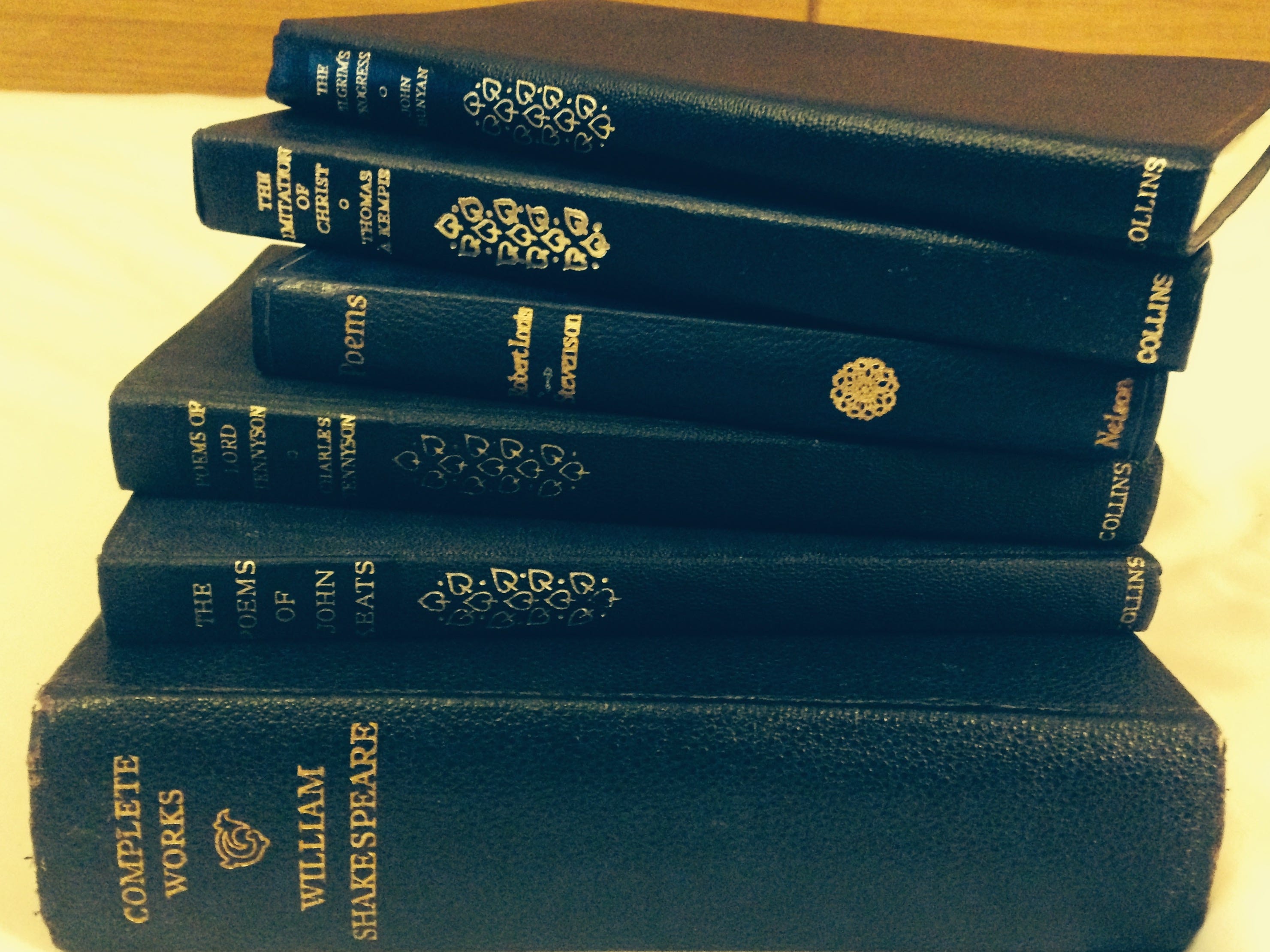
I am sitting in the café of a big box bookstore like it’s 1999. Back then, these behemoth booksellers were cast as the villain, as in my favorite rom-com of all time, You’ve Got Mail. But these days, any brick-and-mortar place where I can be surrounded by books and sit leisurely with them is a treasure. Something about it makes me smile. I’ve just browsed several rows of books—some of them religious, most not. Some are nonfiction; others are fiction. And then there are memoirs that surely live somewhere in between. All of them are trying to stand out to the casual browser. And all are, in some form, a story. The story of an idea, the story of a life, the story of a city or a company and more.
Humans are storytelling creatures. It is how we make sense of the world; it’s how we make meaning of our lives. And there is something of a template for the stories we tell. There is a line, variously attributed but perhaps most often to the great Russian novelist Leo Tolstoy, though I have not seen it cited, that “All great literature is one of two stories: A man goes on a journey or a stranger comes to town.”
Many have remarked that if this were true, then it could also be argued there is really only one story told from two perspectives—for the man who goes on a journey is also a stranger who comes to someone else’s town. Even if we didn’t reduce it that way, think of some great stories that connect these themes:
Bilbo Baggins goes on a journey because Gandalf, a stranger, comes to town.
Harry Potter goes to Hogwarts and begins his quest to defeat Voldemort because an owl (or rather, many owls!) comes to town (and eventually because Hagrid comes to the remote lighthouse cabin where the Dursleys seek to escape).
Little Women, a favorite with my wife and daughters (and let’s be honest, a favorite of mine too), is arguably about Jo’s journey to find herself after deciding against marriage to Teddy, who initially was the stranger who came to town.
Did you catch my reflection on Nolan’s spin on The Odyssey?
Theology and Culture
The Christ-Haunted World of Christopher Nolan's "The Odyssey"
·
Jul 23
I saw Christopher Nolan’s take on Homer’s “The Odyssey” this week. It was fantastic. Despite one truly grotesque scene (Circe and the pigs!), Nolan’s artistry is on full display. But I’ll leave the specifics about camera choices and lighting and angles to the artists and film experts out there. I just want to comment briefly on what struck me about the …
Anyway, I’m not convinced that all stories can be meaningfully reduced to these two themes. But there is something fascinating about searching for the repeated themes human stories seem to trace.
For Christians, there is one story that stands behind all stories: the story of God coming to us in human flesh, to be for us what we are not, to do for us what we cannot; the God who suffered with us, as us, for us; the God who died; the God who was raised up in victory, having gone through death to resurrection life.
This is a story that pulls together all human stories. It makes sense of our longing; it accounts for our failure and our frailty; it offers us a hope beyond ourselves, a redemption outside our reach; it answers the dream of life that goes beyond death.
But maybe the ubiquity of the Jesus story is the very reason some reject it. After all, is this not some version of an old human myth or of several myths? C. S. Lewis, acquainted with myth because of his academic field of medieval literature, referred to Christianity as “a myth which is also a fact.”[i] What he meant is there was an old myth of a “Dying God” that happened “at a particular date, in a particular place, followed by definable historical consequences.”[ii] These parallels ought not make one nervous, Lewis argued. In fact, “they ought to be there—it would be a stumbling block if they weren’t.”
It could be that Lewis had in mind what the writer of Ecclesiastes referred to as God putting “eternity in [our] hearts” (Eccl. 3:11). These myths exist for a reason; they are clues from our own longing. Yet the key in Christianity is that God actually came into our world. Lewis put it this way: “For this is the marriage of heaven and earth: perfect myth and perfect fact: claiming not only our love and our obedience, but also our wonder and delight, addressed to the savage, the child, and the poet in each one of us no less than to the moralist, the scholar, and the philosopher.”[iii]
Christian confession of Jesus is not only the marriage of heaven and earth in the sense of what Lewis called myth and fact. It is also because the confession of who Jesus is links the eternal Son with the incarnate Son. The one who was before all things and through whom all things were made is the one and the same who came into the world that He made. John put it this way in the opening lines of his Gospel account: “In the beginning was the Word and the Word was with God and the Word was God. The Word was with God in the beginning. Everything came into being through the Word, and without the Word nothing came into being. . . . The Word became flesh and made his home among us” (John 1:1–3, 14).
Jesus creating all things and then coming into creation to redeem; Jesus coming to earth for us, dying for our sin, rising in victory—this is the heart of the Creed and the center of our faith.
It is the story of all stories, and because it is the myth that is also true, it captures our wonder and our worship.
This was an excerpt from my latest book, “What’s A Christian, Anyway? Finding Our Way in an Age of Confusion and Corruption”. It is a pastoral guide through the oldest and fullest confession of the Christian faith, the Nicene Creed. I wrote it to help all de-constructors and doubters, disappointed and disillusioned, seekers and skeptics find their way back to the Father, Son, and Holy Spirit.

Find out more and get a whole bunch of free resources for small groups and preachers HERE.
[i] C. S. Lewis, “Myth Became Fact,” in God in the Dock (William B. Eerdmans, 1970), 58.
[ii] C. S. Lewis, “Myth Became Fact,” in Essay Collection: Faith, Christianity, and the Church (HarperCollins, 2001), 141–42.
[iii] Lewis, “Myth Became Fact,”
Thanks for reading Resilient Leadership with Dr. Glenn Packiam! This post is public so feel free to share it.
Comments
Nothing yet. Say the first thing.
Sign in to join the conversation.