

Everywhere you turn, someone is talking about AI. I was driving to LAX the other day and a billboard advertising chocolates said something about AI, though I can’t remember what. The conversation about AI is as ubiquitous as it is contentious.
A few weeks ago, The Gospel Coalition published their AI policy, mirroring what Christianity Today had published months prior. Both take a pretty strong stance, barring AI usage for both research and editing, not merely for writing itself. The support and the outcry were equally loud. Some called them “neo-Luddites”—

Aaron M. Renn 🇺🇸@aaron_renn
This is the single most neo-Luddite thing I've read on AI to date.
thegospelcoalition.org
Our Line in the Sand on AI: TGC’s Missional Opportunity

4:27 PM · Aug 5, 2026 · 108K Views
45 Replies · 8 Reposts · 100 Likes
— others praised them for being “pro-human”.
Crucial to the conversation is what we mean by AI. What kind of automated features are we talking about? LLMs— Large Language Models— are the ones most people think of, the kind of AI that mimic human logic, phrasing, and sentence structure. But tech-savvy folks know there are far deeper levels: Agentic AI can run tasks for you— like combing through your emails for school bulletins and club sports schedules and adding them to your calendar and inviting people you tell it to; or analyzing three years worth of financials and creating summaries and even models to forecast next year’s outlook. I have a friend who created an AI agent that emailed me my travel itinerary and speaking schedule, and checked in with me on the day of the event to make sure I had what I needed. I had no idea she wasn’t real until my friend asked me at a conference dinner event if I had met “Amber” yet. I said no but she had been super helpful, anticipating my needs and supplying me with all the information in a very nice document. He smirked and asked if I thought Amber was real. Welcome to the new world, I thought.
My friend Daniel Darling posted a thoughtful reflection on X last week about recognizing the difference between “work” and “toil”. Work is a gift from God, a pre-Fall, original call given to humans as part of the dignity and glory of being God’s image. Toil is the result of the Fall, the unnecessary exertion of stress that comes from the ground working against you and from thorns that pushing back against you. Work is glorious; we all long for purpose, to make a meaningful contribution to the world. That is why writers write and singers sing and architects design and teacher teach. But toil is felt when deadlines force writers to publish half-baked ideas, or when an industry squeezes every ounce of creativity out of an artist, or when education systems force children into cookie-cutter molds. Every industry is bent, every field is ridden with thorns, every job requires energy-draining, life-sucking toil that spoils the joy of work.
AI can help reduce the load of toil while not replacing the meaning of work.
AI is not going anywhere. Hard-line “either-or” solutions don’t take seriously the gifts and the dangers of it. It is not an unqualified good, nor is it an unmitigated disaster. As with so many other technological innovations, we’re going to become a “both-and” society. We shop at Walmart and at the farmer’s market. We buy stuff from Amazon and from Facebook marketplace. We post on Instagram, and we “Brick” our phones after dark. We send text messages and we give hand-writing cards.
The most fruitful questions are about what tensions we are trying to manage.
Naming tensions comes as a result of making distinctions.
After that lengthy preamble, we now come to the central distinction that helps us name the core tension in every conversation about AI. It has to do with personhood.
In the 1923, a Jewish philosopher named Martin Buber wrote a book called, “I and Thou”. His claim was that human relationships fall into two categories: relationships with an object (which he called, “I-It”) and relationships with a person (which he called, “I-Thou”). Anytime we relate to a human being, we must relate to them as a holy being, a sacred “thou”. We should never treat them like an “It”. Nor should we allow others to treat us like an “It”. And conversely, we should never treat an object like a person. Doing so diminishes that glory of humans being God’s image.
AI summary: When we encounter someone primarily as an object of experience, they become something to classify, use, manage, or understand. In an I–Thou relation, we meet another person in their irreducible particularity and presence, not reducing them to a function, category, or instrument.
Building on Buber’s work, we make argue that the more we interact with objects, the more we diminish our own humanity. Humans were made primarily for “I-Thou” relationships, not “I-It” relationships. All our human relationships are meant to point us up toward the Eternal Thou, God Himself. The better we get at human “I-Thou” relationships, the more ready we are for a relationship with God. Or maybe it’s the other way around.
When we relate rightly to God, we begin to relate rightly with people.
A Christian will recognize much to love about Buber’s framing. In fact, I may already be filling in Christian theology into Buber’s paradigm. The Bible links the love of God and the love as neighbor as the Great Commandment, in Deuteronomy and Leviticus, and of course in Jesus. Epistle 1 John is all about the necessary connection between these two “loves”. We cannot claim to love God whom we have not seen if we do not love our brother and sister whom we do see. John essentially says if we are truly alive, we will truly love.
Dynamic relationships with relational beings are the core of true life.
Other philosophers have a similar way of speaking about “personhood” and the relationship between people by talking about “subject-subject” relationships versus “subject-object” relationships. An “object” is a thing that can be acted upon; but it cannot act upon us. We can move an object, but it cannot move us. This is not only true in a literal sense but also in a metaphorical sense.
Have you ever been in a relationship with a person who only wanted you to do everything they wanted to do? Whenever you were upset, they were indifferent to you, or if you had a desire, they ignored it. But anytime they have a want or express an emotion, you’re supposed to jump to do it or to respond to them. If so, how long did that relationship last? Not long, I’d guess. Why? Because no one wants to be the “object” in a relationship. We want to be treated like a “subject”. A subject is a person who acts. Think of the word “subject” in a grammatical sense— the noun at the start of a sentence— not as another word for “servant”.
A healthy human relationship is between two “subjects”, two people who have their own verbs and actions and being.
A simple way to test this is to ask, “Am I moved by them? And are they moved by me?” Subjects move each other; objects are only moved by another. Even a newborn baby is a subject: what they do moves their parent. A baby cries, and a parent attends to them. We learn early on that we are not objects; we are subjects. We get to start the action in someone else.
Christian theologian Alistair MacFadyen, in his foundational work, “The Call to Personhood: A Christian Theory of the Individual in Social Relationships (1990)”, argued that a person is “formed through social interaction, through address and response.”
Whatever we call it— I-Thou relationships, or subject-subject relationships— they are dynamic. They make us human and they keep us human. They keep us from becoming an “It”, from becoming an object.
I was on a zoom call the other day with several pastors convened by Carey Nieuwhof to talk about the age of AI and the best ways the church should prepare for it. Carey has a brilliant new book on the subject coming out next month. On our call, he shared a slide that arrested me. It showed that for two years in a row, the number one reason Americans use AI is for therapy.
This is crossing an important line. It is one thing to rely on artificial intelligence or augmented intelligence or accelerated intelligence or even aggregated intelligence. It is another thing to begin to count on it for presence.
In a recent study, Barna found that “Practicing Christians express majority-level trust in AI across most domains of personal flourishing—and nearly half (48%) say they would trust AI with their spiritual growth.” Fortunately, pastors “express far lower trust across all the same domains.” There’s plenty to be concerned about in this graph:
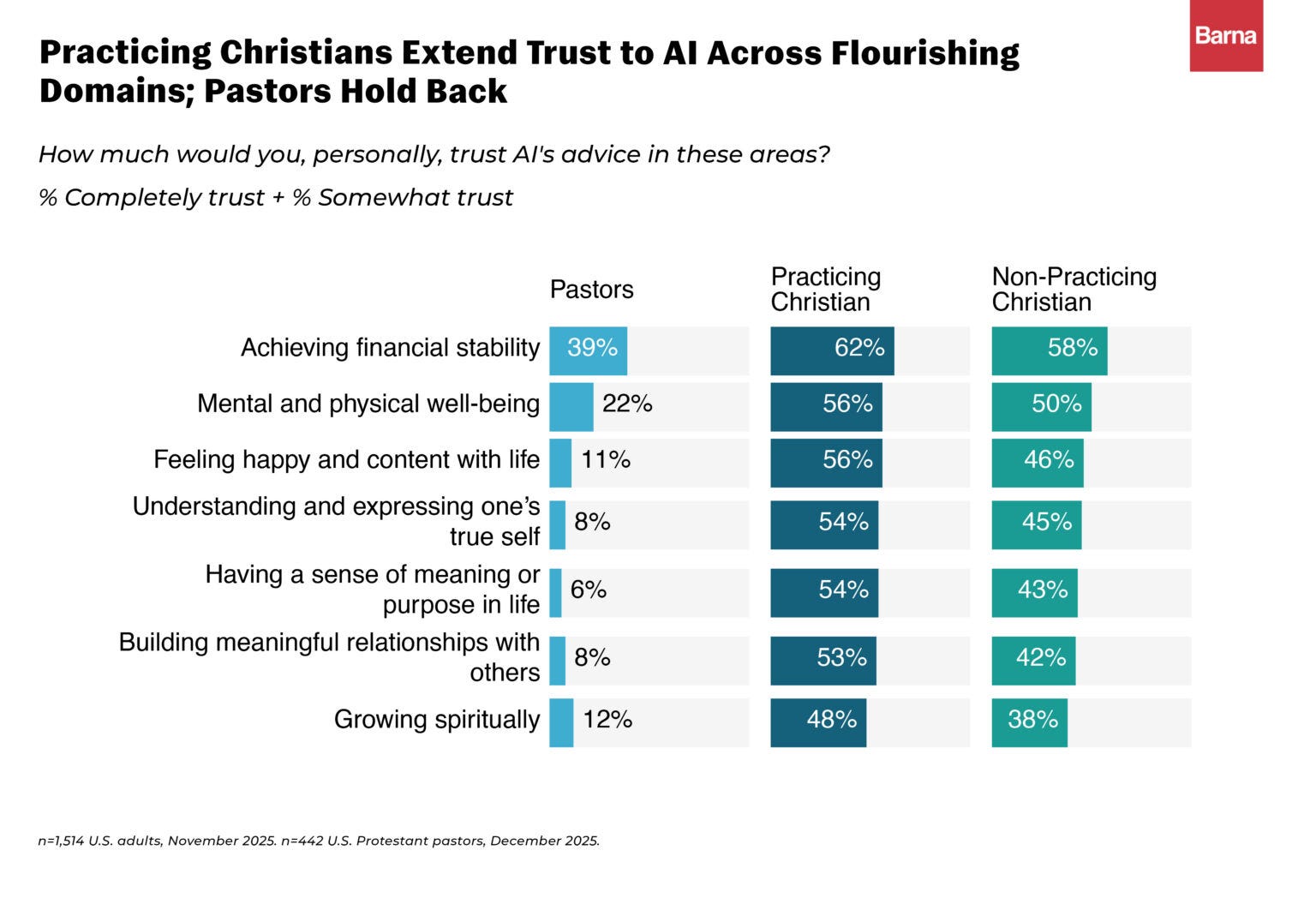
If humans are to be treated as a sacred “I” and “Thou”, as subjects worthy of empathy and love, then our deepest need is for presence. We need the presence of God; and we need the presence of God’s image-bearers, humans. In fact, our presence is the best gift we can give another person.
AI is excellent at intelligence; but it can never replace presence.1
Two of the surest markers of the presence of a dynamic being (read: a living subject versus a static object) are unpredictability and imperfection. The first is true of both God and humans; the second is true of humans.
A word to pastors:
In a world of AI polish, human imperfection and divine unpredictability may be the most powerful things the church can offer.
Why? Because it means God is present, and so are we.
When a small group of staff and elders convened a meeting to talk about how to draft an AI policy for our staff team, we invited a friend who serves at a senior leadership level at a tech AI company that you all probably own stock in. As we tried to lay out some of the issues, I was eager to press to rules and policies. He suggested starting with first principles. That has stuck with me. He said we should we start by defining what a human is, and what a human requires.
The best way to think through the tensions of what AI should and should not do is to start with what humans are and what we should and should not be.
AI is an “It”.
AI must never be treated like a “Thou”. It is an “object” to be moved by me and never to move me.
AI must never act as an “I”. It should not do work for me that diminishes my humanity or the humanity of others.
AI does not replace my thought-work. I do not let it think for me. AI can function like a high level research assistant for some projects. It can supply me with data, research, synopses and summaries.
AI does not do my creative work. AI never creates the first draft nor is it a content originator. AI can do derivative work. It can take a draft and fill it out, or my 1500-word sermon notes and turn it into a Substack, or create supplementary resources like group discussion questions, or summary reports from data files.
All writing that deserves to be a human speaking to a human should be written by a human. I’m thinking about sermons, personal letters, funeral speeches, wedding vows, and more. Bizarre as it sounds to have to say this, I keep hearing more and more stories of Claude or ChatGPT writing eulogies and wedding vows!
AI usage should be disclosed. A human deserves the dignity of knowing when they are not interacting with a human. All AI writing or writing that incorporates AI in structure and argumentation or is collaboratively written with AI should be disclosed. A human deserves to know when a digital brain is talking to it vs when a human is.
I don’t give AI a human name. With apologies to “Amber”, I don’t want my brain acting or interacting with AI as if it is a person. (I appreciate Perplexity’s choice to call it “computer”.)
You could sum up my proposal in one sentence (without the use of AI):
It is humans, not machines, that should become more human.
The flourishing of the world and the glory of God come through God’s image-bearers.
Thanks for reading Resilient Leadership with Dr. Glenn Packiam! This post is public so feel free to share it.
I first heard Andy Crouch make this distention on a Practicing the Way podcast with him and Jay Kim.
Comments
Nothing yet. Say the first thing.
Sign in to join the conversation.