

Enter the Story is a yearlong series at Rockharbor Church through 50 key episodes of the Bible. Each week, I’ve been posting an AI-assisted expanded version of my message notes. You can find the rest of the series here.
“Jesus returned from the Jordan River full of the Holy Spirit, and was led by the Spirit into the wilderness.” Luke 4:1 (CEB)
Jesus is full of the Spirit and He is led by the Spirit into the wilderness. You can be full of the Spirit and still be in the wilderness. In fact, the Spirit may be the one who leads you there.
The wilderness is not a God-forsaken place; the wilderness is a place of testing.
God led Israel through the wilderness for forty years to purify them, to see what was really in them.
“You must carefully perform all of the commandment that I am commanding you right now so you can live and multiply and enter and take possession of the land that the LORD swore to your ancestors. Remember the long road on which the LORD your God led you during these forty years in the desert so he could humble you, testing you to find out what was in your heart: whether you would keep his commandments or not.” Deuteronomy 8:1-2 (CEB)
Before we get to the three tests themselves, we need to sort out a question: What’s the difference between a test and temptation?
First of all, God does not tempt.
“When tempted, no one should say, ‘God is tempting me.’ For God cannot be tempted by evil, nor does he tempt anyone; but each person is tempted when they are dragged away by their own evil desire and enticed.” James 1:13-14 (NIV)
The devil tempts. The devil attempts to distort our desires to create a landing strip to launch his work in us.
God tests us to refine our faith. What we experience as temptation from the devil may, at the very same moment, be testing from God.
But lets be clear: God and the devil are not equal forces. This isn’t the old cartoon image of a little devil on one shoulder and God on the other, evenly matched, waiting to see who wins the tug of war. Spoiler alert: Jesus passed the test and went on to defeat the devil!
So when God tests us by allowing the devil to tempt us, the devil is less like a rival power and more like a dog on a chain. Martin Luther, the 16th-century German reformer, put it this way:
“He can do no more than a bad dog on a chain, who barks, runs around... But because he is tied up, he cannot bite you unless you get too close to him.”
Here’s the key difference:
The devil wants us to make us fall, God wants to make us strong.
The late British NT scholar, Michael Green, puts it this way:
“God deliberately allows temptation. Its arrival does not mean that God’s blessing has evaporated…Temptation builds spiritual muscle.”
“There he was tempted for forty days by the devil. He ate nothing during those days and afterward Jesus was starving. The devil said to him, ‘Since you are God’s Son, command this stone to become a loaf of bread.’ Jesus replied, ‘It’s written, People won’t live only by bread.’ ” Luke 4:2-4 (CEB)
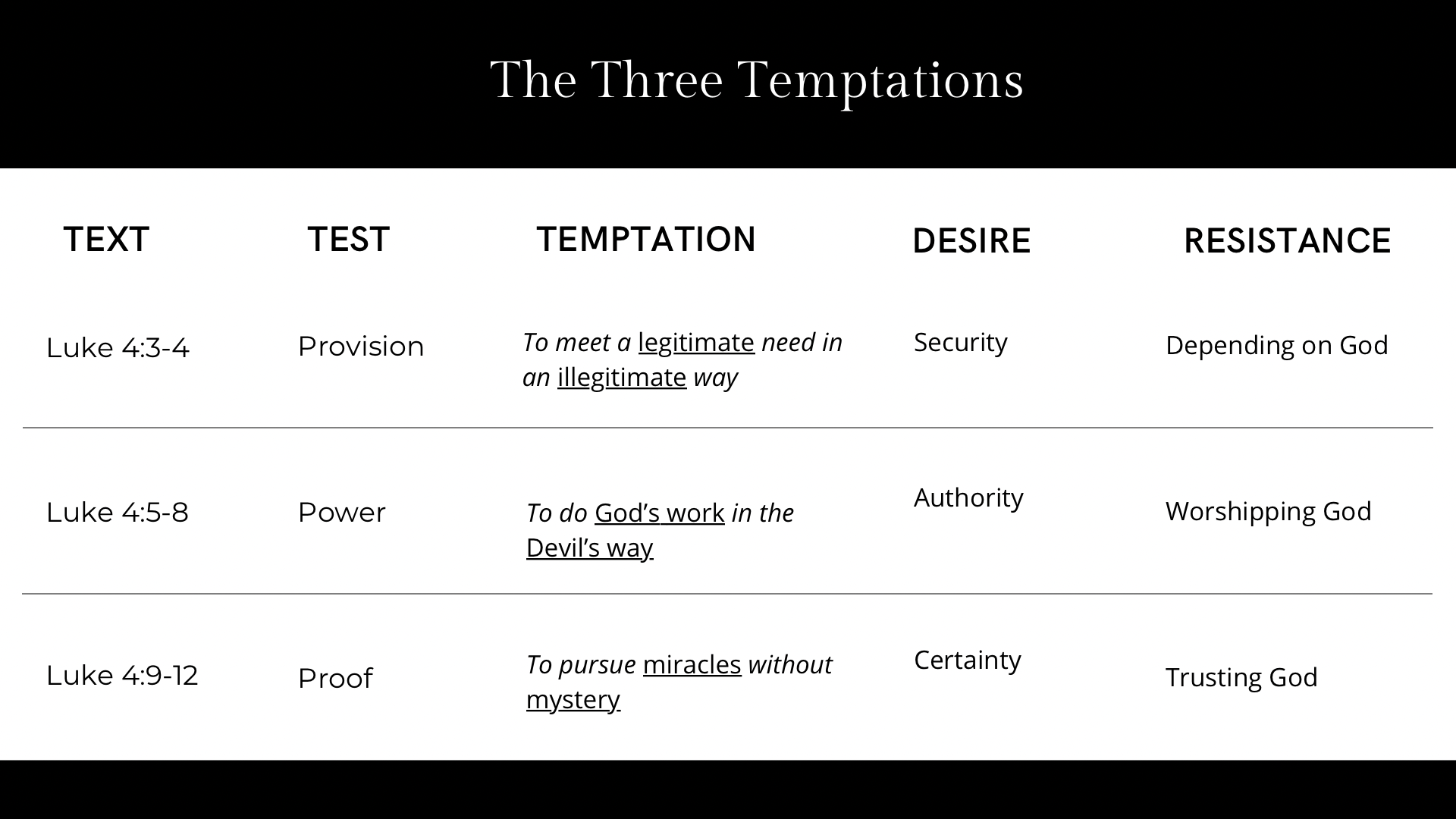
The first test is the test of provision, and the temptation underneath it is this to meet a legitimate need in an illegitimate way.
This temptation shows up when we chase significance through success because we’re starving for a sense of worth. It shows up when we reach for comfort through a drink or a screen, or for companionship through a friendship or relationship we know isn’t wise.
The Scottish novelist Bruce Marshall wrote about a Catholic priest, Father Smith, who meets a “modern” woman who has rejected Christianity as a fairy tale. She can’t imagine how anyone lives without sex, and tells him she believes “that religion is only a substitute for sex.” Fr. Smith answers her: “I still prefer to believe that sex is a substitute for religion and that the young man who rings the bell at the brothel is unconsciously looking for God.”
Every test in this wilderness is really about a good desire pulled into disorder. Here, the desire is security. Your need for bread is not bad. Your dependence is not the problem. The problem is our desire for independence from God.
I think back to seasons in my own life where trusting God for provision wasn’t a metaphor, it was the daily reality. Look, planning ahead is good; prosperity is a blessing. But we must not pursue security so that we never actually have to depend on God.
“Jesus replied, ‘It’s written, People won’t live only by bread.’” Luke 4:4 (CEB)
“He humbled you by making you hungry and then feeding you the manna that neither you nor your ancestors had ever experienced, so he could teach you that people don’t live on bread alone. No, they live based on whatever the LORD says.” Deuteronomy 8:3 (CEB)
The resistance to this temptation is depending on God.
“Next the devil led him to a high place and showed him in a single instant all the kingdoms of the world. The devil said, ‘I will give you this whole domain and the glory of all these kingdoms. It’s been entrusted to me and I can give it to anyone I want. Therefore, if you will worship me, it will all be yours.’ Jesus answered, ‘It’s written, You will worship the Lord your God and serve only him.’” Luke 4:5-8 (CEB)
The second test is the test of power, and the temptation is to do God’s work in the devil’s way.
The book of Revelation contrasts the Beast and the Lamb, the way of domination versus the way of sacrifice. The authority the devil is offering is the kingdoms of the world without death on a cross.
The desire underneath this test is authority. God gave Adam and Eve dominion over the garden and the animals. Authority itself isn’t the problem; it’s the way we choose to use it.
“Jesus answered, ‘It’s written, You will worship the Lord your God and serve only him.’” Luke 4:8 (CEB)
“Revere the LORD your God, serve him, and take your solemn pledges in his name! Don’t follow other gods, those gods of the people around you—” Deuteronomy 6:13-14 (CEB)
The resistance to this temptation is worshipping God. Worship the Lamb, and you get the Lamb’s version of power (sacrifice). Worship the Beast, and you get the Beast’s version of power (control and domination).
“The devil brought him into Jerusalem and stood him at the highest point of the temple. He said to him, ‘Since you are God’s Son, throw yourself down from here; for it’s written: He will command his angels concerning you, to protect you and they will take you up in their hands so that you won’t hit your foot on a stone.’ Jesus answered, ‘It’s been said, Don’t test the Lord your God.’ After finishing every temptation, the devil departed from him until the next opportunity.” Luke 4:9-13 (CEB)
The third test is the test of proof, and the temptation is to pursue miracles without mystery.
We want proof that God is powerful and good. That desire isn’t wrong on its own. But it crosses a line when what we actually want is a God we can control — a God who performs on command, the way the devil is baiting Jesus to perform here, on cue, in front of a crowd, from the highest point of the temple.
To be clear: Jesus is unequivocally against sickness and darkness. The rest of this chapter shows Him standing up in the synagogue, reading from the scroll of Isaiah, declaring that He is the anointed one, the Messiah — and then demonstrating His authority over sickness and demons among people who believe. He’s not indifferent to suffering. He’s not telling us not to expect Him to act.
The desire underneath this test is certainty. But faith is not certainty. Sometime our desire for certainty is actually a desire for immunity. I think of the promises you hear from faith healers “nothing bad will ever happen to you” — which sound like faith but are really a demand for a guarantee.
The truth is, doubt is part of the journey of faith. If there is no room for doubt, there is no room for faith.
“Jesus answered, ‘It’s been said, Don’t test the Lord your God.’” Luke 4:12 (CEB)
“Don’t test the LORD your God the way you frustrated him at Massah.” Deuteronomy 6:16 (CEB)
The resistance to this test is trusting God.
The goal of testing is produce a loving trust in God.
This can happen in us whether we pass the test of fail it. Why? Because Jesus is faithful when we are not! Adam and Eve failed in the garden. Israel failed in the wilderness. But Jesus was faithful!
“These things happened to them as an example and were written as a warning for us to whom the end of time has come. So those who think they are standing need to watch out or else they may fall. No temptation has seized you that isn’t common for people. But God is faithful. He won’t allow you to be tempted beyond your abilities. Instead, with the temptation, God will also supply a way out so that you will be able to endure it.” 1 Corinthians 10:11-13 (CEB)
The same God who led us into the wilderness will lead us through!
Listen on Spotify here.
Watch the message here:
Thanks for reading Resilient Leadership with Dr. Glenn Packiam! This post is public so feel free to share it.
Comments
Nothing yet. Say the first thing.
Sign in to join the conversation.