
This article describes a walk around a historic island near Berlin, Germany, taken up by Professor Gopinath and some graduate students. During the walk, they discuss the conceptual models people build to understand the world around them. The discussion highlights the need to understand the uncertainties associated with every model. Shattering the common belief that science builds perfect models, this discussion underscores that understanding uncertainties indicates a better scientific temperament.
The discussion continues from Part-1 …
Walking southward in that fairyland, they reached an exit gate. Relieved, they came out and found the eastern shore docked with beautiful white sailboats. There were some public gardens and hotels dotted with people. They continued southward on the grassy shore.
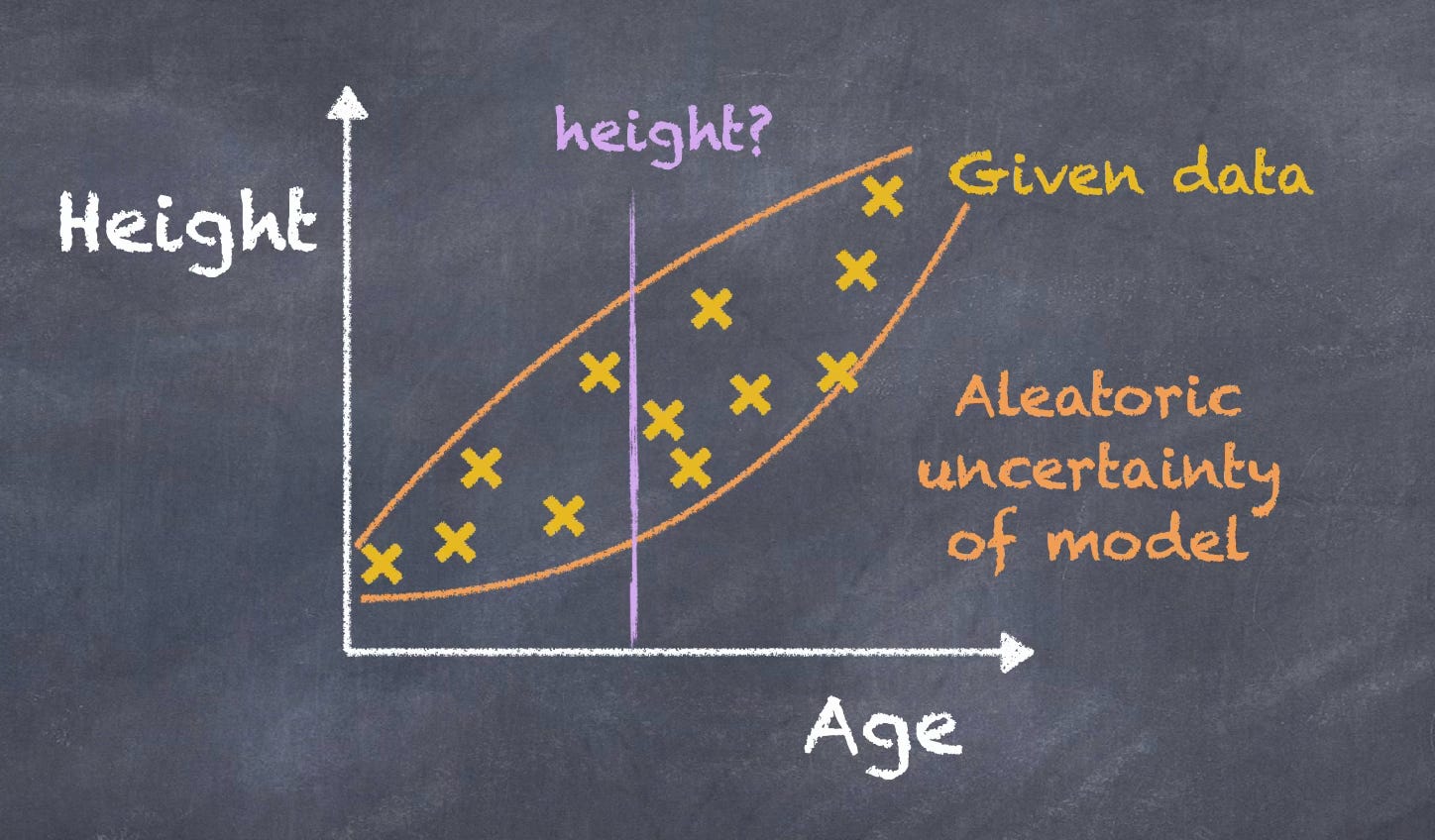
Professor: Apart from learning the limitations of a model, uncertainty could also arise because of inherent ambiguity in observations. This is called aleatoric uncertainty. For example, imagine you are asked to guess a man's age from his height alone. Even after observing the height and age of hundreds of men, you won’t be able to do this task accurately for a new man. Similarly, a low-resolution picture of a person is not easy to recognize even by the best AI models. An AI-driven car with a dirty camera lens may fail to recognize things even with the best-trained models.
Subal: In that case, it would be better if the car stops and informs a human to clean the lens.
Sia: Absolutely.
Karan: Some life decisions could also be inherently ambiguous, e.g., a fresh graduate with PhD offers from two good universities. (Laughter)
Subal: It seems learning is of no help in overcoming this kind of uncertainty.
Professor: Yes. Learning can only help quantify how much the uncertainty is, but it cannot reduce it. Because the available information itself is not sufficient to make a confident decision.
Subal: Stock investments are subject to market risks. (Laughter)
Professor: In any case, these uncertainties are unavoidable, so we must learn to model them as well. Just like an airplane cannot avoid dealing with uncertain winds. It has to learn how large the uncertainty can be at any time and be more alert when it is large.
Subal: It is not possible to be hyper-alert all the time. So, aleatoric uncertainty can help us optimize our efforts in being alert.
On reaching the southern end of the shore, they decided to turn west to walk on the stone-paved street curving through colorful houses decorated with hanging flower plants.
Sia: How does a spiritualist handle such uncertainties?
Professor: Even if you are perfectly intelligent and well behaved, the world has uncertainties, and your decisions may lead you to miserable conditions unwillingly. For example, the Pandavas1 suffered despite being ideal in character and behavior.
Sia: And even the best models cannot cope with it. Even Lord Krishna was present, but the reverses in the lives of the Pandavas could not be checked.
Professor: It is necessary to understand the nature of this uncertainty and deal with it in a productive way. This sounds difficult. But Bhishma2 gives a practical suggestion that a spiritualist understands these uncertainties and uses them to progress towards his/her relationship with God. He tells the following to Yudhishthira3 after the deadly war:
Text within this block will maintain its original spacing when published
Oh perfectly gentle one, O pure hearted and bright,
no one can reason why were you dragged into this fight;
dynamics of the world evolve inevitably in time,
uncertainties unavoidable cover gold with grime;
even the gentle suffer for no fault of their own,
even the smartest ones sometimes do get blown.
Unavoidable is the nature of this uncertainty,
accept it and model it, actually, that is sanity;
productively it can be used, you may be surprised,
wise accept it as God’s wish, without being agonized.
Such reverses only highlight their characters advanced,
just as spots on the moon make its beauty enhanced.
Karan: I hear from people that there are mystics who can tell the future. They know the future precisely and never make a mistake. At least common people respect them for this reason. How can there be any uncertainty then?
Text within this block will maintain its original spacing when published
Don’t we hear about mystics,
that future they can tell
beyond mistakes, charismatic,
casting a magic spell.
Professor: Spirituality upheld by Gita is beyond any magic and mysticism. It is simply a gentle and intelligent way of life. Even the advanced spiritualists face aleatoric uncertainties, but they are not discouraged by them.
Text within this block will maintain its original spacing when published
The spirituality that Gita upholds,
is far beyond any mystic folds.
Simplicity and a gentle way of life,
be keen and humble even in strife.
Mistakes do come even in a gentle one’s ways,
learning from everyone, ever sublime s/he stays.
Intelligent, but factors in chaos of ambiguity,
fixed in practice while upholding authenticity.
They reached the cathedral, where the high spires and bells welcomed them. The peaceful neighbourhood became even more sublime with this medieval cathedral surrounded by a garden which appeared like a meditation spot for the sages.
Professor: Let’s discuss now the third kind of uncertainty, which arises due to distribution shifts. Even when one has learnt something really well, and one is aware of the inherent ambiguities, one may still make a mistake if the situation looks normal but is actually very different from what we are used to observing. For example, when I first rode a bicycle in the Netherlands in winter. The road condition looked normal, but in reality, it was immensely slippery from a thin sheet of frozen water. I felt so confused and afraid.
So, the situation may appear very normal, but it may actually be acutely different because of inherent differences that were unobserved previously by the model. A good example appears in languages. Many Germans tend to pronounce the sound /th/ as /s/ when speaking English. So, when a German coast guard receives a phone call from a British ship saying, “we are sinking”, he responds by asking, “what are you thinking about?” (laughter)
Sia: Another example could be a family concealing a robot girl as their daughter, and no neighbour being able to guess the reason for her extraordinary activities. I just remember it from an 80’s science fiction TV series.
Karan: There is even more chance of making a mistake in such situations, because it seems we can’t even predict such circumstances.
Professor: True.
After spending some time walking in the cathedral gardens, they continued westward on the stone-paved streets.
Sia: How does a spiritualist handle such situations?
Professor: There is a famous incident in this regard [SB 10.14]. Even Brahma4, who is intelligence personified and the original teacher of the entire Vedic civilization, failed to recognize Krishna who was having fun as a cowherd boy in Vrindavan forest. Brahma made a wrong decision to put Krishna in trouble, but after realizing his mistake, he immediately confessed in a humble way and acknowledged the futility of pride [SB 10.14.38].
Text within this block will maintain its original spacing when published
“You, we understand,” confidently some say
let them say so, but I don’t think that way
I can only conclude without any delusion
that prone to error is my every conclusion
We cannot model all possibilities, so don’t be proud. There will always be unseen and unexpected situations. This is the nature of the world - it is infinite. Even more so for God, who is the fundamental foundation of the world. But God is kind, so don’t worry [BG18.66, SB10.14.12].
Karan: How is this different from epistemic uncertainty?
Professor: Well, in this case, there is no expert around to teach us because it is a rare and unexpected situation. Many a time, we may not even be able to detect that this situation is different from what we usually encounter. One has to do the best one can while tolerating the mistakes [SB10.14.8].
They reached the western end where they had started. After spending some time looking at the wooden windmill, they continued walking over the bridge towards the bus stop.
Karan: I get a scary feeling that mistakes are unavoidable.
Subal: Some, not all.
Sia: And some mistakes are good. They could be made into stepping stones of life.
Professor: Well, understanding these uncertainties can help one choose what kind of mistakes to make.
To reduce epistemic uncertainties, learn from the best and collaborate with other experts.
Aleatoric uncertainties must be modeled, and they keep us alert while making decisions.
Distribution shifts teach us to be humble always.
Subal: More importantly, I think uncertainties bring a lot of fun. If everything were perfectly predictable, life would be boring.
Professor: True. Uncertainty brings suspense and fun to movies, dramas, and life.
Karan: And to magic shows. (Laughter)
Their bus arrived, and all of them stepped into the bus, bidding farewell to the Havel and the enchanting island thereon.
[BG x.y] Bhaktivedanta, A. C. (1972). Bhagavad-Gita as it is. Bhaktivedanta Book Trust. Chapter-x, text-y.
https://vedabase.io/en/library/bg/x/y/
[SB x.y.z] Bhaktivedanta, A. C. (1974). Śrīmad Bhagavatam: with the original Sanskrit text, its Roman transliteration, synonyms, translations, and elaborate purports. Bhaktivedanta Book Trust. Canto-x, chapter-y, text-z.
https://vedabase.io/en/library/sb/x/y/z/
Five brothers; one of them, named Arjuna, is the one whom Krishna discusses Gita with. Their mother, Kunti, also suffered for no fault of her own — her husband died soon after the birth of the Pandavas. Duryodhana became their enemy just to take up the throne. He made many plans to execute them which kept them always surrounded by troubles. They lived many years as homeless, sometimes hiding for safety.
The mighty grandfather of Pandavas. He was an invincible warrior and an exalted spiritualist.
The eldest of the five Pandava brothers.
Brahma, who is intelligence personified, was once told that the supreme Lord is playing as a village boy in Vrindavan. None of the features of the supreme Lord, as Brahma had known, were visible in this little boy. So Brahma kidnapped all the friends and calves of this boy to test his potency. The little boy gracefully expanded himself into all the friends and calves, who continued living peacefully in the village with their families. After a year, Brahma came back expecting chaos but was extremely confused to see peace prevailing. Realizing his overconfidence and thereby the mistake of testing the Lord in such an impudent way, he asked for forgiveness from the little boy, who then mildly rebuked him. Actually, this little boy, Krishna, wanted to give him the message that he should stay humble, no matter how intelligent he may be. Thereafter, Brahma showed exemplary humility and apologized for his mistakes.
No posts
Comments
Nothing yet. Say the first thing.
Sign in to join the conversation.