
There are 86 days until the midterm election, and I think a whole lot of us are tired in a way that goes beyond ordinary political fatigue. We are not checked out, and we are certainly not unconcerned about what is happening around us. If anything, the problem is the opposite.
For nearly two years, many of us have been paying attention so closely that it has become difficult to remember what it feels like to move through a day without some fresh outrage waiting for us before we have even finished our coffee.
There is always another headline, another policy, another cruel decision, another video explaining why this particular thing matters and what we are supposed to do about it. We have been asked to stay informed, stay vigilant, stay angry, call our representatives, donate, share, speak up, pay attention, resist, organize, and somehow still go to work, make dinner, tend our homes, love our people, and hold together the ordinary pieces of a life. That kind of sustained intensity does something to a person, especially when there is no clean end point in sight.

Lately, though, I have found myself thinking less about how we get through the next 86 days and more about what happens after them.
I am hopeful about the midterms. I think there is a real possibility that the political landscape shifts in a meaningful way, and if that happens, I imagine there will be a collective sigh of relief that feels almost physical. Not because everything will suddenly be fixed — because it will not be, or because the damage will disappear — because it will not. But because maybe, finally, we will have enough footing to stop spending every ounce of energy bracing for the next blow and begin thinking more seriously about how to mitigate the damage, protect what remains, and start planning for what comes next.
That possibility feels hopeful to me, but it also raises a question I cannot stop thinking about: what are we going to do with all this rage?
For a long time, anger has been one of the primary fuels of political engagement online. It makes sense. There has been plenty to be angry about, and anger can be clarifying. It can sharpen your sense of right and wrong. It can move you to act when complacency would be easier. But anger can also become habitual, especially when an entire media ecosystem is designed to reward it.
I know that because I watched it happen in my own work.
About six months ago, I started noticing that I did not particularly like the way I felt after creating certain kinds of political content. I was not intentionally rage baiting, I was simply talking often about the things that enraged me, and because the things enraging me were also enraging millions of other people, the content performed incredibly well. At the peak of that period, I was averaging around 30 million views a month on Instagram.
These days, now that I have made a conscious effort to let joy, kindness, hope, community, gardens, practical magic, ordinary life, and useful action lead more of what I create, I average somewhere around 2 to 3 million views a month. Most of the content that still performs at the highest level is political, but even there I try to approach it differently. I want people to feel seen in their anger without leaving them stranded inside it.
That choice has cost me reach, and I am very aware of that. There are days when I sit down to make something and have absolutely no idea what to say. I know it would be much easier to open the news, find whatever fresh hell has arrived, turn on the camera, and tap directly into the outrage. I know there is a decent chance that content would travel farther and faster than a video about canning berries or tending a garden or buying local.
But I also know how I feel afterward.
At some point, I had to ask myself whether I wanted to build my work around keeping people activated because activation performs. That question made me deeply uncomfortable because I have spent years criticizing media companies that do exactly that.
I have watched Fox News build an empire around keeping people afraid, furious, and convinced that the next threat is always just around the corner. The ideology may be different from mine, but the emotional mechanism is not difficult to recognize. Find the threat, intensify the fear, feed the anger, and keep people watching.
I did not want to become a more politically agreeable version of the same machine.
That realization did not make me less political. It did not make me less angry, and it certainly did not make me less willing to call bullshit when bullshit needs calling. What changed was the kind of emotional state I wanted to leave people in after they spent a few minutes with me.
I wanted to give them hope.
Not the toxic-positivity kind of hope that asks us to pretend everything is fine when it plainly is not. I mean the kind of hope that has some weight to it, the kind that gives you enough steadiness to act. I want people to remember that they are not alone, that history has had terrible chapters before, and that terrible chapters do eventually end. Systems change. Regimes end. Policies are reversed. Communities organize. People survive things that once felt impossible to survive.
More than anything, I want people to remember that small actions matter.
Calling and writing your representatives, filling a food bank, sharing what grows in your garden, buying from local businesses, thrifting instead of automatically pouring more money into the same giant corporations that help fund the chaos, building local community with people who genuinely care for one another — all of it matters. None of those things are particularly glamorous, and most of them will never go viral, but I have come to believe they are far more meaningful than spending six hours scrolling until you are exhausted, furious, and no more able to affect the situation than you were when you picked up your phone.
That is one of the strangest things about the rage cycle. It can create the feeling of engagement without always producing action. You can consume an enormous amount of information and still be standing in the exact same place at the end of the day, only more depleted.
I think a lot of people keep scrolling because they are trying to make sense of the insanity. They think maybe the next article will explain it, or the next video will provide the missing piece, or the next expert will finally make the behavior of powerful people feel rational. But sometimes there is no satisfying explanation because some actions are rooted in cruelty, opportunism, bad faith, or chaos itself. There is no amount of scrolling that can make those things reasonable.
That is where I have had to change the question.
Instead of asking endlessly, “Why are they doing this?” I try to ask, “What can I do about it?”
Sometimes the answer is political. Sometimes I can make a call, write a letter, donate, or speak up. Sometimes the answer is local. I can spend money at a small business, I can share what I grow in my garden, I can help someone in my community. Sometimes the answer is simply to take whatever ridiculous situation has landed in front of us and squeeze a little usefulness out of it.
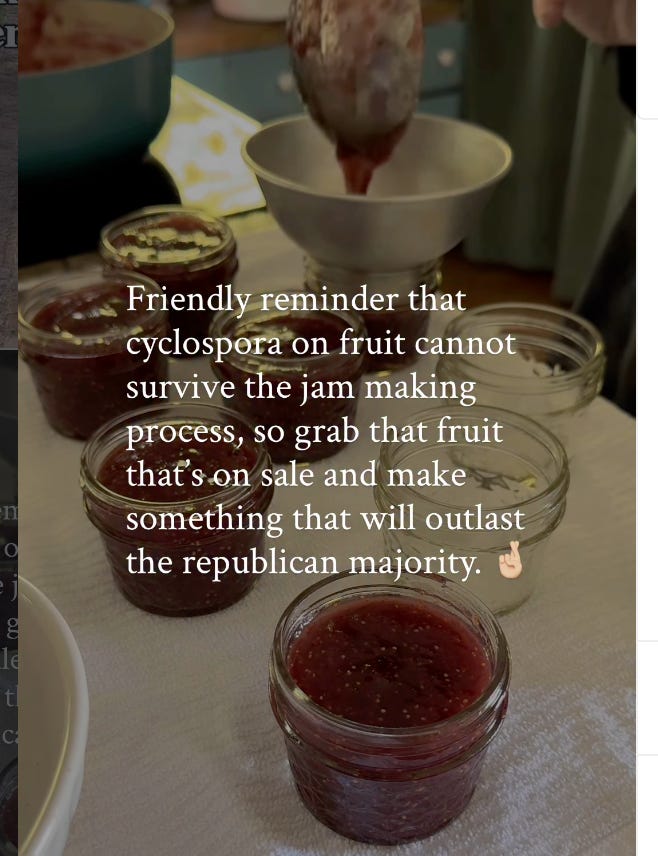
The video I posted yesterday was a good example. It was just an eight-second clip about fruit being on sale because people are nervous about the cyclospora outbreak. The point was not to ignore what is happening. The point was to acknowledge it and then ask, “Fine, what can I do with this?” If berries are cheap, make jam. Preserve something. Take advantage of the incompetence. Make something that might very well outlast the political majority that helped create the mess.
That, to me, is what hope looks like now.
Hope is not pretending the present is good. Hope is behaving as though the present is not permanent.
It is planting flowers because you believe there will be another spring. It is putting food in jars because you believe there will be another winter. It is building friendships and neighborhoods and local networks because you believe people are going to need one another long after this particular political chapter is over. It is making plans for a future you fully intend to be here for.
That is also why I keep thinking about what happens after November.
If the midterms go the way I hope they do, I think there will be an enormous exhale, and then I think we roll up our sleeves. The point is not to rest on our laurels or assume one election fixes everything. The point is to finally have enough leverage to start mitigating damage, protecting what can still be protected, and building toward the next two years with some intention instead of living permanently in reaction mode.
I want those years to feel different. I want them to be rooted more in hope than panic, more in construction than constant crisis. I want us thinking about how to rebuild, how to repair what was gutted, how to strengthen local communities, how to protect vulnerable people, and how to create a better foundation for whatever comes next.
But we cannot do that well if we are exhausted beyond recognition.
We cannot spend four straight years marinating in cortisol and call that civic responsibility. We need to stay informed. We need to pay attention. We need to vote, call, write, donate, organize, and show up. But none of us are individually responsible for carrying the whole country on our backs every waking hour of every day.
Do your part, and then tend to your own world.
Take care of yourself. Take care of your people. Take care of your community. Make dinner. Plant something. Read a book. Sit on the porch. Buy something from the woman downtown who knows your name. Drop food at the pantry. Share tomatoes. Make art. Make jam. Laugh with someone you love.
None of those things mean you stopped caring. They mean you remembered why you cared in the first place.
If we are fighting for a better tomorrow, then I think we need to practice living like tomorrow is worth arriving at. I do not want us to become so consumed by resistance that we forget how to inhabit the very world we say we are trying to protect.

I am still angry. There are days when I am furious. But I stopped letting rage decide what kind of day I am going to have, what kind of work I am going to create, and what kind of energy I am going to pass along to the people who trust me with their attention.
I want you to leave with something useful.
I want you to know they are not alone.
I want you to remember that this moment is not forever.
And on the hardest days, when the news feels unbearable and the chaos feels endless, I hope you do whatever small thing is theirs to do, then put the phone down and find something that feeds their soul instead of their rage.
No posts
Comments
Nothing yet. Say the first thing.
Sign in to join the conversation.