
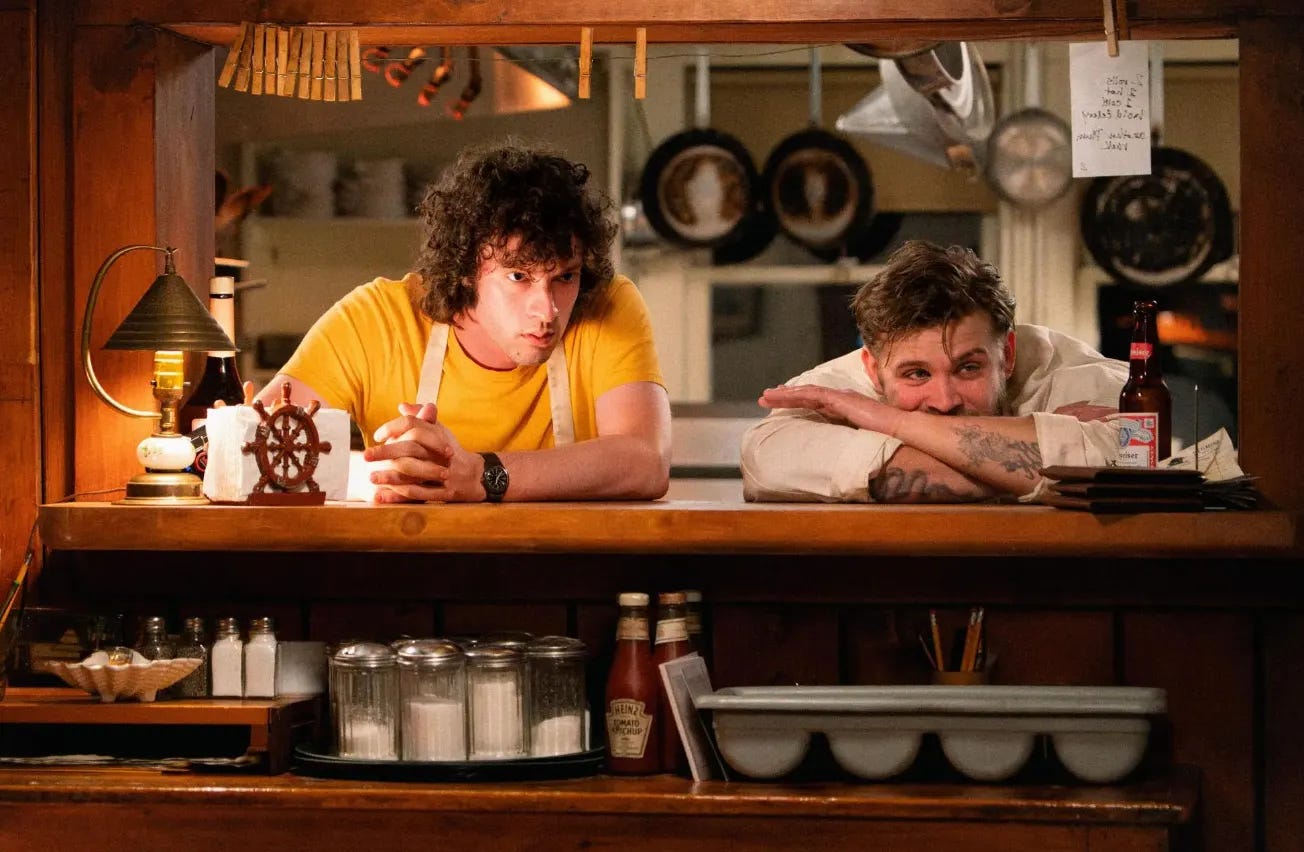
I watched Tony on August 3rd, in a room full of people who'd actually worked a line — an Industry Night screening for hospitality staff, hosted by Donnie Madia, in Chicago, eleven days before the wide release would let everyone else weigh in. The film covers a single summer, long before Bourdain became Bourdain — broke, uncertain, years from the conviction anyone would later recognize as his. I went expecting a movie about a chef. I left thinking about my own field. I didn't expect that. But a snapshot of someone else's becoming has a way of asking what you've done with your own.
By the time the wide release hit theaters, the internet had already decided what it thought — about a film most of it hadn't seen. "Tony would've hated this." Said with the confidence of a man quoting scripture. Nobody stopped to ask how anyone could know that with such certainty about someone who spent his career refusing to be certain about anything.
Laurie Woolever, who was Bourdain's assistant for nearly a decade, put the whole discourse in its place with one headline: You Would Have Hated All This Discourse. Not the movie — the certainty. The idea that a man who built his reputation on distrust of easy narratives would suddenly furnish one, posthumously, on demand, for whoever needed it. Dominic Sessa, who plays him, got asked the same question directly and didn't flinch from it: some of it, he said, Bourdain would probably hate. But even hating it, he'd be watching through the crack in the door — because it was factually incorrect and metaphorically true at once.
Factually incorrect and metaphorically true — at once.
Here's what the film actually got me thinking about, though — not the discourse. The summer itself. Bourdain spent years watching before he trusted what he saw enough to say it plainly, and the years were not kind to him. He lost jobs, lost money, lost time he'd never talk about as wasted, but it was. What he had, the whole way through, was the willingness to eventually be wrong out loud rather than agreeable in silence. That's not a personality trait. That's a discipline most people never practice, because it costs something real before it pays anything back.
Designers are trained observers. Every client meeting is an act of reading a room, a life, an unstated want the client can't quite name. We're good at it — better than most professions, honestly. But observation isn't the hard part. Bourdain proved that. The hard part is what you do with what you've seen once someone's paying you and watching you and waiting for you to just agree with the reference image they brought in.
I know the version of this too. Early on, a client wanted a maker's work — the real thing, the joinery, the hand in it — but not the real budget it required. I could have said so. Could have asked the only honest question in the room: why did you hire me if you already knew the answer you wanted? Instead I engineered the cost out of it. Found a cheaper hand to fake a similar look. Told myself the difference wouldn't show. It did. Not to the client, who never knew what they didn't get — but to me, and to the piece, which held its shape and lost everything else. I didn't lose a client that year. I lost the thing conviction is actually for.
Why did you hire me if you already knew the answer you wanted?
Most designers don’t risk it, even once they’ve felt that cost. They convert the observation into service instead of conviction — give the client back a slightly better version of what they already expected, because disagreeing costs the relationship and agreeing doesn’t cost anything visible, not today. Designers observe everything and believe nothing. Not because they lack the eye. Because they never had the summer that forces the eye into an opinion.
The industry rewards this. A portfolio full of agreement books faster than a portfolio with a point of view that occasionally loses a client over it. Nobody publishes the pitch you didn't win because you told a client the truth about their own house. Nobody photographs the year you spent broke because you wouldn't build the thing you knew was wrong. That's the cost Bourdain paid before anyone would listen to him, and it's the cost most of this field quietly declines to pay.
I don't know what my own losing years bought me, exactly. I know they're the reason I still argue with a client instead of nodding along to a reference image I don't believe in. I know a house built on agreement photographs fine and means nothing, and a house built on conviction sometimes photographs badly and means everything to the people who live in it. I know which one I'd rather be known for, even on the years it costs me the job.
A house built on agreement photographs fine and means nothing.
Bourdain earned his opinions before anyone was paying him for them. Most designers rent theirs, one client at a time, and never notice the difference between rented and owned. The summer before conviction is the part nobody puts in the reel. It's also the only part that makes anything after it worth trusting.
Every home passes through three truths before anyone else sees it. Only one usually survives — and it's never the one that agreed with everybody.
xG
AUTHORGil Melott is the founder and principal of Gil Melott Studio, a nationally recognized luxury residential and boutique hospitality interior design practice based in Chicago, with presence in New York and select national markets. The studio has received an Interior Design Magazine Best of Year Award, international press recognition in WSJ, AD España, Elle Decor, Veranda, Galerie, and Luxe Interiors, and produces the Bespoke Collections product line including the award-winning LUZ lighting series.
The studio works with a selective roster of clients who understand that a home is not a credential — it is a life, authored. Current availability includes projects in the New York metro, Connecticut, and the Bay Area.
Design Alchemy is his ongoing editorial practice — and the basis for a documentary series currently in development — exploring spaces with authorship, interiors with intention, and the design conversation that the industry mostly avoids having.
No posts
Comments
Nothing yet. Say the first thing.
Sign in to join the conversation.