
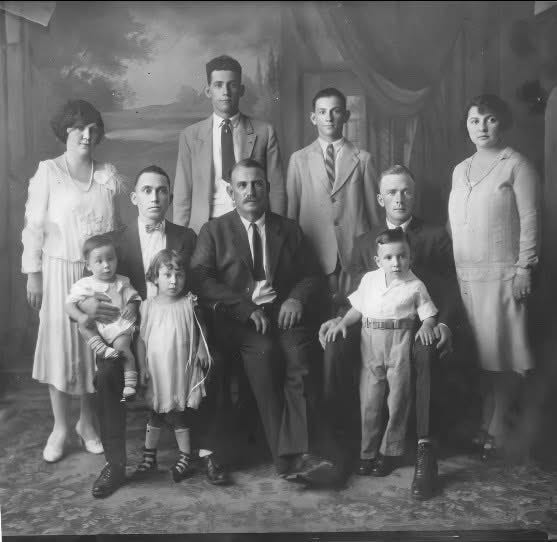
America is turning 250 this month, and the culture has responded the way it responds to every round number: by decorating it. Bunting on porches. “Americana” as a mood — and man, is it in a mood. Heritage, repackaged as a seasonal palette — flag motifs on throw pillows, distressed wood that’s never actually been distressed by anything, a version of the past scrubbed clean.
I want to talk about the other kind of heritage. The kind that doesn’t photograph well.
Family story, as it’s been carried down to me, not as I can footnote it: an ancestor of mine, Damacio Jimenes, fought and died at the Alamo. Fought for Texas. Fought for a set of freedoms that — and this is the part the bunting skips — did not actually extend to him or people like him once the fighting was done. He died defending the idea of a republic that would spend the next hundred-plus years deciding his descendants were not quite the citizens the idea implied. Mexican, in the land his blood helped secure. A stranger in the house he built.
That’s not a footnote. That’s the whole story. A man gave his life for a house he was never fully let live in.
Two movements later — different entry point, same unfinished argument — my grandfather crosses into this country as a boy, traveling with his father and siblings from Italy, learning English somewhere in transit. Not arriving fluent. Becoming fluent, on the way. No inheritance waiting for him either. Just labor, and reinvention, and a language he had to build his life around one word at a time.
Neither man got handed heritage. Both of them had to make a claim to it, in real time, with no guarantee the claim would hold.
This is what the 250th’s marketing gets backwards. It sells heritage as a finished product, something you can order swatches for, something that arrives pre-distressed and pre-approved. Colonial. Farmhouse. “Classic American.” A look, available in three finishes. Live, laugh, bless us everyone.
But if my family’s actual story is any evidence, heritage was never the finished product. It was the unfinished argument. It was a Mexican dying for a promise his country hadn’t kept yet, and a twelve-year-old learning a new language mid-ocean because the old one wasn’t going to get him where he needed to go. Heritage, done honestly, is not a place you inherit. It’s a case you have to keep making.
So when a client tells me they want their home to feel like “heritage,” my first question is: whose? Because the version being sold to you right now, the version on every anniversary tablescape this July, is one very narrow slice of a much larger, much stranger, much more contested inheritance. It’s heritage with the fighting edited out. Heritage as performance, not as record.
A home that actually reckons with 250 years doesn’t cosplay Colonial Williamsburg. It doesn’t need the flag motif to prove the point. It holds the contradiction instead — the pride and the exclusion, the arrival and the unbelonging, the man who died for the house and the men who weren’t let all the way in. It doesn’t resolve that tension for the sake of a nicer photograph. It just tells the truth about it, in wood and light and the objects a family actually kept.
That’s vocal luxury, applied to a bigger canvas than I usually apply it to. Not “let me show you what beautiful taste I have.” Something closer to: let me show you what actually happened here, and let it be complicated.
Damacio Jimenes doesn’t get a plaque with his name spelled right, most places. My grandfather’s English still had a slight accent on it forty years in. Neither of those facts is a tragedy. They’re just true, and they’re mine, and they’re more American than anything currently for sale at a home goods store this month.
Two hundred fifty years in, the tradition isn’t stasis. It never was. The tradition is the argument continuing. Every generation shows up, makes its claim, gets told in some fashion that the claim isn’t quite valid yet, and keeps making it anyway. That’s not a betrayal of the American story. That is the American story — the plot twist room, at the scale of an entire country.
So build the house that tells the truth. Not the one that performs the anniversary.
The one that continues the argument the dead man and the immigrant boy started, whether the culture is in a celebratory mood this particular July or not.
Homes as heritage. Not performance. Never was going to be a small claim.
xG
AUTHOR
Gil Melott is the founder and principal of Gil Melott Studio, a nationally recognized luxury residential and boutique hospitality interior design practice based in Chicago, with presence in New York and select national markets. The studio has received an Interior Design Magazine Best of Year Award, international press recognition in WSJ, AD España, Elle Decor, Veranda, Galerie, and Luxe Interiors, and produces the Bespoke Collections product line including the award-winning LUZ lighting series.
The studio works with a selective roster of clients who understand that a home is not a credential — it is a life, authored. Current availability includes projects in the New York metro, Connecticut, Dallas, and the Bay Area.
Design Alchemy is his ongoing editorial practice — and the basis for a documentary series currently in development — exploring spaces with authorship, interiors with intention, and the design conversation that the industry mostly avoids having.
No posts
Comments
Nothing yet. Say the first thing.
Sign in to join the conversation.