
It’s been a week of solo parenting, household (mis)management, and 100+ degree temps so this is coming to you as a list of my thoughts about The Odyssey, I do not have it in me to do the segues today!
There’s a famous trope in fiction writing called, “As you know Bob.” It’s a lazy technique writers use when they need to explain backstory to the audience, so they get the characters to talk about something that in no way would they normally talk about.
I was painfully aware I was watching Nolan’s The Odyssey during the first 30 minutes of the movie because I wasn’t able to immerse myself in the StoryWorld. Thankfully, once we got into Odysseus’ journey, that overexplaining fell away and the story got going.
So this is your reminder to check and double check the start of your copy, whether it’s story based or not. Have you immersed your reader immediately? For advice on how to do that, see this post:
Nolan couldn’t tell every part of The Odyssey (and Homer couldn’t either) so the choices Nolan made of what to include, leave out, and what to add were all in service to his thematic argument.
And he did an absolutely amazing job of laying down threads through acts one and two and tying them together for us in act three.
This is one of the oldest stories in the world. Even people who don’t really know what The Odyssey is about have heard of the Sirens or the Cyclops. And a lot of us who read the classical translations of Homer’s Odyssey have taken a certain theme from it for decades.
Which means Nolan’s different thematic argument made the story feel both comforting and fresh at the same time. I’ve seen lots of people laugh at the fact we can’t spoil a 3000 year old story. But we can spoil a fresh take, and I’m not going to do that.
And from what I know about Nolan’s past movies, the theme displayed in the Odyssey is his overarching thematic argument, made across many creative projects, and probably developed in nuance and detail over time.
This is what I want copywriters and brand specialists to see when they watch Nolan’s The Odyssey. He has taken a famous, sometimes cliched viewpoint of the world and turned it on it’s head.
He has asked those who have always thought about something one way to now think about it another way.
And this is what a deep take, not a hot take, is about. I would also say this can be what thought leadership is about. How does your brand see the world differently from every other brand, and what does that tell your audience about how you do business and why they should buy from you?
My family had lots of great conversations after the movie about what it meant and how it connected to our current culture, politics, and government.
The fact that an almost 3000 year old story could still have us thinking deeply about the world in 2026 is a sign this is an amazing story in itself. But the lens Nolan applied to it and the specific choices he made in his version of telling the story is what got us talking.
Again, no spoilers, but I will just leave this here 😉
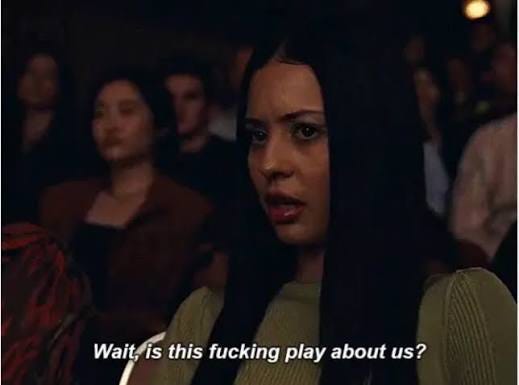
But as brand storytellers, trusting the audience that we can give them specific details to show our thinking and they will be able to extrapolate that to their own lives? That is a difficult but incredibly valuable balance. We don’t want to be spoonfed your opinion, we want to uncover it ourselves.
This is the difference between scanning a LinkedIn post that tells you why a leader is proud of his team and becoming engaged in a brand story that reveals values through choices. Talking of . . .
What choices does Odysseus make when stuck between a rock and a hard place? (Geeky side note, we get this phrase from when he has to decide whether to sail past Charybdis the whirlpool or Scylla in the narrow sea strait.)
Brand stories reveal your values and point of view because they show what choices you made when there was conflict. And while not all brand owners understand or care about values, copywriters should be aware that we are revealing these values to their audience when we tell brand stories.
Isn’t it better to understand what values are on display than leave an assumption about them to the audience?
And FYI, building a Brand Story Bank of 4 - 7 foundational stories is something I do for clients, I have 2 spaces left in August. Building these the right way so the brand understands what values they are showcasing and which parts of the story are important allows them to repurpose the stories across multiple formats and launches. Let me know if you or a client are interested in signing up.
📖 Dungeon Crawler Carl (book 4). My summer obsession!
📺 DTF St Louis. This is a fascinating series. I am intrigued by the red herrings that lead the detectives in the wrong direction and the non-chronological storytelling to reveal character’s values (there it is again!).
🎧 Emmenology. This is an Ologies deep dive on menopause for my fellow middle-aged people!

Let’s find the thematic thread
Do you have a movie director that you love? And you’ve seen a few of their movies? While it’s not always the case, there is often an underlying theme that travels with them through their work.
If you haven’t thought about it before, see if you can locate a common theme. If you don’t have time for a rewatch, search up reviews by critics to see what they think the theme might be (and if you agree).
Comments
Nothing yet. Say the first thing.
Sign in to join the conversation.