
There are a lot of ways to chart the evolution of human society. A common way of thinking about the journey up to now is along these lines:
150,000 to 50,000 years ago: language emerges. Humans begin to share complex ideas, coordinate in groups, and pass on knowledge more efficiently than any species before or since.
12,000ish years ago: The Agricultural Revolution. Humans figure out farming, and what life is like when you have a steady supply of food. Society is more predictable, and people survive longer. The population grows, and the idea of jobs emerges. Groups of people living in the same place grow to city size.
5,000 years ago: Writing emerges. Stories have been around for a long time. The beautiful cave paintings in Lascaux are more than 20,000 years old and tell incredibly detailed stories. However, writing words down unlocks a lot more. Knowledge starts to be shared with accuracy that wasn’t even dreamed of before.
800 years ago: The Scientific Revolution. The scientific method of testing and hypothesising emerges, and human’s understanding of, and relationship with, the natural world is permanently changed.
300 years ago: The Industrial Revolution introduces mechanisation and mass production. The population soars, and the way humans live is changed forever.
80 years ago: The Information Revolution. Computers, the Internet, wireless technologies and social media fundamentally reshape the way humans relate to each other.
If you were born before 1980, you probably have a pretty clear memory of how your life was before you ever had a mobile phone or access to the Internet. If that is you, maybe it is possible for you to imagine how significant all of the major changes in society described above felt. If any of us imagine our life now without a mobile phone or access to the Internet and how completely different that would be, we get a glimpse of what it felt like when someone read their first book, or accurately predicted when the harvest would be ready to eat, or heard Newton describe what gravity was - a difference so profound you can barely connect the before and after.
So it was with medicine, distilling and the printing press. Medicine was big news and continued to catch on, and distilling was a big part of it. It was still absolutely the privilege of the learned few though, and supply was scarce. That was about to change.
In 1440, Johannes Gutenberg completed his work. He had applied his years of training as a goldsmith to a new set of challenges - how to create the right metal alloy to handle the required heat and pressure, how to make a mould that could be used multiple times, how to put that alloy and that mould together to make movable letters of different widths, how to redesign and build an adapted wine press to apply pressure evenly, and ultimately how to put it all together to print the same page of a book over and over again.
So many inventions at once, and maybe the most transformative technology contribution to the spread of human knowledge ever made1.
With the invention of printing and movable type, the secrets of distillation move outside the elite medical and ecclesiastical circles immediately. The monk’s monopoly, along with the magical spell, is broken. A huge breakthrough book is published in 1500 in Strasbourg. The 'Liber de Arte Distillandi de Simplicibus' (Book on the Art of Distillation of Simples2) by Hieronymous Branschweig systematically describes the process of distillation for medical purposes for the first time.
It was written in German, not Latin, which made it accessible to a huge audience. It contained detailed diagrams and processes, and in a stroke begins the move towards a standardised approach to distilling that anyone can learn. It is a textbook and a cookbook in one, and amateur enthusiasts across Europe turning to page one read Branschweig’s enthusiastic description of distilling as ‘the mistress of all medicine’.
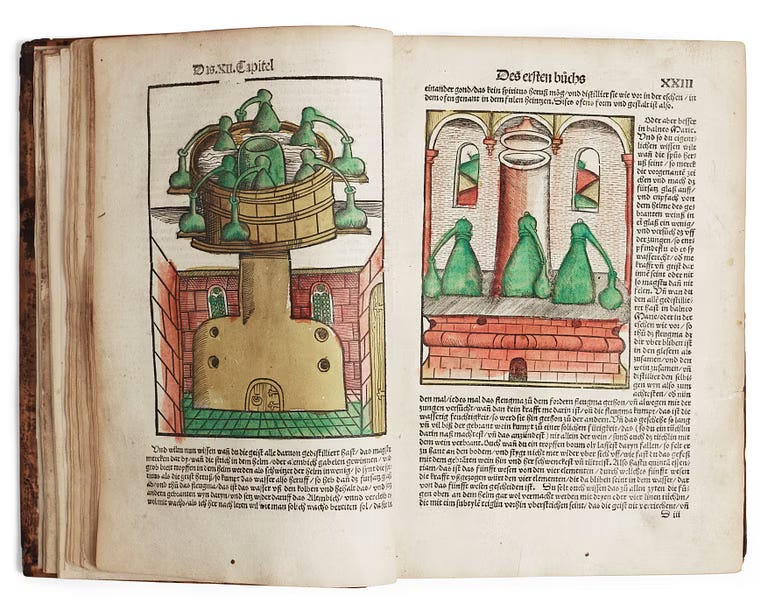
The new print culture, and the generation of different handbooks that followed, profoundly changes our understanding of what spirits are. These were practical descriptions of the tasks required to distil spirits written in the vernacular that anyone could understand, rather than metaphorical mysteries about alchemical transformation. Distilling felt within reach.
As always in history, people with new information and new tools bring new ideas. At this point, the beginning of the 16th Century, the realisation came that you did not after all have to start with wine. You could make intoxicating spirits with anything that would ferment - fruit, potatoes, or - most of all, in England at least - grain.
This was massive news. For farmers, commercial distillation offered a way of preserving and concentrating the value of their surplus grain after a good harvest. A barrel of spirit was much easier to store, transport or sell than a dozen bushels of grain, and it didn’t go off. For everyone else - the innkeepers, the merchants, the drinkers - spirits kept better than any wine or ale. They could be transported a long way, even overseas, and it was much easier to make a consistent product than brewers or wine makers.
In these few paragraphs, we’ve seen a major shift. Distillation has been democratised, and people are seriously into it. All across Europe people are producing ur-gin, flavoured with a wide range of botanicals. Some are for medicine, but a lot more are for fun. Soon we are to find out what happens when humans come face to face with limitless amounts of high proof alcohol…
Every great story deserves a good companion. This post is public - please feel free to share it with someone you know who might enjoy their own sidecar of discovery.
Shout out to greatest living Englishman Tim Berners-Lee and his contribution of HTML, the web server and the web browser here.
‘Simples’ in the title of this book refers to individual medicinal herbs or plants used on their own - what we would probably call botanicals now. It comes from the Latin ‘simplicis, meaning ‘single’.
Comments
Nothing yet. Say the first thing.
Sign in to join the conversation.