
This chapter includes two of my favourite ever facts, so if you like drinks trivia, keep your eyes peeled.
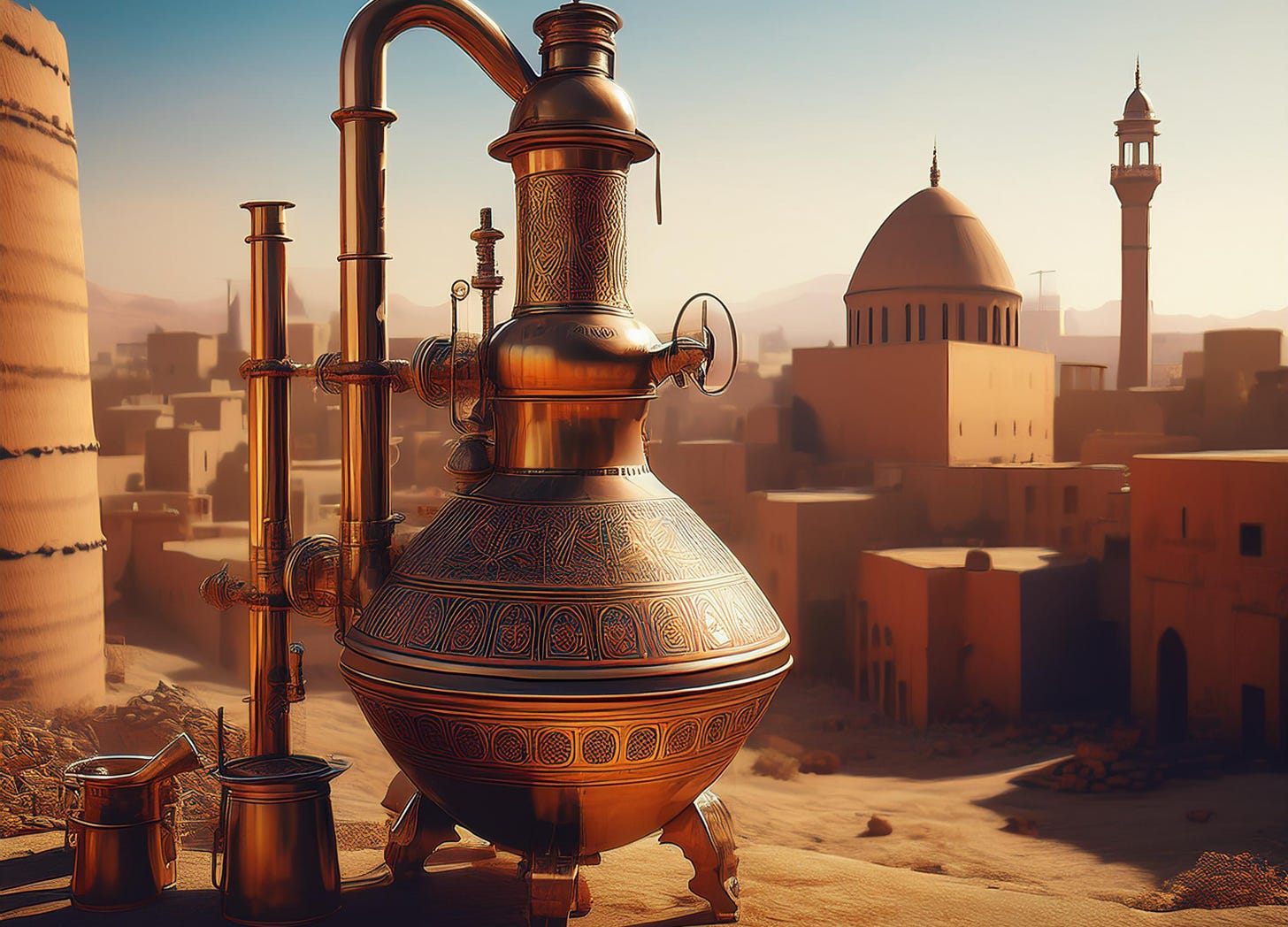
Distilling. The great invention. Science at its best. Distilling is the foundational innovation that everything else we are going to discuss is built on. Personally, I found the origins surprising. Understanding the history of distilling completely changed how I thought about alcohol, medicine, perfume, and their tightly intertwined history.
We must start with at least a paragraph about the Islamic Golden Age. As far as I know, this period of history is barely taught in Western schools. Certainly it didn’t come up at Spencer Park in Clapham Junction.
In the late 800s CE, Baghdad had become the intellectual capital of the world. While Europe was in the Dark Ages, the Abbasid Caliphate was home to the world's first international scientific community. Scholars were translating texts from Greek, Persian, Indian and Chinese sources, building on this knowledge to create new discoveries. The Islamic Golden Age wasn’t just about preserving knowledge though, it was really about transforming it. Scholars were turning alchemy into chemistry, astrology into astronomy, and medicine into a science. If you already knew all that, feel free to skip ahead. If not, I don’t think there is any way to really understand modern distilling, and thus proper drinking, without appreciating something of this period when Persian scholars were busy creating ‘science’.
There are many celebrated scholars from this time. The hero of our story today is Abū Bakr al-Rāzī, or Rahzes, a crucial figure in the mazy development of modern medicine, and the single most important person in the entire 3000+ year history of distilling.

Distilling was definitely not new. It had ancient roots, from Mesopotamian perfumes to Greek seawater experiments, but it was now in 800CE in Baghdad that these fragmented ideas were coalescing into a useful science. Rhazes was making significant improvements to distillation apparatus and techniques. He wrote the first important work on methods and equipment for distillation in his works on alchemy, and he was one of the first to use distillation to produce medicine. The fine line between medicine and alcohol and perfume - three things with the potential to make you feel better - will be discussed further in another chapter. For now, just understanding distilling is enough to get us through this one.
Favourite ever fact #1, Rahzes named the substance that was on his tongue, probably burning it, and that name stuck forever. Like a lot of Arabic, the word he chose began Al- (‘the’). We use so many Arabic words in English - algebra, alchemy, algorithm, alcove, almanac, and - you’ve guessed it, this new one coined by Rahzes - al-koh’l. Imagine such a contribution as coming up with the word ‘alcohol’. But that was not all.
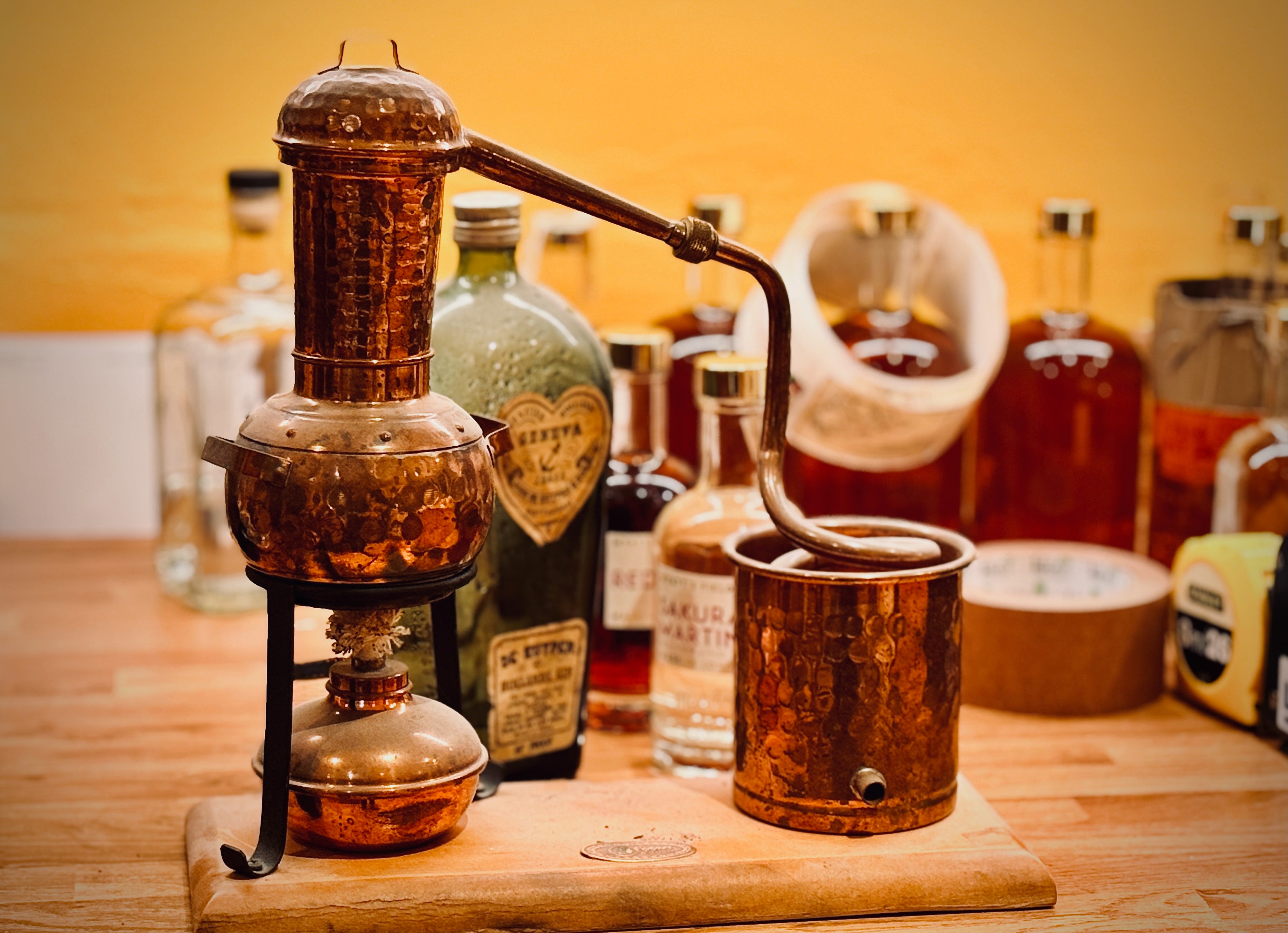
The still Rahzes used in Baghdad would be instantly recognisable to any distiller today. At the bottom was the cucurbit, where the liquid was heated over a flame. It was called that because it looked like a pumpkin, or a melon, or whatever your favourite cucurbit is. Above it perched the alembic head, which collects the rising vapour and channels them into a long beak. The word comes from ‘al-anbiq’, which in Arabic is a narrow vase. It’s called a head and beak because it looks like that. If you squint at the photo above, you can see a long-billed curlew. Finally, a collection vessel catches the distilled liquid. Watch a modern gin still at work and you'll see exactly what Rahzes saw: heat, a mysterious vapour rising, condensing, dripping, collecting. Like magic.
Kohl was a black mascara. It was produced through a process called sublimation, which you can think of as distilling for solids. Rahzes knew that process well. He saw that vapour coming from the neck of his still, and in his imagination it became the genie emerging from the lamp in Thousand and One Nights, the compilation of Arabic tales that was starting to take shape at about this time. The whole distilling process would have seemed pretty magical, even to a hardened scientist like Rhazes. A transformation happens, a clear liquid emerges, it has powerful effects on anyone who consumes it, it can be set alight, and during this process it appears as a misty apparition. It was hard to explain, but nonetheless the outcome was there for all to see.
Rahzes manifested all of that genie magic into his name, al-koh’l. He referred to the djinn of wine, or the release of the genie through distilling. The word alcohol didn’t come to be used as a label for all intoxicating drinks until hundreds of years later. However, though all of those centuries, we hung onto the idea of the genie being released, and we still use that term today, although instead of genie we settled on the Latin word, spirits1.
This post is public so please share it if you’d like to.
Comments
Nothing yet. Say the first thing.
Sign in to join the conversation.