
A few years ago, I sat in a calibration meeting and watched a manager argue for a promotion using one story: his managee had just signed the biggest client of the year.
Everyone nodded that a promotion seemed fair.
Instead, I asked what that person had done the other eleven months.
Silence. Because he had spent those months wrecking the team: two high performers walked because of him.
Essentially, we’d almost promoted someone on the strength of a highlight reel, the kind of reel people post on Instagram.
It’s that time of year again.
At Foorban, the company I work for, we’re in the middle of performance review season, a lighter version this cycle, but the same exercise.
What is a performance review?
A performance review is a formal check-in. Employer and employee sit down, look at the work of the past period, and talk about what went well, what did not, and where things go from here.
It’s meant to be a two-way exchange of feedback, and a chance to set goals for what comes next.
Most companies run this once a year, though a growing number have moved to quarterly check-ins, on the theory that feedback loses value the longer you sit on it.
I disagree, but not with the feedback part.
I disagree that the review should be frequent. Feedback should be frequent. Informal feedback should be frequent. But formal review sessions, more than once or twice a year, start to cost more than they give.
The hardest part of any performance review is doing it fairly.
Every one of us walks into a review already biased. And some more than others.
In performance reviews, we easily remember the dramatic save, or the flashy victory, and forget the “quiet excellence”. The first are one-time hits, the second is sustained and less visible, because nothing ever caught fire.
We rate the person who talks like us more highly than the person who doesn’t. We often mistake a gut feeling for an evidence-based argument.
The hard work of a good reviewer is not that of collecting evidence about the other person. It’s auditing yourself first.
Before I write or do anything, I interrogate my own thinking. Then:
Focus on what (results) and how (behaviors) - I try to focus on what has been accomplished (the what) and how the results were accomplished (the behaviors). You can’t call someone successful just because they crushed their goals - not if they did it while ignoring the culture and behaviors the company actually rewards.
Remind myself that impact has more than one shape - Some people go deep, some go wide. Impact can be different. Those who worked quietly and well, should not be less relevant than those who happened to be loud about it.
Challenge my biases - I’ll ask myself if I am rating this person’s overall contribution in the period, or just the most recent visible moments. Read here for 17 cognitive biases that screw up our decision-making.
Treat gut feeling as a data point, not as a verdict - I trust my gut feeling. I’ve rarely been let down by it. However, if something feels true about someone’s performance, I try to force yourself to name a specific example behind that feeling. If I can’t find one, the feeling should not get a vote.
Cross-check my own conclusions - Go back over the goals set, the feedback that was given throughout the year, and see if your final assessment actually lines up.
Obviously, bias does not disappear completely because you made a checklist, but it just gets harder to hide from.
Also, this process assumes you have good inputs to check yourself against: notes, examples, feedback collected throughout the year, rather than invented the week of calibration.
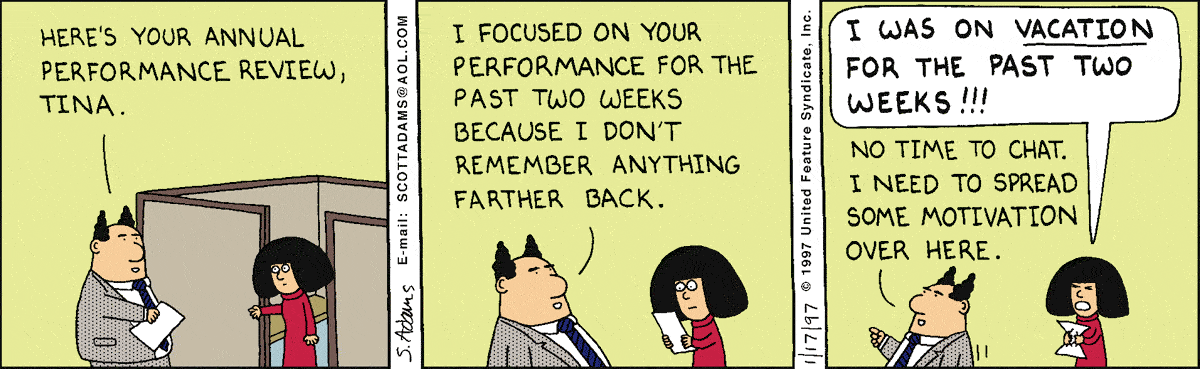
Should you skip that part, no amount of self-interrogation will save you.
Performance review should be a moment of recognition and course-correction. And the fairness of it is determined by what you do before the meeting, alone, with your own biases.
Rate the person against the what and the how.
Notice the quiet excellence, not just the loud ones.
Separate what you actually saw from what you felt.
Do that consistently, and the review becomes what it was meant to be.
We cannot eliminate our biases, but if we work hard to surface them, we can catch them before they cost someone their fair shot.
If you wish to continue reading more, here some suggestions:
See you on Sundays 🗓️
Thanks,
Giacomo
Comments
Nothing yet. Say the first thing.
Sign in to join the conversation.