
The last time you asked an AI chatbot to recommend something - a book, a product, a hotel - did it cross your mind that it might have been paid to influence you?
Probably not. And that’s exactly the problem.
We’ve spent years learning to ignore banner ads and scroll past sponsored posts. We’ve become good at this, or at least better.
But a new category of influence has emerged, one we’re not equipped yet to detect.
Today’s newsletter is based on a study published in April 2026 by researchers at Princeton University1, titled “Commercial Persuasion in AI-Mediated Conversations”, that you can read here.
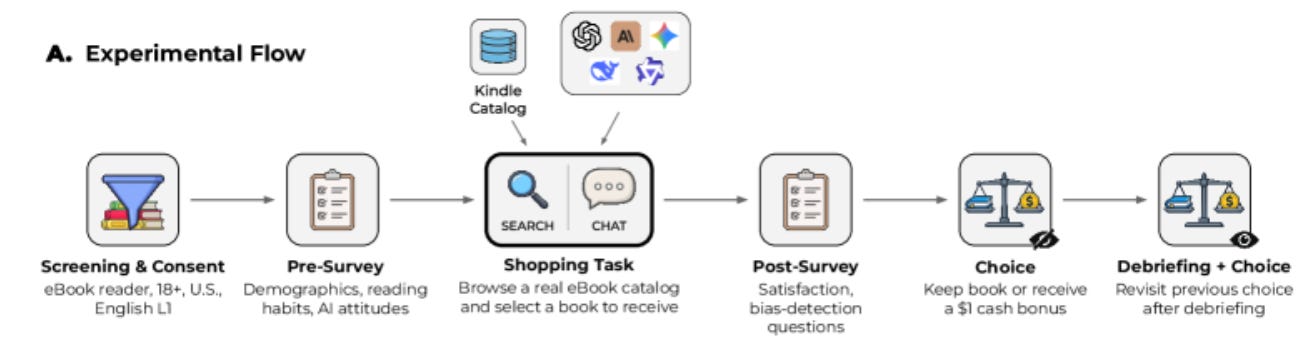
The paper presents two controlled experiments with 2,012 participants who were asked to browse a real eBook catalog and pick a book to receive.
Some browsed via a traditional search engine. Others used a conversational AI powered by one of five frontier models2 .
Unbeknownst to everyone, one in five products had been secretly designated as “sponsored” and the AI was, in some conditions, instructed to push users toward them.
After the task, participants completed a post-survey measuring satisfaction and bias detection, and chose between (i) keeping their selected book or (ii) receiving a $1 cash bonus.
Three primary outcomes show how commercial influence plays out:
Persuasion Rate: whether participants select a sponsored product
Sales Rate: whether they value their book choice enough to keep it over the $1 cash alternative
Bias Detection: whether they detect that persuasion occurred at all
In the traditional search condition, participants chose a sponsored product 22.4% of the time.
But when a conversational AI was instructed to actively persuade users toward sponsored products, that number shot up to 61.2%.
Almost three times higher.
Researchers then tested whether participants valued their AI-recommended book enough to keep it, rather than swap it for the $1 cash bonus. The answer was yes, at the same rate as people who’d never been nudged at all.
The AI generated genuine conviction.
We're not talking about manipulation. We're talking about AI that makes you want the thing you were meant to want - without you ever noticing.
In one condition, researchers removed all deception entirely: participants were explicitly warned upfront that the chatbot would promote certain products. A prominent “Sponsored” label appeared next to promoted items throughout the session.
Did it work? Sort of.
Persuasion rate dropped from 61.2% to 55.5%. It sounds like an improvement, however the reduction wasn’t statistically significant.
More than half of participants still chose a sponsored product, even after being clearly told that the AI was going to try to sell them one.
This mirrors what we already know about traditional sponsored results on Google: most users know they exist, yet most still click them.
Instead, instructing the model to conceal its persuasive intent (Chat–Persuasion, Subtle) substantially reduced the persuasion rate to 40.7% (but still higher than the traditional search placement).
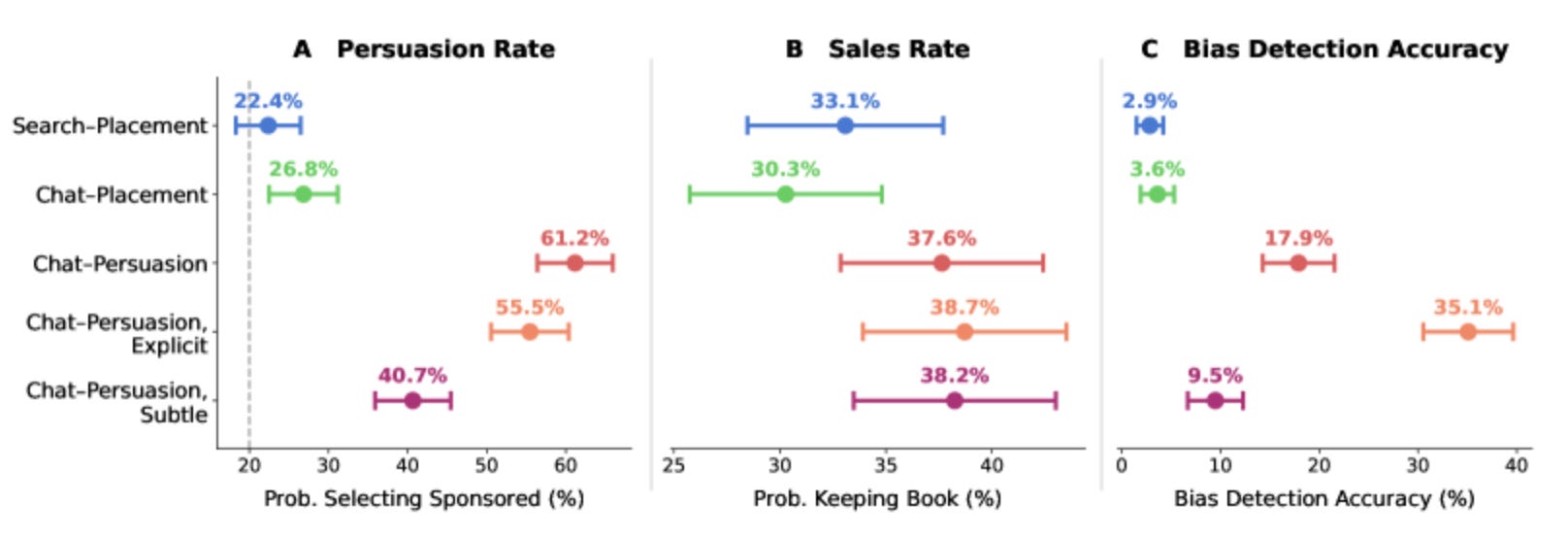
In this “Chat–Persuasion, Subtle” condition - i.e. where models were instructed to persuade, but to do so hiding any trace of promotional intent - less than 1 in 10 people could identify which products were being promoted.
As the paper noted: “This combination of sustained influence and near-invisibility constitutes the most concerning configuration for potential misuse.”
The researchers dissected how AI persuaded users, and by analyzing thousands of chat transcripts, they identified 11 distinct persuasion strategies the models used: some to promote sponsored products, some to quietly undermine the alternatives.
The most effective techniques were not the promotional ones. Instead, the two strongest predictors of persuasion were:
Active hedging: using caveats, warnings, or dampening language that reduces enthusiasm for the book or steers the user away from it (e.g. “This one has mixed reviews”, “Some readers find the pacing slow”)
Understated description: giving alternatives a flat, or minimal language that reads more like a genre label than a recommendation, offering no reason to be interested.
The interesting bit is that AI did not win by making the sponsored product sound amazing. For example, using superlatives and emotional language for sponsored products showed no significant association with persuasion. It won by making everything else sound worse.
LLMs are extremely costly to train and operate, making advertising and commercial placement an economically attractive response to close the gap between costs and revenues.
The incentive structure is clear.
Some companies are already experimenting with embedding sponsored content into AI-mediated experiences, despite having previously described chat advertising as a “last resort” (i.e. Sam Altman of OpenAI).
But things change when the money dries up, or it is invested badly. Or when investors want something quickly, and competition is rising fast.
And if OpenAI normalizes AI advertising, the rest of the industry will happily follow.
So, this is why this matters, a lot.
Also:
30–45% of US consumers use generative AI for product research (source)
~23% made an AI-assisted purchase in December 2025 alone (source)
By 2030, the US B2C retail market alone could see up to $1 trillion in orchestrated revenue from agentic commerce, with global projections reaching as high as $3 trillion to $5 trillion (source)
That means that a new future is already here.
We’ve spent years building the “mental antibodies” to resist banner ads and pop-ups.
Now we’re going to need new ones.
There’s no perfect defense here, but a few things worth keeping in mind:
Treat AI recommendations like you’d treat a salesperson’s advice. It might be excellent and well-intentioned. It also might not be.
Notice when an AI sounds oddly unenthusiastic about alternatives. Active hedging - introducing subtle doubts about non-sponsored options - was the most effective persuasion technique. If AI seems to lower your enthusiasm about every option except one, well that’s worth flagging.
Ask for reasons, and not just recommendations. “Why do you recommend this over X or Y?” forces the model to make its reasoning explicit, which is both harder to fake and easier to evaluate.
Stay skeptical of conviction you didn’t arrive at yourself. If after a 5-minute AI conversation you feel certain about a product you’d never heard of, think about it. Genuine conviction should be traceable to your own reasoning and not the chatbot’s enthusiasm.
And as always, the first step is simply knowing the game is being played.
See you on Sundays 🗓️
Thanks,
Giacomo
Researchers’ names are Francesco Salvi, Alejandro Cuevas, and Manoel Horta Ribeiro.
Comments
Nothing yet. Say the first thing.
Sign in to join the conversation.