
The amount of mental energy spent thinking about a problem should be directly proportional to how soon that problem will significantly affect your life. A 20-year-old who spends a lot of his time worrying about whether his hypothetical future wife will cheat on him when he is 40 is rightly seen to be a neurotic numskull. He does not have the life experience or context required to even begin thinking about such a problem in a useful way. Even if he were to precociously gain the requisite wisdom to ponder such questions, he would still be putting the cart before the horse. Worry about finding someone who is willing to marry you and doesn’t make you miserable first, then you can start worrying about your hypothetical partner’s fidelity. Most people would agree with such statements regarding their personal lives. However, when it comes to public “intellectuals”, they seem to never tire of prognosticating about their most recent apocalyptic bugbear.
“All models are wrong, but some are useful” is a well-known aphorism. What this aphorism misses is that a model’s usefulness and applicability are directly proportional to the simplicity of the system it is modelling. Stochastic uncertainty has a compounding effect on any realistic model. The magnitude of this effect is based on the number and variability of its components. Randomness at each step of the process makes outcomes increasingly uncertain and volatile over time. Climate scientists, A.I. doomers, and macroeconomists commit a double sin when trying to predict the outcomes of extremely complex open systems, over large amounts of time.
If you had asked an average member of the literati in 1925, for a prediction of the big problems in the year 2000, his answer would have been retarded and wrong. If you asked the same question to a median member of the intelligentsia in 1975, his answer would be less retarded and wrong, but it would still be very retarded and wrong. Why should this phenomenon be any different in 2025? Why should we take seriously the auguries of modern-day oracles? When I hear predictions about the issues the world will face in 2050 or 2100 I can’t help but let out an exasperated sigh. Have these midwits never heard of the Dunning-Kruger effect? How would they feel if they hadn’t eaten breakfast this morning? We may never know the answers to these questions. And yet, I feel that it is incumbent upon me to do my small part in undermining their credibility so that they get a little less credit for engaging in such wasteful misuses of their already quite limited mental resources.
To further instantiate my argument I will proceed by providing examples of some predictions, made by some of the leading lights of their generation. Let me start by quoting a 1930 essay by the Right Honourable John Maynard Keynes.
Yet there is no country and no people, I think, who can look forward to the age of leisure and of abundance without a dread. For we have been trained too long to strive and not to enjoy. It is a fearful problem for the ordinary person, with no special talents, to occupy himself, especially if he no longer has roots in the soil or in custom or in the beloved conventions of a traditional society. To judge from the behaviour and the achievements of the wealthy classes today in any quarter of the world, the outlook is very depressing! For these are, so to speak, our advance guard-those who are spying out the promised land for the rest of us and pitching their camp there. For they have most of them failed disastrously, so it seems to me-those who have an independent income but no associations or duties or ties-to solve the problem which has been set them.
Keynes thought that a surfeit of leisure time would be the bane of his grandchildren’s existence. That the curse of excess idleness would haunt their every waking hour. He thought that in order to stave off this torpor we would adopt a 15-hour work-week and spread the labouring hours as evenly as possible (All this sounds very similar to the A.I. will bring about unlimited UBI crowd. Maybe we should start calling them neo-Keynesians?). Alas, I hardly think excess leisure time ranks as one of the top ten problems facing working-age adults in the year of our Lord 2025. I would like to ask some of our modern-day Nostradamuses, do you seriously think that you are more erudite, more grounded in logic and rationality than John Maynard Mother-fucking Keynes. Will we still be talking about your intellectual contributions to humanity in 100 years?

You may be saying to yourself “So what, Keynes was wrong about a lot of shit, it’s hard to predict the economy far into the future, and I like Hayek better anyway.” Alright, alright, you are super based my dude. Let me give you some more straightforward examples. Let’s start with demographics. Population growth should be pretty fucking easy to model right? There are “literally” just two variables. How many people are born and how many people die. And yet, here’s a quote from a report released in 1972, The Limits to Growth by The Club of Rome (One of the worst clubs to ever come out of my home country, and I count the Mafia as a club).
The "resources" that a family has to devote to a child generally increase with income. At very high income, the value and cost curves become nearly invariant with further increases in income, and the resource curve becomes the dominant factor in the composite desired birth rate. Thus, in rich countries, such as the United States, desired family size becomes a direct function of income. It should be noted that "resources" is partially a psychological concept in that present actual income must be modified by an expectation of future income in planning family size.
They tried to hedge their bets by using obscurantist language but here is the chart that they included above this paragraph.
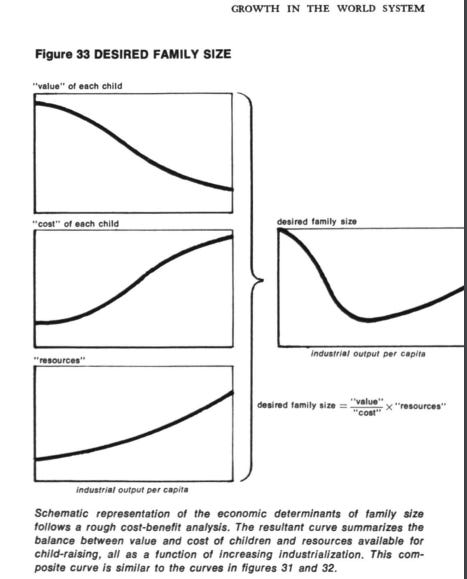
As you can see these “experts” somehow managed to conclude that even though family size obviously decreases with wealth, somehow becoming even richer would cause the fertility rate to start curving back upwards. Clearly, it was because their mega-genius predictive abilities allowed them to successfully reduce the complex nature of fertility rates down to three variables. So, since the U.S. is about three times richer now than in 1972 (Roughly 25,000$ USD real per capita GDP in 1972 vs. roughly 75,000$ real per capita GDP as I write this.) The total fertility rate (TFR) must be much higher right? Oh wait, in 1972 it was 2.01 and now it’s 1.66. Oops. I’ll let absolute chad Vaclav Smil explain why their modelling methods were self-evidently stupid.
But those of us who knew the DYNAMO language in which the simulation was written and those who took the model apart line-by-line quickly realized that we had to deal with an exercise in misinformation and obfustication rather than with a model delivering valuable insights. I was particularly astonished by the variables labelled Nonrenewable Resources and Pollution. Lumping together (to cite just a few scores of possible examples) highly substitutable but relatively limited resources of liquid oil with unsubstitutable but immense deposits of sedimentary phosphate rocks, or short-lived atmospheric gases with long-lived radioactive wastes, struck me as extraordinarily meaningless.
Oh well, everybody makes mistakes right? This doesn’t prove that engaging in longtermism leads to bad outcomes, does it? Well, believe it or not, in 1972 these Club of Rome midwits were actually taken pretty seriously (btw, doesn’t The Club of Rome sound like a group that should be comprised of Mussolini-loving revanchists? Not some gay cathedralist schoolmarms.)
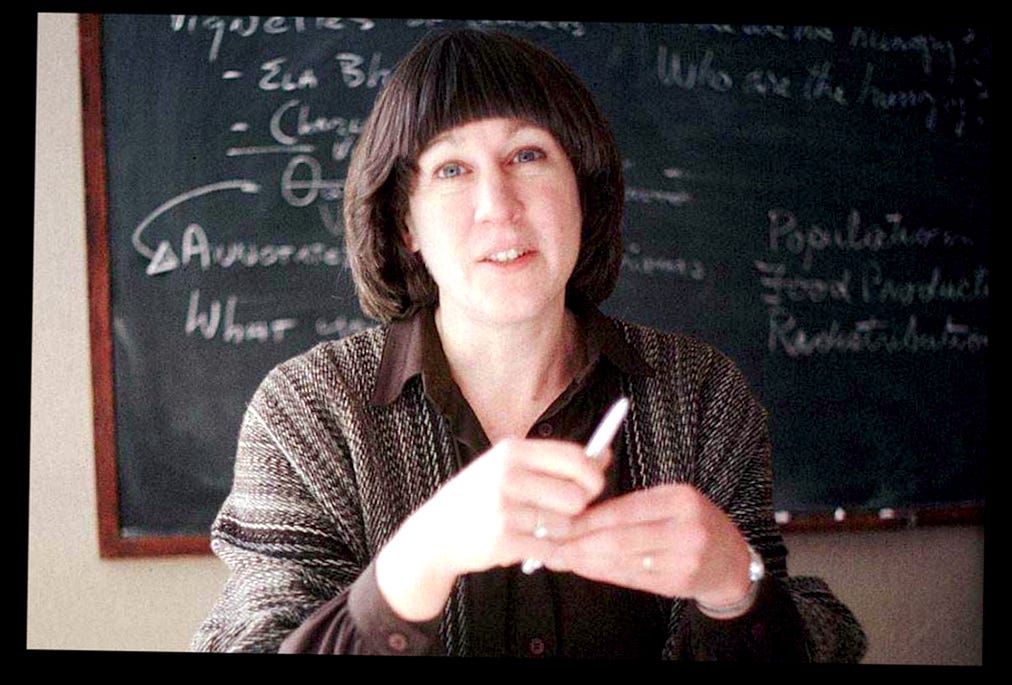
(Here is a picture of one of the authors that gave the world The Limits to Growth. You can tell just by looking at her that she has a deep understanding of what would make someone wanna have more children.)
One of the people who took The Club of Rome and others of their ilk quite seriously was Chen Yun. This Chen Yun guy was a pretty big deal in the Chinese Communist Party during the end of the 20th century. Here’s what he said about population control in 1979 “Comrade Xiannian proposed to me planning ‘better one, at most two’. I'd say be stricter, stipulating that ‘only one is allowed’. Prepare to be criticized by others for cutting off the offspring. But if we don't do it, the future looks grim.” Well, they did do it and they did it very effectively. Now China’s TFR is 1.18. Let’s just say that overpopulation won’t be a problem for them any time soon.
Still not convinced that engaging in longtermism is retarded? And that trying to fix the future’s problems before they happen causes more problems than it solves? Let’s talk about peak oil. In 1956 Marion King Hubert predicted that US oil production would peak in 1970 and then begin an interminable decline. By the late 1990s, it really seemed like he was onto something. The rate of oil production had followed his graph more or less to a T. In 1998, Scientific American published a paper by Colin J. Campbell and Jean H. Laherrère titled The End of Cheap Oil. This paper popularized Hubert’s findings, and for the next few years, everybody and their mother was talking about peak oil and its implications.
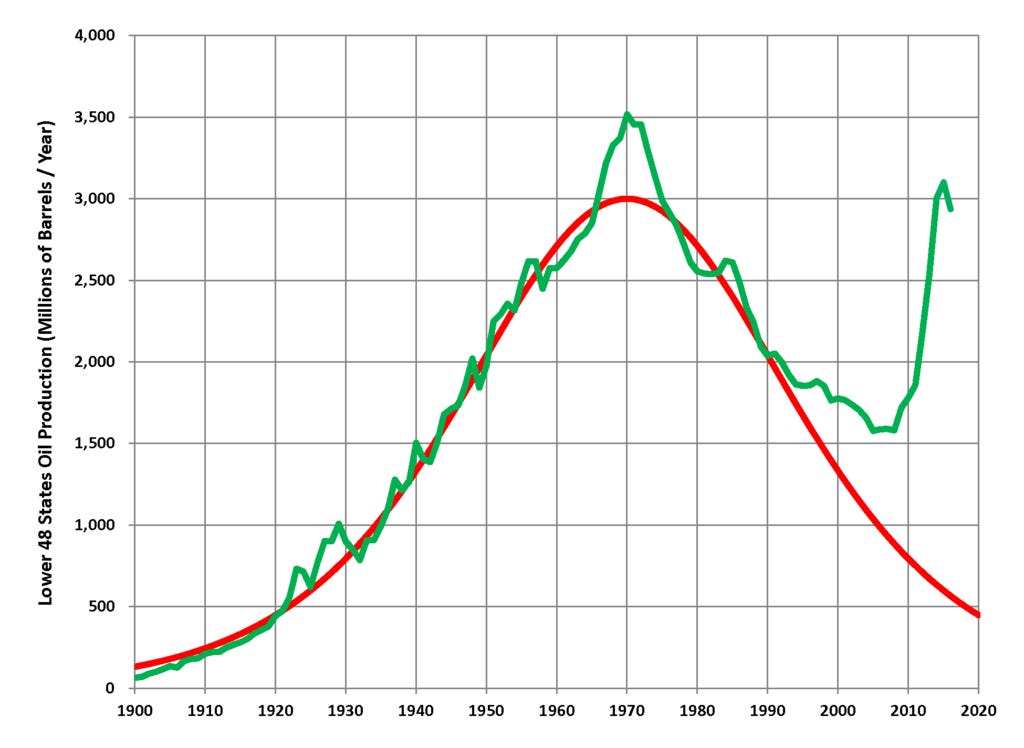
(This graph shows Hubert’s predicted oil production [the red line] and actual production [the green line])
However, expert opinion turned out to be wrong again. I guess they figured that no one would ever come up with some kind of new technological innovation that would enable a different type of oil extraction, plus ca change.
Worrying about the problems that our grandchildren will face in 2100 is a waste of energy. Worrying about the problems of 2050 is still a waste of energy but a little less so. All this talk about the world ending due to AI, or Climate Change, or whatever the next cause du jour will be is simply masochistic neuroticism parading around as “concern for the future”. How about trying to solve the problems of today, instead of engaging in an interminable pageant of exhibitionistic intellectual masturbation. The people of 2100 will find our predictions for the afflictions of the future to be humorous at best and demented at worst. If they could develop a time machine, they would come back and tell us to focus on improving our immediate surroundings and being good to the people around us. They would also tell us to stop whinging about our sanctimonious concerns for their future. To put it bluntly, I’ll share a GIF that would sum up their reaction to our “interest in their long-term well-being”.

No posts
Comments
Nothing yet. Say the first thing.
Sign in to join the conversation.