
I am currently listening to Mahler’s Symphony No. 5 in C-sharp Minor. Mahler was full of curious puzzles and conundrums—I think he delighted in finding a way to avoid the predicable. His puzzles helped him bridge the romanticism of the late 19th century with what was to come in the early 20th century. He dug through folk melodies, philosophy, images from nature, and, most importantly for me at this moment: reflections on life and death. I am pondering death as I listen to this symphony.
The theme of being unpredictable has guided my life as an architect and now, as a painter, my art work. I like “not following rules” and trying my best to conjure up something new. But there is one thing that I know for certain: There is life then there is death. Death is predictable—it is the one rule that cannot be broken. What happens in-between is up to me and how I take care of my body.
Recently my body sent me a short but potentially deadly message:
I am going to alter the DNA in the skin on the outer rim of your right ear. You have not been a good host and an even worse listener to my inner voice. You have neglected to put enough UV blocking cream on your skin. The alteration I am making will send a signal for the instructions of the DNA to create growth-promoting genes that will become overactive and ensure that your protective genes stop functioning.
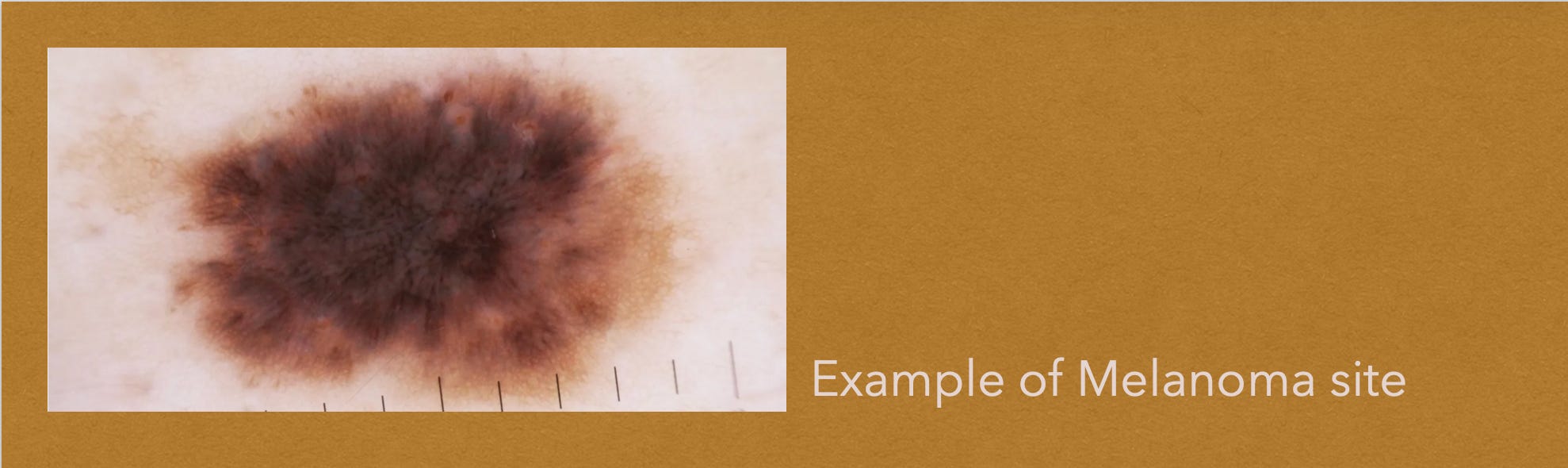
My body’s message to me was real and resulted in my being diagnosed with melanoma (a softer word than cancer—although in this case they mean the same.) My first reaction upon hearing the diagnosis from my dermatologist was “damn!” I learned that my immune system had given up trying to destroy the abnormal cells. And I was soon to find out that the cancer cells which survived the attack from my immune system often develop ways to hide from or suppress an immune attack. In the case of melanoma, there is the danger when the malignant melanocytes—the pigment-producing cells in my skin—acquire the ability to invade nearby tissue and move through the lymphatic system or bloodstream to other parts of the body. This was terrifying.
As the doctor explained it to me: Melanoma commonly spreads first through the lymphatic system. These cancer cells enter tiny lymph channels and travel to nearby lymph nodes, often called “sentinel lymph nodes.” For this reason, sentinel lymph node biopsy is sometimes performed for higher-risk melanomas. The doctor will not perform this biopsy until after all other avenues are checked.
After the phone call, I stood still and just began to cry. It happened that I was at our beach house—just me and my dog. I was walking our Welsh terrier Gemma when the doctor called. Miss Gemma (as I call her) is normally “ready to walk” and not very patient. But when I started listening on the phone, she just sat down and was patient. I swear she “knows” when something if wrong with Lea or me. I was confused and worried. Would I live to see my grandchild graduate from college? What should I do with my remaining days? What were my priorities if I was unlucky—and if I was lucky? Are my affairs in order? Is this the way it will all end? What burdens will my death place on my wife? Do my children know enough about me? The questions swirled like a mini-tornado inside my head and coursed throughout my body.
After I finished the call, I picked Miss Gemma up and gave her a big hug. I looked into her beautiful eyes and just stared. She knew something was not right—and she relaxed and just looked back at me. My mind yelled: Stop worrying until you find out exactly what is going on! Let the doctors do their thing.
My next step was to call those closest to me: my wife and three children. At this point, there was no further tests completed. There was no way of knowing, without specific tests, if the cancer had spread. We did not know if the sentinel lymph nodes had released the cancer cells to my lymph nodes. Not knowing is always upsetting—but in this case it was a matter of life and death. Of course, our medical system meant that I had to wait for a few weeks before I could get an appointment with the surgeon who would be taking samples to test. In the meantime, the lab performed a “Merlin” test on the first sample (from my dermatologist) that revealed the tumor was less than 5mm in depth (about 1/50th of an inch). As it happens my nephew is a Mohs surgeon (in San Diego) and was very helpful explaining the technical analysis. When the depth is less than 5mm, there is a less than 3% chance the tumor has made its way into my lymph nodes and into my body. But for now I had to wait. I am not very good at waiting when uncertainty is present.
Last Tuesday the surgery took place. Mohs surgery involves taking very thin slices off of the tumor and testing each layer—not proceeding to slice again until after the test results are returned for the previous sample. If the test reveals more cancer cells, another layer is removed; this is repeated until the test reveals “normal” skin cells. This process took about 6 hours. Once the “all clear” was received from the laboratory the surgeon removed skin from my jaw line and grafted this slice of skin to the site of the excised skin on the outer rim of my right ear.
A few days ago I received this message from the clinic:
Hi Jeff,
Good news, there was no deeper melanoma, this was all cleared with Mohs, nothing further to do. Take care! Thanks, Elizabeth Corrales, LPN for Deyson Lorenzo, MD OHSU Dermatologic Surgery
Today I had the sutures removed. The surgeon stated:
The central debulk excision on the melanoma was not any deeper than your original biopsy (5mm). So your stage stays T1a, which is good. I recommend follow up every 3-6 months with your dermatologist.
In melanoma staging, T1a is an early-stage classification describing a thin melanoma with lower-risk features. It is part of the TNM staging system:
T = Tumor thickness and ulceration
N = Lymph node involvement
M = Metastasis (spread to distant organs)
For melanoma, T1a specifically means:
The melanoma is less than 0.8 millimeters thick
No ulceration is present (the skin over the melanoma is intact)
This is generally considered one of the most favorable melanoma stages. People with T1a melanoma often have:
A very high cure rate
Low likelihood of spread
Treatment that is commonly limited to:
Complete surgical excision
Wider margins around the original biopsy site
Mahler, who suffered from antisemitism during his lifetime, was not well received by his contemporaries. Comments from critics included descriptions such as: chaotic, morbid, eccentric, a symphonic giant with no sense of proportion. Mahler himself understood that his music was ahead of its time. One of his most famous remarks was:

When I first received the news, I thought to myself “my time has come.” Not in the sense that in the future people would understand me—in the sense that it could all end. Now that I know I am “out of the woods” for the time being, I feel cautiously optimistic. I also feel the urgency to create.
All artists have to decide: Does one create what they think others might like; or do they listen to their inner voice and suffer through the criticism. In my case, I paint what I want, when I want and follow the brush stroke messages traveling from the surface of the canvas to my brain then back to my heart—before looping back to the canvas. This loop is saying: listen carefully to your inner voice and all will be revealed. My forefront questions are still there: priorities? focus? time spent? What is important?
This cancer wake-up call heightened the urgency to paint what I want and help as many libraries as I can—before my time actually arrives! Mortality, I have learned, is not a philosophical abstraction but an active condition that will shape the time I have left on this planet.
So: now I will pay more attention to the body’s message:
___________
For those who want more information regarding observing your own body:
Dermatologists often use the “ABCDE” warning signs with regard to Melanoma:
Asymmetry — one half unlike the other
Border irregularity — ragged or blurred edges
Color variation — different shades of brown, black, red, blue, or white
Diameter — often larger than 6 mm, though smaller melanomas occur
Evolving — changing size, shape, color, itching, or bleeding
No posts
Comments
Nothing yet. Say the first thing.
Sign in to join the conversation.