
I was listening to WIP Sports Radio in Philadelphia this morning.

I used to listen all of the time. Sometimes, when the teams would struggle, I would just turn it off. It was too much for me. The hot takes, the idiotic calls …I knew it came with the package, but damn … what a waste of time.
When I moved to North Jersey, one of the things I missed was my connection with Philly Sports. I was what they call a “Four for Four”

But living in Garfield, NJ … it was impossible to keep up. I would buy the Philadelphia Inquirer on Sundays, but other than that … a score now and then on NY Sports reports, but that was it. Eventually, the internet showed up, and about 3 years ago, Audacy let me get Sports Talk on my phone.
Awesome… sometimes.
When the teams are struggling, the “talk” is vicious. The Phillies take a beating, Jalen Hurts takes a beating, and even college teams can get attention. In fact, the better the team, the higher the expectations, and the more commentary from hosts and callers alike.
And when things go bad … the attacks can be merciless.
This morning, the hosts were having an incredibly spirited, quintessential Philly debate regarding the brutal psychological toll that critics, callers, and media figures take on the sports icons in this town. Jon Ritchie—the former Eagles fullback whom I like a lot—was holding down one side of the argument, drawing on what it actually felt like to take physical and verbal beatings in an unsparing sports market.
Then his co-host dropped the line that instantly made my mind race: “The beatings come with the territory.”
What? Just because they make good money, we get to beat the crap out of them?
As I see it, in professional sports, fans rationalize treating human beings like public property because of a ticket price or a multi-million dollar contract. And I do get used to it, well, until I stop listening.
But as I was making breakfast, feeding the dog, and listening, I realized that this exact, callous attitude is no longer confined to the NFL or MLB.
Decades ago, those of us leading the pageantry arts signed a Faustian bargain. We deliberately went looking for the armor, the prestige, and the commercial infrastructure of professional sports. And the internet complied—rewarding teenager musicians and color guard members with the same vicious, unsparing public vitriol normally reserved for a struggling quarterback.
Heck, I do it too. Hopefully not to the same degree, but when I show disdain or concern for the percussion line of the Carolina Crown, I am talking to the kids in that drumline.
I started to look around … how did we get there?
WGI’s 1995 Blitz: Codifying the “Sport of the ??Arts”
The intentional transformation of our activity from community-based youth groups into hyper-competitive athletic franchises happened in distinct waves. Winter Guard International (WGI) was the first to aggressively weaponize the vocabulary of athletics.
By the early 1990s, WGI was expanding at breakneck speed, supercharged by the official addition of its Indoor Percussion division in 1993. Leadership recognized that to justify the grueling physical training of modern theatrical choreography to school boards, parents, and sponsors, they needed a radical conceptual pivot. In 1995, WGI officially trademarked and launched its defining moniker: “Sport of the Arts”.
This wasn’t just a clever piece of marketing filler. It was backed by an absolute overhaul of the competitive framework:
The Death of the Tick: WGI completely abandoned the archaic military “tick system”—which subtracted fractions of a point for errors—and codified a progressive “build-up” scoring philosophy. Risk was now rewarded from zero upward. Made sense, well, I thought it did.
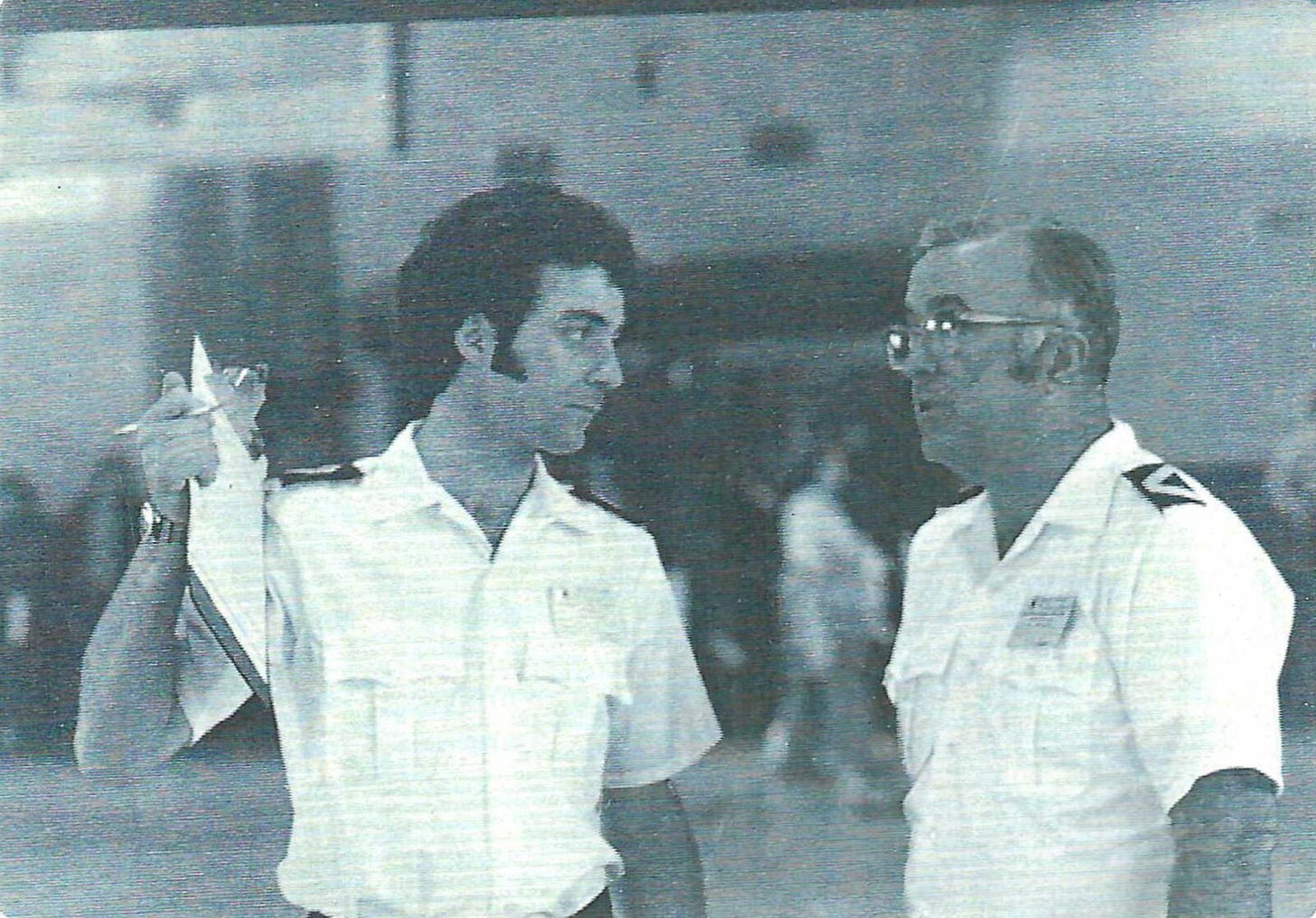
The Franchise Tier System: WGI formalized strict A, Open, and World Class divisions, deliberately mirroring the minor-to-major league infrastructure of professional sports.
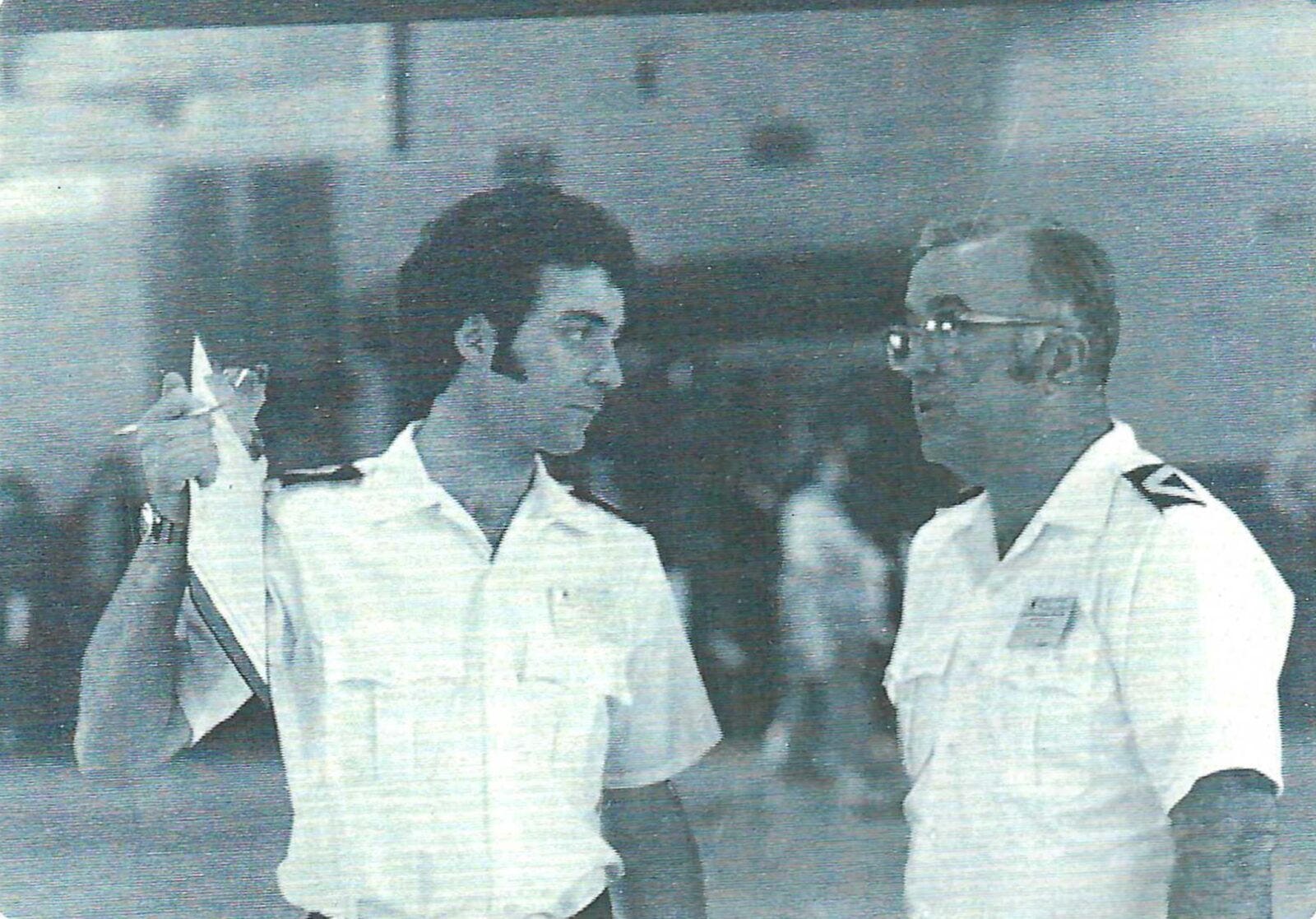
By 1995, WGI had successfully rewritten the narrative. They gave the public permission to view indoor ensembles not as a hobby, but as elite arena athletes.
DCI’s Delayed Leap: Marching Music’s Major League (2004)
For years, Drum Corps International (DCI) watched WGI’s explosive growth with a mix of fascination and institutional stubbornness. Although DCI had uniform competitive rules, the ghost of its traditional military heritage hung heavily over the boardroom. Throughout the late 1990s, DCI dragged its feet, slow to recognize that the activity was rapidly evolving beyond its mid-century roots.
The dam finally broke in 2004. Facing escalating tour costs and desperately chasing corporate sponsorships, DCI executed its own massive modern rebranding, officially rolling out its trademarked moniker: “Marching Music’s Major League™”.
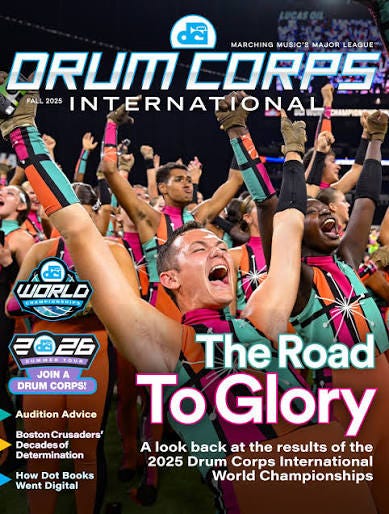
The 2004 season became the ultimate structural turning point: Perhaps key … if a short-lived marriage …
The ESPN Era: Coinciding with the rollout, DCI secured national television broadcasts on ESPN2, deliberately packaging complex artistic field shows into tight, consumable sports segments complete with sideline commentators and player profiles.
I remember walking into a bar/restaurant when I got home from finals to attend a meeting. The Championships were on television. Cool. What was not cool were the two 20-something patrons yelling “get this crap off of this television”

The Erasure of Educational Grace
When the circuits officially adopted those sports skins in 1995 and 2004, the prestige and performance standards soared. But we also permanently altered the audience's psychology.
Fans stopped acting like encouraging parents or arts patrons; they began acting like sports fanatics. Empowered by the total anonymity of the rising internet—starting in the 1990s with the unmoderated digital coliseum of the Usenet newsgroup rec.arts.marching.drum-corps (RAMD) and bleeding into modern social media—the audience adopted the unsparing critique culture of a sports call-in show.
Because the activity claimed to be the “Major Leagues,” the public decided that the teenagers on the field no longer required grace. A dropped rifle or a cracked trumpet note was no longer viewed as a learning moment for a student; it was treated with the exact same vitriol reserved for a professional athlete’s game-losing blunder.
Leaders were also fair game. Believe me… I learned the hard way. Anonymous letters, calls to my board … you name it. And the kids were affected, no doubt. A not-so-great year was bad enough, but now I had kids asking me about posts they saw on the bus.
The Architect’s Dilemma: When the Rules Outrun the Reason
There is a distinct, humbling irony in finding myself where I am today. For decades, I was labeled the chief iconoclast of the drum corps world—the king of rule changes. I spent a career managing the Cadets, fighting traditionalist gatekeepers to drag the activity into the modern era, pushing relentlessly for the introduction of amplification and electronics. Later, I spearheaded the controversial G7 initiative, trying to fundamentally restructure the economic and competitive power dynamics of DCI’s elite tier.
My formal training is not in commercial entertainment, but in Secondary Social Studies Education and Non-profit Management. I have spent my life analyzing how institutions operate, how budgets scale, and how systems either serve or exploit their constituents.
It is through that exact lens of systemic management that I look at the state of the activity today with profound concern.
The tools I fought so hard to introduce have mutated into a runaway arms race. Watching the top ensembles on the field today, the sheer scale of the electronic infrastructure—most notably the overwhelming, highly engineered audio landscape utilized by groups like the Bluecoats—has reached a point that is frankly beyond my comprehension. We didn’t just introduce a microphone to hear a marimba mallet; we opened a portal to a hyper-produced, stadium-sized concert format that has fundamentally severed the activity from its acoustic, educational roots.
The economic fallout of this aesthetic escalation is devastating, and completely predictable to anyone who understands non-profit mechanics. By legalizing an unchecked technological wonderland, the circuit has guaranteed an unlevel playing field. The massive, runaway spending of the “Top Four” corps ( my estimate; could be three) has turned the activity into a financial bloodsport. While a tiny handful of elite franchises possess the capital, corporate sponsorships, and design monopolies to fund these rolling sound stages, the rest of the activity is being economically choked out trying to keep pace.
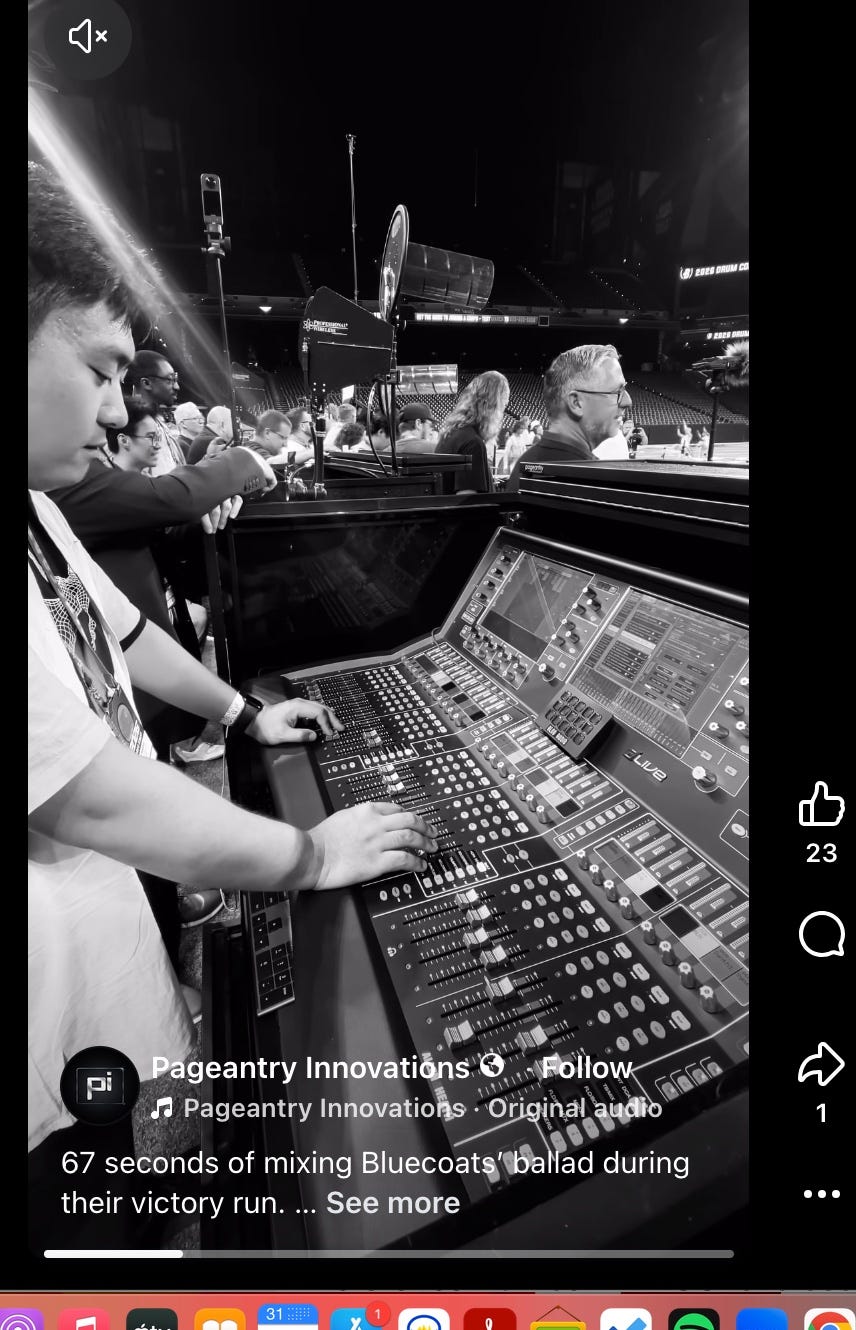
The ultimate tragedy of this corporate-sports evolution is that the burden of this hyper-expensive arms race does not fall on billionaire owners. It falls squarely on the backs of the students, who are forced to pay skyrocketing tuition costs just to march, only to be subjected to the unsparing, anonymous vitriol of an internet audience that treats them like failing professional athletes.
We set out to give the marching arts a bigger stage and better tools. But by trading the grace of an educational sanctuary for the ruthless matrix of a professional sports league, we built an empire where the technology is deafening, the budgets are unsustainable, and the human beings on the field are entirely expendable.
I have written about some of this.
The review of the 990s is a beginning, but it is difficult to see beyond the generalizations in such documents. I credit the Bluecoats for investing in their area's nonprofits; others invest in more than one organization. But if you do not think that every drum corps is figuring out how to get their hands on next-level electronics systems … you are not paying attention.
Seems to me we are at a turning point. We have been here before, and we had plans … and 50 drum corps. Now, we have 25?
Like I said … a turning point

No posts
Comments
Nothing yet. Say the first thing.
Sign in to join the conversation.