
There will be some folks over at SRP who will get a wee bit nervous at the thought of me writing about how things are going at the my gig.
They shouldn’t worry. I’m not going to share anything that’s not already covered at open meetings. Also, see below for the social media disclosure that they ask we put on every communication about SRP.
I think we all get it: I don’t speak for the board.
The SRP Board has been operating quietly and mostly out of the peripheral vision of the public for over 100 years. So, it will definitely feel uncomfortable at first to be observed in this way.
But discomfort is the first step in a more responsive company.
1. Big changes will take time. But, they should not take as long as some on the board would like.
I’m talking about moving away from fossil fuels, as if you couldn’t guess.
Some in the advocacy groups would like to see us not only cease any new gas power plant planning, but also close some that are in operation now.
I’m with them in spirit. It has been, and continues to be misguided, to say that gas is some kind of bridge fuel. It is short-sighted to pen new agreements to support gas lines from Texas for a new gas power plant in Navajo Country, for instance.
Anything but clean energy there will just continue the same tragedy of pollution and water waste for what will become a stranded asset in less than 15 years.
But, I digress.
Our biggest challenge to reducing carbon, other than past board votes, is how long it takes to plan, purchase and implement new power resources. For instance, SRP is purchasing gas turbines now and planning out the Marigold Energy Center in Pinal County, which won’t come in to operation until between 2030 and 2032.
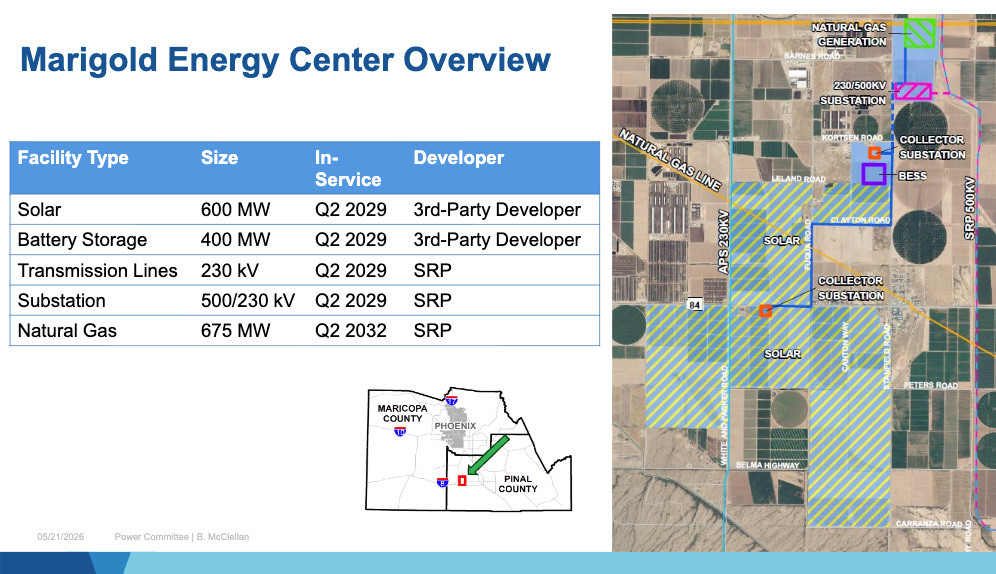
As much as I want to find an alternative for the 675MW of new gas planned in this example, the process has begun to finance and order these turbines.
I’m not convinced that we can’t change the direction of this. But we’d need to come up with 675MW of power or energy efficiency off-sets after this process has already begun.
2. The staff is not the Board. I was approached by one of the older board members who recycled an old talking point, which I thought climate change deniers had given up over a decade ago; that more carbon in the atmosphere is good for plants. (Myth busting here and here.)
It was heartening to have conversations with some on staff who made it clear that they accept the science of climate change.
I was surprised, however, to see in presentations last week about future water levels that staff seemed to dodge the phrase “climate change.” They treated our troubling outlook for Colorado River and Salt River water levels as more of a normal, cyclical dry period, rather than the logical outcome of having 420 ppm of carbon in the atmosphere.
This very talented staff should not be discouraged from thinking more creatively when it comes to a clean energy future. And that starts with never feeling like they have to censure themselves to appeal to the tender sensibilities of climate change deniers in the room.
On a hopeful note, staff has already responded to calls from Board members to include Green Bonds in this year’s planned $919M bond sale. That did not go un-noticed or un-appreciated.
3. Differences in mirror are smaller than they appear. Before I took office, I heard that some staff were really worried that the Clean Team members were going to dramatically upend things at SRP.
I’m convinced that there were some folks (probably those who had sipped the Turning Point cool-aid) who thought Clean Team members were going to immediately flex their muscle and radically re-work the company.
That has obviously not happened. Further, if you listen to the questions that new board members are asking, it becomes clear that we are talking about relatively small policy changes today that will result in huge carbon reductions in a few years.
If you take a step back and look at the thing that people fear the most —that SRP may have to double its energy capacity over the next decade— you start to see that we can meet that demand many different ways.
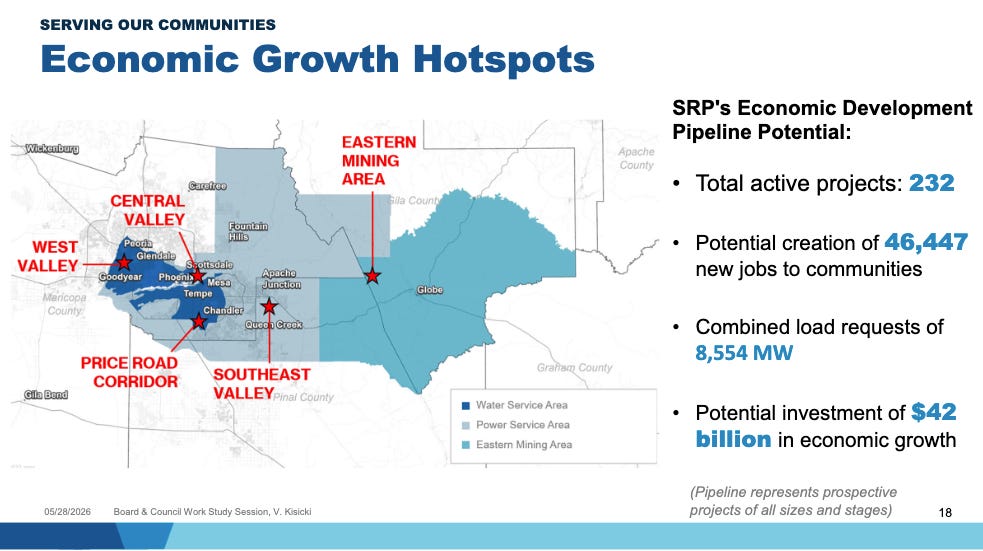
Take data centers, for example.
First, we are learning that not every data center that has inquired about moving in to SRP territory actually will. So, that doubling of demand may not even happen.
Second, people I’ve spoken with around the board and council are more open than I expected to the idea that data centers should generate and pay for their own clean energy.
In another example, there is notable enthusiasm for investing more in to battery infrastructure, which will flatten out the duck curve.
4. Decarbonizing as a money saver. There are three things that SRP customers spend money on, which we can reduce: servicing debt, profit for power purchase agreements and fuel.
These things can be re-balanced to save customers money, but here’s a little background first.
First, ten percent of SRP’s annual budget goes to interest payments on bonds that SRP issues. That’s about $400M every year. SRP is very proud of its great credit rating, and they should be. They also strongly believe that this amount of debt load it not out of the ordinary, and that it spreads out the burden of running this massive operation between today’s customers and tomorrow’s.
I believe that this way of thinking will need to change as batteries last longer and the grid becomes more decentralized. Also, I believe that more customers than we think are okay with paying for infrastructure today, knowing that it will benefit future generations. After all, that is how we valued infrastructure in this country for decades.
Second, SRP has also made the decision to pay outside developers to build and operate almost all of their clean energy power stations. These are called Power Purchase Agreements (PPAs). SRP management has not done the same for gas power facilities.
As you know, when you pay somebody to do something for you, there is a profit margin built in. It’s the difference between making your own dinner and ordering Grub Hub.
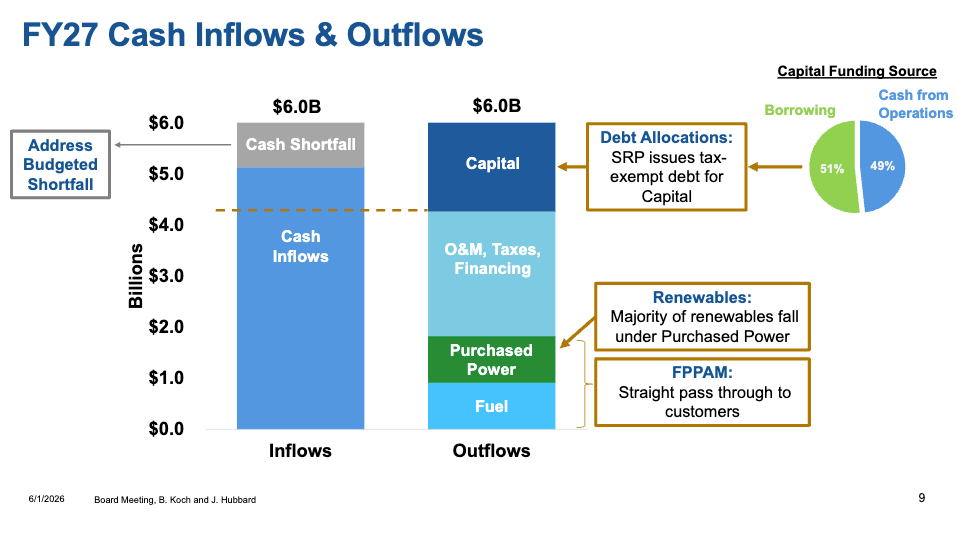
Third, about $900M goes to fuel for power plants ever year. We know that we need to reduce this faster; both because climate change is real and because clean energy will only become cheaper and fossil fuels more expensive over time.
Those are three items you don’t think about when you see your bill, but they are there.
The way I see it, the more aggressively we can reduce fuel costs by going green, the more we can redirect those funds to building our own capacity so we are not paying others to do it. And, over time, we can save money to build our own capital projects and avoid at least some debt.
Now, the staff I’ve spoken to certainly think this is crazy. After all, we are in a growing market. My response is that we should map out a 15-year scenario with these goals in mind and see what we can learn
I think there is money there to save, but we won’t know unless we think creatively.
Despite learning how painfully slow it is to turn this aircraft carrier, I’m certain of these truths:
The Clean Team members are just as dedicated as ever to save money and decarbonize, even if you are not hearing from us like you did during the campaign.
Even though we have a majority, the institution controls the information and we are working to get more of it.
This will take some time, but we are seeing real wins already.
So, stay tuned. There is more to come.
Ken Clark is a Salt River Project Board member. The views expressed in this content are solely his individual views and opinions, and are not made on behalf of the SRP Board of Directors or Salt River Project Agricultural Improvement and Power District.
No posts
Comments
Nothing yet. Say the first thing.
Sign in to join the conversation.