
Every industry eventually hits a point where a person stops being just a top performer and becomes the actual benchmark. It’s that rare level of greatness where a name completely outgrows the job title. You do not even have to follow the field closely to know who they are; their name just becomes the word you use when you’re trying to describe something flawless.
That’s where Lionel Messi sits today. He doesn’t just belong to football history anymore; he has crossed over into the global mainstream.
If you asked most people to describe who Messi is to them, they may not be able to list all his achievements and awards in one sitting. What actually sticks with us is the feeling of watching someone constantly break barriers and etch their name into the history of greatness.
That’s the real distinction. Plenty of people win. Very few become the standard.
For this piece, the central argument is not on how Messi became one of the greatest footballers ever. It’s “What does it take for someone to become the standard by which excellence itself is measured?”
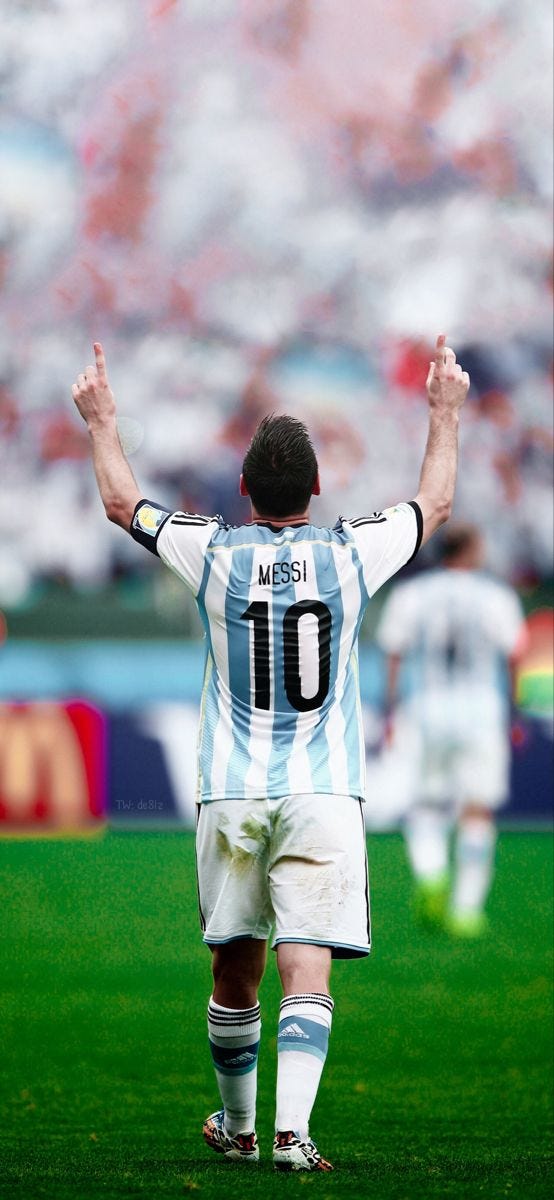
We live in a society that is obsessed with visibility, where we are constantly conditioned to broadcast the process, narrate the grind, and package every minor milestone into a piece of shareable content. Messi’s career represents a completely different philosophy because his greatness was established entirely by what happened when the cameras weren’t rolling.
Looking back at his early years at Barcelona, there was no carefully curated personal brand or media strategy; there was only the relentless, almost boring repetition of the fundamentals executed at full speed. What looked like magic on the field was the accumulation of thousands of hours spent mastering the art of scoring goals.
In any creative or professional field, this is what real competence looks like from the outside—it is thousands of hours of doing the highly repetitive, unglamorous practices needed to succeed. A seasoned designer who instantly spots a tiny alignment error, or an editor who knows exactly which paragraph is dragging a piece down, is not relying on a sudden stroke of genius. They have spent so much time with the basics that their brains handle complex problems automatically, without them even having to think about it.
A lot of people build a great career off one good phase, but they often get stuck when the industry shifts or their initial energy starts to fade. What made Messi different is that he did not just stay successful; he has reinvented himself over the course of his twenty-year career. He started as a dynamic winger, turned into a lethal false-nine, and shifted into an elite playmaker who controls the entire game with fewer touches and less running.
The willingness to let go of an old identity is what separates a temporary peak from a long career. A brilliant creative who wins awards at twenty-five for being experimental is going to need a completely different toolkit by thirty-five, where success is less about making a splash and more about leadership, restraint, and lifting others. Similarly, a founder who is amazing at managing the chaotic energy of a brand-new startup has to learn how to build systems if the company is going to survive long-term. Many ambitious people look at reinvention as a sign of weakness, as if the first version of themselves failed, but it’s the opposite: changing is the only thing that keeps their best work from becoming a thing of the past.
We naturally focus on spectacular highlights and sudden breakthroughs, but those peak moments only matter because of the grueling, unglamorous years behind them. The 2022 World Cup felt so significant not just because Argentina won a trophy, but because it was the final chapter of a story that took nearly twenty years to build.
This is where the reality of success gets uncomfortable for anyone chasing big career goals. Most of us secretly hope for that one massive breakthrough that will change our lives overnight—a viral project, a huge client, a major award, or a lucky introduction. But the people who become the ultimate benchmarks in their industries almost always earn the trust of their peers long before they ever get public applause. Consistency is tough because it lacks the quick emotional high that comes with intensity. Intensity gives you the brief feeling of a major change, but consistency is what actually delivers it.
At a certain point in a great career, the work stops being just a personal achievement and begins to reshape the entire field. There are teenagers entering professional football today who never actually saw Messi play in his prime, yet they naturally copy the angles of his passes and the timing of his movements because those choices have permanently changed how the game is played. It’s the same way Fela Kuti’s work became the bedrock for modern Afrobeats and all its sub-genres, or how Virgil Abloh’s design philosophy completely transformed the way a generation looks at fashion and branding.
When you reach that level, your personal way of doing things simply becomes part of the industry’s default foundation. It is important to remember that this kind of deep influence has nothing to do with temporary popularity. Plenty of famous people leave absolutely nothing behind once the spotlight moves on to the next trend. Real influence shows up organically in the work of other people, subtly shifting the baseline of what is considered excellent.
A great question to ask yourself as you build your career is this: What would be left over if my name were completely removed from the project? Would there still be a framework, a standard, or a way of thinking that your peers could carry forward into their own work? Aiming for that kind of lasting impact is far more rewarding than simply chasing admiration.
People often talk about finding legendary careers inspiring. Still, if we are being completely honest, I think what we are really looking for is proof that a human life can be intensely organised around the pursuit of a craft without becoming emotionally empty or one-dimensional. Messi’s trajectory shows that obsessive devotion to a discipline can yield something far larger than mere personal success.
The trophies and accolades are great milestones, but they aren’t the reason his name makes perfect sense to people who have absolutely no interest in sports. We instinctively recognise the universal, human pattern hidden inside his story: discipline, excellence, and an impact that outlives the celebration. That is the exact part of the blueprint worth keeping.
Not everyone will become global icons, and the truth is, the world doesn’t need millions of Messis running around. But we can still build our daily work on that same foundation. We can choose to get unusually good at the boring basics, stay teachable long after our first taste of success, and deeply care about the quality of our work when absolutely nobody is watching.
The real reward of mastery is not that people remember your personal highlight reel; it’s that your name eventually becomes the definitive answer to a much bigger question: “What does excellence look like?”
Once your work becomes the answer to that question, you are no longer just successful—you have become the standard.
No posts
Comments
Nothing yet. Say the first thing.
Sign in to join the conversation.