
There is a popular saying we have heard many times: a moving man will eventually meet their luck. The premise is that as long as you keep moving, opportunity will eventually find you. It’s the kind of line that sounds incredibly wise until you try to apply it to your own life and realise you can’t make the leap.

We are told that the only thing standing between us and momentum is the decision to start. “Just start,” they say. “Do it afraid.” “Until you start, you’ll never know.” While I understand the sentiment, it does not work for everyone. The internet is already saturated with the brand of hustle culture, which perpetuates the idea that if you are not constantly grinding, you simply lack discipline or do not desire success badly enough.
My perspective on this changed when I watched an analysis by Lindsian on the paradox of the ambitious yet lazy mind. Her insights made me realise that feeling stuck is not a single, flat experience; it has distinct flavours, manifesting in four clear scenarios where we quietly undermine our own potential:
This is for those who have one too many on their plates, not necessarily that they feel stagnated. In this state, you might find yourself with five different directions for your career, three half-formed business propositions, and two entirely different versions of the person you could become if you simply selected one path and committed to it. This abundance of choice feels like an asset, but in practice, the competing options simply cancel each other out.
There is the exhaustion that comes from holding open too many doors simultaneously. Because each option seems entirely reasonable and potentially correct, choosing any single path carries the grief of abandoning the others. Consequently, you avoid making a choice. You continue to circle the options, conducting endless research and waiting for one specific path to reveal itself as the definitive winner.

The truth is that certainty is rarely available before a decision is made. True clarity typically arrives afterward, once you have lived with the consequences of a choice and can look back with the benefit of hindsight.
People caught in this particular loop are often working incredibly hard, but their energy is spent entirely on deciding rather than on the act of doing. The tragedy here is not laziness; the thought of possibility has made the first step feel prohibitively expensive, simply because opening one door requires you to close several others that you had not finished imagining.
This is the scenario where, by most conventional measures, everything is perfectly acceptable. The job pays well, and on the surface, life appears to be treating you incredibly well. Because nothing is actively wrong, you find it remarkably difficult to justify disrupting your entire existence for something as vague as ambition. Comfort exerts a powerful, silent claim on us that discomfort never could, because discomfort at least provides a visceral reason to move.
This is precisely where many people remain stuck for years without ever naming their condition, because it does not present itself as pain. Instead, it presents itself as entirely adequate. You tell yourself that you will finally begin when the timing is better, when you have accumulated more savings, or when your circumstances become more settled.
Yet the reality remains that life never finishes settling. Comfort is not a trap because it is inherently bad; it is a trap because it is just tolerable enough to encourage you to postpone the harder, more rewarding path indefinitely.
Walking away from safety for the sake of the uncertain is, by most rational measures, a counterintuitive thing to do. Remaining where you are is not always foolish, but we owe it to ourselves to be honest about what we are doing: is this a conscious choice to stay, or a slow drift because we never actually want to leave?
In Herman Melville’s short story, Bartleby the Scrivener, the clerk Bartleby responds to every workplace request with the simple phrase: “I would prefer not to.” He does not refuse nor does he comply with his boss’ order. This is a kind of suspended state where the task is acknowledged but never quite undertaken, and the phrase itself becomes a wall nobody can argue with because it is not an argument at all.
I think a lot of times we state ambitions but end up in that same suspended state. You say you want to make a short film, build a business, or move to a new city and restart your life, and yes, you mean it with every fiber of your being.
However, wanting a grand outcome in the abstract is entirely different from wanting the unglamorous, repetitive, and frequently tedious daily labour required to construct it. These two desires require completely different appetites. Beneath the loud, public desire to possess the final product is often the stubborn preference to avoid the process.
This state is a fundamental mismatch between the clean, attractive idea of a lifestyle and the messy, physical texture of building it. When the gap between the concept and the reality becomes visible, it is highly tempting to keep talking about the goal rather than confront the fact that some part of you is declining the work required to get there.
The last version belongs to the overthinkers, and it’s the one I recognise most in myself. This isn’t paralysis by too many options or comfort dressed up as contentment. It’s the belief that if you think about something long enough, you will eventually engineer a plan so flawless that it guarantees success.
Driven by this assumption, you continue to contemplate. You run endless scenarios, map out potential failure points, and prepare detailed contingencies for complications that have not occurred and may never arise.
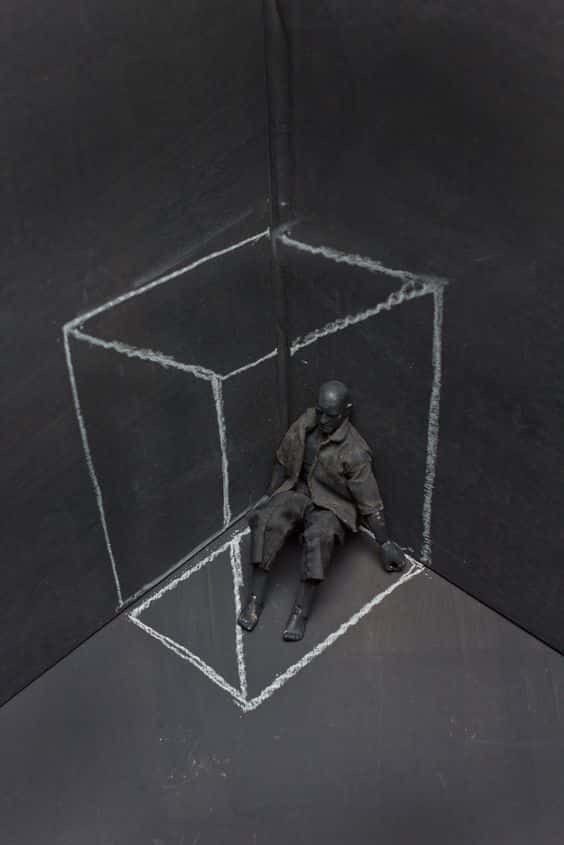
The core flaw in this approach is that internal contemplation cannot produce the specific clarity you are waiting for. The practical information you require literally does not exist yet; it only reveals itself through the friction of doing the work, adjusting your approach, and trying again. You cannot intellectualise your way into momentum; you can only move your way there.
You stand to gain a profound sense of relief in finally accepting that overthinking is not a valid form of preparation. It is simply a method of avoidance that happens to feel productive because it requires immense cognitive effort and mimics the appearance of diligence.
I do not think any of these four distinct hurdles can be solved by simply trying harder, because effort was never the actual obstacle.
The traditional proverb assumes that the moving man possesses a natural capacity to just move. What this perspective overlooks is the experience of everyone standing at the threshold—those who desperately wish to take action but find that desire alone cannot close the distance between the room they occupy and the exit.
Perhaps, maybe the saying has nothing to do with luck at all. Instead, it requires us to admit that movement is rarely a simple matter of willpower. More often, it is a matter of having the clarity to recognise which of these four rooms you are currently standing in, because it is impossible to walk out of a space when you have not yet noticed that you are trapped inside it.
No posts
Comments
Nothing yet. Say the first thing.
Sign in to join the conversation.