
When I find myself in times of trouble, please play “Let it Be.”
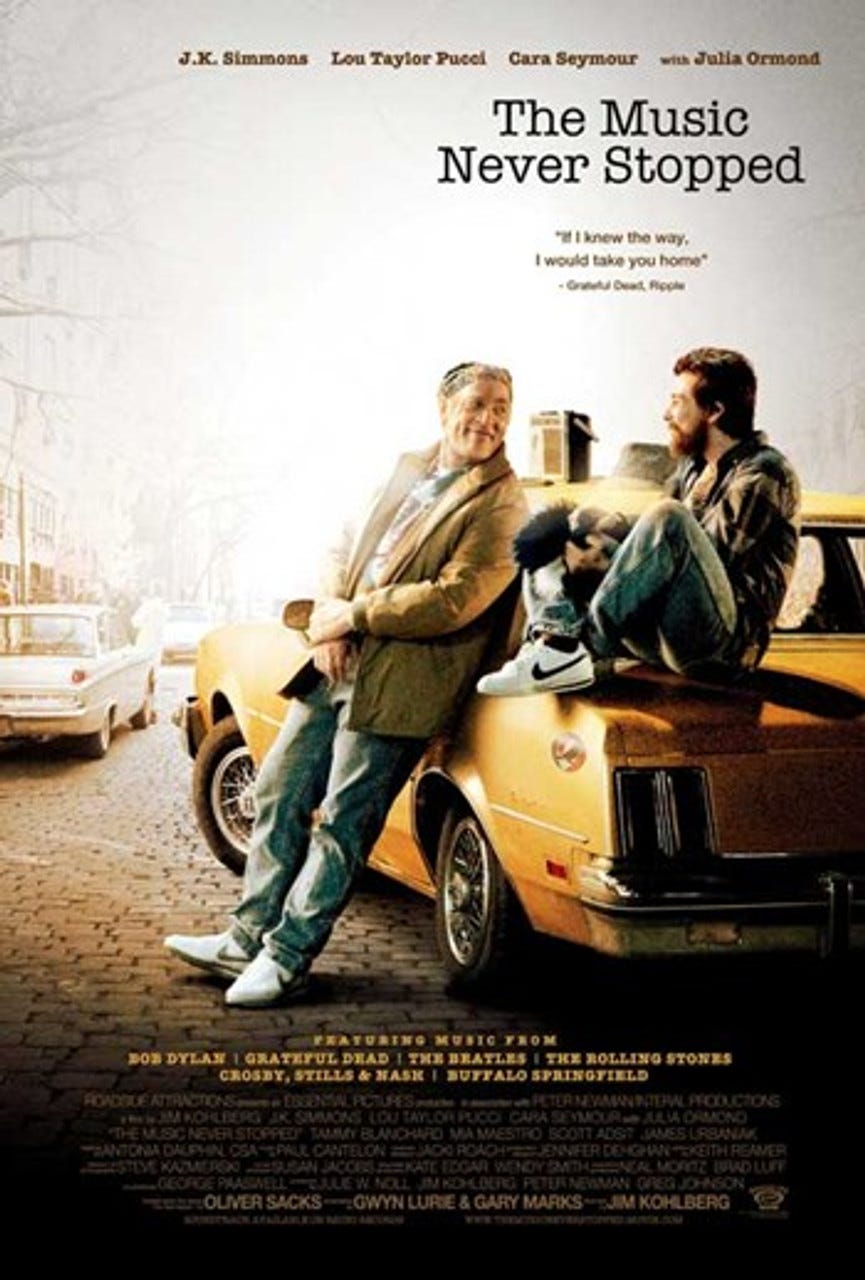
The 2011 movie The Music Never Stopped follows the story of a young man and his father building, losing, and recovering their relationship. Gabriel, the young man, has become a homeless, deadhead drifter. His square father, Henry, is an out-of-work engineer. They reunite at a rehabilitation hospital after a brain tumor robs Gabriel of most of his memory. A music therapist there finds that the psychedelic music of Gabriel’s youth, especially the Grateful Dead tunes that Henry hated, help Gabriel begin to remember who he is. In the climactic scene, the pair cement their new bond at a Dead concert, and Gabriel begins the long journey of recovering some of his memory.
Given the title and the tunes, I took Nathan to see The Music Never Stopped the summer it came out. (As I write this, I have the distinct memory – see what I did there? – of watching the film at the old Great Hills 8 Cinema, probably the only time I ever went there.) The music, of course, was excellent. The plot pretty schmaltzy. My only real complaint is that the breakthrough song for Gabriel and Henry at the concert is not one of the Dead’s classic tunes from the 60s and 70s. Instead, it’s “Touch of Grey” from 1987, the only Top 10 hit in the band’s 30-year recording history and probably their pop-est release. I guess the song’s bittersweet lyrics propel the film’s narrative better than, say, “Uncle John’s Band” or “Sugar Magnolia.” Both of them, and a few others, do get some airtime. Oh well, a touch of grey kind of suits us anyway.
The movie is based on “The Last Hippie” by Oliver Sacks, MD, an essay published in his amazing book An Anthropologist on Mars. About 20 years before the movie came out, Sacks testified before a U.S. Senate committee on music’s surprising power to help patients with neurological deficits. “Music for [patients with Alzheimer’s disease] can have an almost magical power by eliciting memories and associations and restoring to them the moods, the memories, the fluency, and the feeling of their former selves and their former lives,” he said.
I’d forgotten (there I go again) about the movie until I read about the power of music therapy in the latest issue of (gotta admit it) AARP – The Magazine. The article tracks some of the scientific research on music therapy and dementia. It reports on studies that document how patients with Alzheimer’s disease can regain some critical cognitive abilities by listening regularly to what the author calls “autobiographical music.” Those are the sounds of our teens and early 20s, the playlists for those music-infested years when we abandoned childhood and grew into adults.
To give my family a guide to what they should play for me when (I honestly don’t think it’s “if”) I’ve become lost in dementia, here’s a list of the albums I wore out during those critical years. There are many, many more from that era; but if these don’t work, I don’t think anything else will. In the 40 years since, I really haven’t added much to my autobiographical music. In somewhat chronological order:
The Beatles’ Let it Be,
The Allman Brothers’ Live at the Filmore East,
Bob Marley’s Catch a Fire,
The Dead’s Europe ’72 and the A side of Blues for Allah,
Jackson Browne’s For Everyman
Bob Dylan’s Blood on the Tracks, and
Warren Zevon’s Excitable Boy.
What’s on your dementia-fighting list? Put it in the comments, and share with those who will be cleaning up after you when the time comes.
As for me, it’s comforting to think that my memories of Elizabeth Reed will keep me coherent and connected when things start slip, slidin’ away.
Comments
Nothing yet. Say the first thing.
Sign in to join the conversation.