
It seems I start too many Substack posts with “Sorry, it’s been too long.” But yes, it has. It’s been a busy time with my novel, That Pinson Girl, as I continue to do the fun things: book events and visiting with book clubs and watching TPG find her spot in the world, including a forthcoming audio book—yay! But something interesting happened last night that I want to share with you, or at least with those of you who may be wrestling with revision. We might call this post a little “craft essay,” if you will, but it’s a lesson for me to remember as much as it is to pass on to you.
I’m working on another novel. The story takes place in Mississippi during the waning years of the Vietnam War, which means it must involve the civil rights struggles that were still happening in the late sixties. There’s a young woman at the heart of this story who, much like Leona Pinson in That Pinson Girl, confronts circumstances in her life she would rather change, but change seems mostly out of her reach. So I have to ask myself: what will shape this character—her name is Lydia—into one who meets the challenges of her life in active ways that will invite readers to go “Oh!” in recognition?
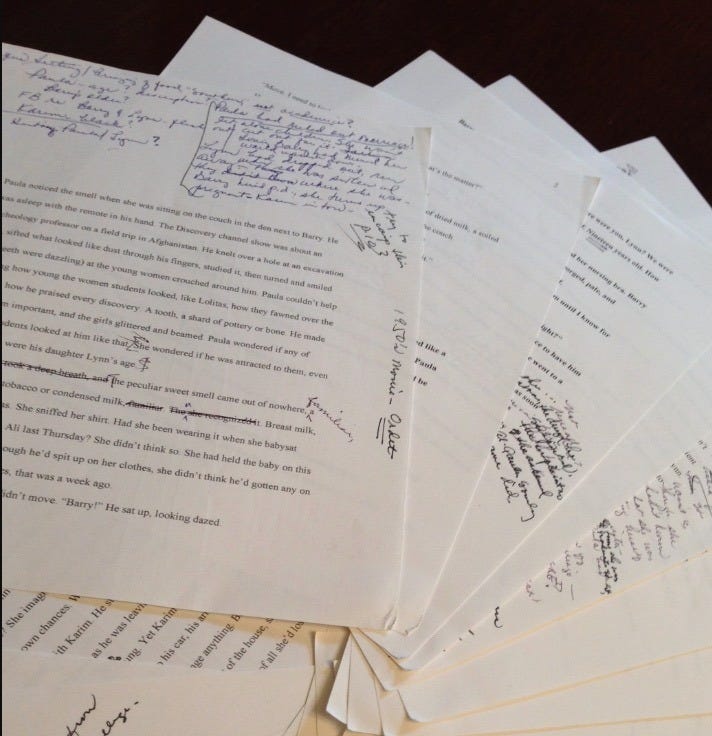
Last night, I was struggling to find a way to develop the last quarter of the book so that it resolves the main character’s issues and ends in a more satisfying way. (That was not happening so far!) In the scene I was tackling to revise, one that comes late in the book, the main character, Lydia, and her friend, Suzanne, are in the midst of a hard conversation. Suzanne’s husband, who works for the Department of Justice handling civil rights cases, has been beaten nearly to death. The two women are sitting in an ICU waiting room where Suzanne awaits updates on her husband’s dire condition.
Their conversation took on unexpected, new life when their dialogue seemed to flow through my fingers on the keyboard, as though I were eavesdropping. (Or maybe I became a medium?!) Their exchange played out in ways I hadn’t anticipated. Lydia’s response to her friend’s anguish opened a door—thank you, Andre Dubus III, for showing me how to “open doors” in a fiction workshop some years ago—for Lydia to act on her convictions in ways I had not yet imagined. Finding that strength may pave the way to a stronger ending.
I mostly avoid presenting writing fiction as some sort of other-world experience, as though the story somehow magically “flows” through me. Creating story is generally hard work with lots of trial and error. But very rarely, I have this kind of experience, where the characters take over and gift me some element of the story. Granted, this eureka did not come fully formed! It’s up to me to make the idea work going forward. But the block that had kept me from seeing what would enliven this character through to the end seems to be gone. (We shall see!)
So I suppose my message to you and to myself is this: as authors who face the blank page and its dilemmas over and over again, we have to keep looking for clues, for doors to open that we may not have noticed before. When we “see” the story or some part of it differently—or when the characters tell us what to do—it is indeed a gift. We take the gift with much gratitude and renewed energy to press forward.
No posts
Comments
Nothing yet. Say the first thing.
Sign in to join the conversation.