
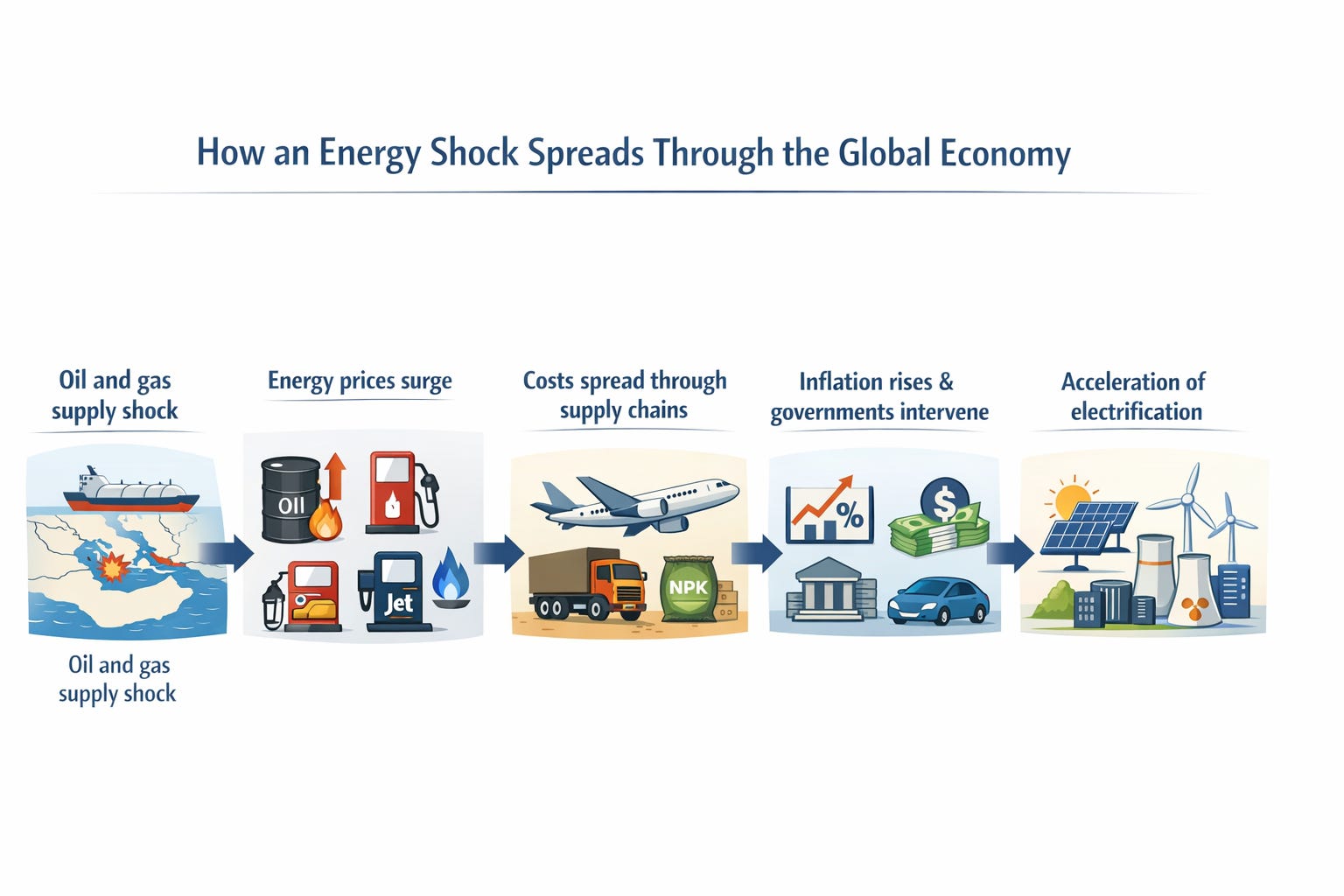
The most important consequence of the ongoing crisis in the Gulf will most likely not be the military headlines but the economic shock that follows as rising energy prices spread across the global economy. Oil and gas sit are the basis of modern industry and when their prices rise the impact quickly moves far beyond the energy sector itself. Chemicals, fertilisers, plastics, transport and manufacturing all depend heavily on hydrocarbons as fuels or feedstocks and as those input costs rise they are gradually passed through the entire system. The longer the crisis persists the greater these impact become because higher energy costs accumulate across supply chains, the result of which is rising inflation, slowing economic growth, economic pain and social unrest. History tells us that when energy shocks reach this scale governments do not sit still. After the oil crises of the 1970s countries such as France responded with massive structural programmes to rebuild their energy systems, and if this crisis continues governments around the world will have little choice but to react in a similar way, only this time the transformation will take place across the globe and will involve electrification, renewables and the digitalisation of power systems across the global economy.
Today, much of the media discussion focuses on petrol/gasoline prices but that only tells part of the story. Probably the more important transmission mechanism into the real economy is diesel which powers trucks and global logistics, as well as agricultural and construction equipment. When diesel prices rise the cost of moving goods increases and that quickly feeds into the price of food, manufactured goods and consumer products. Jet fuel is another channel through which the shock spreads. Higher jet fuel prices push up the cost of air freight which affects high value goods transported by air while also making passenger travel more expensive which in turn affects tourism and business travel. Diesel and jet fuel prices have roughly doubled in recent weeks which means the inflationary potential of the shock is extremely high if the conflict continues.
The price shock is also not limited to oil markets. It is also spreading rapidly through global gas markets and for Europe and Asia that may prove just as important. Roughly a fifth of global LNG trade normally passes through the Strait of Hormuz and Qatar remains one of the cornerstone suppliers to the world market which means any disruption tightens global gas balances almost immediately. Europe may no longer depend on Russian pipeline gas the way it once did but that has made it more exposed to global LNG prices and as the conflict has escalated gas prices have jumped sharply and European gas prices are now 6 times higher than the US Henry Hub price. These high gas prices in turn impact power prices particularly in gas dependent countries like Italy which saw average power prices in March twice that of the same period last year.
Energy shocks also ripple into agriculture beyond higher diesel prices because natural gas and hydrocarbon liquids are key inputs in the production of fertilisers, noting that the Gulf region is a major exporter which means disruption in the Strait of Hormuz quickly feeds into fertiliser prices which in turn leads to higher food prices. Petrochemicals extend the impact further because plastics, packaging materials, synthetic fibres and countless industrial materials originate from oil and gas feedstocks. Then there is a whole range of other industrial raw materials tied to the hydrocarbon system, from helium to sulphur and other gases that are produced alongside oil and natural gas and are essential inputs for industries ranging from electronics to chemicals and healthcare.
What this means is that what begins as an energy shock can become an agricultural and industrial shock which in turns pushes up inflation across the globe. For central banks this creates a real dilemma. Their primary mandate is to maintain price stability and when energy prices rise inflation usually follows which forces policymakers to tighten monetary policy by raising interest rates. At the same time governments rarely sit still when energy bills surge. Political pressure almost always leads to subsidies, tax reductions or price caps designed to shield households and industry from the worst of the shock. During the European gas crisis in 2022 governments spent hundreds of billions of euros protecting consumers. These measures soften the immediate blow but they transfer the burden to public finances and increase government borrowing just as inflationary pressures are building. The result can be a dangerous combination of weak or even negative growth and persistent inflation.
Behind all of this lies a deeper structural issue which is the geography of the fossil fuel system itself. Oil and gas reserves are concentrated in relatively few regions and those fuels must travel long distances through pipelines and shipping lanes before reaching consumers. That means the system inevitably depends on narrow passages and strategic chokepoints such as the Strait of Hormuz, as well as the Suez Canal and the Strait of Malacca, but also on pipeline systems such as Nord Stream 1 and 2 which Europe discovered can be just as vulnerable to disruption, sabotage and geopolitics. For decades policymakers assumed that this infrastructure was secure and that the risks around it were relatively small, but recent events have shown how wrong this assumption was.
This is also why the deeper consequence of the current crisis may not be the short term price spike but the longer term acceleration away from fossil fuels. Countries that depend heavily on imported fuels are reminded with every crisis that their economies remain exposed to geopolitical shocks. The alternative is domestically generated electricity from local resources such as solar, wind, hydro and nuclear. Once this infrastructure is built it can provide energy for decades with minimal dependence on fuel imports. At the same time the world is electrifying faster than ever as electric vehicles replace combustion engines, heat pumps replace gas boilers and new electricity demand emerges from AI, data centres and the wider digitalisation of the economy. In other words we no longer have the option of electrifying less. The real question now is how quickly countries can build the power systems needed for life in the 21st century.
No posts
Comments
Nothing yet. Say the first thing.
Sign in to join the conversation.