
When the Strait of Hormuz slammed shut after the United States and Israel struck Iran on February 28, almost everyone wanted to know the same thing: what happens to gas prices? Wrong question. The gas pump was the smallest part of this story.
What that closure really did was expose how much of the world squeezes through one narrow channel — and how many industries, on how many continents, sit downstream of it. I spent my early years in the oil business living and working in Asia, the Middle East, and Alaska, so I figured I knew. Even I was struck by the full list of what moves through the Persian Gulf.
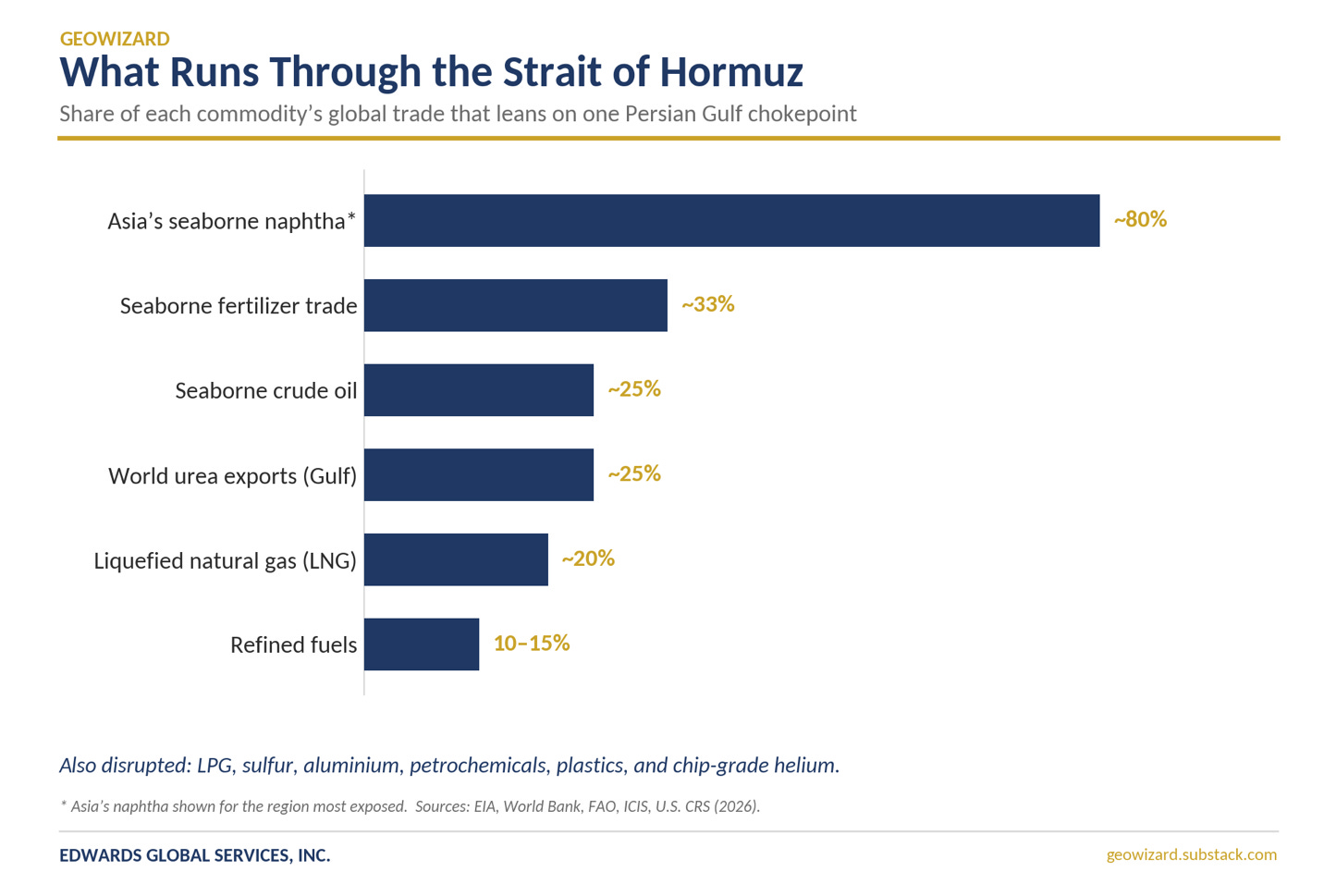
The Strait of Hormuz carries roughly a quarter of the world’s seaborne oil and a fifth of its liquefied natural gas. But it’s also the artery for about a third of all seaborne fertilizer. The Gulf supplies around a quarter of the world’s urea, and when Iran halted ammonia production and Qatar suspended urea, ammonia, and sulfur, prices roughly doubled. Urea topped $850 a ton, and the World Bank now sees fertilizer up about 31 percent this year. Some 80 percent of Asia’s seaborne naphtha — the feedstock for plastics and synthetic textiles — comes from the region, and Asian plastics makers have already declared force majeure. Add refined fuels, LPG, the aluminum that carmakers are now panic-buying, and the helium South Korea’s chipmakers buy from Qatar, and the bill doesn’t land only in crude. It lands in food, factories, and semiconductors.
I’m writing this on the morning of Monday, June 15, and the news has just turned. Over the weekend the United States and Iran announced a peace deal, with a formal signing set for Friday. President Trump declared the Strait of Hormuz open “toll free,” ordered the U.S. naval blockade lifted, and told the world’s ships to start their engines — “Let the oil flow!” Good news, and overdue. But a deal ends the shooting; it doesn’t un-ring the bell. The agreement isn’t even signed yet, the terms haven’t been released, and a waterway throttled for three and a half months doesn’t return to full flow the day a president says so. Physical supply won’t snap back overnight — and the deeper rethink this war set in motion won’t reverse at all.
Now here’s the part that will outlast the war. Every government and every boardroom staring at that list is asking the same question: how do we make sure one chokepoint can never do this to us again? The answer is a wholesale rethink of where things come from. Buyers will spread their suppliers and lock in long-term contracts with the dependable ones — American and allied LNG at the front of the line. They’ll friend-shore not just the mining but the processing and chemistry that turn raw material into finished product, toward countries willing to pay for redundancy. They’ll build stockpiles, add a second and third supplier to contracts that used to have one, and lean toward energy-secure regions, North America high among them kept at a safe distance from the Gulf by simple geography.
None of this happens overnight. A mine and its processing plant take seven to fifteen years to build; an LNG train, four to six. The next three to five years won’t be a finished realignment but a scramble toward one: costly, uneven, and paid for with a security premium. That window is plenty long enough for the decisions that matter: the contracts re-signed, the capital committed, the supply maps redrawn.
For those of us who help brands decide where to plant a flag in new countries, the lesson is blunt. The lean, single-source supply chain just showed everyone its hidden price tag, and resilience is the new organizing principle. The companies, and the countries, that read and react to the new sourcing map early, that figure out where energy, fertilizer, and inputs are actually going to come from, are the ones that will still be standing when the next chokepoint closes. And there’s always a next one.
Here’s what I’ve learned advising companies through shocks like this over the years: trade doesn’t break. It reroutes. The only question is whether you’ll be holding the new map or the old one — whether a country will have multiple sources of energy and commodities or still be dependent on a Persian Gulf that will most certainly be shut down again someday.
Want this kind of global-business analysis every Tuesday? Subscribe free at geowizard.substack.com.
William (Bill) Edwards is CEO of Edwards Global Services, Inc. that has been taking companies global since 2001. He can be reached at bedwards@edwardsglobal.com or +1 949 375 1896.
Sources
IEA — The Strait of Hormuz (oil and LNG transit shares; Asia destination). https://www.iea.org/about/oil-security-and-emergency-response/strait-of-hormuz
farmdoc daily, University of Illinois — Why Global Trade Dependency Turns a Localized Conflict into a Global Crisis (one-third of seaborne fertilizer). https://farmdocdaily.illinois.edu/2026/03/the-strait-of-hormuz-why-global-trade-dependency-turns-a-localized-conflict-into-a-global-crisis.html
World Bank — Commodity Markets Outlook, April 2026 (fertilizer +31%, urea +60%, energy +24%). https://www.worldbank.org/en/news/press-release/2026/04/28/commodity-markets-outlook-april-2026-press-release
World Bank — Fertilizer Prices Surge as Strait of Hormuz Disruptions Tighten Supplies (urea above $850/ton; Gulf ≈ a quarter of global urea). https://blogs.worldbank.org/en/opendata/fertilizer-prices-surge-as-strait-of-hormuz-disruptions-tighten-
World Bank — The Commodity Markets Outlook in Eight Charts (aluminum projected up ≈ 22% in 2026). https://blogs.worldbank.org/en/developmenttalk/the-commodity-markets-outlook-in-eight-charts3
ICIS, via IOM3 — Strait of Hormuz Closure Affects Chemicals and Plastics Exports (≈ 80% of Asia’s seaborne naphtha). https://www.iom3.org/resource/strait-of-hormuz-closure-affects-chemicals-and-plastics-exports.html
C&EN (American Chemical Society) — Hormuz Strait Pinch Worsens for Asian Chemical Makers (petrochemical force majeure). https://cen.acs.org/business/petrochemicals/Hormuz-Strait-pinch-worsens-Asian/104/web/2026/03
OilPrice.com — Oil Supply Shock Ripples Through Fertilizer, Plastics, and Tech (naphtha, ammonia, urea, helium). https://oilprice.com/Energy/Energy-General/Oil-Supply-Shock-Ripples-Through-Fertilizer-Plastics-and-Tech.html
U.S. Congressional Research Service — Iran Conflict and the Strait of Hormuz: Impacts on Oil, Gas, and Other Commodities, 2026. https://www.congress.gov/crs-product/R45281
UK House of Commons Library — Israel/US-Iran Conflict 2026: Reopening the Strait of Hormuz, June 2026 (conditional ceasefire; Iran toll/permission system; reduced shipping). https://commonslibrary.parliament.uk/research-briefings/cbp-10636/
Food and Agriculture Organization (FAO) — Global Agrifood Implications of the 2026 Conflict in the Middle East, 2026.
Credendo — Global Supply Chains in Chaos After One Month of Conflict in the Middle East, April 2026.
Sidley Austin — Iran, the Strait of Hormuz, and the Distress Risks Ahead, April 2026.
Brent crude price data via Trading Economics and CNBC, June 2026.
NBC News — Deal reached between the United States and Iran, Trump says, June 14, 2026. https://www.nbcnews.com/news/us-news/deal-reached-united-states-iran-war-rcna350039
Comments
Nothing yet. Say the first thing.
Sign in to join the conversation.