
Welcome to the 163rd Edition of the Geowizard Biweekly Global Business Update – I start this issue off with an update on the draft deal to end the Iran War and its implications for global businesspeople from several believable sources. Some ships are transiting into and out of the Straits of Hormuz but not many yet. Of course, by the time you read this the situation may have changed again!
From there we widen the lens. Inside you’ll find the global scramble for data centers and compute power, SpaceX’s record-shattering IPO, McKinsey on planning for a world where black swans and gray rhinos now travel in herds, and a redrawn map of the world’s richest nations (Ireland up, Japan down). On commodities and trade, the Wall Street Journal and the IMF ask the same question from different angles: why hasn’t the war shock done more damage….yet?
This edition has country reports from Asia, Brazil, China, Europe, India, Indonesia, Poland, the U.S., and Vietnam. Including Poland landing its largest foreign investment ever. The franchise pages track Pizza Hut’s $2.7 billion sale, Starbucks reshaping Japan and India, McDonald’s crowned America’s favorite, and brands still betting on China. And global franchising is entering a period in which demographic forces can no longer be treated as background context.
My book pick for this edition is Ker Gibbs’s The Fragile Dragon, which argues China is neither ten feet tall nor collapsing, a useful corrective for anyone calibrating strategy.
Plenty to chew on. Let’s dig in.
Full subscribers have access to all the content listed above……...and more.
The mission of this newsletter, started in March 2020 during the COVID business slowdown, is to use trusted global and regional information sources plus our network of in-country Associates to update our subscribers on key global and local trends that can impact the success of their businesses at home and abroad. We do not get involved with or report on politics!
This newsletter has been assembled, edited and curated by William (Bill) Edwards who has more than five decades of experience helping companies enter and scale in international markets. He has guided over 50 brands across multiple sectors into more than 35 countries. Bill’s experience includes living and working in 7 countries, and leading projects across more than 50 countries worldwide. Contact Bill with questions, comments and contributions. Bedwards@edwardsglobal.com, +1 949 375 1896.
First, A Few Words of Wisdom From Others For These Times
“It’s good for America when the rest of the world grows, because you can sell more to the rest of the world.”, Jamie Dimon, Chairman and CEO, JPMorgan Chase
“Should you find yourself in a chronically leaking boat, energy devoted to changing vessels is likely to be more productive than energy devoted to patching leaks.”, Warren Buffett, Past Chairman and CEO, Berkshire Hathaway
“Seek purpose – happiness will follow. Purpose gives life depth; happiness tends to show up along the way when you’re living intentionally. Chasing happiness alone is slippery; it prefers to be surprised.)”, Judge Jim Gray
Interesting Data, Articles and Studies
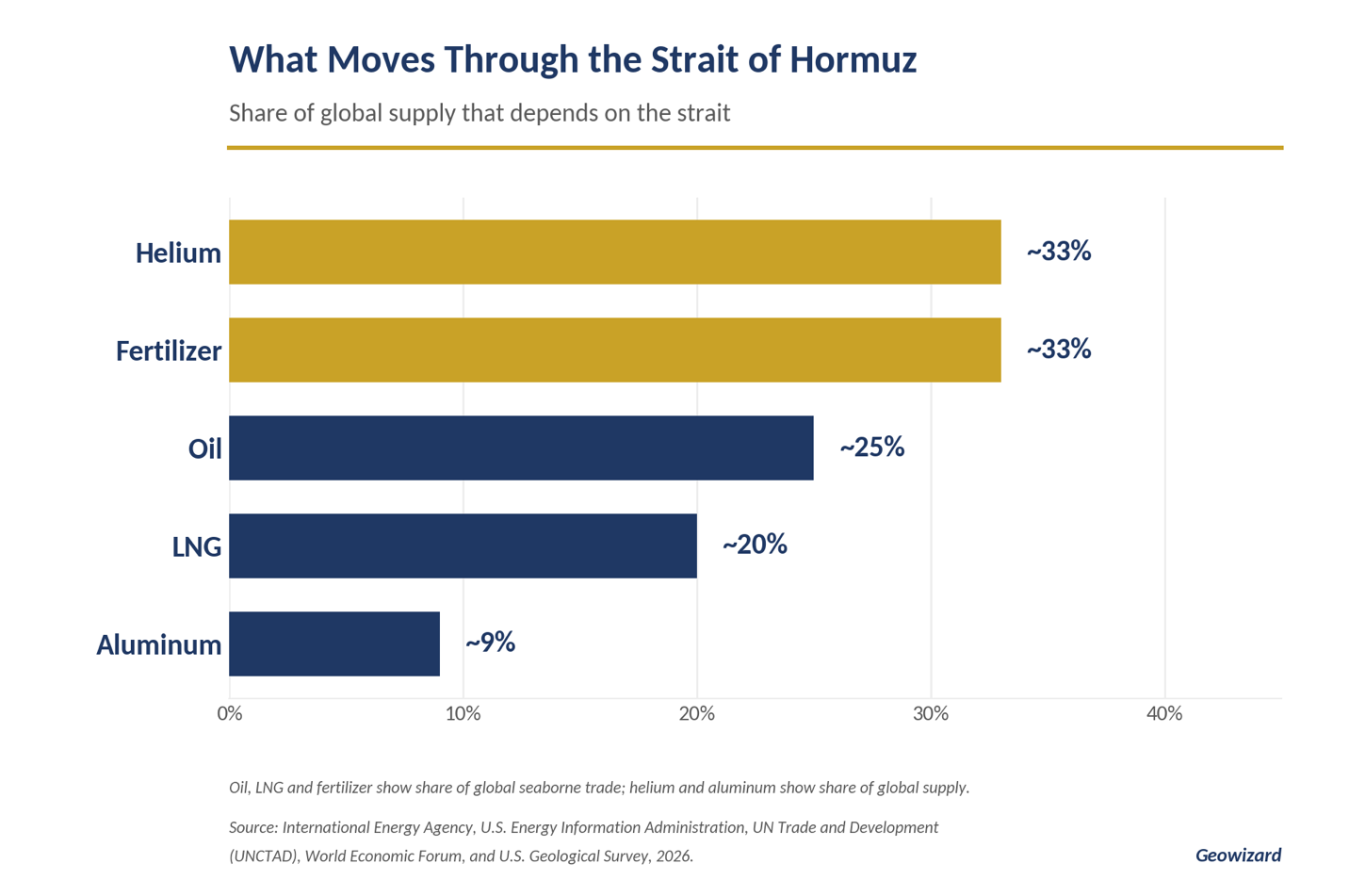
Editors’ Note: Iran War Ceasefire: Where Things Stand As of June 22nd AM - The Iran ceasefire has moved from battlefield to paperwork. But a signed framework and a functioning peace are not the same thing. The Strait of Hormuz carries an outsized share of the world’s commodities, so the next 60 days carry real consequences for anyone in energy, agriculture, shipping, or manufacturing. Here’s where things stand.
On June 17, President Trump and Iranian President Masoud Pezeshkian signed the Islamabad Memorandum, a 14-point framework ending military strikes, reopening Hormuz toll-free for 60 days, and lifting the U.S. naval blockade with a 60-day window to negotiate final terms.
On June 18, CENTCOM removed the blockade of Iranian ports. The deal also waives, but does not eliminate, sanctions on Iran’s oil exports, returning Iranian crude to world markets.
Commodities at stake: roughly a quarter of global seaborne oil and a fifth of LNG move through Hormuz, plus about one-third of seaborne fertilizer trade, including more than 30% of urea. The strait also carries significant aluminum, helium, and sulfur with knock-on risk to food and manufacturing prices.
Over the weekend of June 20-21 US and Iranian negotiators met face to face for the first time in Europe to start the 60 day discussions.
The deal is fragile. On June 20, Iran closed Hormuz again three days after reopening citing Israel’s strikes in Lebanon as a breach.
The bottom line for global business: Treat the next 60 days as a planning window, not a resolution. Hormuz remains the swing variable, and on-again/off-again closures will keep tanker rates, war-risk insurance, energy, and fertilizer prices volatile regardless of what’s signed. If you source, ship, or sell anything touching the Gulf, keep contingency routing and forward-cover live. And because the hardest issues such as nuclear, missiles, frozen assets were deferred, one bad day on the Lebanon track can shut the strait within hours.
Sources: International Energy Agency; U.S. Energy Information Administration; UN Trade and Development (UNCTAD); U.S. Congressional Research Service; U.S. Central Command; The Washington Times.
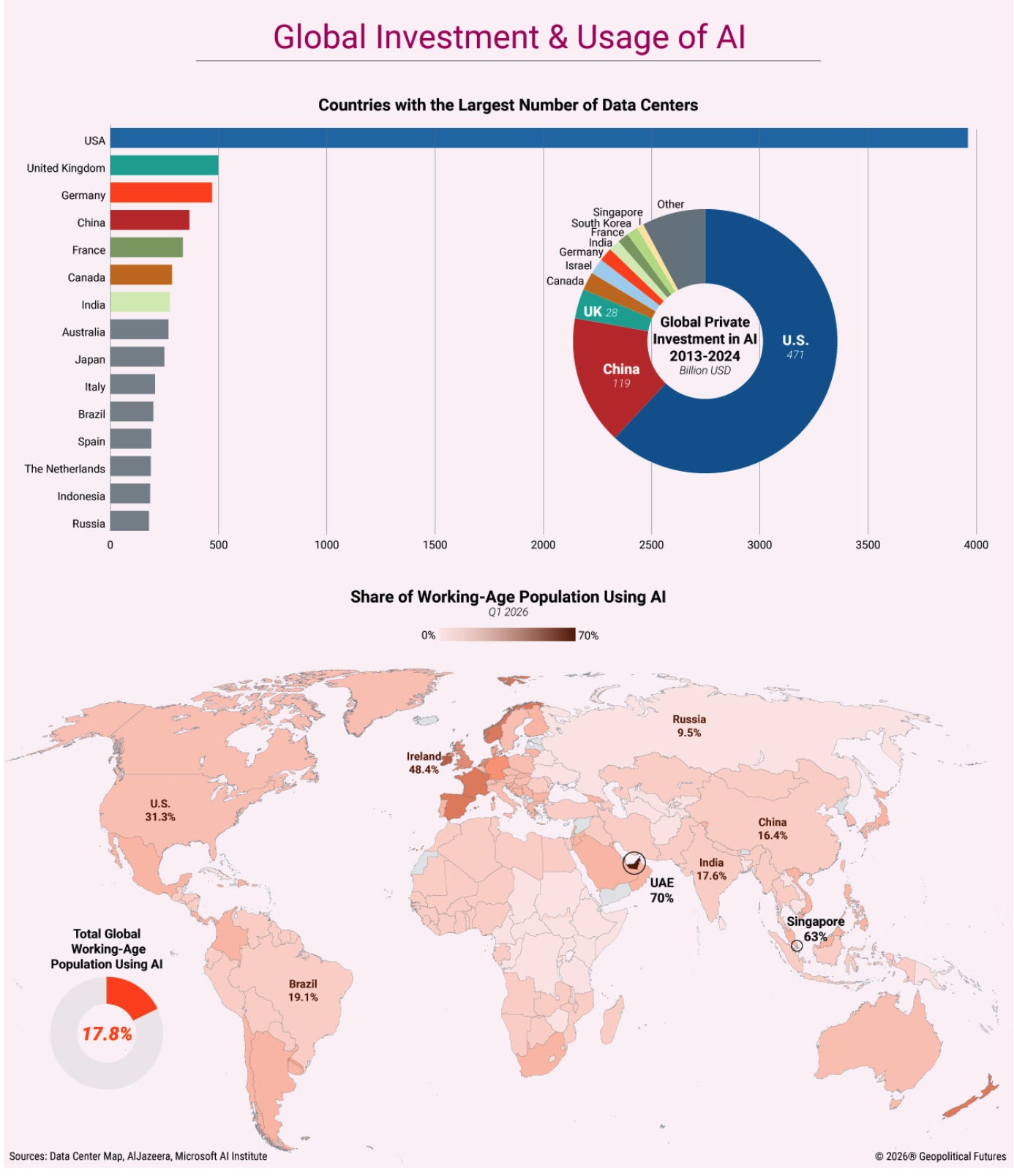
“The Great Data Center Race - Access to compute, power and digital infrastructure is critical in the AI era. The United States remains the dominant force, leveraging its AI firms, cloud providers and capital markets to build infrastructure at unprecedented scale, while China is mobilizing state resources to expand domestic compute capacity and reduce dependence on foreign technology. Europe is investing in data centers and AI “gigafactories” to strengthen digital sovereignty, while Canada, Australia and the Nordic region are attracting investment through abundant energy resources and favorable operating conditions. Japan is integrating data center expansion with broader semiconductor and technology initiatives, India is emerging as one of the world’s fastest-growing data center markets due to rapid digitization and a vast domestic consumer base, and Brazil is positioning itself as Latin America’s leading digital infrastructure hub. Russia, meanwhile, is focused on building domestic capacity to support technological autonomy despite constraints imposed by sanctions and limited access to advanced technologies.”, Geopolitical Futures, June 12, 2026
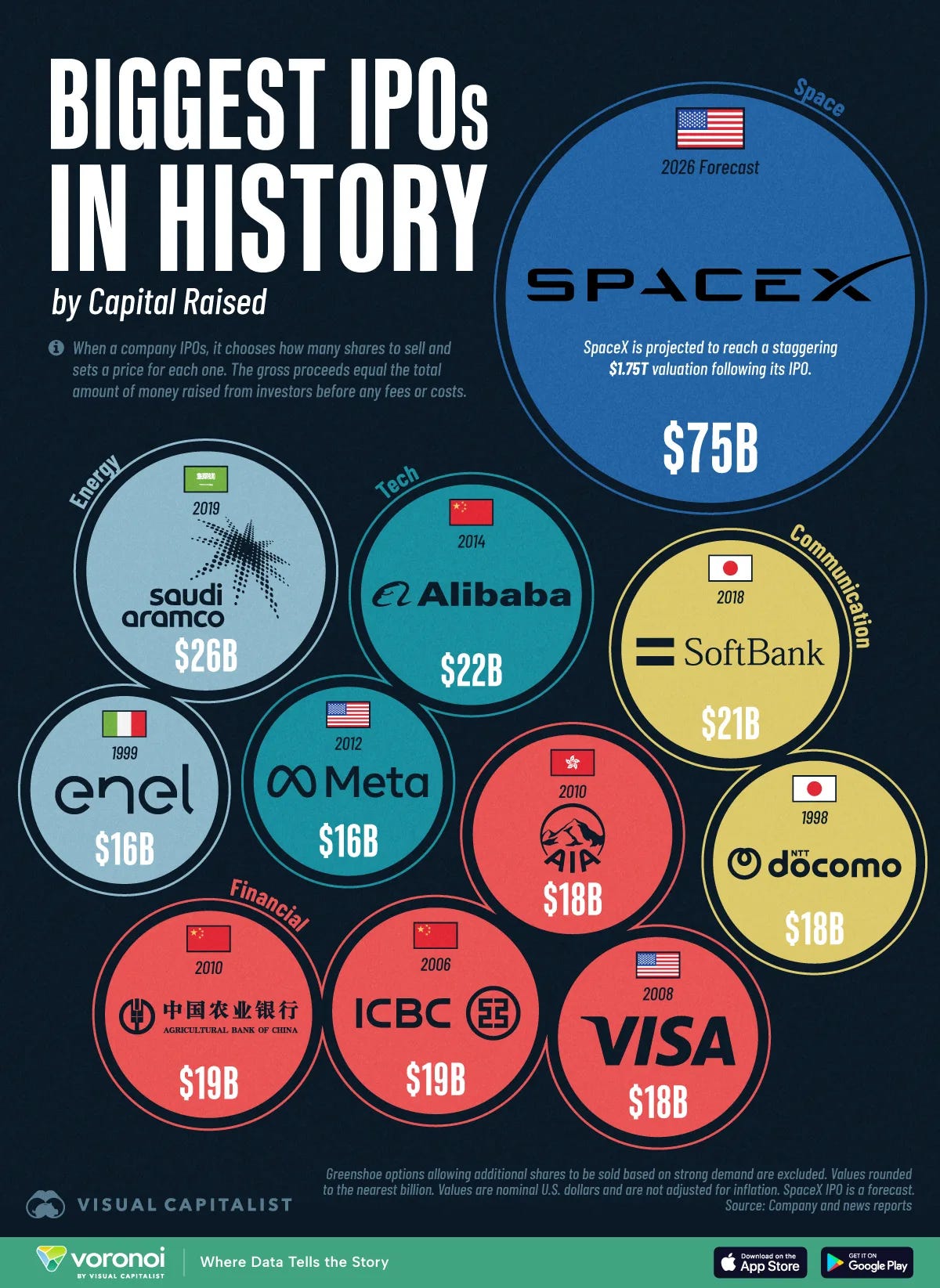
“The Biggest IPOs in History—and Where SpaceX Fits In - SpaceX expected to raise $75 billion in its June 2026 IPO, nearly three times more than any company in history. Saudi Aramco currently holds the IPO record after raising $25.6 billion in 2019. China, Japan, Saudi Arabia, and the U.S. account for many of the world’s largest public offerings. This graphic ranks the biggest IPOs in history as of 2026 using corporate disclosures and news reports, based on gross proceeds raised before fees and expenses. Values are rounded to the nearest billion dollars, exclude greenshoe options, and are not adjusted for inflation.”, Visual Capitalist, June 12, 2026
Editor’s Note: On Thursday, June 18th shares of SpaceX closed at US$185 per share putting Elon Musk’s rocket company within reach of Amazon’s market capitalization.
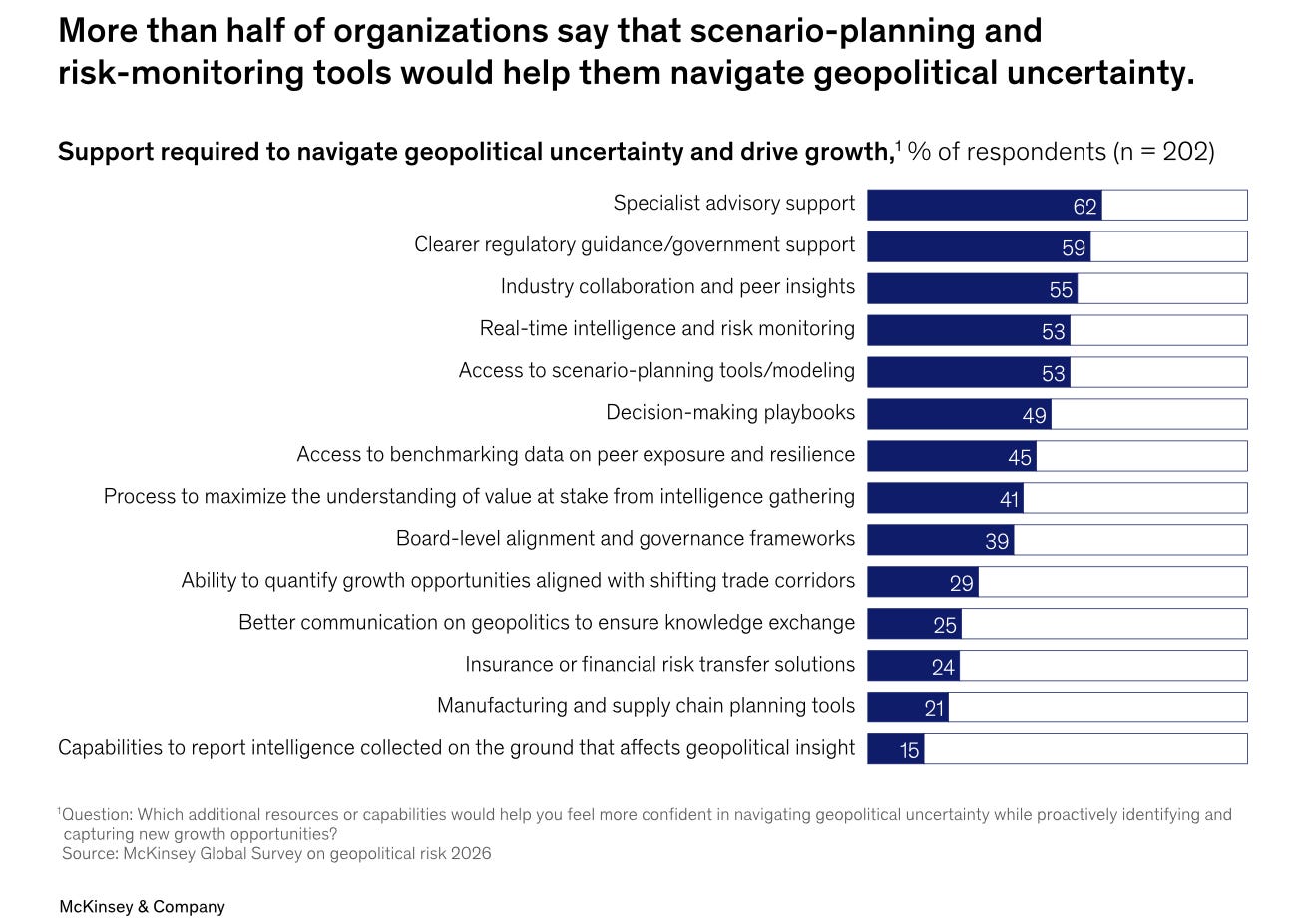
“The art, science, and technology of geopolitical scenario planning - Strategic foresight is not about predicting the future but setting strategy and building capabilities to navigate multiple potential futures. Large companies and governments have long monitored flashpoints and modeled scenarios to anticipate and prepare for disruptions. Yet some of the defining shocks of this century - from the COVID-19 pandemic to Russia’s invasion of Ukraine to the biggest global energy crisis in history, caused by the conflict in Iran - have caught many off guard and left them unprepared to react. Moreover, the scope and velocity of such disruptions seem to be on the rise. While “black swans” (unpredictable events with high impact)2 and “gray rhinos” (probable events with high impact)3 used to occur sporadically, today several alight or stampede simultaneously. In a recent McKinsey survey,4 fewer than one-third of respondents deem their organizations’ management of geopolitical risk ‘mature.’”, McKinsey & Co., June 10, 2026
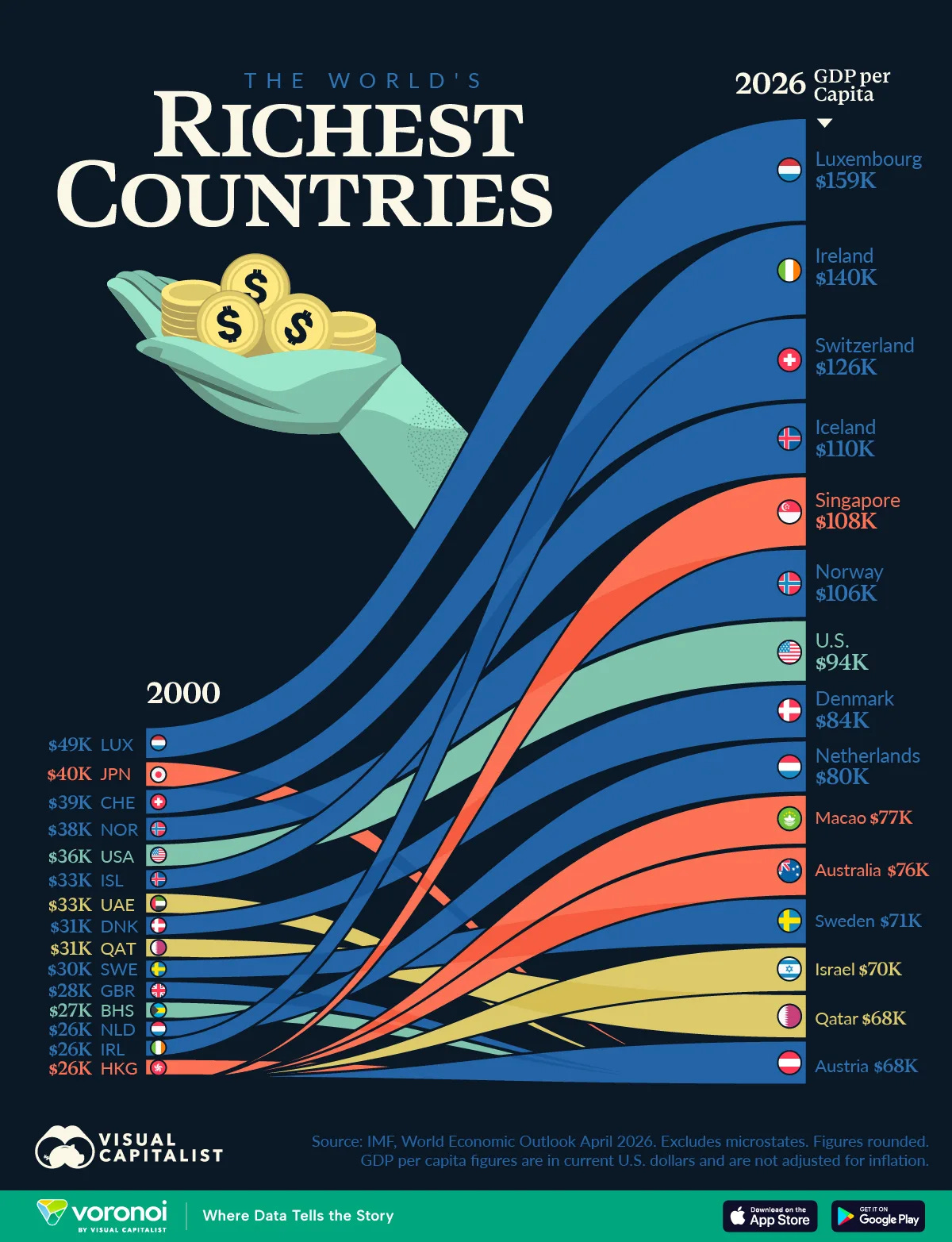
“The World’s Richest Countries by GDP Per Capita - Ireland rose from 14th to 2nd place since 2000, with GDP per capita climbing above $140,000. Japan fell from #2 to #39, marking one of the sharpest declines among advanced economies. Nine of the world’s 15 richest countries in 2026 are located in Europe. The world’s richest countries look very different than they did 25 years ago. Ireland has climbed from 14th place to second, while Japan has fallen from #2 to #39 despite remaining the world’s fourth-largest economy. These shifts highlight how globalization, technology investment, demographics, and currency movements have reshaped economic prosperity over time. Figures are shown in current U.S. dollars and are not adjusted for inflation.”, Visual Capitalist & the International Monetary Fund, June 10, 2026.
Comments
Nothing yet. Say the first thing.
Sign in to join the conversation.