
So, this is the first in a series of four or five posts that will explore some similarities and some differences between the Ancestral Puebloan Culture in the Four Corners area (Colorado, New Mexico, Arizona and Utah) and the Native American Traditions in the Big Sioux Watershed in South Dakota, Iowa and Minnesota. Actually, we’ll be mainly looking at Colorado and New Mexico because of our recent family outing in that area and we’ll focus on the part of the watershed where Good Earth State Park and Blood Run National Historic Landmark are located.
We’re starting out with a look at Mesa Verde National Park because that was the first place that we visited on our four-day tour. It wasn’t the first time that we visited there, but the last time was probably about a half-century ago! Needless to say, things have changed…. A LOT! Yeah, there’s lots of added infrastructure and the excavation, interpretation, protection, stabilization, have all evolved over the past fifty years. But the biggest change seems to be a recognition that input from the descendants of the builders of the cliff dwellings is critically important. And, there’s a clear acknowledgement that those descendants are still living on the Land as contemporary tribal nations such as the Hopi and Zuni, as well as in modern day pueblos including Taos, Sandia, Acoma, and Laguna.
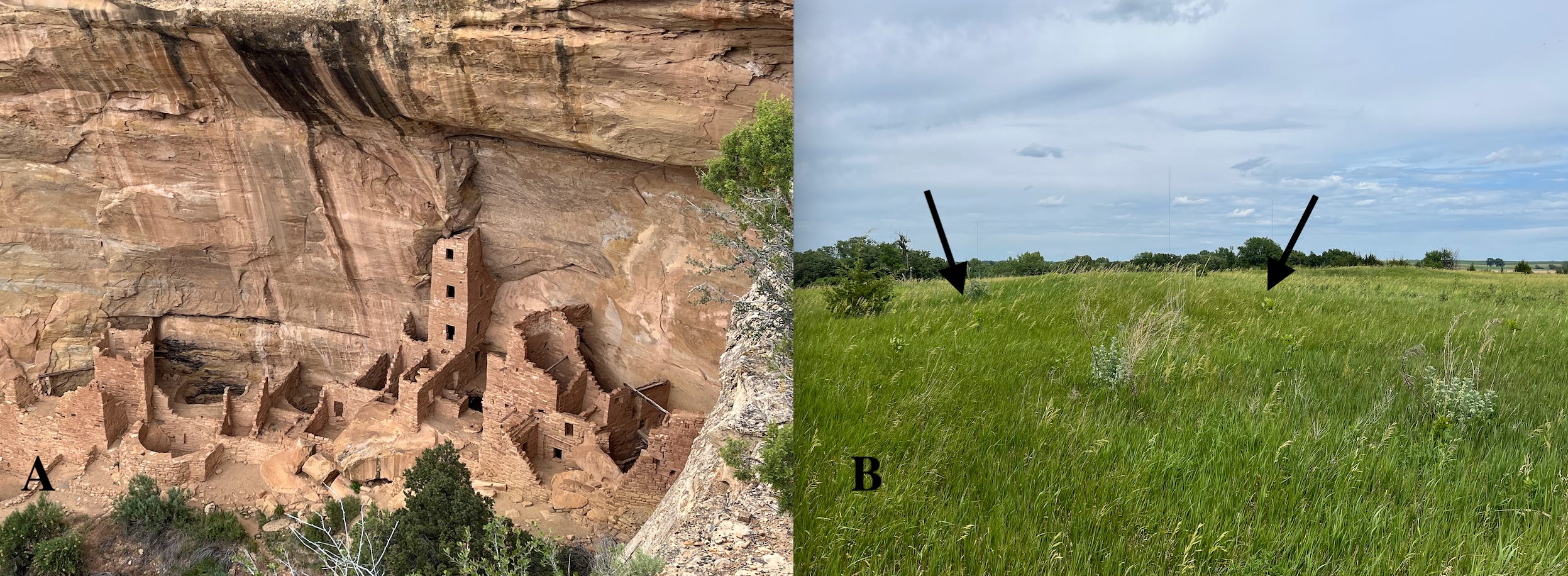
Figure 1----A) Square Tower House at Mesa Verde National Park. B) Earth mound at Blood Run National Historic Landmark located between the two black arrows and marked by sage and cedar.
There’s a dramatic difference between the structures built by the people in CO and NM and those in SD and IA. The cliff dwellings are imposing structures (Figure 1-A) that make it easy to recognize the engineering abilities of the native people. In contrast the mounds built in Blood Run (Figure 1-B) and the geoglyphs built in Good Earth are subtle features that probably have more significance than we commonly acknowledge.
Mesa Verde and Good Earth/Blood Run are both examples of multi-component archaeological sites or “Ancient Campsites” and there’s a broad overlap in their time spans. The Ancestral Puebloan Culture was active from about 500 to 1300 AD; the Square Tower House dates to 1200 AD to 1300 AD. The people of the Oneota Cultural tradition built the mounds at Blood Run from about 1500 to 1700; they were the ancestors of contemporary tribal nations now located in the same general region. The geoglyphs in Good Earth are much older and have been dated at 50 BC to 500 AD. So, the time spans aren’t exactly the same at 500 to 1300 AD and 50 BC to 1700 AD. But the more important take-away is that both ancient cultures have modern descendants still living in the area!
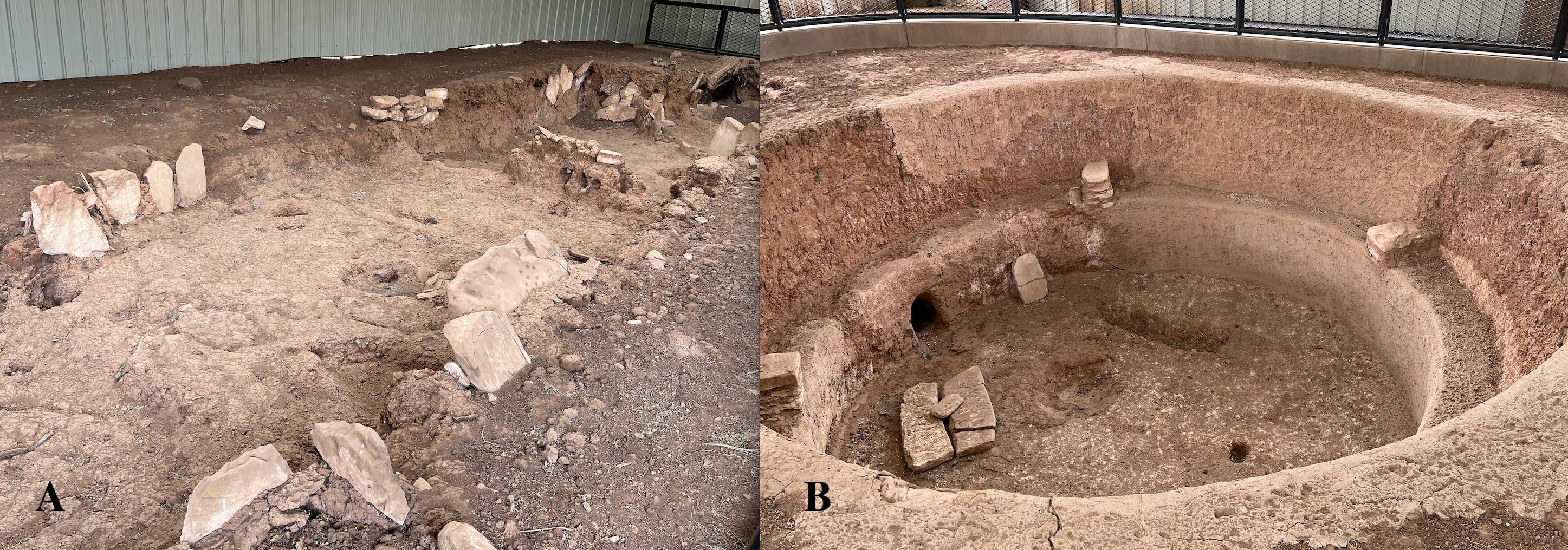
Figure 2----A) Excavated rectangular home built with vertical rock slabs. B) Excavated circular pit house with specific elements that would later be incorporated into ceremonial kivas.
The dwellings perched in the cliffs are impressive, but the highway along the mesa getting to them has a record of the deep roots that preceded their construction. In the 800s AD, houses were rectangular (Figure 2-A) but then evolved into circular pit houses (Figure 2-B) by the 900s AD. Construction methods also changed from using wood and vertical rock slabs to the stone masonry walls that were eventually used to build the cliff dwellings. And the circular pit dwellings evolved into the ceremonial “kivas” that are a hallmark of those later cliff dwellings.
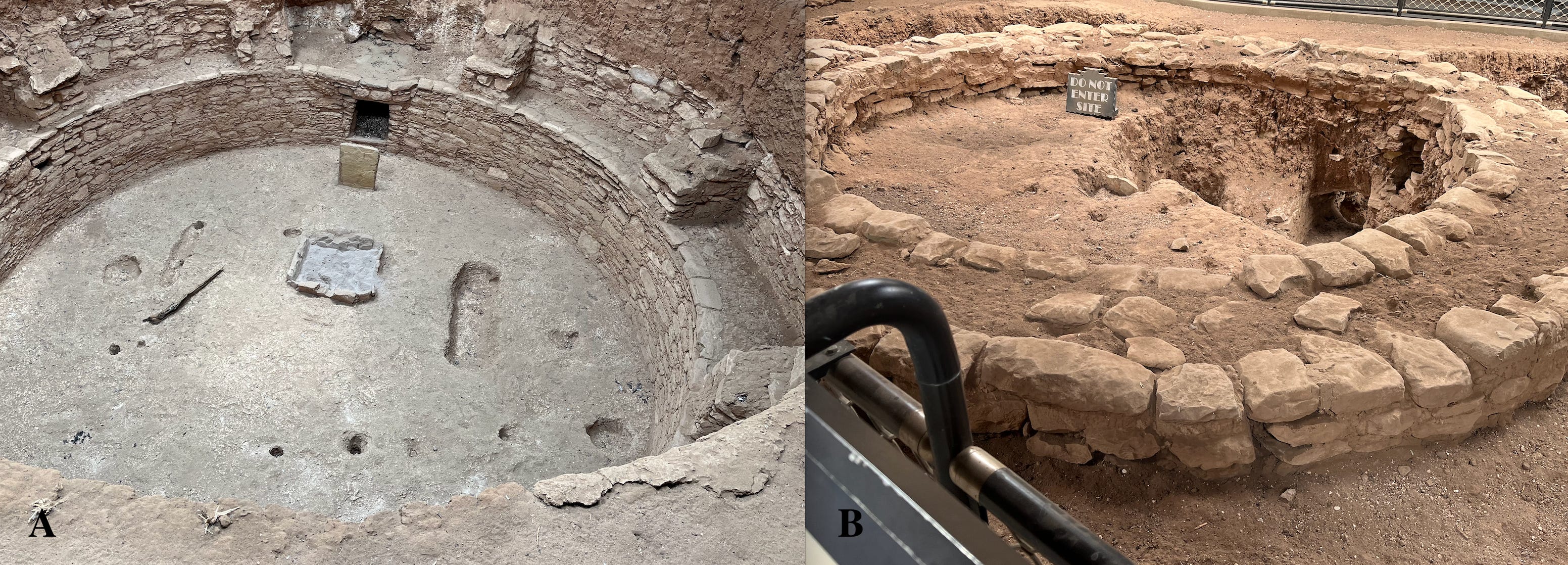
Figure 3----A) Excavated ancient ceremonial kiva similar to the contemporary kivas used today. B) Excavated foundation for a round tower.
By the mid 1000s the circular kivas were well established as ceremonial community spaces (Figure 3-A). One of the information markers quoted an Elder from a modern community: “The kiva and the surrounding plaza area are still the religious and sacred centers of Pueblo communities. The kivas people see at Mesa Verde are like the kivas that Pueblo people still use today for religious activities, social activities, and as gathering places for the community.”
The later cliff dwellings also had another distinctive architectural feature: towers. Towers may have been used for defense or astronomical observations, or line-of-sight communication. The foundation shown in Figure 3-B is for a circular tower but there were also square towers like the one shown in Figure 1-A. And there’s also another distinctive structure at Mesa Verde that ties the area to Chaco Canyon and other Ancestral Pueblo sites. The D-shaped Sun Temple is similar to other D-shaped buildings and incorporates alignments similar to those observed elsewhere.
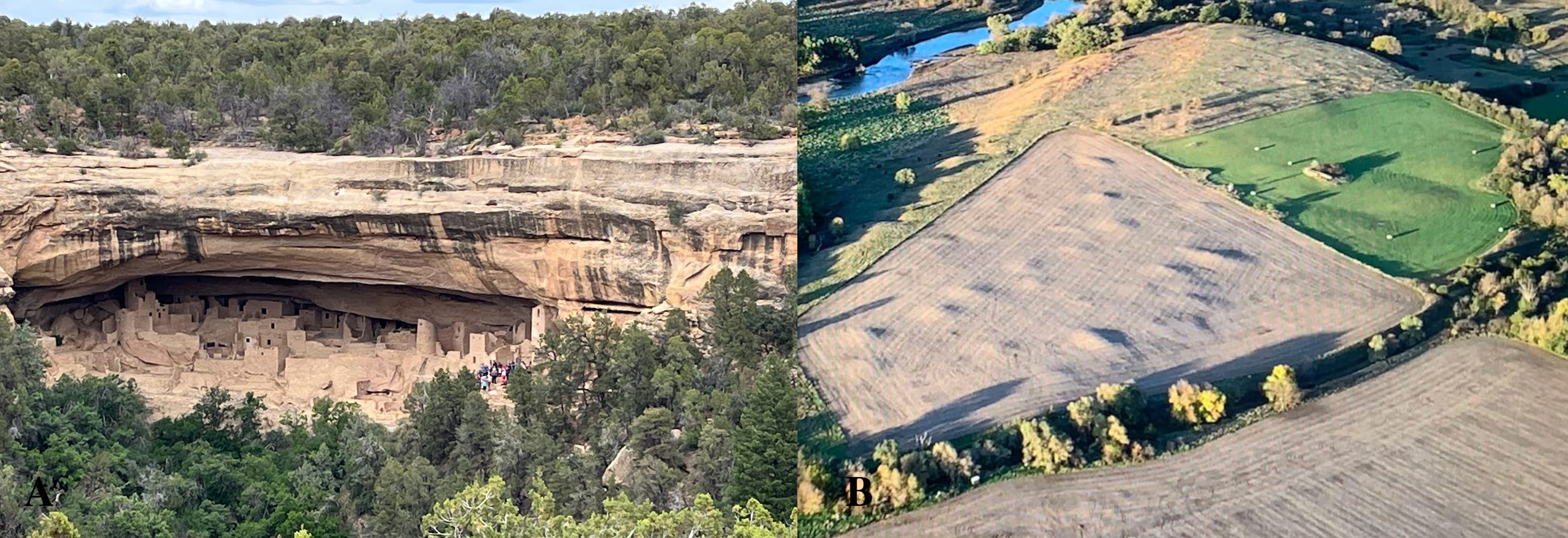
Figure 4----A) The Cliff Palace nestled in its sandstone alcove at Mesa Verde. B) View from the air of mounds in a plowed field at Blood Run. Photo taken by Jim Zangger.
The cliff dwelling shown in Figure 4-A includes both round and square towers that are clearly visible as well as a number of underground kivas that are not so conspicuous. There’s something else that sets this elaborate structure apart from the earth structures constructed at good Earth and Blood Run. The cliff dwelling has clearly-defined and well-enforced protection! Remember the pot hunters in the Indiana Jones movie that described how young Indy got his hat and whip?
Unfortunately, the situation is different at Blood Run. The majority of the main mound group is located in an agricultural field (Figure 4-B) that is tilled every year. It lies outside of the established boundary of the National Historic Landmark and is consequently unprotected from the annual erosion by human activities. Although there have been efforts to acquire that parcel of land over the past decade, it still is private property and the cultural treasures there are at risk.
This is an example of a classic institutional failure to respond to a clearly articulated need that the Land has. We need to do better than this. Even though the mounds are less dramatic than cliff dwellings, their cultural significance is well known. We have an obligation to the Omaha, Ponca, and Ioway Tribal Nations (the modern descendants of the Oneota Cultural tradition) to respect and protect this iconic archaeologic property.
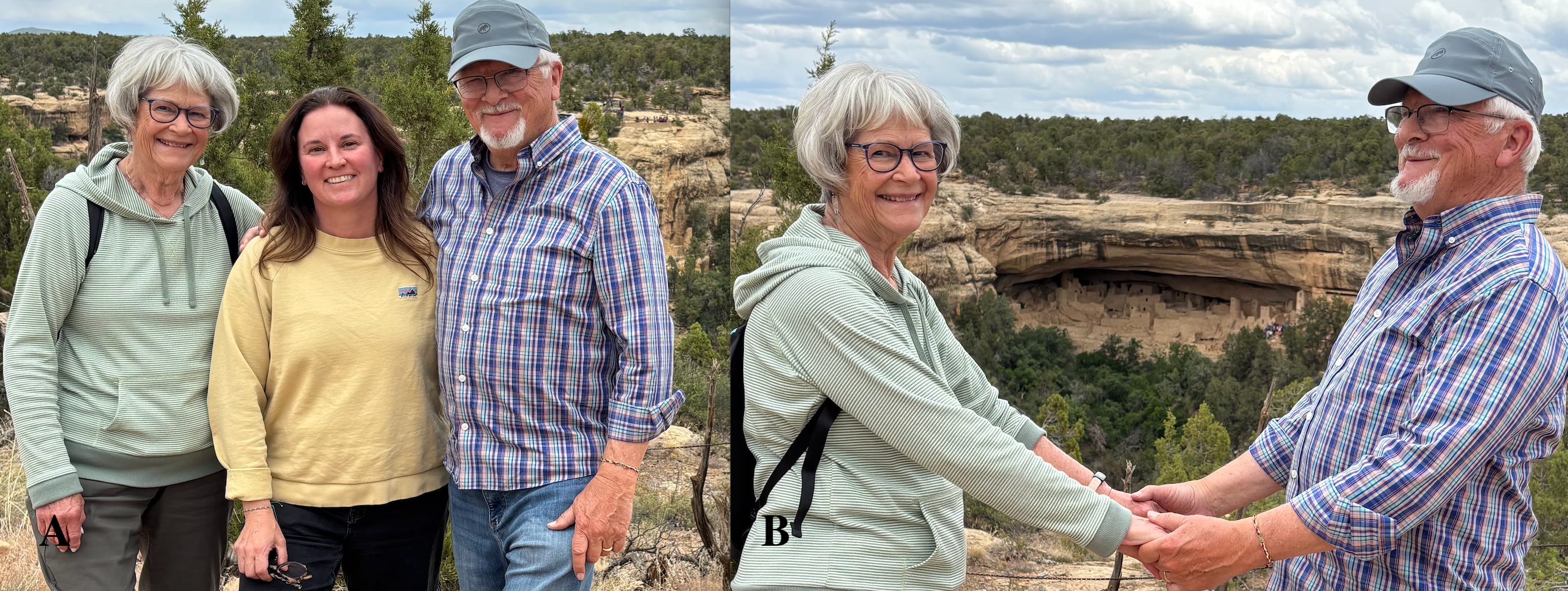
Figure 5---- A) Our exploration party at Mesa Verde. B) Two “kids” posing in front of the Cliff Palace.
Margaret and I had the help of Joelle Wistler in our visit to Mesa Verde (Figure 5-A). She drove us out to the park from Durango and then drove around the park while we concentrated on looking at the scenery. We’re very grateful to have her as our daughter-in-law.
However, Joelle was not responsible for setting up the “schmaltzy” pose in Figure 5-B! That would be Margaret’s forte! But I have to admit, it is a pretty cool picture. And the blue corn fry bread that we got at the end of our visit to Mesa Verde National Park was also pretty cool.
Our next stop will be at Aztec Ruins National Monument.
No posts
Comments
Nothing yet. Say the first thing.
Sign in to join the conversation.