
This piece of fiction is based in part on actual events. Seems like we just keep encountering our American Purgatory.
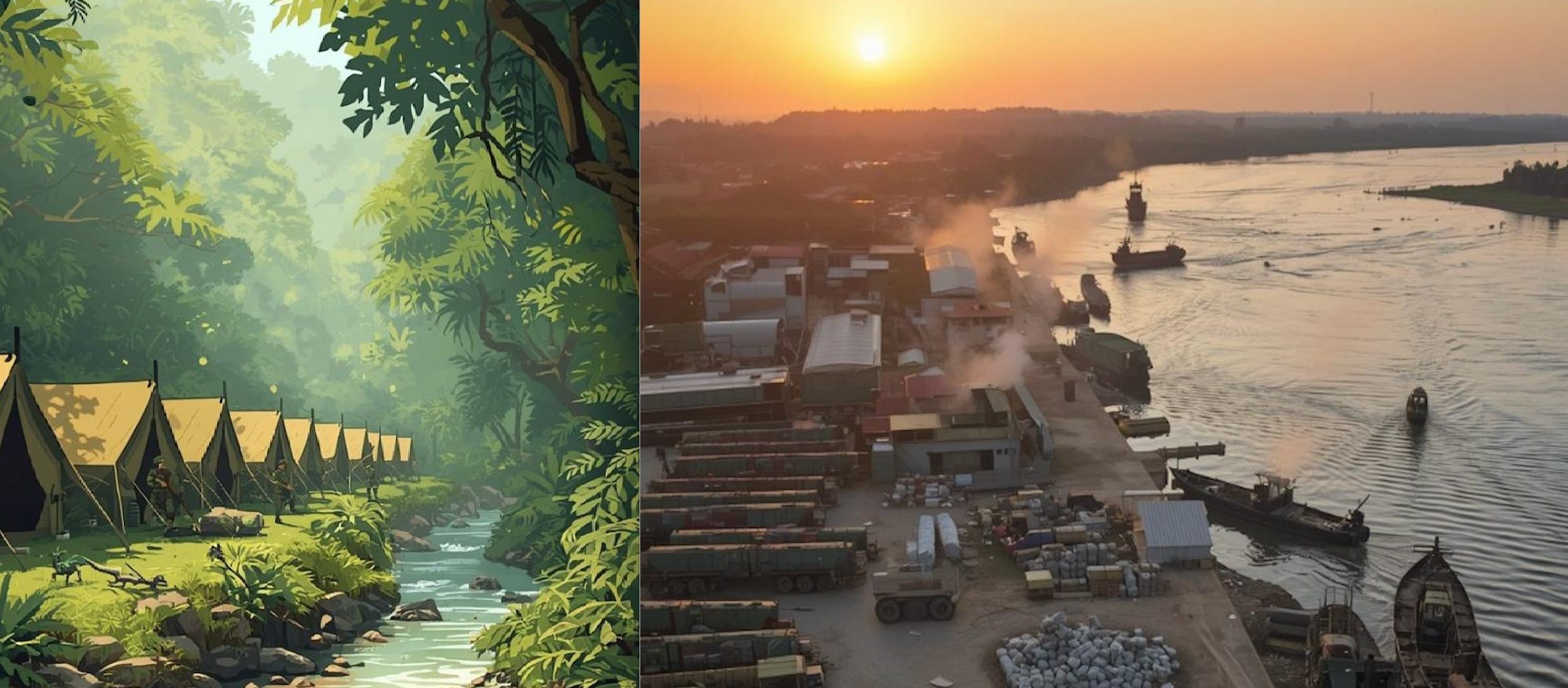
Figure 1 —Military life along a major river.
The unit was bivouacked along a little creek that flowed into a big river. This position was close to the dock area so the soldiers could move freely back and forth.
An older man smiled carefully and leaned back in the folding chair behind his portable field desk. The rain beat a steady tattoo on the tent canvas and he was grateful to have the wooden floorboards that kept him up out of the mud. The mud was pervasive. The camp was a mess and although it was only mid-morning, it was already hot.
He looked up at the young lieutenant standing in front of the desk. “You graduated from West Point?” He looked down again at the transfer paperwork.
“Yes, Sir! Class of ’61, Sir!”
The major shifted to a slightly more comfortable position in his chair. “Well, Lieutenant, you seem to be pretty enthused about this deployment.”
“Happy to be here, Sir! I look forward to showing these rag-tag guerillas how to fight.”
The major raised an eyebrow and said, “It’s not going to be much like your training at the Point. Things are different out here. These guys are masters of the hit and run. They move fast through the heavy vegetation and carry only their weapons and some food. After a raid, they melt away into the civilian population and we never know who is the enemy.”
“I’m well aware of the conditions, Sir.” The young lieutenant carried a condescending air. “They aren’t really soldiers if they won’t stand and fight.”
“I don’t think that you understand what we’re up against.” The major frowned and swatted a mosquito. “The civilians are divided in their allegiance and it’s hard to tell the raiders and the people that sympathize with them from our own true allies. I’m not particularly convinced that we should even be out here in the bush conducting operations this far from the more secure cities and towns.”
“Surely you’re not questioning the mission?” the smug young lieutenant asked in a shocked tone.
“I most certainly am,” the major sighed.
He looked over at the sergeant slouched on a campstool just to the left of the desk. The man had a grizzled gray beard, was dirty, and obviously exhausted.
“Mahoney here just got back from an all-night scouting patrol,” the major said. “Did you turn up any of the insurgents, Sergeant?”
“No, Sir. But, they’re still out there. We heard some rumors from the locals about a battalion of regular army soldiers that’s trying to hook up with the rebels.”
“Good! Maybe we’ll get a decisive stand-up fight from those real soldiers!” The lieutenant was enthused.
The major frowned. “What about that forward artillery position that was over run?” he asked Mahoney.
“There were two casualties. The troops had set up a temporary command post in a root cellar. It was the only structure left on a burned-out farm and worked well as a makeshift bunker. The bastards broke through the perimeter, threw a satchel charge down into the bunker, and shot the two boys who staggered out after the explosion.”
“So, the officers left down in the bunker were only wounded?”
“They were better off than the soldiers who charged out and got killed. The officers were bleeding from their ears and the concussion from the explosion stunned them, but they were essentially unharmed.”
“At least the leaders were not hurt,” the young lieutenant said in a patronizing tone.
Mahoney winced and grunted. The major frowned dangerously.
“Dismissed, Lieutenant!” he barked.
“Yes, Sir! Thank you, Sir!” The lieutenant snapped a salute, pivoted sharply, and did a smart military step out through the canvas fly that covered the front opening of the tent.
“There goes the bright courage of ignorance,” Mahoney said, nodding toward the door.
“You’re right about that,” the major replied and swatted at another particularly persistent mosquito. “Did you hear anything about the river patrol that also went out last night?”
“No good news,” Mahoney said. “The bow gunner got shot right off the boat because they got too close to the heavy underbrush along the channel.”
“Those river patrols are just as useless and dangerous as the isolated artillery positions,” the major said. “I’m caught between the dumb ideas that the generals cook up and the young men that I have to send out on these stupid missions.”
“Yes, Sir,” the sergeant said in a noncommittal way. “That reminds me. When I was headed up here to report, I saw a lot of commotion down on the docks. Looked like there was more than just the usual supplies and ammunition that came in on that last shipment.”
The major brightened somewhat. “We’ve had informal word that there are replacement weapons on the way. These old rifles that we’ve got now don’t work very well in this hot, wet weather.”
“I wouldn’t know about any promised improvements, Sir. When we’re out on patrol, we make do with what we’ve got. Sometimes a knife and a deadfall trap work better than any fancy munitions.”
“I know,” the major said. “You should go get cleaned up and rested, Mahoney.”
After the man left, the major pushed back his folding chair, stood up, and clumped across the wooden floor to the door of the tent. He lifted the flap and saw the sergeant stop to speak to two soldiers lounging outside an adjacent tent pitched in the shade of a huge tree. The major squinted through the warm and misty morning and realized that there was a headache starting behind his eyes. He was vaguely grateful that he could not hear the conversation among the three seasoned fighters.
“Sergeant Mahoney!” both men greeted the bedraggled sergeant with ironic smiles.
“Surely you didn’t report to your commanding officer in that unkempt and disrespectful condition?” the young private asked in a horrified tone.
“Our new lieutenant was impressed that you would even dare to appear before the Old Man without getting into a fresh uniform,” the older corporal continued.
“Yeah well, there it is,” the disheveled sergeant shrugged and scraped his muddy boots on a protruding tree root. “Did you actually talk to that rooster?”
“More like listened,” the corporal groaned. “He’s eager to meet the enemy. He was pumping us about how we search for engagement when we’re out in the bush. He hasn’t even been off the base yet, but he’s got plenty of ideas on how things should be done.”
“We told him that we don’t have to look too hard in this sector,” the private said. “We told him that they find us whenever they want to.”
“But he’s ignorant and that’s dangerous,” the corporal added. “He said that we’ve got to get out into the countryside and not stay hunkered down in base camps and garrisoned in friendly towns.”
“That fits. The son-of-a-bitch was excited to hear about a regular army battalion being in the country,” Mahoney sighed. “He said we’ll get a good show-down fight from them rather than chasing guerillas through the underbrush.”
“The last time there was an enemy probe by a regular army battalion, there was hell to pay,” the corporal said. “They dug in on the top of that big hill down the river and proceeded to shoot the shit out of us.”
“That’s because the Brass just keep sending squads attacking up the hill,” the private groaned. “They ground us up like chopped meat. I still can’t believe that the three of us got out alive.”
“When the newspapers reported that fiasco, it really fanned the antiwar sentiment back home,” Mahoney said. “I heard that there were even riots against the draft in New York City.”
“You know that the hill was quietly abandoned just a few weeks later,” the corporal said. “Those god-damn, glory-chasing officers said it was a strategic position. But, it was more strategic for their careers than for the war.”
“That’s the way the military works,” Mahoney said. “The officers play at giving the orders and the enlisted men do the fighting and dying. That new little boy lieutenant will fit right in.”
“He may end up being a good candidate for a back shot,” the private said quietly.
The corporal nodded solemn agreement. “You remember that arrogant captain who charged into an ambush and then ordered us to shoot up that little nearby village to cover for his bad call?” he asked Mahoney.
“Yup, I do,” Mahoney nodded. “There would have been a lot of civilians killed if that sniper’s shot hadn’t stopped the bastard cold about midway toward the settlement.”
The three men retreated into their own private thoughts. Mahoney leaned back against the trunk of the tall tree and looked up to where a humid and hazy blue sky was partially visible among languid green leaves. When the blue would be replaced by the gray clouds that brought rain every afternoon, he intended to be asleep in his bunk. It had been a long night.
“It’s going to be another hot day,” the corporal said.
“Here comes the Old Man,” the private gestured with his chin.
“At least he’s more reasonable than most officers,” Mahoney said. “He doesn’t like being here any better than we do.”
The major had left his tent and was on his way down the hill toward the loading docks along the river.
“Well, Mahoney,” he said as he approached the group standing under the tree, “you didn’t get very far toward your rest and recovery.”
“No, Sir,” the sergeant said. “That confusion looks more like a gossip session than off-loaded supply cases,” he added looking off toward the docks.
All four men under the tree watched as a lone figure broke away from a tight group of excited officers to hurry up the hill toward them. And, all four men were disappointed to see that it was the enthusiastic young lieutenant.
“Big news, Sir!”
“We didn’t get the new replacement rifles, did we?”
“I don’t know anything about the supply shipment. That’s the quartermaster’s job. What I’ve got is much more important information.”
“What you’ve got is a smart mouth and a cocky attitude,” the major snapped. “Just what is this great news?”
“Vicksburg has fallen! The Mississippi River is under Union control! President Lincoln has called General Grant back east to command the Army of the Potomac! Now, things will really get done!”
The major shrugged. “More likely, things will grind along in the same way that they have for the last several years out here in Missouri. We’re just an army of occupation chasing bushwhackers through a civilian population that is more sympathetic to the Confederacy than to the Union.”
“The confusion in Washington will continue to get translated into marching orders in St. Louis headquarters and we’ll be left out here to do the hard work of being boots on the ground,” Mahoney said. “Nothing will change. We’re in Purgatory.”
~~~~~~~~~~~~~~~~~~~~~~~~~~~~~~~~~~~~~~~~~~~
POSTSCRIPT
Did this story have the “feel” of the Vietnam War or are you too young to remember? This is the Civil War rather than the Vietnam War. Both wars had the same heartbreak of sacrificing young people to meet the whims of a bunch of old white guys.
The Civil War started on April 12, 1861. One of my great-grandfathers was a Union courier in the campaigns along the Mississippi River. He rarely talked about it. This post is my fictional imagining of something that might have happened.
This past week we celebrated Earth Day. However, my family has no memory of that first one because we were waiting for my brother’s body to return from Vietnam. Bob Shurr was killed on April 13, 1970. Here’s a link to an essay about how Bob’s death impacted the life of the Farm family.
We are now living in time similar to the Civil War and Vietnam War. There’s talk about re-instating the draft for an unpopular and unnecessary war. America is divided and this new war has incurred casualties; some of the first Americans to die were young people from the Midwest. Here’s a link to a poem that captures the trauma that parents experience when notified of a military death. And here’s a link to an unsanitized description about what really happened in that recent example of American Purgatory.
No posts
Comments
Nothing yet. Say the first thing.
Sign in to join the conversation.