
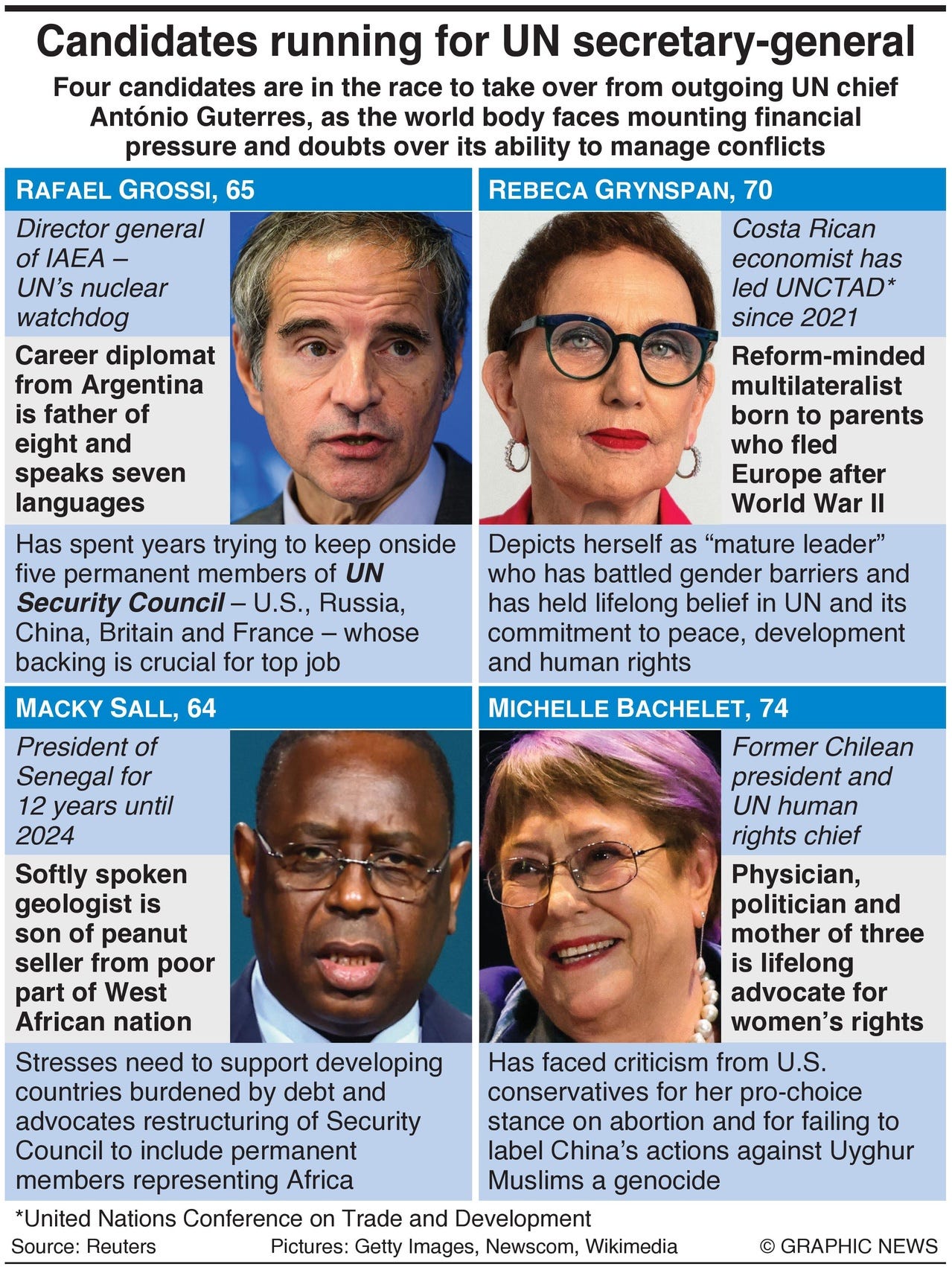
Four candidates have entered the race to become the next UN Secretary-General. They are serious people with serious credentials. Grossi has spent years threading needles between Washington, Moscow and Beijing on nuclear inspections. Bachelet led one of the most politically exposed portfolios in the UN system. Grynspan is a genuine reform-minded multilateralist. Sall offers a voice for the Global South and for debt-burdened developing economies.
But does it really matter? The institution they are competing to lead has quietly receded into the shadows. Several years ago, I sat through a kidnap response workshop run by a former UN security adviser. At points during the training, he voiced his doubts about what the UN actually achieved, summing it up as an organisation that mostly held “meetings about meetings.” It neatly encapsulated the effectiveness, or lack of it, and has stuck with me since.
The International Crisis Group described the organisation going into the 2025 General Assembly as one “in trauma,” with morale at historic lows, U.S. funding cuts forcing sweeping cuts to staff, and an institution visibly struggling to make itself relevant in Gaza, Sudan, Ukraine, Myanmar and now Iran. The UN’s own press office, reporting on a Security Council debate last December titled “Leadership for Peace,” quoted delegates warning that the organisation risks irrelevance — or even collapse — if its next leader cannot drive reform of the Security Council itself.
The Council is where the paralysis is most visible. In 2025 alone, permanent members cast vetoes blocking meaningful action on Gaza and Ukraine, while the Council sat largely mute through a coup in Guinea-Bissau, a Cambodia–Thailand border conflict, and a flare-up between India and Pakistan over Kashmir. The global civil society alliance CIVICUS put it plainly: the Council’s five permanent members represent a minority of the world’s people and reflect an international order that no longer exists.
The S. Rajaratnam School of International Studies made a harder structural point last October: so long as the veto remains and the P5’s composition is frozen, the Security Council’s effectiveness will continue to track the narrow self-interest of its permanent members — and the legitimacy of the whole UN architecture will erode alongside it.
The view from the Golden Triangle
The problem isn’t confined to the Security Council’s high politics. It reaches into the technical agencies that are supposed to be the UN’s strongest card — the places where its staff know and fix things governments cannot.
Some years ago, while conducting due diligence on a Burmese tycoon whose business interests had long been rumoured to sit at the intersection of politics and the regional narcotics economy, I managed to secure a meeting in Yangon with a senior official at the UN Office on Drugs and Crime — the agency whose remit explicitly covers the Golden Triangle, one of the world’s largest drug trafficking corridors, particularly methamphetamine flows out of Shan State.
What that meeting revealed was telling then, and remains symptomatic of the institutional decay we are watching play out today.
Comments
Nothing yet. Say the first thing.
Sign in to join the conversation.