
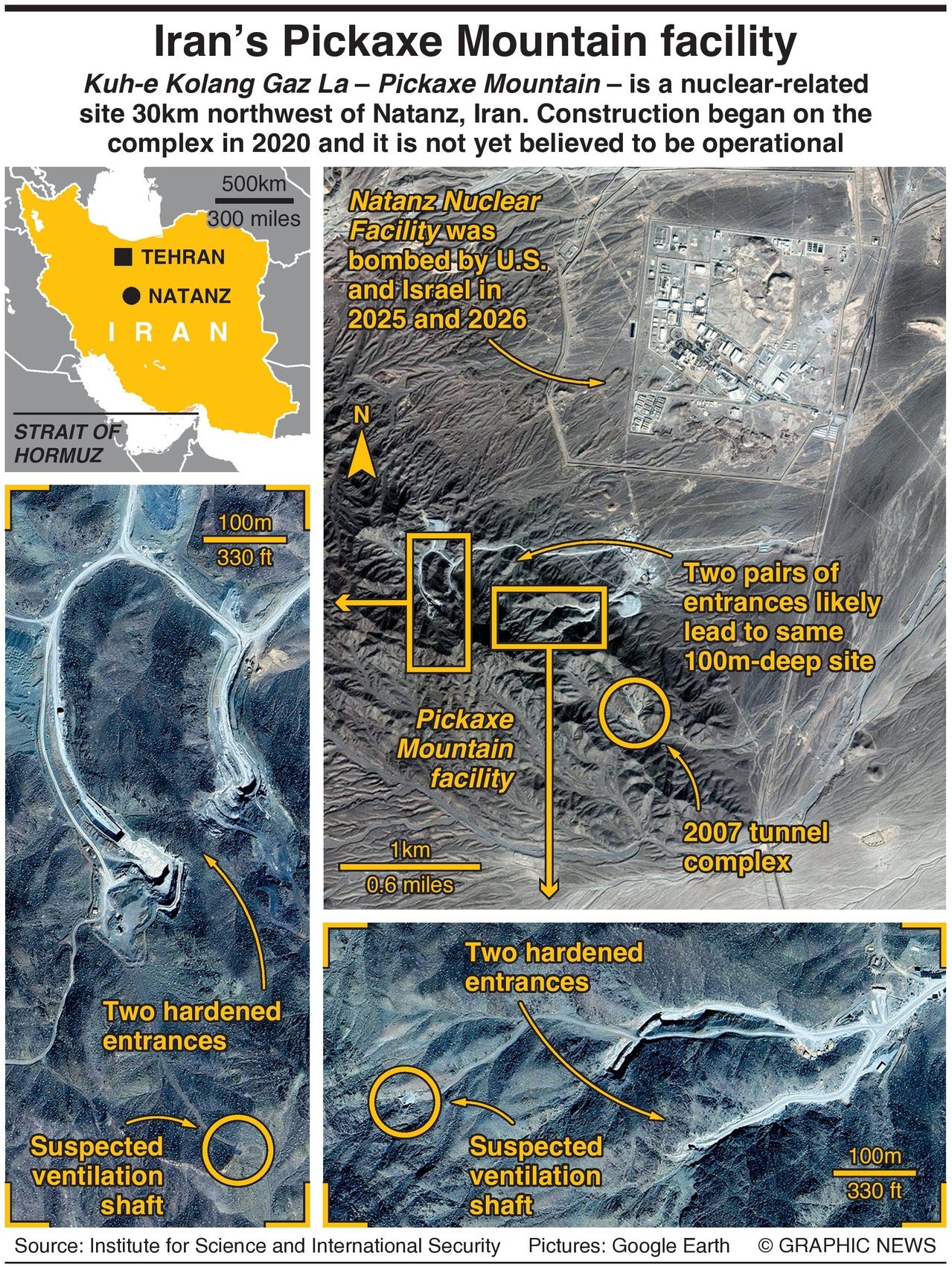
“We’re going to take out Pickaxe Mountain. Tell the Iranians to be ready.” President Trump delivered the line in a mid-July interview, and he has sharpened it since. the United States, he says, will hit the fortified complex near Natanz “probably pretty soon.” It is the kind of threat that sounds decisive until you ask the obvious follow-up: with what, and to what end?
The striking thing about Pickaxe Mountain — Kuh-e Kolang Gaz La, dug into the Zagros range roughly two kilometers from the Natanz enrichment complex — is that most analysts do not believe it can be destroyed from the air. Estimates of its depth vary wildly, from a relatively conservative 80 to 100 meters to the more cinematic figure of roughly 2,000 feet of granite, and the spread itself is reason for caution. But the consensus points one way: the complex likely sits deeper than the reach of the GBU-57, the most powerful bunker-buster in the American arsenal and the same class of weapon used against Fordow and Natanz. You do not announce a strike on a target you cannot destroy unless destroying it was never quite the point.
So what is the point? Start by splitting the mountain into two parts: the buried core and the exposed surface. The core — the tunnel networks and whatever centrifuges or material they hold — is probably safe from anything dropped by an aircraft. The surface is not. Tunnel portals, ventilation shafts, power feeds, spoil piles, vehicles, and the hardened entrances Iran has spent years reinforcing are all reachable. Trump has hinted at exactly this narrower ambition, musing about aiming a strike at the front door rather than the vault behind it. That is not destruction; it is denial of access. You cannot collapse the mountain, but you can bury its doors, and buying time — months, not years — is a coherent if modest objective. It also matches the pattern already set at Natanz, Fordow, and Esfahan, where entrances were cratered and sealed rather than the plants themselves erased. The Institute for Science and International Security, whose satellite imagery underpins much of what is publicly known about the site, has gone further still, judging that Pickaxe is better suited to a ground assault or sabotage than to airstrikes at all — a conclusion worth holding onto.
If a strike cannot destroy Pickaxe, it can still do several other things, and this is where the calculus turns interesting. It can signal: a demonstration of resolve, a way of telling Tehran that no site is sacrosanct and that quietly consolidating a buried fallback will not be tolerated. It can shape a negotiation, converting a fortress into a bargaining chip. It can work as a feint — a strike, or even a credible threat of one, forces Iran to decide whether to divert scarce air defenses and matériel to protect the mountain, and in doing so to reveal how much it values what is inside while thinning its defenses elsewhere. And it can play at home, offering the visible appearance of momentum in a war that, by mid-July, is not supplying much.
Each of those purposes runs into the same wall. If the site is genuinely vulnerable only to ground forces or sabotage, then the one method with a real chance of success is precisely the one the administration can least afford to use. And here the mirror has two faces. Trump may be probing to see whether Iran over-commits to defending Pickaxe. But the feint can run the other way, too: Tehran has every incentive to make the mountain look busy — to stage movement, feign activity, and let the imagery leak — precisely to bait Washington into the quagmire of a ground operation. A hardened site that lures an adversary into committing troops it does not want to commit is worth more as a trap than as a bunker.
That trap works because of the numbers back home. Support for the war has sunk to the lowest levels of the conflict: around a third of Americans back it, a clear majority oppose it, and only about a quarter say it was worth fighting — less than the Iraq and Afghanistan wars drew in comparable polling. Close to seven in ten want a deal to end it as quickly as possible. A president reading those figures cannot plausibly sell the country on boots on the ground in central Iran, which is exactly what makes the ground option a non-starter and the signaling read so persuasive. The vow to “take out” Pickaxe is loud precisely because the instrument that could actually do it has already been removed from the table by public opinion.
There is a deeper uncertainty underneath all of this, and it deserves to be stated plainly. The alarm over Pickaxe rests heavily on Israeli intelligence, relayed by Israeli and American officials, that Iran moved thousands of centrifuges into the mountain last fall — a claim that, if true, makes it a live enrichment fallback rather than a construction site. That is an assessment, not an established fact, and it sits awkwardly beside ISIS’s imagery-based read that the facility is not yet operational. Both cannot be fully right. Either Pickaxe is a functioning redoubt that airstrikes urgently need to neutralize, or it is an unfinished shell whose menace is mostly potential — and the entire case for or against a strike swings on which it is.
Which leaves Trump staring at a genuinely bad menu. Strike from the air, and he risks a spectacle that advertises the limits of American power: a mountain hit and still standing, its doors buried but its core intact. Send in ground forces — the one option with real teeth — and he courts a casualty-heavy operation in a war the public has already abandoned, possibly the very trap Tehran is laying. Do nothing, and he leaves Iran a hardened, deeply buried platform to rebuild from. None of these is good. A strike on the entrances — loud enough to signal, cheap enough to survive politically, limited enough to change little — may end up chosen not because it works, but because it is the least ruinous of a ruinous set. That is not a strategy so much as a search for a purpose.
No posts
Comments
Nothing yet. Say the first thing.
Sign in to join the conversation.